PART A
1) Ab Landlord owns a dilapidated 30-year-old apartment building in Los Angeles. The net cash flow from renting the apartments last year was $200,000. She expects that inflation will cause the net cash flows from renting the apartments to increase at a rate of 10 percent per year (next year’s net cash flows will be $220,000, the following year’s $242,000, etc.) The remaining useful life of the apartment building is 10 years. A developer wants to buy the apartment building from Landlord, demolish it, and construct luxury condominium. He offers Landlord $1.5 million for the apartments.
Assume there are no taxes. The market rate of return for investments of this type is 16 percent and is expected to remain at that level in the future. The 16 percent interest rate includes an expected inflation rate of 10.5 percent. The real rate of interest is 5 percent.
1.16 = (1.05) (1.105)
Required:
a) Evaluate the developer’s offer and make a recommendation to Landlord. Support your conclusions with neatly labeled calculations where possible. Note that the $1.5 million purchase offer would be paid immediately, whereas the first cash flow from retaining the building is not received until the end of the first year.
Answer:
Ab Landlord needs to weigh the purchase offer against the present value of the net cash flows from his current operation. Mr. Landlord expects the net cash flow in real dollars to remain constant at $200,000/year. Since we have the cash flow in real dollars, we can use the real interest rate of 5% to calculate the present value
PV = 200,000 x Annuity Factor (i= 0.05, t = 10)
= 200,000 x 7.722
= 1,544,000
Since the present value of the current operation is greater than the purchase offer., Mr. Landlord should keep the property.
b) Suppose that Los Angeles imposes rent controls, so that Landlord will not be able to increase her rents except to the extent justified by increases in costs such as maintenance. Effectively, the future net cash flows from rents will remain constant at $200,000 per year. Does the imposition of rent controls change Landlord’s decision on the developer’s offer? Support your answer with neatly labeled calculation where possible.
Answer:
In this case, the net cash flows remain constant in nominal dollars.
PV = 200,000 x Annuity Factor (i=0.16, t=10)
= 200,000 x 4.833
= 966,600
If rent control is impose, then Landlord should sell the building now for $1,500,000
2) Absorption costing of inventories, as required by US GAAP, has been criticized for encouraging managers to increase year-end inventories in order to boost reported profits. Which of the following techniques is the most effective at resolving this problem?
Answer: Adoption of just-in-time (JIT) production system
3) After the Iraqi invasion of Kuwait in August 1990, the world price of crude oil doubled to more than $30 per barrel in anticipation of reduced supply. Immediately, the oil companies raised the retail price on refined oil products even though these products were produced from oil purchased at the earlier, lower prices. The media charged the oil companies with profiteering and price gouging, and politicians promised immediate investigations
Required: Critically evaluate the charge that the oil companies profited from the Iraqi invasion. What advice would you offer the oil companies?
Answer:
The opportunity cost of the oil in process was higher after the invasion and thus the oil companies were justified in raising prices as quickly as they did. For example, suppose the oil company had one barrel of oil purchased at $15. This barrel was refined and processed for another $5 of cost and then the refined products from the barrel sold for $21. Replacing that barrel requires the oil company to pay another $15 per barrel on top of the $15 per barrel it is already paying. Therefore, in order to replace the old barrel, the prices of the refined products must be raised as soon as the crude oil price rises.
However, accounting treats the realized holding gain on the old oil as an accounting profit, not as an opportunity cost. Therefore, the income statement of oil companies with large stocks of in-process crude will show accounting profits, unless they can somehow defer these profits.
Switching to income-decreasing accounting methods and writing off obsolete equipment will help the oil companies avoid the political embarrassment of reporting the holding gains. In January 1990, the large oil companies received significant adverse media publicity when they reported large increases in fourth-quarter profits.
It is useful having discussed this problem to ask the following question: What happens to oil companies in the reverse situation when a large, unexpected price drop occurs? Suppose the oil company purchased old barrels for $15 and sold the refined products for $21. New barrels now can be purchased for $10. The company would like to keep selling refined products at $21, but competition from other oil companies will push the price of refined products down. Depending on how quickly the price of refined products fall, the oil companies will report smaller (maybe even negative) accounting earnings as their inventory of $15 oil gets refined and sold, but at lower prices.
4) All Things Tennis (ATT), a French company, manufactures a variety of tennis gear, such as racket covers, tennis bags, and embroidered towels. ATT sells all its products exclusively in Europe through independent distributors. ATT’s most popular line is a series of racket covers with various animal pictures on the cover.
ATT is currently making 500 animal racket covers a week at an average per unit cost of 3.50$ which includes both variable costs and allocated fixed costs. The variable cost of each racket cover is 1.10$. ATT sells the racket covers to distributors for 4.25$. A distributor in Canada, TorontoSports, wants to purchase 100 racket covers per week from ATT and sell them in Canada, Toronto offers to pay ATT 2$ per racket cover. ATT has enough capacity to produce the additional 100 racker covers and estimates that if it accepts Toronto’s offer, the per unit cost of all 600 racker covers will be 3.10$. Assume the cost data provided (3.50$ and 3.10$) are accurate estimates of ATT’s costs of producing the racket covers. Further assume that ATT’s valuable cost per racket cover does not vary with the number of racket covers manufactured.
Required:
a) Given the data in the problem, what is ATT’s weekly fixed cost of producing the animal racket covers?
Answer:
Given that the variable cost per racket cover is 1.10 Euros, the fixed cost per week is
AC=FC/ Q + VC
3.10 = FC/ 600 + 1.10
FC = 1,200 euros
3.50 = FC/ 500 + 1.10
FC= 1,200 euros
b) To maximize firm value, should ATT accept Toronto’s offer? Explain why or why not
Answer:
The change in total cost if the 100 unit Toronto SPorts offer is accepted is:
600 x 3.10 euros – 500 x 3.50 euros = 110 euros
Or, each racket cover has variable cost of 1.10 euros. Since Toronto Sports is willing to pay 2 euros per racket cover or 200 euros for 100 covers, by accepting this order ATT makes 90 euros a week. Therefore, ATT should accept Toronto’s offer if these are all the relevant facts.
c) Besides the data provided in the problem, what other factors should ATT consider before making a decision to accept Toronto’s offer?
Answer:
ATT should consider the following non-quantitative factors:
- What prevents Toronto from reselling the racket covers back to dealers in Europe at prices below ATT’s current price of 4.25 euros?
- If ATT sells the racket covers to Toronto at 2 euros, what prevents ATT’s European customers from learning of this special deal and demand similar price concessions. In other words, why do we expect to be able to implement this price discrimination strategy?
- Will Toronto purchase other GS products and import them to Japan?
- What is Toronto’s credit worthiness, and will they pay for the racket covers upon taking delivery?
5) The Alpha Division of the Carlson Company manufactures product X at a variable cost of $40 per unit. Alpha Division’s fixed costs, which are sunk, are $20 per unit. The market price of X is $20 per unit. The market price of X is $70 per unit. Beta Division of Carlson Company uses product X to make Y. The variable costs to convert X to Y are $20 per unit and the fixed costs, which are sunk. Are $10 per unit. The product Y sells for $80 per unit.
Required:
a) What transfer price of X causes divisional managers to make decentralized decisions that maximize Carlson Company’s profit if each division is treated as a profit center?
Answer:
The transfer price should be equal to the opportunity cost of Alpha Division supplying X to the Beta Division, which is the market price of $70 per unit
b) Given the transfer price from part (a), what should the manager of the Beta Division do?
Answer:
If the manager of the Beta Division must pay $70 per unit of X, the manager of Beta Division will not be able to generate a profit and should look for other opportunities rather than processing X
c) Suppose there is no market price for product X. What transfer price should be used for decentralized decision-making?
Answer:
If there is no market for X, the opportunity cost of supplying X is the variable cost of X or $40 per unit
d) If there is no market for product X, is the operations of the Beta Division profitable?
Answer:
If the Beta Division only has to pay $40 per unit of X, then Beta can operate profitably by adding $20 in variable cost and selling product Y for $80 per unit
6) The Alphonse Company allocates fixed overhead costs by machine hours and variable overhead costs by direct labor hours. At the beginning of the year the company expects fixed overhead costs to be $600,000 and variable costs to be $800,000. The expected machine hours are 6,000 and the expected direct labor hours are 80,000. The actual fixed overhead costs are $700,000 and the actual variable overhead costs are $750,000. The actual machine hours during the year are 5,500 and the actual direct labor hours are 90,000.
Required:
a) How much overhead is allocated?
Answer
| The application rate for fixed costs is: |
| $600,000/6,000 machine hours = $100/machine hour. |
| The application rate for variable costs is: |
| $800,000/80,000 direct labor hours = $10/direct labor hour. |
| The overhead allocated: | |
| Fixed overhead (5,500 machine hours) ($100/machine hour) | $550,000 |
| Variable overhead(90,000 direct labor hours) ($10/direct labor hour) | 900,000 |
| Total overhead allocated | $1,450,000 |
b) What is the over/under-absorbed overhead?
Answer:
There is no over/under-absorbed overhead: (700,000 + 750,000) – 1,450,000 = 0
7. Amy Laura is opening a snowboard rental store. She rents snowboards for skiing on a weekly basis for $75 per week, including the boots. The skiing season is 20 weeks long. Laura can buy a snowboard and boots for $550, rent them for a season, and sell them for $250 at the end of the season.
THe store rent is $7,200 per year. During the off season, Laura sublets the store for $1,600. Salaries, advertising, and office expenses are $26,000 per year.
On average, 80percent of the boards in any given week are rented. After each rental, the boards must be resurfaced and the boots deodorized. Labor (not included in the $26,000) and materials to prepare the board and boots to be re-rented cost $7.
Required:
a) How many boards must Lura purchase in order to break even?
Answer:
| FIxed Costs | |
| Store rent (net of sublet, 7200-1600) | 5600 |
| Salaries, advertising, office expense | 2600 |
| 31600 | |
| CM per board per year: | |
| Revenue per week | 75 |
| Refurbishing cost | -7 |
| CM per board per week | 68 |
| X number of weeks | 20 |
| Seasonal CM from 100% rental | 68 x 20 = 1360 |
| X likelihood of rental | X 80% |
| Expected seasonal CM per board | 1088 |
| Net cost per board (550-250) | 300 |
| Net contribution per board per year | =1088-300 = 788 |
| Break-even number of boards (31600 – / 788) | 40.10 |
b) Suppose that Laura purchases 50 boards. What profit does she expect?
Answer:
Expected profit with 50 boards
| Expected seasonal CM per board (from part a) | 1088 |
| X number of boards | 50 |
| Expected CM | 54400 |
| Less: | |
| Cost of boards (300 x 50) | (15,000) |
| FC | (31,600) |
| Expected profit | 7800 |
c) Laura purchases 50 boards. What fraction of her boards must she rent each week to break even?
Answer:
Break-even number of rentals with 50 boards:
| Total FC | |
| Store rent | 5600 |
| Salaries, advertising, and office expense | 26000 |
| Boards and boots (net of resale, 300 x 50 | 15000 |
| 46600 | |
| CM per board per week | 68 |
| Break-even number of rentals: 46600 / 68 | 685.29 |
| Total possible number of rentals (50 boards x 20 weeks( | 1000 |
| Break even fraction of boards rented each week | 68.5% |
d) Explain why the percentage utilization you calculated in part (C ) differs from the expected rental rate of 80 percent.
Answer:
In the long run, all costs are variable. However, once purchased, the boards are a fixed cost. The reason for the difference is Amy has about ten more boards than the break-even number calculated in part (a). In part (a), before the boards are purchased, they are a variable cost. She can buy any number of boards she wants and pay a proportionately higher cost for them and rent them all 80 percent of the time. Therefore the cost of the boards is a variable cost with respect to the number of rentals. It is subtracted from the revenue in calculating the contribution margin per board. Once you buy the boards, their cost becomes fixed. Instead of being included in calculating contribution margin, it is included in the fixed cost (numerator of the break-even volume)
8) Assuming the firm sells everything, it produces and assuming that variable cost per unit does not change with volume, total profits are higher as volume increases because fixed costs are spread over more units.
Answer: FALSE
Profits = P x Q – (FC – VC x Q) Q(P-VC) – FC = Q(P-VC) – (FC/Q) Q
Notice that average fixed costs per unit (FC÷Q) falls as Q increases, but with more volume, you have more fixed cost per unit such that (FC÷Q) × Q = FC.
That is, the decline in average fixed cost per unit is exactly offset by having more units.
Profits will increase with volume even if the firm has no fixed costs, as long as price is greater than variable costs. Suppose price is $3 and variable cost is $1. If there are no fixed costs, profits increase $2 for every unit produced. Now suppose fixed cost is $50. Volume increases from 100 units to 101 units. Profits increase from $150 ($2 ×100 – $50) to $152 ($2 × 101 – $50).
The change in profits ($2) is the contribution margin. It is true that average unit cost declines from $1.50 ([100 × $1 + $50]÷100) to $1.495 ([101 × $1 + $50]÷101). However, this has nothing to do with the increase in profits. The increase in profits is due solely to the fact that the contribution margin is positive.
Alternatively, suppose price is $3, variable cost is $3, and fixed cost is $50. Alternatively, suppose price is $3, variable cost is $3, and fixed cost is $50.
200 causes average cost to fall from $3.50 ([100 × $3 + $50]÷100) to $3.25 ([200 × $3 + $50]÷200), but profits are still zero.
9) At the beginning of year 1, Northern Sun Inc., a food processing concern, is considering a new line of frozen entrees. The accompanying table shows projected cash outflows and inflows. Assume that all inflows and outflows are end of period payments.
| Initial investment year 1 | Year 2 | Year 3 | Year 4 | Year 5 | |
| R&D | (200) | ||||
| Packaging and design | (55) | ||||
| Product testing | (100) | (50) | |||
| Marketing | (15) | (10) | (10) | (10) | |
| Distribution | (30) | (50) | (50) | (50) | |
| Cash inflow | 100 | 250 | 300 | 300 | |
| Net cash flows | (355) | 55 | 190 | 240 | 190 |
Required:
The Company’s cost of capital is 10 percent. Compute the following:
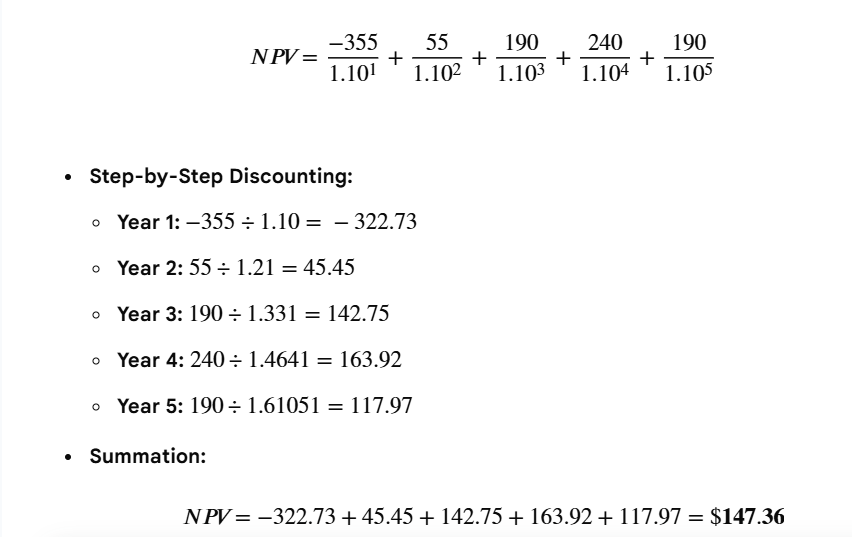
a) Net present value
Answer:
| Net Cash inflow(outflow) | Year | Discount factor @ 10% | Present Value |
| (355) | 1 | 0.909 | (323) |
| 55 | 2 | 0.826 | 45 |
| 190 | 3 | 0.751 | 143 |
| 240 | 4 | 0.683 | 164 |
| 190 | 5 | 0.621 | 118 |
| Net Present Value | 147 |
b) Payback
| Year | Inflow | Cumulative inflow | Investment to be recovered |
| 1 | 0 | 0 | 355 |
| 2 | 55 | 55 | 300 |
| 3 | 190 | 245 | 110 |
| 4 | 240 | 485 | |
| 5 | 190 | 675 |
3 years + (110 / 240) = 3.46 years
10) At the Hilton Apple Fest and Trade Expo, James Jones, owner of Jones Orchard, saw a sign displayed in front of a vendor’s booth: i can get you pesticides at $10.00 a gallon—guaranteed in writing! Over a one-year period, the vendor guarantees delivery of between 350,000 and 500,000 gallons of pesticide at a maximum price of $10 per gallon. Since Jones Orchard is currently paying $11.30 per gallon, the offer is appealing. However, Jones uses only 25,000 gallons and the annual management fee for this service is a whopping $275,000.
The only way Jones can see to make the offer work is to form a buying consortium with other farmers.
As long as all of the farmers are located within 10 square miles, the vendor is willing to allow the formation of a consortium. Including Jones Orchard, five farms are within this area.
Their pesticide needs and anticipated costs are as follows:
| Gallons | Price per Gallon | |
| Jones | 25,000 | $11.30 |
| Gilbert | 35,000 | 11.20 |
| Santos | 50,000 | 11.12 |
| Singh | 100,000 | 10.90 |
| Chen | 150,000 | 10.70 |
| Total | 360,000 |
All of the farmers are willing to participate in the buying consortium as long as there is an anticipated cost savings for each farmer. Everyone agrees that each farmer should pay the same amount for materials. But allocation of the management fee is left entirely up to Jones.
Required:
a) Based upon the numbers provided, demonstrate that this consortium could work.
Answer:
For the consortium to be viable, it must meet the quantity and geography requirements of the vendor while reducing the pesticide costs to every member. The expected group demand of 360,000 gallons is within the stated requirements for purchases and all members are within a 10-mile area, so the vendor’s requirements are met.
Everyone can end up saving money if and only if the total costs expected for purchasing through the consortium are less than the total costs expected by purchasing outside of the consortium, suggesting the existence of potential savings to be shared by each member of the consortium.
The total expected outside costs are:
| Gallons | Price per Gallon | Total Cost | |
| Jones | 25,000 | $11.30 | $282,500 |
| Gilbert | 35,000 | 11.20 | 392,000 |
| Santos | 50,000 | 11.12 | 556,000 |
| Singh | 100,000 | 10.90 | 1,090,000 |
| Chen | 150,000 | 10.70 | 1,605,000 |
| Total | 360,000 | $3,925,500 |
Within the consortium, the guaranteed maximum cost is the management fee plus the pesticide cost, $275,000 + 360,000 × $10.00 = $3,875,000. Therefore, costs are expected to be less within the consortium than outside it, providing an expected savings of $3,925,500 – $3,875,000 = $50,500.
Some may interpret the requirement that all members pay the same price for materials as implying that the maximum guaranteed price to be paid for materials within the consortium must be less than the cheapest outside price paid by any member. Since the $10 per gallon cost guaranteed to the consortium is less than Chen’s $10.70 expected outside cost, this requirement would also be met.
b) Jones initially considers allocating the management fee either (1) equally between all members or (2) based upon each farmer’s percentage of total gallons needed. Would either method work? Show allocation by each method.
Answer:
Neither method would work. Under equal allocation, Jones Orchard would pay $275,000 ÷ 5 + 25,000 × $10 = $305,000 within the consortium, versus $282,500 outside of it.
Since all members of the consortium have agreed to pay the same for materials purchased through the consortium, allocating by percentage would serve to provide all members with identical average costs per gallon. Under this allocation scheme, the average cost per gallon for the consortium would be (360,000 × $10.00 + $275,000) ÷ 360,000 = $10.764. Since this is greater than Chen’s outside cost of $10.70 per gallon, this cost allocation scheme would also fail. The complete set of allocations follows:
Equal Allocation
Under equal allocation, each member would be allocated $275,000 ÷ 5 = $55,000 of the management fee. At a maximum cost of $10 per gallon for materials, Jones and Gilbert would pay more within the consortium than outside it.
| Materials | + | Fee | = | ConsortiumCost | vs | OutsideCost | |
| Jones | $250,000 | $55,000 | $305,000 | $282,500 | |||
| Gilbert | $350,000 | $55,000 | $405,000 | $392,000 | |||
| Santos | $500,000 | $55,000 | $555,000 | $556,000 | |||
| Singh | $1,000,000 | $55,000 | $1,055,000 | $1,090,000 | |||
| Chen | $1,500,000 | $55,000 | $1,555,000 | $1,605,000 |
Percentage Allocation
Under percentage allocation, each member of the consortium would be allocated the management fee based upon his or her portion of the total group purchases. All members are better off except Chen, whose consortium cost of $1,614,583 is greater than his outside cost of $1,605,000:
| Materials | + | (Total Fee | × | Proportion) | = | ConsortiumCost | |
| Jones | $250,000 | $275,000 | 25/360 | $269,097 | |||
| Gilbert | $350,000 | $275,000 | 35/360 | $376,736 | |||
| Santos | $500,000 | $275,000 | 50/360 | $538,194 | |||
| Singh | $1,000,000 | $275,000 | 100/360 | $1,076,389 | |||
| Chen | $1,500,000 | $275,000 | 150/360 | $1,614,583 |
c) Jones believes it would make sense to allocate the management fee on an ability-to-pay basis. As the chapter allocates joint costs based upon net realizable value, allocate the management fee based upon the potential dollar savings opportunity of each farm. Is this method feasible?
Answer:
Potential Savings. In this problem, the question of allocating the management fee to the individual consortium members is conceptually similar to allocating the joint chicken costs as presented in the text.
Just as the wings of the chicken are “free” with each chicken, membership in the consortium is free with the existence of the consortium. The management fee can be treated as a joint cost. Once in the consortium, each member is entitled to purchase materials at a cost that will not exceed $10 per gallon. The anticipated materials cost for each member, therefore, can be treated as the costs beyond the split-off point. The total consortium purchases are “disassembled” into five components: Jones’s 25,000 gallons, Gilbert’s 35,000 gallons, and so on. Once the joint costs and the costs beyond split-off have been identified, the opportunity costs of not buying from the consortium must be defined. The opportunity costs are the potential savings lost by continuing to purchase from outside the consortium once the consortium is in existence. The total incurred by each farmer in purchasing outside the consortium, therefore, serves the same function in this example as revenue served in the chicken example. In this case, allocating by this potential savings will guarantee that all members are expected to save money by forming the consortium. The numbers work out as follows:
| Total | Jones | Gilbert | Santos | Singh | Chen | |
| Outside cost | $3,925,500 | $282,500 | $392,000 | $556,000 | $1,090,000 | $1,605,000 |
| Consortium cost | 3,600,000 | 250,000 | 350,000 | 500,000 | 1,000,000 | 1,500,000 |
| Opportunity cost | $325,500 | $32,500 | $42,000 | $56,000 | $90,000 | $105,000 |
| Percentage of opportunitycost | 100% | 9.985% | 12.903% | 17.204% | 27.650% | 32.258% |
| Fee | $275,000 | $27,458 | $35,483 | $47,312 | $76,037 | $88,710 |
| Materials | 3,600,000 | 250,000 | 350,000 | 500,000 | 1,000,000 | 1,500,000 |
| Consortium cost | $3,875,000 | $277,458 | $385,483 | $547,312 | $1,076,037 | $1,588,710 |
| Outside cost | 3,925,500 | 282,500 | 392,000 | 556,000 | 1,090,000 | 1,605,000 |
| Savings | $50,500 | $5,042 | $6,517 | $8,688 | $13,963 | $16,290 |
d) Consider the issue of private versus public information as it relates to the cost allocation schemes presented in this problem. Address whether the information required to implement each scheme is essentially held in common by all of the farmers in the consortium or privately held by each individual farmer. In particular, given that the consortium will allocate the management fee by ability to pay, how might each farmer’s privately held cost information serve to undermine the consortium’s future existence?
Answer:
At first glance, it would seem that the allocation schemes presented in (b) should be adequate. These methods fail, however, when examined within the context of the members’ cost and demand expectations, thereby causing Jones to consider the more complex ability-to-pay scheme of (c). Despite the fact that the ability-to-pay scheme is promising, they do not appear likely to succeed due to their reliance on what is essentially private information. Since the amount of pesticides demanded by each farmer varies greatly, equal allocation is intuitively the least satisfying of the three general cost allocation methods presented. Equal allocation, however, relies only on public information: the amount of the management fee and the number of members in the consortium. This information can be easily shared by all members and can be determined at the formation of the consortium.
Allocation by percentage of total demand would appear to be the most direct way to solve any problems created by differences in quantities demanded. But allocating by percentage places greater reliance on private information than equal allocation in that the anticipated number of gallons required by each farm, and hence the relative proportions of quantities required, is self-reported and not verifiable a priori. This would not be a problem if the consortium could allocate the management fee after all purchases for the period were made. In that case, allocations could be based on actual purchase data that all members should have direct access to.
Evaluating the feasibility of the ability-to-pay method requires data on what each farmer would have paid absent the consortium. Since there is really no definitive ex post method to measure the accuracy of these self-reported expectations, there is opportunity to use private information to “game the system.” Without a way to objectively determine and/or verify each farmer’s cost information, there are strong incentives, once it is known that common costs are allocated based upon ability to pay, for members to attempt to increase savings through the understatement of expected outside costs. Since the savings offered by the consortium are relatively small ($50,500 ÷ $3,875,000 = 1.3%), it would not take very much misreporting to render it untenable.
11. Athletic Inc. is a wholesale distributor supplying a wide range of moderately priced sporting equipment to large chain stores. About 60 percent of Athletic’s products are purchased from other companies and the remainder are manufactured by Athletic. The company has a plastics department that is currently manufacturing molded fishing tackle boxes. Athletic is able to manufacture and sell 8,000 tackle boxes annually, making full use of its direct labor capacity at available workstations. Presented below are the selling price and costs associated with Athletic’s tackle boxes.
| Selling price per box | $86.00 | |
| Costs per box | ||
| Molded plastic | $8.00 | |
| Hinges, latches, handle | 9.00 | |
| Direct labor ($15.00/hr.) | 18.75 | |
| Manufacturing overhead | 12.50 | |
| Selling and administrative cost | 17.00 | 65.25 |
| Profit per box | $20.75 |
Because Athletic believes it could sell 12,000 tackle boxes if it had sufficient manufacturing capacity, the company has looked into the possibility of purchasing the tackle boxes for distribution. Maple Products, a steady supplier of quality products, would be able to provide up to 9,000 tackle boxes per year at a price of $68 per box delivered to Athletic’s facility.
Bart Johnson, Athletic’s product manager, has suggested that the company could make better use of its plastics department by manufacturing skateboards. To support his position, Johnson has a market study that indicates an expanding market for skateboards and a need for additional suppliers. Johnson believes that Athletic could expect to sell 17,500 skateboards annually at $45 per skateboard. Johnson’s estimate of the costs to manufacture the skateboards follows.
| Selling price per skateboard | $45.00 | |
| Costs per skateboard | ||
| Molded plastic | 5.50 | |
| Wheels, hardware | 7.00 | |
| Direct labor ($15.00/hr.) | 7.50 | |
| Manufacturing overhead | 5.00 | |
| Selling and administrative cost | 9.00 | 34.00 |
| Profit per skateboard | $11.00 |
In the plastics department, Athletic uses direct labor hours as the application base for manufacturing overhead. Included in manufacturing overhead for the current year is $50,000 of factorywide, fixed manufacturing overhead that has been allocated to the plastics department. For each product that Athletic sells, regardless of whether the product has been purchased or is manufactured by Athletic, a portion of the selling and administrative cost is fixed at $6 per unit. Total selling and administrative costs for the purchased tackle boxes would be $10 per unit.
Required:
Prepare an analysis based on the data presented that will show which product or products Athletic Inc. should manufacture and/or purchase to maximize the company’s profitability. Show the associated financial impact. Support your answer with appropriate calculations.
The first question to raise is why is there a constraint on direct labor or work stations?
Surely, more input can be acquired at some cost. But given the existence of some short-run labor constraint, the following analysis is presented.
In order to maximize the company’s profitability, Athletic Inc. should purchase 9,000 tackle boxes from Maple Products, manufacture 17,500 skateboards, and manufacture 1,000 tackle boxes. This combination of purchased and manufactured goods maximizes the contribution per direct labor hour available, as calculated in Charts 1 and 2.
| Calculate unit contribution | |||
| Purchased | Manufactured | ||
| Tackle Boxes | Tackle Boxes | Skateboards | |
| Selling Price | $86.00 | $86.00 | $45.00 |
| Less: | |||
| Material | 68.00 | 17.00 | 12.50 |
| Direct labor | n/a | 18.75 | 7.50 |
| Manufacturing overhead* | n/a | 6.25 | 2.50 |
| Selling & administrative cost** | 4.00 | 11.00 | 3.00 |
| Contribution margin | $14.00 | $33.00 | $19.50 |
| Contribution margin | $14.00 | $33.00 | $19.50 |
| Contribution margin per hr. | n/a | $26.40 | $39.00 |
* Calculation of variable overhead per unit:
| Tackle Boxes: | |
| Direct labor hours | = $18.75 ÷ $15.00 = 1.25 hours |
| Overhead/DLH | = $12.50 ÷ 1.25 = $10.00 |
| Capacity | = 8,000 boxes × 1.25 = 10,000 hrs. |
| Total overhead | = 10,000 hrs. × $10 = $100,000 |
| Total variable overhead | = $100,000 – $50,000 = $50,000 |
| Variable overhead per hour | = $50,000 ÷ 10,000 = $5.00 |
| Variable overhead per box | = $5.00 × 1.25 = $6.25 |
| Skateboards: | |
| Direct labor hours | = $7.50 ÷ $15.00 = .5 hours |
| Variable overhead | = $5.00 × .5 = $2.50 |
** For calculating contribution margin, $6.00 of fixed overhead cost per unit for distribution must be deducted from selling and administrative cost.
Chart 2
| The optimal use of Athletic’s available direct labor | ||||||
Item | Quantity | Unit Contribution | DLHper Unit | Total DLH | Balanceof DLH | Total Contribution |
| Total hours | 10,000 | |||||
| Skateboards | 17,500 | $19.50 | .50 | 8,750 | 1,250 | $341,250 |
| Make Boxes | 1,000 | 33.00 | 1.25 | 1,250 | –– | 33,000 |
| Buy Boxes | 9,000 | 14.00 | –– | –– | –– | 126,000 |
| Total Contribution | 500,250 | |||||
| Less: | ||||||
| Contribution from manufacturing = 8,000 boxes x $33 | 264,000 | |||||
| Improvement in contribution margin | $236,250 | |||||
Another troubling aspect of this problem is that price and quantity are fixed. Since the firm faces a demand curve, they should explore if it might be possible to reduce the price of skateboards to sell more of that higher contribution margin per direct labor hour item.
12. At a Stern-Stewart conference, one of the topics discussed was “taking EVA to the shop floor.” This session described “driving EVA analysis, decision making and incentives down through every level of an organization.” If you were attending this session, what questions would you ask the panelists?
Answer:
An implicit assumption in “taking EVA to the shop floor” is that on average firms are overly centralized. Driving EVA, decision making, and incentives down is consistent with changing all three legs of the stool. However, the question arises as to why all firms should be decentralizing. This is the implicit assumption lurking in this discussion.
At any point in time, some firms may be overly centralized and others over decentralized. Without some technological or competitive shock to firms there is no good reason to believe that on average all firms are overly centralized and should decentralize by driving EVA down to the shop floor.
PART B
13) The balanced scorecard approach
Answer: Combines both decision management and decision control.
14) The balanced scorecard as a measure of corporate performance has been both criticized and lauded. Which is true?
Answer:
Deviation from a single financial measure, such as EPS, ROA or EVA, in order to focus on the multiple measures of the balanced scorecard may cause management to reduce firm value
15) The Baltic Company is considering the purchase of a new machine tool to replace an obsolete one. The machine being used for the operation has a tax book value of $80,000, with an annual depreciation expense of $8,000. It has a salvage value (resale value) of $40,000, is in good working order, and will last, physically, for at least 10 more years. The proposed machine will perform the operation so much more efficiently that Baltic engineers estimate that labor, material, and other direct costs of the operation will be reduced $60,000 a year, if it is installed. The proposed machine costs $240,000 delivered and installed, and its economic life is estimated at 10 years, with zero salvage value. The company expects to earn 14 percent on its investment after taxes (14 percent is the firm’s cost of capital). The tax rate is 40 percent, and the firm uses straight-line depreciation. Any gain or loss on the machine is subject to tax at 40 percent.
Should Baltic buy the new machine?
Answer:
This problem is best solved via the incremental method.
| Depreciation on new machine | $24,000 |
| Depreciation on old machine | 8,000 |
| Increase in depreciation | $16,000 |
| Increase in depreciation tax shield (40% × $16,000) | 6,400 |
| Disposal of old machine | $40,000 |
| Initial investment | (240,000) |
| Reduction in tax liability from selling old machine[$40,000 – $80,000] × 40% | 16,000 |
| NET COST OF NEW MACHINE 240,000 – 40,000 – 16,000 | 184,000 |
| Reduction in operating expenses [$60,000 × (1 – 0.40)] | 36,000 |
| Increase in depreciation tax shield (40% × $16,000) | 6,400 |
| Total annual cash flows = 36,000 + 6,400 | $42,400 |
| Present value of annual cash flows ($42,400/yr, r= 14%, t=10)=42,400 = (1-(1 + 14%)^-10)/ 0.14 = 5.2161 PV = 42,400 x 5.2161 | 221,163 |
| Net present value = 221,163 – 184,000 | $37,163 |
Baltic should purchase the new machine.
16. Barb Bubbletop (BB) produces bangles. Each bangle requires .25 lbs of bronze which should cost $16 per lb. In August, BB purchased 12,000 lbs of bronze at $15 per lb. In the month, 41,000 bangles were made, and 11,000 lbs of bronze were used. Which is false of BB’s materials variances?
- The company should have spent $164,000 on materials
- Bronze inventory increased by $15,000
- Material quantity variance is $18,000 unfav
- Materials price variance is $12,000 unfav
Answer: All of the above are false
| Standard quantity for actual output | = 41,000 × 0.25 = 10,250 lbs |
| Price variance | = ($15 – $16) × Quantity purchased |
| = ($15 – $16) × 12,000 = $12,000 fav | |
| Quantity variance | = (12,000 – 10,500) × $16 = $28,000 fav |
17) Barbara Karloff Inc. recently set up as a microbrewery to manufacture a variety of beers, ales and stouts to customer specifications. The standard sizes per batch are as follows: stout, 5,000 gallons; ale, 8,000 gallons; and beer, 10,000 gallons. A beer batch takes six days to process, ale ten days and stout 14 days, the difference primarily attributable to the number of steps in the brewing process and the amount of time needed to mature the brew to the intended flavor specifications. By tradition, a new batch is started at 7 a.m., the start of a work day. It costs $1,800 in labor and variable overheads to set up each batch. The brewery’s monthly fixed overheads are $220,000, which is allocated to products based on gallons. Other costing data appears below.
| Per gallon of output | Beer | Ale | Stout |
| Basic direct materials | $0.40 | $0.60 | $0.90 |
| Variable conversion costs | $0.80 | $1.00 | $1.20 |
| Bottle | Label | Case/Crate/Pack | |
| Other direct materials | $0.05 | $0.03 | $0.25 |
Basic direct materials are applied at the start of the process. Direct materials costs are charged when used in production and variable conversion costs are applied evenly throughout the production process. All products are sold in 12-ounce bottles. Beer is sold with 24 bottles per case, but ale is packed by the dozen in mini-crates, and stout in 6-packs.
In April, the first month of operations, BKI finished five batches of beer, three of ale and one of stout. Dribbles of liquids from one batch that do not completely fill a bottle are poured away. Bottles from a batch that do not make up a complete case, crate or pack are donated to the company monthly picnic. In reviewing the production records, you find that a batch of stout was started on the 23rd, a batch of ale on the 27th, and a batch of beer on the 29th. These batches constitute ending work in process (EWIP).
a) Which is true as far as equivalent units of output are concerned?
Answer:
7,857 gallons of stout have been completed with respect to conversion costs.
Even with a dual rate overhead allocation scheme, the batch cost does not change
| General information | ||||
| Fluid ounces per gallon | 128 | |||
| Fluid ounces per bottle | 12 | |||
| Beer | Ale | Stout | Total | |
| Complete batches produced | 5 | 3 | 1 | 9 |
| Batch analysis | ||||
| Gallons | 10,000 | 8,000 | 5,000 | 79,000 |
| Fluid ounces | 1,280,000 | 1,024,000 | 640,000 | |
| Bottles | 106,666.7 | 85,333.3 | 53,333.3 | |
| Complete bottles | 106,666 | 85,333 | 53,333 | |
| Bottles per package | 24 | 12 | 6 | |
| Number of packages | 4,444.417 | 7,111.083 | 8,888.833 | |
| Number of complete packages | 4,444 | 7,111 | 8,888 |
| CONVERSION COSTS | Beer | Ale | Stout | Total |
| Complete batches produced | 5.000 | 3.000 | 1.000 | 9.000 |
| EWIP, partially complete | 0.333 | 0.400 | 0.571 | 3.000 |
| Equivalent batches | 5.333 | 3.400 | 1.571 | |
| Equivalent gallons produced | 53,333 | 27,200 | 7,857 | 88,390 |
| COMPUTATIONS | |||
| Days to complete batch | 6 | 10 | 14 |
| Days in month | 30 | 30 | 30 |
| Batch start date | 29 | 27 | 23 |
| Full days done | 2 | 4 | 8 |
| Conversion completion % | 33.3% | 40.0% | 57.1% |
| Batches in EWIP | 1 | 1 | 1 |
b) With respect to direct materials, which is true for the first month of operations?
Answer:
Fifty-eight bottles were donated to the picnic
Calculate the fractional packages per batch that represent whole bottles that can be donated to the picnic. For example, .417 packages of beer × 24 = 10 bottles.
| Beer | Ale | Stout | Total | |
| Bottles donated to picnic, per batch | 10 | 1 | 5 | 16 |
| Total bottles donated | 50 | 3 | 5 | 58 |
c) With respect to conversion costs, which is true for the first month of operations?
Answer:
Total conversion costs are $320,784
| Conversion costs | Beer | Ale | Stout | Total |
| Complete batches produced | 5.000 | 3.000 | 1.000 | 9.000 |
| EWIP,partially complete | 0.333 | 0.400 | 0.571 | 3.000 |
| Equivalent batches | 5.333 | 3.400 | 1.571 | |
| Equivalent gallons produced | 53,333 | 27,200 | 7,857 | 88,390 |
| Variable conversion costs | $0.80 | $1.00 | $1.20 | |
| Total variable conversion costs | $42,666.67 | $27,091.20 | $9,426.21 | $79,184.08 |
| Batch set-up costs | $10,800.00 | $7,200.00 | $3,600.00 | $21,600.00 |
| Direct conversion costs | $53,466.67 | $34,291.20 | $13,026.21 | $100,784.08 |
| Brewery fixed overheads, month | $132,744.32 | $67,699.60 | $19,556.08 | $220,000.00 |
| Total conversion costs | $186,210.98 | $101,990.80 | $32,582.30 | $320,784.08 |
| COMPUTATIONS: | |||
| Days to complete batch | 6 | 10 | 14 |
| Days in month | 30 | 30 | 30 |
| Batch start date | 29 | 27 | 23 |
| Full days done | 2 | 4 | 8 |
| Conversion completion % | 33.3% | 40.0% | 57.1% |
| Batches in EWIP | 1 | 1 | 1 |
17) Barrington Bears has developed the following sales forecasts for the next few months. January 500, February 600, March 720, April 800 and May 770. BB has 80 bears on hand on Dec. 31. Normal ending inventory policy is to hold 20% of next month’s sales.
Each bear needs .8 yards of fabric and two pounds of stuffing. Fabric is budgeted to cost $15 per yard and stuffing $4 per pound. Direct labor is paid $18 per hour. Each bear takes 40 minutes to hand-finish. Variable overheads total $21 per direct labor hour. Fixed overheads amount to $25,000 per month.
Eighty yards of fabric and 100 pounds of stuffing were in stock at year-end. Ten percent and 25% of next month’s stuffing and fabric needs respectively are planned for raw materials ending inventory each month.
a) How many bears must be produced in February?
Answer:
624
| Bears needed | Jan | Feb | Mar |
| for Sales | 500 | 600 | 720 |
| for End Inv | 120 | 144 | 160 |
| Total needed | 620 | 744 | 880 |
| Beg. Balance | -80 | -120 | -144 |
| Bears to produce | 540 | 624 | 736 |
b) What quantities of fabric and/or stuffing must be purchased in March?
Answer:
600.4 yards of fabric.
| Fabric | ||||
| Quantity needed | Jan | Feb | Mar | Apr |
| for Production | 432.0 | 499.2 | 588.8 | 635.2 |
| for End Inv | 124.8 | 147.2 | 158.8 | |
| Total needed | 556.8 | 646.4 | 747.6 | |
| Beg. Balance | -80.0 | -124.8 | -147.2 | |
| Yards to purchase | 476.8 | 521.6 | 600.4 |
| Stuffing | ||||
| Quantity needed | Jan | Feb | Mar | Apr |
| For Production | 1080.0 | 1248.0 | 1472 | 1588 |
| For End Inv | 124.8 | 147.2 | 158.8 | |
| Total needed | 1204.8 | 1395.2 | 1630.8 | |
| Beg. Balance | -100 | -124.8 | -147.2 | |
| Pounds to purchase | 1104.8 | 1270.4 | 1483.6 |
c) What is the purchases budget for February?
Answer:
$12,905.60
| Fabric | ||||
| Quantity needed | Jan | Feb | Mar | Apr |
| for Production | 432.0 | 499.2 | 588.8 | 635.2 |
| for End Inv | 124.8 | 147.2 | 158.8 | |
| Total needed | 556.8 | 646.4 | 747.6 | |
| Beg. Balance | -80.0 | -124.8 | -147.2 | |
| Yards to purchase | 476.8 | 521.6 | 600.4 |
| Qty | Cost | ||
| Fabric | 521.6 | $15 | $7,824.00 |
| Stuffing | 1270.4 | $4 | $5,081.60 |
| $12,905.60 |
d) What are budgeted conversion costs for January?
Answer:
$39,040
| Budgeted conversion costs | Jan | |||
| Variable costs | $14.040.00 | |||
| Bears to produce | 540 | DLrate/hr | $18.00 | |
| Direct labor hour/bear | 2/3 | Var OH/hr | $21.00 | |
| Total DLH | 360 | $39.00 | ||
| Fixed overheads | $25,000.00 | |||
| Total | $39,040.00 | |||
e) Assume that the production target for February is 650 bears. What is the production budget for the month of February?
Answer: $54,900
| Unit cost sheet, per bear | |||
| Qty | Cost | Total | |
| Fabric, yds | 0.8 | $15.00 | $12.00 |
| Stuffing, lbs | 2.0 | $4.00 | $8.00 |
| Direct labor, hr | 2/3 | $18.00 | $12.00 |
| Variable overheads, per DLH | 2/3 | $21.00 | $14.00 |
| Variable cost per bear | $46.00 | ||
| Production target | 650 | ||
| Total variable costs | $29,900.00 | ||
| Fixed mfg overhead | $25,000.00 | ||
| Production budget | $54,900.00 | ||
f) Given the production target of 650 bears for February, assume that the actual output for February was 630 bears and that actual production costs totaled $54,280. Which is true?
Answer:
BB missed the flexible budget target by $300
While the actual expenditure of $54,280 is $620 less than the master budget of $54,900, it is not appropriate to compare directly actual expenditure with master budget expenditure, because the levels of activity are different (650 in master and 630 for actual). Thus actual is properly compared only with the flexible budget, which essentially is the master budget UPDATED for actual levels of output.
| Unit cost sheet, per bear | |||
| Qty | Cost | Total | |
| Fabric, yds | 0.8 | $15.00 | $12.00 |
| Stuffing, lbs | 2 | $4.00 | $8.00 |
| Direct labor, hr | 2/3 | $18.00 | $12.00 |
| Variable overheads, per DLH | 2/3 | $21.00 | $14.00 |
| Variable cost per bear | $46 | ||
| Actual production output | 630 | ||
| Total variable costs | $28,980 | ||
| Fixed MFO overhead | $25,000 | ||
| Flexible budget Production | $53,980 | ||
| Actual Costs | $54,280 | ||
| Unfavorable production budget variance | -$300 | ||
g) Assume that in March there was a favorable variance from the production master budget. Which factors may not have contributed to this result?
Answer: BB spent more on fixed overhead than planned.
h) What is the budgeted amount for direct labor and variable overhead for January?
Answer: 14,040
Explain:
January Budgeted Sales = 500 bears
January Desired Ending Inventory = 20% x 600 (Feb sales) = 120 bears
January beginning inventory = 80 bears (on hand Dec. 31)
Budgeted Production = Budgeted Sales + Desired Ending Inv – Beginning Inv.
= January Production = 500 + 120 – 80 = 540 bears
Hours per bear = 40 minutes / 60 minutes per hour = 2/ 3 hours
Total hours needed = 540 bears x 2/ 3 hours = 360 direct labor hours
Compute Direct Labor and Variable OH Costs
Direct Labor Rate = $18 per hour.
Variable OH rate = $21 per hour
Combined rate = 19 = 21 = $39 per hour
Total Budgeted Cost = 360 hours x $39 per hour = $14,040
18) Barry’s Fashions operates a Downtown Store and a Mall Store. Both stores use three centralized, corporate service departments (human resources, maintenance, and information management). The following table summarizes the allocation bases used to allocate each service department, the operating expenses (in millions) incurred by each service department, and the amount of each allocation base used by the three service departments and the two stores.
| Allocation Base | Operating expenses | HR | Maint | Info. Mgmt. | Downtown Store | Mall Store | Total | |
| HR | Employees | $0.4 | 20 | 110 | 30 | 850 | 1,200 | 2,210 |
Maint | Square footage (thousands) | 0.9 | 12 | 18 | 20 | 80 | 130 | 260 |
| Info Mgmnt | Lines printed (Millions) | 1.5 | 6 | 2 | 5 | 120 | 90 | 223 |
Required:
(Round all fractions to three significant digits)
a) Using the direct allocation method for allocating service department costs, calculate the amount of information management expense allocated to the Mall Store.
Answer:
Information Management expense allocated to the Mall Store using the direct allocation.
| DowntownStore | Mall Store | Total | |
| Number of lines printed | 120 | 90 | 210 |
| Fraction of lines printed | 0.571 | 0.429 | |
| Amount allocated | $0.857 | $0.643 | $1.500 |
b) Using the direct allocation method for allocating service department costs, calculate the allocated cost per line printed for information management services.
Answer:
Allocated cost per line printed for Information Management using the direct allocation method.
| DowntownStore | Mall Store | Total | |
| Number of lines printed | 120 | 90 | 210 |
| Info. Mgmt. expenses | $1.500 | ||
| Allocated cost per line printed | $0.007 |
c) Using the step-down allocation method for allocating service department costs, calculate the amount of information management expense allocated to the Mall Store. Note that the order of the service departments is as indicated in the table.
Answer:
Information Management expense allocated to the Mall Store using the step-down allocation method.
| Fraction of Allocation Base Used by Downstream Departments or Stores | ||||||
| Operating Expense | Human Resources | Maintenance | IM | DowntownStore | Mall Store | |
| Human resources | $0.400 | 0 | 0.050 | 0.014 | 0.388 | 0.548 |
| Maintenance | $0.900 | 0 | 0 | 0.087 | 0.348 | 0.565 |
| Info. Management | $1.500 | 0 | 0 | 0 | 0.571 | 0.429 |
| Allocated Service Department Costs | ||||||
| Allocate HR first | $0.400 | $0.020 | $0.006 | $0.155 | $0.219 | |
| Allocate Maintenance second | $0.920 | $0.080 | $0.320 | $0.520 | ||
| Allocate IM third | $1.586 | $0.905 | $0.680 | |||
| Total allocated to stores | $1.381 | $1.419 | ||||
| Total allocated to stores | $1.381 | $1.419 | ||||
d) Using the step-down allocation method for allocating service department costs, calculate the allocated cost per line printed for information management services. Note that the order of the service departments is as indicated in the table.
Answer:
Allocated cost per line printed for Information Management using the step-down allocation method.
| DowntownStore | Mall Store | Total | |
| Number of lines printed | 120 | 90 | 210 |
| Info. Mgmt. expenses | $1.586 | ||
| Allocated cost per line printed | $0.008 |
e) Compare and contrast your answers in parts (b) and (d). First, describe why you get different answers. Second, which number would you recommend management use?
Answer:
The step-down method (part d) results in a higher cost per line because being the last service department in the step-down order, IM is allocated some of the other service department costs. Thus, the numerator is higher and the denominator is the same, causing the allocated cost per line to be higher. Answering the second question depends on several factors. These include:
- Simplicity. The direct allocation is simple to compute and easy to explain. Given that most of each service department is consumed by the two stores (i.e., there are few large internal transfers among the three service departments) ignoring these internal transfers does not radically distort the opportunity costs of a store using a particular service department.
- Taxes. Are any taxes likely to be affected by the different allocations? Given the two stores are in the same tax jurisdiction and there are no inventory valuations involved, taxes are unlikely to be a consideration.
- Resource utilization. Allocating IM based on lines printed is in effect a transfer pricing method for lines printed. Equivalently, lines printed are being taxed. Fewer lines will be printed with the higher transfer price in part d ($0.008) than in part b ($0.007). Which of these two numbers best captures the opportunity cost imposed on Barry Fashions when one more line is printed? Moreover, the transfer price of the other two service departments is affected by placing IM last. The other two transfer prices will be lower by placing IM last. Thus, the likelihood of inducing a death spiral in each service department is affected.
- Control and Compensation. The reported profits of the two stores will differ depending on which service department allocation method is chosen. If compensation depends on reported profits after service department allocations, the store managers’ pay will be impacted positively or negatively. However, given the magnitude of the difference ($0.001 × 120 million lines) is relatively small, the control/compensation effects are likely trivial.
- Given the above factors, it appears that in this situation the direct allocation method is best
19) Basic Price and Quantity Variances for Labor and Materials
Arrow Industries employs a standard cost system in which direct materials inventory is carried at standard cost. Arrow has established the following standards for the direct costs of one unit of product
| Standard Quantity | StandardPrice | StandardCost | |
| Direct materials | 8 pounds | $1.80 per pound | $14.40 |
| Direct labor | 0.25 hour | $8.00 perhour | 2.00 |
| $16.40 |
During May, Arrow purchased 160,000 pounds of direct materials at a total cost of $304,000. The total factory wages for May were $42,000, 90 percent of which were for direct labor. Arrow manufactured 19,000 units of product during May using 142,500 pounds of direct material and 5,000 direct labor hours.
Required:
- Calculate the direct materials price variance for May
Answer:
$16,000 unfavorable ($304,000/160,000 – $1.80) × 160,000 - Calculate the direct materials quantity variance for May
Answer:
$17,100 favorable (142,500 – 19,000 × 8) × $1.80 - Calculate the direct labor wage rate variance for May
Answer:
$2,200 favorable ($42,000 × .9 ÷ 5,000 – $8) × 5,000 - Calculate the direct labor efficiency variance for May
Answer: $2,000 unfavorable (5,000 – 19,000 × .25) × $8
Notice that 17,500 pounds of material are still in inventory (160,000 pounds less 142,500). These are being carried at standard cost of $1.80 per pound. Thus, the inventory value at standard cost is $31,500 ($1.80 × 17,500).
20) BBF Corporation is a manufacturer of a synthetic chemical. Gary Voss, president of the company, has been eager to get the operating results for the just-completed fiscal year. He was surprised when the income statement revealed that income before taxes had dropped to $885,500 from $900,000, even though sales volume had increased by 100,000 kilograms. The drop in net income occurred even though Voss had implemented two changes during the past 12 months to improve the company’s profitability:
a) In response to a 10 percent increase in production costs, the sales price of the company’s product was increased by 12 percent. This action took place on December 1, 1994, the first day of the current fiscal year.
b) The managers of the selling and administrative departments were given strict instructions to spend no more in the current fiscal year than last year.
BBF’s accounting department prepared and distributed to top management the comparative income statements presented below.
| BBG CORPORATIONStatements of Operating Income For the Years Ended November 30 ($000s) | ||
| Last Year | Current year | |
| Sales revenue | $9,000 | $11,200 |
| Cost of goods sold | $7,200 | $8,320 |
| Under/over-absorbed overhead | (600) | 495 |
| Adjusted cost of goods sold | $6,600 | $8,815 |
| Gross margin | $2,400 | $2,385 |
| Selling and administrative expenses | 1,500 | 1,500 |
| Income before taxes | $900 | $885 |
The accounting staff also prepared related financial information to assist management in evaluating the company’s performance. BBF uses the FIFO inventory method for finished goods. Budgeted and fixed overhead are equal and the beginning inventory last year has $3.00/kg. of fixed overhead.
| BBG CORPORATION | ||
| Selected Operating and Financial Data | ||
| Last Year | Current Year | |
| Sales price | $10.00/kg. | $11.20/kg. |
| Material cost | 1.50/kg. | 1.65/kg. |
| Direct labor cost | 2.50/kg. | 2.75/kg. |
| Variable overhead cost | 1.00/kg. | 1.10/kg. |
| Fixed overhead cost | 3.00/kg. | 3.30/kg. |
| Total fixed overhead costs | $3,000,000 | $3,300,000 |
| Normal production volume | 1,000,000 kg. | 1,000,000 kg. |
| Selling and administrative (all fixed) | $1,500,000 | $1,500,000 |
| Sales volume | 900,000 kg. | 1,000,000 kg. |
| Beginning inventory | 300,000 kg. | 600,000 kg. |
| Production | 1,200,000 kg. | 850,000 kg. |
Required:
a) Explain to Gary Voss why BBF Corporation’s net income decreased in the current fiscal year despite the sales price and sales volume increases.
Answer:
In absorption (full) costing, as currently employed by BBF Corporation, fixed manufacturing overhead is considered a product cost rather than a period cost. Fixed manufacturing overhead is applied to production based upon a normal production volume of 1,000,000 kg. Thus, the fixed manufacturing overhead is applied to products in the same manner as variable costs even though they do not vary with production. In addition, if production and sales are not equal during the year, fixed manufacturing overhead costs are deferred as part of inventory costs (production exceeds sales) or released upon sale of inventory (sales exceed production).
During last year, production exceeded sales, resulting in a portion of the fixed manufacturing overhead costs being inventoried in finished goods rather than being recognized as an expense of the period. This resulted in last year’s income before taxes being higher than might be expected. Then in the current year, sales exceeded production resulting in more fixed manufacturing overhead costs being recognized. First, finished goods were sold out of inventory which meant that the fixed overhead costs that were incurred last year and inventoried were released as period costs in the current year. Secondly, fixed manufacturing overhead was under applied this year because only 850,000 units were produced. This gave rise to under-absorbed overhead that was charged to cost of goods sold. Both of these factors increased cost of goods sold and resulted in a reduction of gross margin and income before taxes in the current year.
b) A member of BBF’s accounting department has suggested that the company adopt variable (direct) costing for internal reporting purposes.
- Prepare an operating income statement through income before taxes for the current year ended November 30, using the variable (direct) costing method.
Answer:
Income Statement
| BBG CorporationOperating Income Statement (Variable Costing) for the Current Year Ended November 30 ($000s omitted) | ||
| Sales ($11.20 × 1,000,000 kg) | $11,200 | |
| Variable cost of goods sold: | ||
| 600,000 units at $5.00 | $3,000 | |
| 400,000 units at $5.50 | 2,200 | 5,200 |
| Contribution margin | $6,000 | |
| Fixed cost of operation: | ||
| Factory overhead ($3.30 × 1M) | $3,300 | |
| Selling and administrative | 1,500 | 4,800 |
| Income before taxes | $1,200 | |
- Present a numerical reconciliation of the difference in income before taxes using the absorption costing method as currently employed by BBF and the proposed variable costing method.
Answer:
Reconciliation
| Net Income — Variable costing | $1,200 |
| Net Income — Absorption costing | 885 |
| Difference | $315 |
| Accounted for as follows: | |
| Beginning inventory: | |
| 600,000 units at $3.00 of fixed cost per unit | $1,800 |
| Ending inventory: | |
| 450,000 units* at $3.30 of fixed cost perunit | 1,485 |
| Difference | $315 |
*450,000 = 600,000 + 850,000 – 1,000,000
c) Identify and discuss the advantages and disadvantages of using variable costing for internal reporting purposes.
Answer:
The advantages of direct (variable) costing for internal reporting include the following:
- Reduces the incentives to overproduce which are prevalent under absorption costing.
- Variable costing aids in forecasting and reporting income for internal management purposes.
- Fixed costs are reported at incurred values (and not absorbed), increasing the opportunity for more effective control of these costs.
- Profits vary directly with sales volume and are unaffected by changes in inventory levels.
- Analysis of the cost/volume/profit relationship is facilitated
The disadvantages of direct (variable) costing for internal reporting include the following:
- Management may fail to properly consider the fixed cost elements, the opportunity costs of capacity, and their impact in the decision-making process.
- Variable costing lacks acceptability for external financial reporting or as the basis for income tax calculation. As a result, additional record-keeping costs are required.
- The distinction between fixed and variable costs is often arbitrary and can be subject to managerial discretion. This can reduce the effectiveness of internal reports as a decision control function.
21) Because people prepare budgets, budget figures are often biased. Which is true?
Answer:
Production cost estimates tend to be overstated to create wriggle room (budgetary slack)
22) Beck Manufacturing is a contract manufacturer that assembles products for other companies. Beck has two service departments, Maintenance and Administration, and two operating divisions, Small Components and Large Components. The following data summarize the utilization of each service department.
| Small | Large | |||||
Maint | Admin | Components | Components | AllocationBase | Service Dept. Cost | |
Maintenance | 50,000 | 300,000 | 400,000 | 250,000 | Square feet of floor space | $950,000 |
Administration | 17 | 34 | 68 | 221 | Numberof employees | $567,000 |
Square feet of floor space required by each user is the allocation base for allocating the Maintenance department cost of $950,000. Number of employees is used to allocate the Administration department cost of $567,000. Beck uses the step-down method of allocating service department costs to the two operating divisions. The $950,000 and $567,000 amounts represent the operating costs of the Maintenance and Administration departments, respectively, and they do not include any cost allocations from the other service departments.
Required:
a) Allocate the two service department costs to the two operating divisions using the step-down method where Maintenance is the first service department allocated and Administration is the second service department allocated.
Answer:
Step-down method where Maintenance is the first service department allocated and Administration is the second service department to be allocated.
| Maintenance | Administration | Small Components | Large Components | ||
| Allocation Percentages: | |||||
| Maintenance | 0.00% | 31.58% | 42.11% | 26.32% | |
| Administration | 0.00% | 0.00% | 23.53% | 76.47% | |
| Allocated Costs: | |||||
| Maintenance | $0 | $300,000 | $400,000 | $250,000 | |
| Administration | $0 | $0 | $204,000 | $663,000 | |
| Total | $604,000 | $913,000 | $1,517,000 |
b) Allocate the two service department costs to the two operating divisions using the step-down method where Administration is the first service department allocated and Maintenance is the second service department allocated.
Answer:
Step-down method where Administration is the first service department allocated and Maintenance is the second service department to be allocated
| Maintenance | Administration | Small Components | Large Components | ||
| Allocation Percentages: | |||||
| Administration | 5.56% | 0.00% | 22.22% | 72.22% | |
| Maintenance | 0.00% | 0.00% | 61.54% | 38.46% | |
| Allocated Costs: | |||||
| Administration | $31,500 | $0 | $126,000 | $409,500 | |
| Maintenance | $0 | $0 | $604,000 | $377,500 | |
| Total | $730,000 | $787,000 | $1,517,000 |
c) Calculate the allocated cost per square foot and the allocated cost per employee resulting from using the step-down method where Maintenance is the first service department allocated and Administration is the second service department allocated (as in part [a])
Answer:
The allocated cost per square foot and the allocated cost per employee resulting from using the step-down method where Maintenance is the first service department allocated and Administration is the second service department to be allocated (part a)
| Cost of Maintenance to be allocated | $950,000 |
| Square feet in allocation base | 950,000 |
| Cost per square foot of Maintenance | $1.00 |
| Cost of Administration to be allocated | $867,000 |
| Number of employees in allocation base | 289 |
| Cost per employee of Administration | $3,000 |
d) Calculate the allocated cost per square foot and the allocated cost per employee resulting from using the step-down method where Administration is the first service department allocated and Maintenance is the second service department allocated (as in part [b])
Answer:
The allocated cost per square foot and the allocated cost per employee resulting from using the step-down method where Administration is the first service department allocated and Maintenance is the second service department to be allocated (part b)
| Cost of Maintenance to be allocated | $981,500 |
| Square feet in allocation base | 650,000 |
| Cost per square foot of Maintenance | $1.51 |
| Cost of Administration to be allocated | $567,000 |
| Number of employees in allocation base | 306 |
| Cost per employee of Administration | $1,853 |
e) Describe why the costs per square foot and the costs per employee vary in parts (c) and (d) above.
Answer:
The cost per square foot of Maintenance in part (d) increases for two reasons: the numerator increases because besides Maintenance’s own cost of $950,000, Maintenance is allocated $31,500 of Administration cost; and the denominator falls because there are fewer square feet in the allocation base since Administration is no longer in the allocation base. Likewise, the cost per employee of Administration decreases in part (d) for two reasons: the numerator decreases because now only Administration’s own cost of $567,000 is allocated (there are no Maintenance costs allocated to Administration) and the denominator increases because Maintenance’s square footage of 50,000 square feet is included in the allocation base.
23) Below are some budgeting techniques which are used rarely (or more often) by government agencies and corporations. Which is true?
Answer:
| Private sector | Public sector | ||
| d. | Zero-based budgeting | Rarely | Often |
24) Below are various statements about different budgeting techniques. Which is false?
Answer:
Budget ratcheting tightens targets when performance fails to meet the target by a predetermined percentage.
25) Bertie’s Burritos, a fast food enterprise, wants to understand his cost structure. He collected data, which appears below, to analyze costs using the high-low method.
| Month | Volume | Total costs |
| January | 5,000 | $2,700 |
| February | 7,000 | $3,700 |
| March | 6,000 | $3,400 |
Which is true?
Answer:
Estimated fixed costs are $200
Explain: TC = FC + (VC per unit x Volume)
3,700 = FC + (0.50 x 7000)
FC = $200
Explanation: Using the high-low method, going from 5,000 burritos to 7,000 burritos increases total cost by $1,000. So, each of these additional 2,000 burritos cost $1,000. Hence, each of these burritos have an average variable cost of $0.50. We can plug in the variable cost of $0.50 per burrito into one of the cost functions and solve for fixed cost (FC):
While it is arithmetically true that total costs at volume of 8,000 are estimated at $4,200, 8,000 lies outside the relevant range, defined by the range of data collected. Cost behavior outside the relevant range has not been studied.
26) Blue Sage Mountain produces hinged snowboards. The price charged affects the quantity sold. The following equation captures the relation between price and quantity each month.
Selling price = 530 – 0.20 x Quantity sold
In other words, if they wish to sell 500 boards a month, the price must be $43- (530 – 0.20 x 500). Fixed cost of producing the boards are $70,000 a onth and the variable costs per board are $90.
Required:
a) Prepare a table with quantities between 100 and 2,000 boards in increments of 100 that calculates the price, total revenue, total costs, and profits for each quantity price combination.
Answer:
Table of prices, quantities, revenues, costs and profits
b) Determine the profit maximizing quantity price combination.
Answer:
Profits are maximized when the price is set at $310 and 1,100 boards are sold.
c) Fixed costs fall from $70,000 a month to $50,000 a month. Should Blue Sage change its pricing decision?
Answer:
If fixed costs fall from $70,000 to $50,000, prices should not be changed because a price of $310 and 1,100 boards continue to maximize profits as illustrated below
d) Variable costs fall from $90 per unit to $50 per unit. Should Blue Sage change its pricing decision?
Answer:
If variable costs fall from $90 to $50 per board, prices should be lowered to $290 per board to maximize profits as illustrated below
27) Boris Bangles planned to sell 280,000 banjos at $400 each, but actually sold 250,000 at $425 each.
a) Which is true of BB’s sales price variances?
Answer: $6.25 million fav
| Sales price variance | |||
| Actual | Actual @ std | ||
| AQ | 250,000 | AQ | 250,000 |
| AP | $425.00 | SP | $400.00 |
| $106,250,000 | $100,000,000 | ||
| -$6,250,000 | fav | ||
| Sales price var | |||
Note: the rule of thumb introduced earlier (when left total > right, variance is unfav) applies to cost variances. It must be flipped when dealing with revenue variances.
b) Which is true of BB’s sales quantity variances?
Answer: $12 million fav
| Sales variances | |||
| Actual @ std | Flexible budget | ||
| AQ | 250,000 | SQ | 280,000 |
| SP | $400.00 | SP | $400.00 |
| $100,000,000 | $112,000,000 | ||
| $12,000,000 | unfav | ||
| Sales quantity variance | |||
28) Boulder Mountain manufactures two products, Standard and Deluxe. Boulder Mountain’s overhead consists of $5,000,000 for machining and $2,500,000 for assembly. The following information has been complied about the two products.
| Standard | Deluxe | |
| Direct labor hours | 10000 | 15000 |
| Number of parts | 90000 | 160000 |
| Machine hours | 10000 | 30000 |
Overhead allocated to Standard using a single overhead rate based on the number of parts and using activity-based costing, respectively, are:
Answer: $2,700,000 and $2,250,000
Total OH cost = 5,000,000 + 160,000 = $7,500,000
Total Number of parts = 90,000 + 160,000 = 250,000 parts
Plantwide OH rate = 7,500,000 / 250,000 parts = $30/ part
OH Allocated to Standard = 90,000 parts x $30 = $2,700,000
Machining COst Pool Allocation
Total machine hours = 10,000 + 30,000 = 40,000 hours
Machining Rate = 5,000,000 / 40,000 hours = $125/ machine hour
Allocated to Standard = 10,000 hours x $125 = $1,250,000
Assembly Cost Pool Allocation
Total Direct labor hours = 10,000 + 15,000 = 25,000 hours
Assembly Rate = 2,500,000 / 25,000 hours = $100/ labor hour
Allocated to Standard = 10,000 hours x $100 = 1,000,000
Total ABC OH Allocated to Standard
1,250,000 + 1,000,000 = $2,250,000
29) Brighton Holdings own private companies and hires professional managers to run its companies. One company in Brighton Holdings’ portfolio is Sunder Properties. Sunder owns and operates apartment complexes and has the following operating statement.
| Sunder Properties (last Fiscal year) | |
| Revenues | 86.50 |
| Expenses | (72.30) |
| Net Income before taxes | 14.20 |
Brighton HOldings estimates Sunder Properties before tax weighted average cost of capital to be 15 percent. Brighton Holdings rewards managers of their operating companies based on the operating company’s before tax return on assets. (The higher the operating company’s before tax ROA, the more Sunder managers are paid). Sunder Properties total assets at the end of the last fiscal year are $64 million.
Required:
a) Calculate Sunder’s ROA last year
Answer
| Revenues | 86.50 | |
| Expenses | ||
| With interest | 72.30 | |
| Interest | (2.60) | |
| Expenses (excluding interest) | 69.70 | |
| Net Income before taxes | 16.80 | |
| Divided by total assets | 64 | |
| ROA = 16.8 / 64 | 26.25% |
b) Sunder management is considering purchasing a new apartment complex called Valley View that has the following operating characteristics (million $)
| Revenues | 16.60 |
| Expenses | 13.30 |
| Total Assets of new apartment | 20 |
Will the managers of Sunder Properties purchase Valley View?
Answer:
ROA Valley View:
| Revenues | 16.60 | |
| Expenses | ||
| Including interest | 13.30 | |
| Interest | (0.71) | |
| Expenses (excluding interest) | (12.59) | |
| Net Income before taxes | 4.01 | |
| Divided by total assets | 20.00 | |
| ROA = 16.8 / 64 | 20.05% |
31) Because the ROA of the new project (20.05%) is less than the firm’s ROA (26.25%), Sunder’s ROA will fall if the new project is accepted. Hence, management is expected to reject the new project.
a) If they had the same information about Valley View as Sunder’s management, would the shareholders of Brighton Holdings accept or reject the acquisition of Vallery Viet in part (b)?
Answer:
The shareholders of Brighton Holdings will want the managers of Sunder Properties to purchase Valley View if it has a positive residual income
| Net income before taxes (excluding interest) | 4.01 | |
| Total Assets | 20 | |
| WACC | 15% | 3.00 |
| Residual income | 1.01 |
Since residual income is positive, the shareholders will want to see the apartment complex be purchased.
Alternatively, since Valley View has a return on investment of 20.05% that exceeds Sunder’s weighted-average cost of capital of 15%, Valley View is a profitable acquisition.
b) What advice would you offer the management team of Brighton Holdings?
Answer:
Compensating the managers of Sunder Properties based on ROA gives them incentives to under-invest. We see in part (b) managers in Sunder reject the apartment complex because it lowers their overall average ROA, even though the apartment has a return in excess of its cost of capital (i.e., residual income is positive in part (c)). One suggestion is that Brighton Holdings compensate Sunder Properties’ management based on residual income, not ROA. By making this change, Sunder does not have the incentive to reject positive residual income projects
32) Bobo, Inc. manufactures small motors used in refrigerators, washing machines, and other household appliances in JuJu division. JuJu division is located in a country with a 30% income tax rate. JuJu transfers the motors to LaSalle division which is located in a country with a 40% income tax rate. The variable cost per motor is $560 and LaSalle sells each motor for $960. Bobo, Inc.’s full cost per motor is $800. Should the transfer be priced at variable cost or full cost, and why?
Answer: Full cost because total firm net income is higher by $24 per motor.
33) Bungalow Industries manufactures and sells hardware for homes such as door knobs and cabinet pulls. Each door knob sells for $15 per unit and during its first year of operations, Bungalow produced 24,000 units and sold 20,000 units. The company has fixed manufacturing overhead costs of $126,000 and fixed selling and administrative expenses of $32,000. Each door knob has $3.00 of direct materials, $1.00 of direct labor and $.50 of variable overhead.
a) Which of the following is not true?
Answer: Next year, Bungalow produces 22,000 units and sells 26,000 units. As a result, profit for the year for the door knob division is equal for absorption and direct costing
Explain:
Baseline Cost and Unit Values (Year 1)
Selling Price $15
Variable Manufacturing cost per unit = $3 + 1 + 0.50 = $4.50
FIxed Manufacturing OH per unit (Absorption) = 126,000 / 24,000 produced = $5.25
Total Manufacturing Cost per unit (Absorption) = 4.50 x 5.25 = 9.75
Ending Inventory Units = 24,000 produced – 20,000 sold = 4,000 units
Evaluating the options
Fixed costs in ending inventory = 4,000 units x 5.25 = 21,000
Revenue = 20,000 x 15 = 300,000
Less VC = 20,000 x 4.50 = 90,000
Less Fixed expenses = 126,000 + 32,000 = 158,000
Profit = 300,000 – 90,000 – 158,000 = $52,000
If Bungalow uses absorption costing, profit for the door knob division is $73,000
Rev = 300,000
COGS = 20,000 x 9.75 = 195,000
Gross Margin = 300,000 – 195,000 = 105,000
FIxed S&A expense = 32,000
Profit = 105,000 – 32,000 = $73,000
The average cost per door knob under absorption costing is higher than the average cost per door knob under direct costing.
Absorption cost includes fixed OH 9.75 per unit while direct (variable) costing only tracks variable production expenses 4.50 per unit.
b) If Bungalow Industries uses absorption costing, what is the manufacturing cost per unit?
Answer: 9.75
Explain:
Fixed MOH nper unit = Total Fixed MOH Costs / Units Produced = 126000 / 24000 units = 5.25 per unit
DM = $3
DL = $1
Variable OH = 0.50
Fixed OH = 5.25
Total Absorption Cost per unit = 3 + 1 + 0.50 + 5.25 = 9.75
Part C
- Candice Company has decided to introduce a new product that can be manufactured by either of two methods. The manufacturing method will not affect the quality of the product. The estimated manufacturing costs of the two methods are as follows:
| Method A | Method B | |
| Raw materials | 5 | 5.60 |
| Direct labor | 6 | 7.20 |
| Variable overhead | 3 | 4.80 |
| Directly traceable incremental fixed manufacturing costs per year | 2440000 | 1320000 |
Candice’s market research department has recommended an introductory unit sales price of $30. The incremental selling expenses are estimated to be $500,000 annually plus $2 for each unit sold, regardless of manufacturing method.
Required;
a) Calculate the estimated break-even point in annual unit sales of the new product if Candice Co. uses
(i) Manufacturing method A
(ii) Manufacturing method B
Answer:
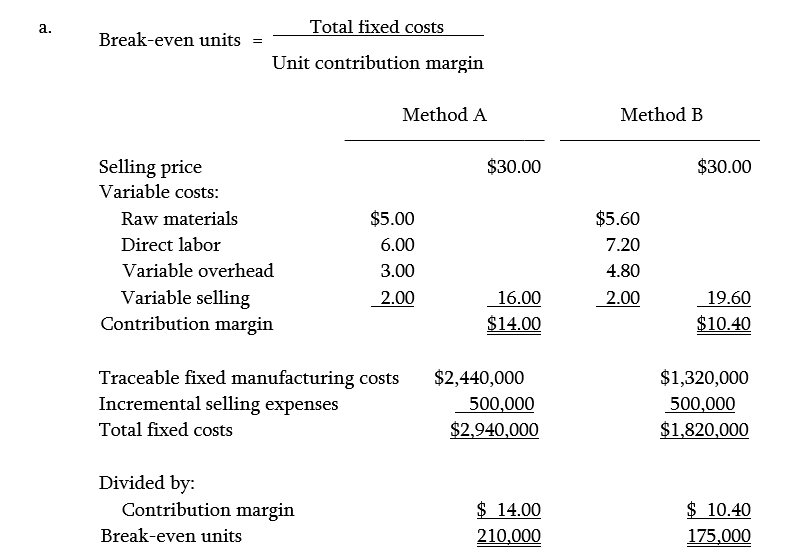
b) Which production technology should the firm use and why?
Answer:
The choice of production methods depends on the level of expected sales. Candice Company would be indifferent between the two manufacturing methods at the volume (x) for which total costs are equal.
16x + 2,940,000 = 19.60x + 1,820,000”3.60x = 1,120,000
X = 311,111 units
In a world of certainty, if management expects to produce fewer than 311,111 units it would choose method B. Above 311, 111 units they would prefer method A. the figure below illustrates this situation. The two break-even points for the two manufacturing methods occur at 210,000 and 175,000 units. However, it is the point where the two cost curves intersect (311,111 units) that is relevant. Method B has lower total costs up to 311,111 units and then method A has lower costs beyond this volume.
With uncertainty, the problem becomes more complicated because the two methods affect operating leverage differently. Operating leverage affects risk, cost of capital, and expected tax payments (to the extent that marginal tax rates vary with profits). Basically, the production method with the lower break-even volume has the lower systematic risk and thus the lower discount rate.
2) Carla Book is a tax attorney specializing in representing clients during an IRS audit. Carla’s clients can pay either an hourly fee or a flat fee. The hourly fee is based on profit for Carla (her desired hourly pay) plus a portion of overhead. The flat fee is a one-time charge regardless of the hours of work required of Carla. Some clients choose the hourly rate because they don’t want to run the risk of overpaying, while other clients select the flat fee which is a one-time charge to complete the service and locks in the cost of hiring a tax attorney. Carla has two different flat-fee rates: IRS audit (simple) $3,500 and IRS audit (complex) $6,000. Carla expects to work 2,200 hours during the coming year of which 1,400 will be billable to clients at the hourly rate. The remainder of her working hours will be devoted to clients who selected the flat fee. Carla wants her billing rate to reflect $70 per hour worked plus a fee to recover the expected overhead spread over 2,200 hours. Carla expects to have $220,000 in overhead during the year. Carla completed 40 simple audits and 22 complex audits for clients who paid the flat fee. She worked and billed clients for 1,300 hours. Her actual overhead was $200,000.
What did Carla earn during the year after expenses (if necessary, round all amounts to the nearest dollar)?
Answer: $293,000
Calculation
Overhead Rate/ hr = 220,000 expected OH / 2,200 expected hours = $100 per hour.
Hourly Billing rate = 70 + 100 = 170/ hr
Hourly Fees = 170 x 1300 actual hours billed = 221,000
Flat fees (simple audits) = 40 x 3500 = $140,000
Flat fees (Complex Audits) = 22 x 6000 = 132000
Total Revenue = 221,000 + 140,000 + 132,000 = 493,000
Net Earnings = 493,000 – 200,000 actual OH = $293,000
a) Cash of $12,000 will be received in year 6. Assuming an opportunity cost of capital of 7.2%, which of the following is true?
Answer:
The present value is $7,907
Future Value FV = $12,000 (received in year 6)
Discount rate (r ) = 7.2% = 0.072
Number of Periods (n) = 6 years
Present Value = FV / ((1+r)^n) = 12,000 / ((1+0.072)^6) = 7,907.01
b) Cathy’s Mats produces and sells artistic placemats for dining room tables. These placemats are manufactured out of recycled plastics. For last year and this year each mat has a variable manufacturing cost of $3, and fixed manufacturing overhead is $150,000 per year (both Last Year and This Year). Cathy’s Mats incurs no other costs. The following table summarizes the selling price and the number of mats produced and sold Last Year and This Year:
| Last Year | This Year | |
| Selling price | $5.00 | $5.00 |
| Variable manufacturing cost | $3.00 | $3.00 |
| Fixed manufacturing cost | $150,000 | $150,000 |
| Units produced | 150,000 | 50,000 |
| Units sold | 100,000 | 100,000 |
Cathy’s Mats uses FIFO (First-in First Out) to value its ending inventory. Last year, Cathy’s Mats had no beginning inventory.
Required:
a) Prepare income statements for Last Year and This Year using absorption costing.
Answer:
Absorption costing income statements for Last Year and This Year
| Last Year | This Year | |
| Selling price | $5.00 | $5.00 |
| Variable manufacturing cost | $3.00 | $3.00 |
| Fixed manufacturing cost | $150,000 | $150,000 |
| Units produced | 150,000 | 50,000 |
| Units sold | 100,000 | 100,000 |
| Ending inventory | 50,000 | 0 |
| Average fixed cost of units produced | $1.00 | $3.00 |
| Total manufacturing cost per unit | $4.00 | $6.00 |
| Absorption Costing: | Last Year | This Year |
| Absorption Costing: | Last Year | This Year |
| Cost of goods sold (FIFO) | ||
| From previous year production | $0 | ($200,000) |
| From current year production | (400,000) | (300,000) |
| Total cost of goods sold | ($400,000) | ($500,000) |
| Net income before tax | $100,000 | $0 |
b) Prepare income statements for Last Year and This Year using variable costing.
Answer:
Variable costing income statements for Last year and This Year:
| Variable Costing: | Last Year | This Year |
| Revenue | $500,000 | $500,000 |
| Cost of goods sold (FIFO) | (300,000) | (300,000) |
| Fixed manufacturing cost | (150,000) | (150,000) |
| Net income before tax | $50,000 | $50,000 |
c) Write a short memo explaining why the net income amounts for Last Year and This Year are the same or different in parts (a) and (b).
Answer:
Under variable costing (part b) net income is the same in both years because all the fixed manufacturing costs are written off each year regardless of whether inventory is added or depleted. However, in part a, absorption costing assigns some of the fixed costs to Last Year’s ending inventory when more mats were produced than sold. But when these mats are sold this year, the inventoried fixed costs hit income along with all the fixed costs incurred This Year.
d) Assume all the same facts (and data) as given in the problem, EXCEPT that This Year Cathy’s Mats produced 60,000 mats rather than 50,000 mats. Compute net income for Last Year and This Year using (i) absorption costing and (ii) variable costing.
Answer:
Over producing This Year and adding 10,000 units to inventory:
| Last Year | This Year | |
| Selling price | $5.00 | $5.00 |
| Variable manufacturing cost | $3.00 | $3.00 |
| Fixed manufacturing cost | $150,000 | $150,000 |
| Units produced | 150,000 | 60,000 |
| Units sold | 100,000 | 100,000 |
| Ending inventory | 50,000 | 10,000 |
| Average fixed cost of units produced | $1.00 | $2.50 |
| Total manufacturing cost per unit | $4.00 | $5.50 |
| Absorption Costing: | Last Year | This Year |
| Revenue | $500,000 | $500,000 |
| Cost of goods sold (FIFO) | ||
| From previous year production | $0 | ($200,000) |
| From current year production | (400,000) | (275,000) |
| Total cost of goods sold | ($400,000) | ($475,000) |
| Net income before tax | $100,000 | $25,000 |
| Variable Costing: | Last Year | This Year |
| Revenue | $500,000 | $500,000 |
| Cost of goods sold (FIFO) | (300,000) | (300,000) |
| Fixed manufacturing cost | (150,000) | (150,000) |
| Net income before tax | $50,000 | $50,000 |
e) Write a short memo explaining why the net income amounts for Last Year and This Year are the same or different in (i) and (ii) of part (d).
Answer:
Under absorption costing, over producing This Year and adding 10,000 units to inventory results in higher profits This Year of $25,000, because this is the amount of fixed costs included in inventory at the end of This Year. These higher profits do not result under variable costing because all fixed manufacturing overhead is written off directly to the income statement.
3) CC uses absorption (full) costing and its direct competitor, FF uses variable costing for internal decision making purposes. Last year, both companies reported the same production and sales volumes. Which is true?
Answer:
Unable to determine
One of the first four is true if the two companies face identical costs and revenues, and, if, and only if, one of the following two conditions holds true:
a) Neither company had a beginning inventory
b) Both had a beginning inventory of an identical number of units and identical cost.
Neither cost structure nor inventory levels were addressed in the question; therefore it is not possible to evaluate relative net income positions.
4) A chair manufacturer has established the following flexible budget for the month.
| Units Produced and Sold | |||
| 1,000 | 1,500 | 2,000 | |
| Sales | $10,000 | $15,000 | $20,000 |
| Variable Costs | (5,000) | (7,500) | (10,000) |
| Fixed Costs | (2,000) | (2,000) | (2,000) |
| Profit | $3,000 | $5,500 | $8,000 |
Required:
a) What is the sales price per chair?
Answer:
The sales price per chair can be calculated by dividing the sales dollars by the number of units: $10,000/1,000 units = $10/unit
b) What is the expected profit if 1,60 chairs are made?
Answer:
The variable cost per unit can be calculated by dividing the variable costs by the number of units: $5,000/1,000 units = $5/ unit.
The expected profit of making and selling 1,600 chairs is:
| Revenues ($10/unit) (1,600 chairs) | $16,000 |
| Variable costs ($5/unit) (1,600 chairs) | (8,000) |
| Fixed costs | (2,000) |
| Profit | $6,000 |
5) A chair manufacturer has two divisions: framing and upholstering. The framing costs are $100 per chair and the upholstering costs are $200 per chair. The company makes 5,000 chairs each year, which are sold for $500.
Required:
a) What is the profit of each division if the transfer price is $150?
Answer:
Profit of each division if the transfer price is $150/chair:
| Framing | Upholstery | |
| Revenues | ||
| ($150/chair) (5,000 chairs) | $750,000 | |
| ($500/chair) (5,000 chairs) | $2,500,000 | |
| Costs | ||
| ($100/chair) (5,000 chairs) | 500,000 | |
| ($150 + $200/chair) (5,000 chairs) | 1,750,000 | |
| Profit | $250,000 | $750,000 |
b) What is the profit of each division if the transfer price is $200?|
Answer:
Profit of each division if the transfer price is $200/ chair.
| Framing | Upholstery | |
| Revenues | ||
| ($200/chair) (5,000 chairs) | $1,000,000 | |
| ($500/chair) (5,000 chairs) | $2,500,000 | |
| Costs | ||
| ($100/chair) (5,000 chairs) | 500,000 | |
| ($200 + $200/chair) (5,000 chairs) | 2,000,000 | |
| Profit | $500,000 | $500,000 |
6) Chamiching makes hacksaw blades. Inventory values are determined using the first in, first out (FIFO) method. Production and sales data for the first three years appear below.
| Hacksaw blades | Sold | Produced |
| Yr 1 | 18,000 | 22,000 |
| Yr 2 | 25,000 | 23,000 |
| Yr 3 | 37,000 | 35,000 |
| Sales price | Full cost | |
| Yr 1 | $10.00 | $6.00 |
| Yr 2 | $11.00 | $6.60 |
| Yr 3 | $12.00 | $7.60 |
In the first year, variable costs accounted for half of the full costs. Total fixed production costs increased each subsequent year by 20%, as a result of step-fixed costs and a general inflationary price increase.
a) For Chamiching, which of the following is true?
Answer:
The fixed cost per unit in Yr 3 is $2.72
First, find Yr 1’s total fixed costs (TFC). TFC in subsequent years is 20% more than the preceding year.
| Full cost | * % variable = | Variablecost | Unit Fixed cost | |
| Yr 1 Full cost per unit (given) | $6.00 | 50% | $3.00 | $3.00 |
| Units | Av. UnitFC | TFC | Av. UnitFC | |
| Yr 1 Total fixed costs | 22,000 | $3.00 | $66,000.00 | |
| Yr 2 Total fixed costs | 23,000 | $79,200.00 | $3.44 | |
| Yr 3 Total fixed costs | 35,000 | $95,040.00 | $2.72 |
TFC in Yr 2 = $66,000 x ½ = $79,200
TFC in Yr 3 = $779,200 x 1.2 = $95,040
b) For Chamiching, which of the following is true?
Answer:
VCI exceeds FCI in Yrs2 and 3 only.
In years 2 and 3, sales volume exceeded production volume, so variable costing income will exceed full costing income.
c) For Chamiching, if variable costing is used, which of the following is true?
Answer:
Yr 3’s gross profit is $171,687
| Variable Costing Income Statement | |
| Yr 3 | |
| Sales | $444,000.00 |
| Beginning Inventory | $6,313.04 |
| Variable production costs | $170,960.00 |
| Variable GAFS | $177,273.04 |
| Less Ending inventory | $0.00 |
| Variable cost of goods sold | $177,273.04 |
| Total Contribution margin | $266,726.96 |
| Less Production fixed costs | $95,040.00 |
| Less Production fixed costs | $95,040.00 |
| Valuation of ending inventory | |
| Units | 0 |
| Unit VC | $4.88 |
| VC ending inventory | $0.00 |
Beginning Inventory in Yr 3 = ({[Yr 2 Full cost per unit × Yr 2 production] – Yr 2 Fixed cost} ÷ Yr 2 production) × Yr 2 units in inventory
= ({[$6.60 × 23,000] – $79,200 (from Q10-4)} ÷ 23,000) × 2,000
= $6,313.04
Variable production costs in Yr 3 = [(Full Cost per unit in Yr 3) × Units produced in Yr 3] – Yr 3 Fixed costs
= [$7.60 × 35,000] – $95,040 (from Q10-4)
= $170,960
d) For Chamiching, if absorption costing is used, which of the following is true?
Answer:
Yr 2’s gross profit is $112,400
| Absorption costing income statement | |
| Yr 2 | |
| Sales | $275,000.00 |
| Beginning Inventory | $24,000.00 |
| Variable prod. Costs | $72,600.00 |
| Production fixed costs | $79,200.00 |
| Goods available for sale | $175,800.00 |
| Less-Ending inventory | -$13,200.00 |
| COGS | $162,600.00 |
| GP | $112,400.00 |
| Valuation of ending inventory | |
| Units | 2,000 |
| Unit VC | $3.16 |
| VC ending inventory | $6,313.04 |
| Production fixed costs | $79,200.00 |
| * Inventory fraction | 2/23 |
| Inventoried fixed costs | $6,886.96 |
| Ending inventory (VC + FC) | $13,200.00 |
e) For Chamiching, when variable costing income is reconciled to absorption costing income, which of the following is true?
Answer:
In Yr 2, $5,113 is deducted from variable costing income to find absorption costing income.
| Reconciliation of profit | ||||
| Yr 1 | Yr 2 | Yr 3 | Total | |
| Variable costing income | $60,000 | $117,513 | $171,687 | $349,200 |
| + Fixed cost deferred in End Inv | $12,000 | $6,887 | $0 | |
| – Fixed cost in Beg Inv | $0 | – $12,000 | – $6,887 | |
| = Absorption costing income | $72,000 | $112,400 | $164,800 | $349,200 |
f) For Chamiching, which of the following is true?
Answer:
The company should always choose absorption costing because it facilitates income smoothing.
Over the three years, Chamiching accumulates the same total income regardless of the choice of inventory costing method.
| Chamiching | |||||
| Profits | Yr 1 | Yr 2 | Yr 3 | Total | Std dev |
| Production ‘profit’ (VC) | $60,000 | $117,513 | $171,687 | $349,200 | 55,852 |
| Gross profit (FC) | $72,000 | $112,400 | $164,800 | $349,200 | 46,529 |
| “Profit” as% of sales | Yr 1 | Yr 2 | Yr 3 | Std dev | |
| Variable costing | 33.3% | 42.7% | 38.7% | 0.047 | |
| Absorption costing | 40.0% | 40.9% | 37.1% | 0.020 |
The adoption of absorption costing does indeed facilitate income smoothing.
Absorption costing is a classic example of the application of GAAP’s accounting concept: matching. The standard deviation of the time series is markedly smaller for the absorption costing data.
7) The City of Las Angeles (COLO) recently installed a complex camera system to photograph vehicles running through a red light. This monitoring system is likely to:
Answer:
- Be ignored unless there is a punishment for non-compliance
- Increase traffic fine revenue for COLO
- Be hated by the public
- Encourage COLO to reduce the period of the orange light
- ALL of the above
8) The City of Toledo has received a proposal to build a new multipurpose outdoor sports stadium. The expected life of the stadium is 20 years. It will be financed by a 20-year bond paying 8 percent interest annually. The stadium’s primary tenant will be the city’s Triple-A baseball team, the Red Hots. the plan’s backers anticipate that the site also will be used for rock concerts and college and high school sports. The city does not pay any taxes. The city’s cost of capital is 8 percent. The costs and estimated revenues are presented next:
| Cash Outflows | |
| Construction costs | 12,000,000 |
| General maintenance (including labor) | 250,000 per year |
| Cash inflows | |
| Red Hots’s lease payment | 650,000 per year |
| Concerts | 600,000 /yr |
| College and high school sports | 50,000 / yr |
Required:
a) Should the city build the stadium (Assume payments are made at the end of the year)
Answer:
| Annual Cash Flows | ||
| Maintenance | (250000) | |
| Cash Inflows | ||
| Lease payments | 650000 | |
| Concerts | 600000 | |
| Other sports events | 50000 | |
| Annual Net Cash Flows | 1050000 | |
| X Annuity Factor | 9.818 | |
| Less Original Outlay | 10308900 | |
| Net Present Value | 12000000 | |
| (1691100) |
The city should not build the stadium.
b) The Red Hots have threatened to move out of Toledo if they do not get a new stadium. The city comptroller estimates that the move will cost the city $350,000 per year for10 years in lost taxes, parking, and other fees. Should the city build the stadium now? State your reasoning.
Answer:
The Present Value of the lost revenues is
PV = (350000) x Annuity Factor (r= 0.08, t =10)
= (2348500)
The negative present value of the lost revenues is greater than the negative present value of the stadium. It is now in the interest of the city to build the stadium
9) CJ Equity Partners
CJ Equity Partners is a privately held firm that buys small family-owned firms, installs professional managers to run the firms, and then sells them three to five years later, often for a substantial profit. CJ Equity is owned by four partners who raise capital from wealthy investors and invest this money is unrelated firms. Their aim is to provide a 15 percent rate of return on their investors’ capital after paying the partner of CJ Equity a management fee. CJ Equity currently owns three operating companies: a toll and ie company (Jasco TOols), a chemical bottling company (Miller Bottling), and a janitorial supply company (JanSan). The professional managers running these three companies are paid a fixed salary and bonus based on the performance of their company. Currently, CJ Equity is measuring and rewarding its three professional managers based on the net income after taxes of their individual companies. The following table summarizes the current year’s operations of each of the three companies.
| Jasco Tools | Miller Bottling | Jansan | |
| Weighted average cost of capital | 14% | 12% | 10% |
| CJ Equity management fee | $0.200 | 0.200 | 0.200 |
| Number of employees | 84 | 120 | 85 |
| Interest expense | 1.6 | 1.8 | 0.8 |
| Income tax rate | 20% | 20% | 20% |
| Operating expenses | 33600 | 36800 | 18200 |
| Revenues | 38600 | 42900 | 21200 |
| Total assets | 20.1 | 31.2 | 16.3 |
CJ Equity charges each of the three operating companies an annual management fee of $200,000 for managing the companies, including filing the various tax returns. The weighted average cost of capital represents CJ Equity’s estimate of the risk adjusted, after tax rate of return of similar companies in each operating company’s industry.
You have been hired by CJ Equity as a consultant to recommend whether CJ Equity should change the way it measures the performance of the three companies (net income after taxes), which is then used to compute the professional managers’ bonuses.
Required:
a) Design and prepare a performance report for the three operating companies that you believe best measures each operating company’s performance and which will be used in computing the three professional managers’ bonuses. In other words, using your performance measure, compute the performance of each of the three operating companies.
Answer:
The following table computes the performance of each operating company using residual income after taxes (or EVA).
| Jasco Tools | Miller Bottling | Jansan | |
| Total Assets | 20.1 | 31.2 | 16.3 |
| After tax weighted -average cost of capital (WACC) | 0.14 | 0.12 | 0.10 |
| After tax capital charge | 2.81 | 3.744 | 1.630 |
| Residual Income | |||
| Revenues | 38600 | 42900 | 21200 |
| Operating expenses | (33600) | (36800) | (18200) |
| CM Equity management fee | (0.200) | (0.200) | (0.200) |
| Net operating profit before capital charge and taxes | 4.800 | 5.900 | .2.800 |
| Income taxes (20%) | (960) | (1180) | (560) |
| Net income after taxes | 3840 | 4720 | 2240 |
| Capital charge (Total Assets x WACC) | (2810) | (3740) | (1630) |
| REsidual income (NI after tax – Capital Charge) | 1.030 | 980 | 610 |
b) Write a short memo explaining why you believe the performance measure you chose in part (a) best measures the performance of the three professional managers.
Answer:
Memo explaining the choice of performance measure:
Residual income is used to measure the performance of each of the operating companies because it provides the professional managers incentive to operate their company profitably, which includes using their assets efficiently. Each operating company is charged for the total assets in the company times each company’s risk adjusted, after tax cost of capital. This represents the opportunity cost to investors of assets invested in the company. Each operating company is charged for taxes to give them incentives to make tax-efficient decisions. Note: interest expense is not included in the calculation of residual income to avoid double counting the cost of debt financed assets. Using residual income gives each operating company’s professional manager incentives to use assets efficiently. Any asset (or project) that is not returning the company’s weighted-average cost of capital reduces firm value.
The CJ Equity management fee is included as an expense because each operating company imposes costs on CJ Equity in the form of oversight and tax preparation.
The problem with the current performance measure (net income after taxes) is it creates an over investment problem. Using net income after taxes only charges the professional managers for the cost of assets financed with debt. Equity financed assets are “free.” ROA is not used as a performance measure because it creates incentives to under- (and in some cases to over-) invest in positive NPV projects.
| Jasco Tools | Miller Bottling | Jansan | |
| Total Assets | 20.1 | 31.2 | 16.3 |
| After tax weighted -average cost of capital (WACC) | 0.14 | 0.12 | 0.10 |
| Return on Assets (ROA) | |||
| Revenues | 38.60 | 42.90 | 21.2 |
| Operating expenses | (33.60) | (36.80) | (18.20) |
| CM Equity management fee | (0.20) | (0.20) | (0.20) |
| Net Operating profit before taxes | 4.80 | 5.90 | 2.80 |
| Income taxes (20%) | -0.96 | -1.18 | -0.56 |
| Net income after taxes | 384 | 4.72 | 2.24 |
| ROA | 19.10% | 15.13% | 13.74% |
10) Cogen’s Turbine Division manufactures gas-powered turbines for generating electric power and hot water for heating systems. Turbine’s variable cost per unit is $150,000 and its fixed cost is $1.8 million per month. It has excess capacity. Cogen’s Generator Division buys gas turbines from Cogen’s Turbine Division and incorporates them into electric steam generating units. Both divisional managers are evaluated and awarded as profit centers.
The generator Division has variable cost of $200,000 per completed unit, excluding the cost of the turbine, and fixed cost of $1.4 million per month. The Generator Division faces the following monthly demand schedule for tis complete generating unit (turbine and generator).
| Quantity | Price ($000) | Quantity | Price ($000) |
| 1 | $1,000 | 5 | $800 |
| 2 | 950 | 6 | 750 |
| 3 | 900 | 7 | 700 |
| 4 | 850 | 8 | 650 |
Required:
a) If the transfer price of turbines is set at Turbone’s variable cost ($150,000), how many turbines will the Generator Division purchase to maximize its profits?
Answer:
If the transfer price is set at variable cost ($150,000), the Generator Division will buy seven turbines (see table) as this level maximizes the division’s profits.
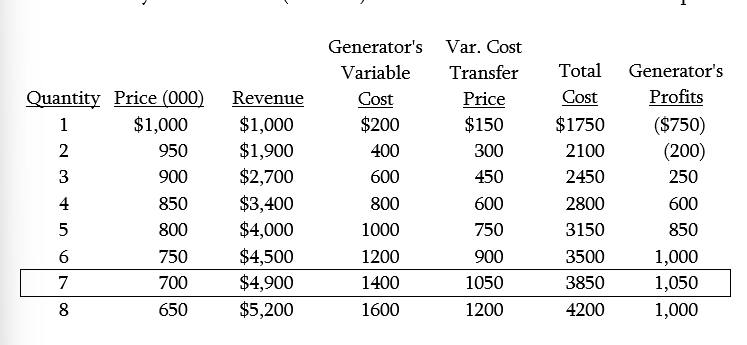
b) The Turbine Division expects to sell a total of 20 turbines a month, which includes both external and internal sales. Calculate the (average) full cost of a turbine (fixed cost plus variable cost) at this level of sales.
Answer:
The (average) full cost (000s) of a turbine is
Full cost = VC + FC / 20 = 150 + $1800 / 20 = $240
c) If the transfer price of turbines is set at Turbine’s (average) full cost calculated in part (b), how many turbines will the Generator Division purchase?
Answer:
If the transfer price is set at full cost ($240,000), Generator will buy six turbines:
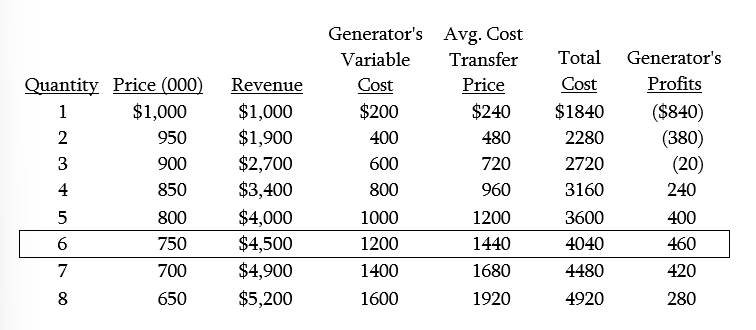
d) Should Cogen use a variable cost transfer price ora full cost transfer price to transfer turbines between the Turbine and Generator divisions? Why?
Answer:
Conventional wisdom argues that variable-cost transfer pricing yields the firm-profit maximizing solution. This is certainly the case as long as variable cost is reasonably easily observed and not subject to gaming. However, the Turbine Division has incentive to reclassify what are in reality fixed costs as variable costs and to convert activities that are now a fixed cost into a variable cost (by replacing contracts written in terms of fixed cash flows with contracts written so the cash outflows vary with units produced). Thus, full-cost transfer prices, being less subject to managerial discretion, might be preferred to variable-cost transfer prices, even though full-cost transfer prices result in fewer units being transferred and hence slightly lower overall profits.
11) Columbine Granite produces a number of different granite products from its granite quarry in Georgia. The production process begins when a 50 foot tall block of solid granite excavated from the mountain quarry. These huge blocks of granite are drilled and broken into movable smaller blocks for processing into building materials. The smaller blocks are cut into granite slabs of desired thickness and the granite slabs are then polished using abrasives and diamond polishing wheels to enhance the beauty of the granite. The slabs are then sorted by size. Some slabs will be cut to smaller dimensions due to natural imperfections in the stone. The larger pieces that cannot be used in slabs are broken up for decorative stone. Sand and stone dust result from cutting the 50 foot blocks out of the mountain, cutting these into smaller blocks, cutting these smaller blocks into slabs, and from producing the decorative stones. A 50-foot tall block of granite produces the following finished products:
| Tons/ batch | Cubic Feet/ Batch (volume) | |
| Sand and stone dust | 330 | 7500 |
| Decorative stone | 577.5 | 5000 |
| Small 2 slabs (d4” x 8”) | 412.5 | 8750 |
| Large 2 slabs ( 4’ x 12’) | 330 | 3750 |
The cost of removing the 50 foot block from the mountain, cutting it into smaller blocks, and then the cost of cutting the slabs is $183,000. A 50 foot block produces, on average, 937.5 4’ x 8’ slabs and the cost of polishing one 4’ x 8’ slab is $90. A 50 foot block produces, on average, 500 4/x 12’ slabs and the cost of polishing one, 4’ x 12’ slabs is $144. The cost of finishing and packaging the 330 tons of sand and stone dust is $500, and the cost of further grinding and packaging the 577.5 tons of decorative stones is $2,500.
Once each of the four products is finished (i.e., the sand and stone dust is finished and packaged and the slabs are polished), they are sold for the following amounts:
| Price/ ton | Price/ slab | |
| Sand and stone dust | 25 | |
| Decorative stone | 75 | |
| Small 2 slabs (under 4’ x 8’) | 320 | |
| Large 2 slabs (4’ x 12’) | 480 |
Required:
a) Allocate the $183,000 cost of removing the 50 foot block from the mountain, cutting it into smaller blocks, and cutting the smaller blocks into slabs to the four products using tons of each product produced from the 50 foot block as the allocation base.
Answer:
The following table allocates the $183,000 cost of removing the 50 foot block from the mountain, cutting it into market blocks, and cutting the smaller blocks into slabs to the four products using tons of each product produced from the 50 foot block as the allocation base.
| Allocated joint cost | |||
| Tons/ batch | Pct of tons | Cost using tons | |
| Sand & stone dust | 330 | 20% = 330/1650 | 36600 =20% * 183000 |
| Decorative stone | 577.5 | 35% | 64050 |
| Small 2” slabs (4’ x 8’) | 412.5 | 25$ | 45750 |
| Large 2:” slabs (4’ x 12’) | 330 | 20% | 36600 |
| 1650 | 100% | 183000 |
b) Calculate the total profits of producing each of the four products and the total profit of processing a 50 foot block after allocating the $183,000 cost to the four products using tons of each product produced from part (a).
Answer:
Total profits of producing each of the four products and the total profit of processing a 50 foot block after allocating the $183,000 cost to the four products using tons of each product produced from part (a) above are calculated in the following table.
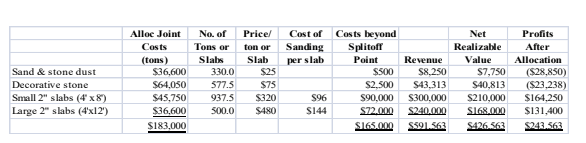

c) Allocate the $183,000 cost of removing the 50-foot block from the mountain, cutting it into smaller blocks, and cutting the smaller blocks into slabs to the four products using the cubic feet (volume) of each product produced from the 50′ × 20′ × 20′ block as the allocation base.
Answer:
The following table allocates the $183,000 cost of processing the 50 foot block to the four products using cubic feet (volume) of each product produced from the 50 foot block as the allocation base.
| Cubic ft/ batch | Pct of tons | Allocated joint cost | |
| Tons/ batch | Volume | Cost using cubic ft | |
| Sand & stone dust | 7500 | 30% | 54900 = 30% * 183000 |
| Decorative stone | 5000 | 20% | 36600 |
| Small 2” slabs (under 4’ x 8’) | 8750 | 35% | 64050 |
| Large 2:” slabs (4’ x 12’) | 3750 | 15% | 27450 |
| 25000 | 100% | 183000 |
d) Calculate the total profits of producing each of the four products and the total profit of processing a 50-foot block from the mountain after allocating the $183,000 cost to the four products using cubic feet (volume) of each product produced from part (c)
Answer:
Total profits of producing each of the four products and the total profit of processing a 50 foot block after allocating the $183,000 cost to the four products using cubic feet of each product produced from part c above are calculated in the following table.
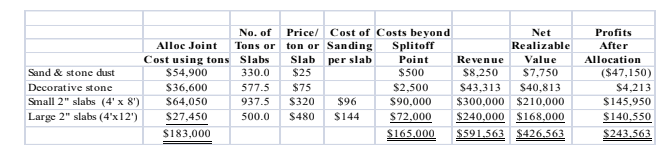
e) Which of the four products (i.e., sand and stone dust, decorative stones, the \(4′ x 8’\) slabs, and the \(4′ x 12’\) slabs) should Columbine sell and which ones should not be sold? Assume that the products Columbine decides not to sell can be used as fill material in the quarry. There is no cost of hauling the unsold products back to the quarry, and any unsold products do not incur the additional processing costs (i.e., the sand and stone dust does not require any packaging, the decorative stones do not require further grinding and packaging, or the \(4′ \times 8’\) and \(4′ \times 12’\) slabs do not require any polishing). Justify your answer
Answer:
Columbine should produce all four products because each generates positive contribution margin (net realizable value or cash flow) after costs of further processing once the blocks are cut. Even though sand and stone dust and decorative stones report negative profits after allocating the joint costs, such allocations distort the actual profitability of each product. Dropping these two products do not improve the total cash flow of producing one more 50 foot block because the joint costs allocated to these two products will have to be allocated to the remaining slabs.
f) Should Columbine Granite use tons or cubic feet (volume) to allocate the $183,000 cost of removing the 50-foot block from the mountain, cutting it into smaller blocks, and cutting the smaller blocks into slabs to the four products? Justify your recommendation based on well-reasoned arguments.
Answer:
Insufficient information is provided in the problem to determine which of the two joint cost allocations should be used. To decide whether tons or cubic feet should be used to allocate the joint cost of $183,000 one would need to know how firm-wide cash flows are affected. For example, one would need to examine the tax effects and possible control effects from the alternative allocations. Columbine might want to consider net realizable value as the allocation scheme, as that methodology does not distort relative profitability and all products show a positive profit as indicated in the table below:
14) A company budgeted the following purchases for raw materials:
Month January February March April May June July
Budget $10,000 $20,000 $25,000 $22,000 $27,000 $30,000 $24,000
The company has a policy of paying for 40% of the purchases in the month of purchase, 35% in the month following the purchase, and 25% in the second month following the purchase.
Based on this information, what are the budgeted cash disbursements for May?
Answer:
May Purchase = 27,000 x 40% = 10,800
April Purchase = 22,000 x 35% = 7,700
March purchase = 25,000 x 25% = 6,250
Total = 24,750
15) A company makes DVD players and incurs a variety of different costs. Place a check in the appropriate column if the cost is a product cost or a period cost. Further, classify each product cost as direct materials, direct labor, or manufacturing overhead
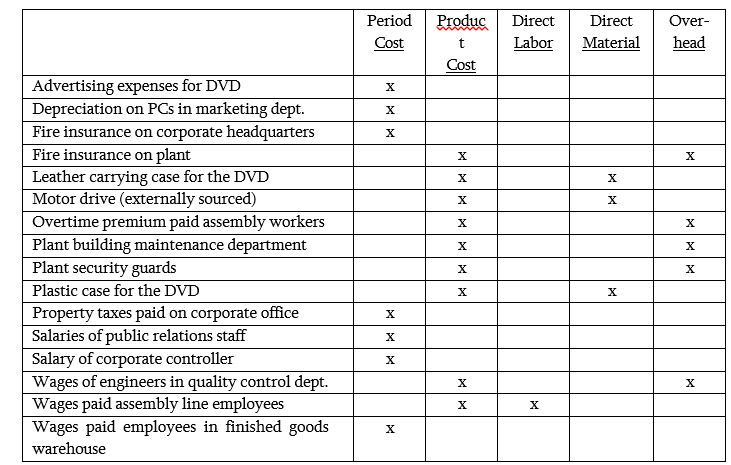
16) A company has projected the following sales for the spring quarter of 2014:
April $200,000
May $250,000
June $275,000
65% of all sales are paid for with cash. The remainder is on credit. The pattern for credit receivables collections are:
Month of Sale 60%
Month After Sale 30%
Second Month After Sale 10%
What are the forecasted cash collections for the month of June?
Answer:
April Credit Sales = 200,000 x 35% = 70,000
May credit sales = 250,000 x 35% = 87,500
June Sales Cash = 275,000 x 65% = 178,750
Credit = 275,000 x 35% = 96,250
Cash Collected in June
June Cash = $178,750
June credit sales = 96,250 x 60% = 57750
May credit sales = 87,500 x 30% = 26,250
April Credit sales = 70,000 x 10% = 7000
Total = 269,7570
17) A company is experiencing an increase in their bad debt expense. Which change in credit policy would cause this increase?
Answer: Credit limits were increased for all customers
18) A company needs 10,000 units of a component used in producing one of its products. The latest internal accounting reports show that the per unit manufacturing cost to be $150.00, variable manufacturing costs of $110.00 and fixed manufacturing cost of $40. The company recently received an offer from another manufacturer to produce the component for $144.00. If it buys the component on the outside 40% of the fixed manufacturing cost can be avoided.
Required:
a) If the company buys the component from the outside supplier at $144.00, what is the impact on income?
Answer:
$18,000 ($18.00 per unit more costly to buy on the outside x 10,000 units)
| Make | Buy | |
| Variable Manufacturing Costs | $110.00 | $0.00 |
| Fixed Manufacturing Cost avoided | $0.00 | ($16.00) |
| Purchase Price | $0.00 | $144.00 |
| Total | $110.00 | $128.00 |
b) What price would make the company indifferent between making the component internally and having the outside supplier make it?
Answer:
$126.00
| Make | Buy | |
| Variable Manufacturing Costs | $110.00 | $0.00 |
| Fixed Manufacturing Cost avoided | $0.00 | ($16.00) |
| Purchase Price | $0.00 | $126.00 |
| Total | $110.00 | $110.00 |
19) A company plans to purchase inventory for the second half of 2014 as follows:
July = $100,000
August = $75,000
September = $225,000
October = $125,000
November = $250,000
December = $30,000
They usually pay 50% of inventory purchases in the month of purchase, 35% in the following month, and 15% in the second month.
Based on this information, what are the forecasted total 2014 cash payments for inventory purchased in the second half of 2014?
Answer:
July $100,000
August $75,000
September $225,000
October $125,000
November = 250,000 x 85% = 212,500
December = 30,000 x 50% = 15,000
Total 2014 cash payments = 752,500
20) A company sells three products as shown below:
| Product X | Product Y | Product Z | Total | |
| Units | 60,000 | 140,000 | 50,000 | 250,000 |
| Sales | $90,000 | $150,000 | $60,000 | $300,000 |
| Variable Costs | $63,000 | $93,000 | $19,000 | $175,000 |
| Contribution Margin | $125,000 | |||
| Fixed Costs | $100,000 |
These three products all always sold in fixed proportions. In other words, Product X always accounts for 24% of total sales (60,000/250,000), Product Y always accounts for 56% of total sales (140,000/250,000), and Product Z always accounts for 20% of total sales (50,000/250,000).
Required:
a) How many units of each product need to be sold to break-even?
Answer:
Weighted Contribution Margin per Unit = 125,000/250,000 = $0.50
$100,000 fixed costs/ $0.50 weighted Contribution margin per unit = 200,000 units In total to break-even.
X= 60,000/250,000 = 24% of total units sold
0.24 x 200,000 = 48,000 units
Y= 140,000/250,000 = 56% of total units sold
0.56 x 200,000 = 112,000 units
Z = 50,000/250,000 – 20% of total units sold
0.20 = 200,000 = 40,000 units
b) How many units must of each product must be sold if the company wants to have a profit of $50,000?
Answer:
($100,000 fixed costs + 50,000 target profit)/ $0.50 weighted Contribution Margin per unit = 300,000 units in total to earn $50,000
X= 60,000 / 250,000 = 24% of total units sold
0.24 x 300,000 = 72,000 units
Y= 140,000/250,000 = 56% of total units sold
0.56 x 300,000 = 168,000 units
Z= 50,000/250,000 = 20% of total units sold
0.20 x 200,000 = 60,000 units
21) A company manufactures and sells widgets. The following information is available:
• Each widget sells for $100.
• The variable cost per widget is $50.
• Total fixed costs per month are $300,000.
How many widgets does the company need to sell each month to break even?
Answer:
CM = 100 -50 = $50/ widget
Break-even unit = 300,000 / $50 = 6,000 widget
22) A company manufactures custom-built wooden bookshelves. Which two costs would the company classify as period costs?
Answer:
Salary cost of the receptionist & Advertising cost
23) A company’s statement of cash flows includes the following cash transactions:
| Sales | $1,250,000 |
| Inventory Purchase | (750,000) |
| Property and Equipment purchase | (270,00)) |
| Interest Payment on Long-term Debt | (25,000) |
| Payment of Wages | (315,000) |
| Payment of Rent | (40,000) |
| Borrowing Long-term debt | 200,000 |
| Payment of Cash Dividends | (15,000) |
| Repurchase of Treasury Stock | (40,000) |
| Total Cash flows | (5,000) |
Assuming the company uses US GAAP standards, what is the total cash flow from financing activities?
Answer: Total Financing Cashflow = 200,000 – 40,000 – 15,000 = 145,000
24) Complex companies adopt decentralization in order to realize all of the following benefits, except:
Answer: Reduced record-keeping
25) A computer manufacturer has the following account balances at the end of the year.
| Work-in-process | $100,000 |
| Finished goods | 800,000 |
| Cost of goods sold | 2,000,000 |
| Total | $2,900,000 |
These accounts contain $500,000 of allocated overhead. Actual overhead, however, is $600,000.
Required:
What are the account balances after prorating the under-absorbed overhead?
Answer:
The under-applied overhead of $600,000 – $500,000 or $100,000 is prorated to work-in-process, finished goods, and cost of goods sold based on the relative size of the account balances.
| Work-in-process ($100,000/$2,900,000) ($100,000) | $3,448 |
| Finished goods ($800,000/$2,900,000) ($100,000) | 27,586 |
| Cost of goods sold ($2,000,000/$2,900,000) ($100,000) | 68,966 |
| Total applied | $100,000 |
New account balances:
| Work-in-process $100,000 + $3,448 | $103,448 |
| Finished goods $800,000 + 27,586 | $827,586 |
| Cost of goods sold $2,000,000 +$68,966 | $2,068,966 |
27) Housing Markets
A condo identical to yours in your neighborhood sold last week for $150,000. Your condo has a $120,000 assumable, 8 percent mortgage (compounded annually) with 30 years remaining. An assumable mortgage is one that the new buyer can assume at the old terms, continuing to make payments at the original interest rate. The condo that recently sold did not have an assumable mortgage; that is, the buyers had to finance the condo at the current market rate of interest, which is 15 percent. What price should you ask for your condo?
Answer:
PV of annuity at 8% = 11.258
PV of annuity at 15% = 6.566
120,000 / 11.28 = Annual mortgage payment @ 8%
= 10659 x 6.566 = 69,987 PV of payments
Price of condo = Gain on loan $120,000 – 69,987 = 5, 0013 + Sale price of identical condo 150,000 = 200,013
A third condo, again identical to the one that sold for $150,000, is also being offered for sale. The only difference between this third condo and the $150,000 condo is the property taxes. The $150,000 condo’s property taxes are $3,000 per year, while the third condo’s property taxes are $2,000 per year. The differences in the property taxes are due to vagaries in how the property tax assessors assessed the taxes when the condos were built. In this tax jurisdiction, once annual taxes are set, they are fixed for the life of the condo. Assuming the market rate of interest is still 15 percent, what should be the price of this third condo?
Answer:
Difference in property taxes is $1,000/ year for perpetuity.
PV = 1000 / 0.15 = 6,667
Third condo should sell for 150,000 + 6.667 = 156,667
29) The controller of a small private college is complaining about the amount of work she must do at the beginning of each month. The president of the university requires the controller to submit a monthly report by the fifth day of the following month. The monthly report contains pages of financial data from operations. The controller was heard saying, “why does the president need all this information? He probably does not read half of the report. He’s an English professor and probably does not know the difference between a cost and a revenue?
Required:
a) What is the probable role of the monthly report?
b) What is the controller’s responsibility with respect to a president who does not know much accounting?
Answer:
a) There are two possible roles for the monthly report: facilitating planning decisions and control. Monthly reports provide more timely information than annual reports. With monthly reports the president can identify problem areas more quickly and make corrective actions. The president may also use the monthly reports to evaluate the work of his managers. The monthly reports provide information about how managers are performing.
b) If the president of the university is unfamiliar with accounting numbers, the controllers must adapt the monthly report to make it more comprehensible. The controller may even want to highlight areas in the report that might need attention
30) The Cope Company had an over-absorbed overhead balance at year-end. The firm wrote off one-third of it to Cost of Goods Sold, thereby raising net income by $100,000, and the remainder was charged to inventory accounts. Overhead is allocated to products using direct labor dollars. The firm uses a flexible budget to calculate its overhead rate. Before the year began, the variable overhead rate and budgeted volume were estimated to be $7.00 per direct labor dollar and $1 million, respectively. Actual overhead incurred for the year was $9.7 million, and actual direct labor cost was $1,250,000.
Required:
What budgeted fixed overhead amount did the Cope Company use in calculating the overhead rate?
Answer:
| 1/3 Over-applied overhead written off to CGS | $100,000 |
| Total Over-applied overhead (× 3) | 300,000 |
| Overhead incurred | 9,700,000 |
| Overhead absorbed | $10,000,000 |
| ÷ Direct labor cost | $1,250,000 |
| Overhead rate | $8/DL$ |
| Overhead rate | = | (FOH + VOH × BV)/BV |
| $8 | = | (FOH + $7 × $1M)/$1M |
| $8/DL$ | = | FOH + $7 × $1M)/$1M |
| $8M | = | FOH + $7M |
| Fixed overhead | = | $1 million |
31) Cope Products uses a flexible budget to set the overhead rate at the beginning of the year based on units produced. In year 1 budgeted fixed overhead is $1 million and budgeted variable overhead is $2 per unit. Direct material and direct labor together are $5 per unit. Blauvelt sells the completed product for $30. There is no beginning inventory. Budgeted volume is 80,000 units. Production and sales are 80,000 units.
Actual overhead incurred in year 1 is $1,160,000.
Any under- or over-absorbed overhead is written off to cost of goods sold.
In year 2, budgeted volume and production are again both 80,000 units. However, only 60,000 units are sold. Budgeted fixed overhead is $1 million and budgeted variable overhead is $2 per unit. Direct material and direct labor are $5 per unit. Final selling price remains at $30 per unit. Actual overhead incurred in year 2 is $1.35 million.
Required:
a) Calculate net income in year 1 first using absorption costing and then using variable costing. Explain any difference between the two net income numbers.
Answer:
Net income in year 1 using absorption costing and variable costing is the same because production and sales are the same. There is no inventory at the end of the year. Net income under both absorption and variable costing is:
| Absorption Costing Net Income Year 1 | |
| Revenue (80,000 × $30) | $2,400,000 |
| Direct material & labor (80,000 × $5) | 400,000 |
| Overhead (80,000 × $14.50*) | 1,160,000 |
| Net income | $840,000 |
* $14.50 = ($1,000,000 + $ x 80,000) / 80,000
| Variable Costing Net Income Year 1 | |
| Revenue (80,000 × $30) | $2,400,000 |
| Direct material & labor (80,000 × $5) | 400,000 |
| Variable overhead (80,000 × $2.00) | 160,000 |
| Fixed overhead | 1,000,000 |
| Net income | $840,000 |
b) Calculate net income in year 2 using absorption costing, where the overhead rate used to assign overhead to products is based on actual overhead incurred.
Answer:
Net income in year 2 using absorption costing where the overhead rate used to assign overhead to products is based on actual overhead incurred:
| Absorption Costing Year 2 | |
| Revenue (60,000 × $30) | $1,800,000 |
| Direct material & labor (60,000 × $5) | 300,000 |
| Overhead (60,000 × $16.875*) | 1,012,500 |
| Net income | $487,500 |
**$16.875 = $1,350,000 / 80,000
c) Calculate net income in year 2 using variable costing, where any difference between budgeted overhead and actual overhead is treated as a fixed cost.
Answer:
Net income in year 2 using variable costing where the difference between budgeted overhead and actual overhead is treated as a fixed cost.
| Variable Costing(Excess overhead is treated as fixed) Year 2 | |
| Revenue (60,000 × $30) | $1,800,000 |
| Direct material & labor (60,000 × $5) | 300,000 |
| Variable overhead (60,000 × $2) | 120,000 |
| Fixed overhead ($1,000,000 + (1,350,000- 1,160,000*) | 1,190,000 |
| Net income | $190,000 |
** $1,160,000 = $1,000,000 + $2 x 80,000
d) Calculate net income in year 2 using variable costing, where any difference between budgeted overhead and actual overhead is treated as a variable cost.
Answer:
Net income in year 2 using variable costing where any difference between budgeted overhead and actual overhead is treated as a variable cost.
| Variable Costing(Excess overhead is treated as variable) Year 2 | |
| Revenue (60,000 × $30) | $1,800,000 |
| Direct material & labor (60,000 × $5) | 300,000 |
| Variable overhead (60,000 × $4.375*) | 262,500 |
| Fixed overhead | 1,000,000 |
| Net income | $237,500 |
** *$4.375 = $2.00 + ($1,350,000 – 1,160,000)/80,000
e) Explain why your answers in parts (b), 9c ), and (d) differ.
Answer:
Absorption costing reports higher net income ($487,500) than variable costing ($190,000 or $237,500) when production exceeds sales because some of the fixed overhead costs are placed in the ending inventory. However, by treating the excess overhead costs as variable (part d) some of these excess overhead costs are placed in inventory by over producing. Thus, variable costing does not totally eliminate the incentives to over produce
32) A corporation has total liabilities of $300 million, total owners’ equity of $100 million, and current assets of $50 million. What is the value of the firm’s long-term assets?
Answer:
Total Assets = 300 M + 100 M = 400 M
Long-term Assets = 400M – 50M = $350,000
33) Cosmo Inc. operates two retail novelty stores: the Mall Store and the Town Store. Condensed monthly operating income data for Cosmo Inc. for November are presented in the accompanying table. Additional information regarding Cosmo’s operations follows the statement.
| Total | Mall Store | Town Store | |
| Sales | $200,000 | $80,000 | $120,000 |
| Less variable costs | 116,000 | 32,000 | 84,000 |
| Contribution margin | $84,000 | $48,000 | $36,000 |
| Less direct fixed expenses | 60,000 | 20,000 | 40,000 |
| Store segment margin | $24,000 | $28,000 | ($4,000) |
| Less common fixed expenses | 10,000 | 4,000 | 6,000 |
| Operating income | $14,000 | $24,000 | ($10,000) |
- One-fourth of each store’s direct fixed expenses would continue through December of next year if either store were closed
- Cosmo allocates common fixed expenses to each store on the basis of sales dollars
- Management estimates that closing the Town Store would result in a 10 percent decrease in Mall Store sales, while closing the Mall Store would not affect Town Store sales.
- The operating results for November are representative of all months. Required:
a) A decision by Cosmo Inc. to close the Town Store would result in a monthly increase (decrease) in Cosmo’s operating income during next year of how much?
Answer:
Closing Town Store
| Total | Mall Store | Town Store | |
| Sales | $72,000 | $72,000 | 0 |
| Less variable costs | 28,800 | 28,800 | 0 |
| Contribution margin | $43,200 | $43,200 | 0 |
| Less direct fixed expenses | 30,000 | 20,000 | 10,000 |
| Store segment margin | 13,200 | 23,200 | (10,000) |
| Less common fixed expenses | 10,000 | 10,000 | 0 |
| Operating income | $3,200 | $13,200 | ($10,000) |
| Operating income with both stores | 14,000 | ||
| Decline in operating income | $10,800 |
** 80,000 – 10% x 80,000 = 72,000
** (32,000/ 80,000) x 72,000 = 28,800
Cosmo is considering a promotional campaign at the Town Store that would not affect the Mall Store.
Increasing monthly promotional expenses at the Town Store by $5,000 in order to increase Town Store sales by 10 percent would result in a monthly increase (decrease) in Cosmo’s operating income during next year of how much?
Answer:
| Total | Mall Store | Town Store | |
| Sales | $212,000 | $80,000 | $132,000 |
| Less variable costs | 124,400 | 32,000 | 92,400 |
| Promotion | 5,000 | 0 | 5,000 |
| Direct fixed expenses | 60,000 | 20,000 | 40,000 |
| Common fixed expenses | 10,000 | 3,774 | 6,226 |
| Operating income | $12,600 | $24,226 | ($11,626) |
| Operating income with both stores | 14,000 | ||
| Decline in operating income | $1,400 |
** 110% x 120,000 = 132,000
** (84,000 / 120,000) x 132,000 = 92,400
(132,000/ 212,000) x 10,000 = 6,226
b) Half of Town Store’s dollar sales are from items sold at variable cost to attract customers to the store. Cosmo is considering deleting these items, a move that would reduce the Town Store’s direct fixed expenses by 15 percent and result in the loss of 20 percent of Town Store’s remaining sales volume. This change would not affect the Mall Store. A decision to eliminate the items sold at cost would result in a monthly increase (decrease) in Cosmo’s operating income during next year of how much?
Answer:
| Town Store | |
| Sales | $60,000 |
| Variable costs (84,000 – 60,000) | (24,000) |
| Direct fixed expenses (40,000 × .85) | (34,000) |
| Sales decline (60,000 × 20%) | (12,000) |
| Variable costs saved on sales decline (24,000 × 20%) | 4,800 |
| Store segment margin | (5,200) |
| Previous store segment margin | (4,000) |
| Decline in operating margin | $1,200 |
34) A CPA firm estimates that an audit will require the following work:
| Type of Auditor | ExpectedHours | Cost perHour | StandardCosts |
| Manager | 10 | $50 | $500 |
| Senior | 20 | 40 | 800 |
| Staff | 40 | 30 | 1,200 |
| Total | 70 | $2,500 |
The actual hours and costs were:
| Type of Auditor | Actual Hours | Actual Cost per Hour | Actual Costs |
| Manager | 9 | $52 | $468 |
| Senior | 22 | 38 | 836 |
| Staff | 44 | 30 | 1,320 |
| Total | 75 | $2,624 |
Required:
Calculate the direct labor, wage rate, and labor efficiency variances for each type of auditor and interpret.
Answer:
The direct labor variance for each type of auditor is:
| Type of Auditor | Actual Costs | StandardCosts | Direct Labor Variance | |
| Manager | $468 | $500 | ($32) | |
| Senior | 836 | 800 | 36 | |
| Staff | 1,320 | 1,200 | 120 | |
| Total | $2,624 | $2,500 | $124 | Unfavorable |
The wage rate variance for each type of auditor is:
| Manager | ($52/hour – $50/hour) (9 hours) | $18 | |
| Senior | ($38/hour – $40/hour) (22 hours) | (44) | |
| Staff | ($30/hour – $30/hour) (44 hours) | 0 | |
| Total wage rate variance | ($26) | Favorable | |
The labor efficiency variance for each type of auditor is:
| Manager | (9 hours – 10 hours) ($50/hour) | ($50) | |
| Senior | (22 hours – 20 hours) ($40/hour) | 80 | |
| Staff | (44 hours – 40 hours) ($30/hour) | 120 | |
| Total labor efficiency variance | $150 | Unfavorable | |
Note that the direct labor variance is equal to the sum of the wage rate and labor efficiency variances. The favorable wage rate variance means that on average the auditors were paid less than expected although managers were paid more than expected. The unfavorable labor efficiency variance means that on average the auditors took longer to complete the audit than expected. Managers, however, spent less time on the audit than expected
PART D
35) Davos Inc. makes fiberglass ski-boards in Switzerland. Identify the correct matching of terms.
Answer: Payroll taxes for workers in the Packaging Department are direct labor.
36) Derf Company applies overhead on the basis of direct labor hours. Two direct labor hours are required for each product unit. Planned production for the period was set at 9,000 units.
Manufacturing overhead for the period is budgeted at $135,000, of which 20 percent is fixed. The 17,200 hours worked during the period resulted in production of 8,500 units.
Manufacturing overhead cost incurred was $136,500.
Required:
Calculated the following three overhead variances:
a) Overhead volume variance.
b) Overhead efficiency variance
c) Overhead spending variance
Answer:
Expected overhead = $135,000 [$27,000 (fixed) + $108,000 (variable)]
Expected volume = 9,000 units or 18,000 direct labor hours (dl hrs)
Overhead rate = $135,000 ÷ 18,000 dl hrs = $7.50 per dl hr
Variable overhead rate = $108,000 ÷ 18,000 dl hrs = $6 per dl hr
Flexible budget = $27,000 + $6 per dl hr × direct labor hours
| Overhead volume variance | = | flexible budget at standard volume-overhead absorbed |
| ($27,000 + $6 × 17,000) – $7.50 × 17,000 | ||
| $1,500 unfavorable | ||
| Overhead efficiency variance | = | $6 per dl hr × (actual volume – standard volume) |
| = | $6 × (17,200 – 17,000) | |
| = | $1,200 unfavorable | |
| Overhead spending variance | = | $136,500 – (27,000 + $6 × 17,200 dl hrs) |
| = | $6,300 unfavorable |
37) The Denna Water plant in Sarasota, Florida, bottles purified and flavored waters in a variety of sizes (20, 36, 48, and 64 ounces) for sale through vending machines and retail stores. Volume is measured as bottled ounces.
The plant’s annual budgeted fixed manufacturing overhead amounts to $1.8 million, and variable manufacturing overhead is projected at $0.005 per bottled ounce. Projected volume in the Sarasota plant next year is 200 million ounces. Actual volume for the year accumulated to 210 million ounces and total manufacturing overhead incurred (both fixed and variable) was $2.85 million.
Required
a) Calculate the Denna Sarasota plant overhead rate.
Answer:
Overhead rate = (1.8 million + 0.005 x 200 million oz.) / 200 million oz.
= 1.8 million / 200 million oz + 0.005
= 0.009 + 0.005
= $0.014
b) How much overhead was absorbed to products in the Sarasota plant?
Answer:
| Overhead absorbed: | |
| Actual Volume (millions) | 210 |
| OH rate/ounce | $0.014 |
| Overhead absorbed (millions) | $2.940 |
c) Calculate the Denna Sarasota plant’s over- or under-absorbed overhead
Answer:
| Over/under absorbed(millions): | |
| Overhead absorbed | $2.940 |
| Less: Actual overhead incurred | 2.850 |
| Over absorbed overhead | $0.090 |
d) Describe the effect on income when the over- or under-absorbed overhead calculated in (c) is written off to cost of goods sold.
Answer:
$90,000 more overhead was charged to products (WIP, Finished goods, and Cost of Goods Sold) than was actually incurred. So, when this over-absorbed overhead is written off to CGS, it lowers CGS and raises net income before taxes
38) Department 100 is the first step in the firm’s manufacturing process. Data for the current quarter’s operations are as follows:
| Number of Unit | |
| Beginning work-in process (70% complete( | 30000 |
| Units started this quarter | 580000 |
| Units completed this quarter and transferred cost | 550000 |
| Ending work in process (60% complete) | 60000 |
Required:
Materials are added at the beginning of the process. Conversion costs (labor and capital costs) are incurred uniformly. The firm uses the FIFO method of inventory according. How many equivalent units of conversion cost were used in the current quarter in Department 100?
Answer:
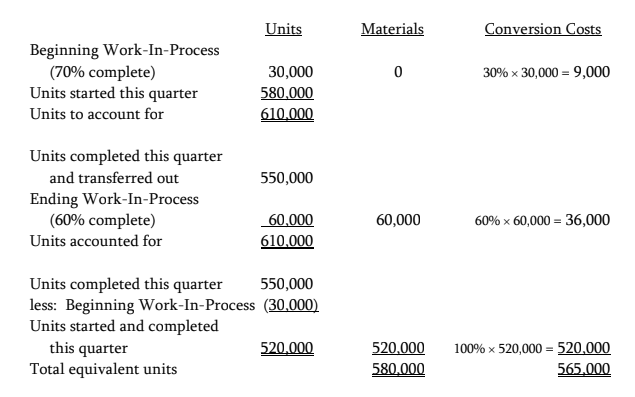
39) Digital Convert (DC) is a three year old startup company with most of its capital coming from banks and personal investments by the founders. DC manufactures a high-resolution scanner (MXP35). At the heart of the MXP35 is a photoelectric light sensor that converts light into digital pixels. DC currently produces the MXP35 for $480 (VC) per unit and incurs virtually no fixed manufacturing costs. All of its equipment is leased are structured whereby DC only pays for the actual units produced. DC operates out of a building that is provided free by New York State for entrepreneurial startups. NY State also pays utilities, taxes, insurance, and administrative consume most of its profits from sales of the MXP35.
DC faces the following monthly demand schedule for the MXP35 (where price is the wholesale price DC receives):
| Quantity | Price |
| 19 | 1278 |
| 20 | 1240 |
| 21 | 1202 |
| 22 | 1164 |
| 23 | 1126 |
| 24 | 1088 |
| 25 | 1050 |
| 26 | 1012 |
The equation of the demand curve for the preceding table is P=2000 – 38Q.
In other words, if DC wants to sell 20 MXP35s per month, it would charge a wholesale price of $1,240 per unit.
Required:
a) Given DC’s current cost structure of $480 variable cost and zero fixed costs, what is the profit-maximizing price-quantity contribution for MXP35?
Answer:
Profits are maximized at a wholesale price of $1,240 and a quantity of 20 units as calculated in the following table:
| Quantity | Price | VC | FC | Profit |
| 10 | 1,278 | 480 | 0 | 15162 |
| 20 | 1240 | 480 | 0 | 15200 |
| 21 | 1202 | 480 | 0 | 15162 |
| 22 | 1164 | 480 | 0 | 15048 |
| 23 | 1126 | 480 | 0 | 14858 |
| 24 | 1088 | 480 | 0 | 14592 |
| 25 | 1050 | 480 | 0 | 14250 |
| 26 | 1012 | 480 | 0 | 13832 |
b) DC learns of a new manufacturing process for their photoelectric light sensor that lowers the VC from $480 per unit to $100 per unit. But the equipment must be leased for $7,000 per month for 24 months. If DC leases the new equipment, then over the next 24 months DC commits to paying $7,000 each month. If DC installs the new equipment, what is the price-quantity combination that maximizes profits?
Answer:
If DC adopts the new technology, profits are maximized at a wholesale price of $1,050 and a quantity of 25 units as calculated in the following table:
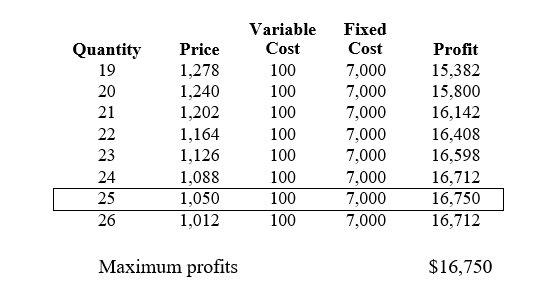
c) Before deciding to adopt the new photoelectric light sensor production technology, DC does some further research into its cost of financial distress. While the demand curve DC faces represents its normal demand, random monthly variation can cause demand to shift up or down unexpectedly. Given its existing bank loans, its variable costs of $480 per unit, no fixed manufacturing costs, and its small cash balances. DC faces a 15 percent chance of defaulting on its loans sometime over the next 24 months. If DC defaults on its loans, the owners of DC estimate the cost of default (legal costs, bank fees, and so forth) to be $500,000. With the additional fixed leasing cost of the new sensor manufacturing technology, the owners of DC predict that the likelihood of defaulting on their fixed monthly commitments (bank loan and the $7,000 equipment lease) increase to 25 percent over the next 24 months. Prepare an analysis supporting your recommendation as to whether DC should adopt the new sensor manufacturing process or stay with their current manufacturing technology.
Answer:
The following table shows that adopting the new sensor manufacturing technology does not maximize DC’s total profits after considering the expected cost of financial distress. Adopting the new technology lowers the value of DC by $12,800. In other words, DC should stay with its current manufacturing technology.
| Monthly profits from the new technology | $16,750 |
| Monthly profits from the existing technology | 15,200 |
| Incremental profits from the new technology | 1,550 |
| Number of months the new technology must be leased | X 24 |
| Incremental profits over the next 24 months | $37,200 |
| Cost of financial distress | $500,000 |
| Increase in likelihood of financial distress over 24 months | x10% |
| Increase in expected cost of financial distress | $50,000 |
| Expected total profits (loss) of new technology | ($12,800) |
40) DigitalEar invented and patented a new digital behind-the-ear hearing aid with adaptive noise reduction and automatic feedback cancellation. DigitalEar produces four different models of its DigitalEar device. The following table summarizes the planned production levels, costs, and selling prices for the four DigitalEar devices for this year.
| DigitalEar Hearing Aid Models | ||||
| A21 | B45 | C24 | D88 | |
| Budgeted production and sales (units) | 12,000 | 8,000 | 5,000 | 3,000 |
| Selling price | $500 | $600 | $700 | $1,000 |
| Direct labor (DL) hours per unit | 2.0 | 2.8 | 3.0 | 3.5 |
| Direct material per unit | $110 | $120 | $130 | $150 |
| Direct labor cost (wages, benefits, and payroll taxes) per DL hour | $25 | $25 | $25 | $25 |
DigitalEar allocates both fixed and variable manufacturing overhead to the four devices using a single overhead rate, which includes both fixed and variable manufacturing overhead. The number of direct labor hours in each device is used as the allocation base for assigning overhead to hearing aids. Budgeted volume measured using direct labor hours is calculated using the budgeted sales of each device. Variable manufacturing overhead is budgeted at $12.00 per direct labor hour and fixed manufacturing overhead is budgeted this year at $2,157,000.
Required:
a) Calculate DigitalEar’s budgeted manufacturing overhead rate per direct labor hour for this year.
Answer:
The following table first calculates the budgeted volume measured as total direct labor hours for the budgeted production levels, and then calculates the overhead rate for the year.
| A21 | B45 | C24 | D88 | Total | |
| Budgeted Volume | 12,000 | 8,000 | 5,000 | 3,000 | |
| Direct labor hours per unit | 2.0 | 2.8 | 3.0 | 3.5 | |
| Total direct labor hours | 24,000 | 22,400 | 15,000 | 10,500 | 71,900 |
| Total direct labor hours | 71,900 |
| Variable OH per direct labor hour | × $12.00 |
| Total variable OH | $862,800 |
| Fixed mfg OH | 2,157,000 |
| Budgeted manufacturing OH | $3,019,800 |
| Total direct labor hours | ÷ 71,900 |
| OH rate per direct labor hour | $42.00 |
b) Using absorption costing, calculate the budgeted manufacturing cost per unit for each of DigitalEar’s four hearing aid devices.
Answer:
The budgeted unit manufacturing cost of the four devices:
| Unit manufacturing cost (Absorption costing) | ||||
| A21 | B45 | C24 | D88 | |
| Direct material | $110.00 | $120.00 | $130.00 | $150.00 |
| Direct labor | 50.00 | 70.00 | 75.00 | 87.50 |
| Manufacturing OH | 84.00 | 117.60 | 126.00 | 147.00 |
| Mfg cost per unit | $244.00 | $307.60 | $331.00 | $384.50 |
c) During the year, actual manufacturing overhead incurred (fixed plus variable) was $3,110,000, and the actual number of direct labor hours used producing the four hearing aids was:
| A21 | B45 | C24 | D88 | |
| Actual direct labor hours | 26,000 | 23,800 | 18,600 | 12,250 |
Calculate the over –or – under-absorbed overhead DigitalEar for this year.
Answer:
Overhead was over-absorbed by $277,300, as calculated in the following table:
| A21 | B45 | C24 | D88 | Total | |
| Actual direct labor hours | 26,000 | 23,800 | 18,600 | 12,250 | 80,650 |
| Overhead rate per DL hour | × $42.00 | ||||
| OHabsorbed to products | $3,387,300 | ||||
| Actual OH incurred | 3,110,000 | ||||
| Over absorbed OH | $277,300 |
d) Assuming that the entire over- or under-absorbed overhead you calculated in part (c) is written off to cost of goods sold, does this write-off increase or decrease net income before taxes? Explain.
Answer:
If the entire $277,300 is written off to cost of goods sold (CGS), net income increases from what it was before the write off. An over-absorbed overhead amount indicates that too much overhead was absorbed into the products (more overhead was absorbed than was incurred). So, the write off to cost of goods sold backs out of expenses (CGS) the amount of the over-absorbed overhead, thereby lowering CGS and raising net income
41) The director of a marathon race wants to assign the cost of having police officers along the race route to manage crowd control.
Which consideration is an appropriate cost driver?
Answer:
The number of race participants and spectators
42) DisKing Company sells used DVDs on line. The projected after-tax net income for the current year is $120,000 based on a sales volume of 200,000 DVDs. DisKing has been selling the disks at $16 each. The variable costs consist of the $10 unit purchase price of the disks and a handling cost of $2 per disk. DisKing’s annual fixed costs are $600,000 and DisKing is subject to a 40 percent income tax rate.
Required:
a) Calculate DisKing Company’s break-even point for the current year in number of DVDs.
Answer:
Break-even $600,000/ ($16-12) = 150,000 units
b) Calculate the increased after-tax income for the current year if projected unit sales volume increase 10 percent.
Answer:
| Sales 200,000 × 16 × 1.1 | $3,520,000 |
| Variable Costs 200,000 × 12 × 1.1 | (2,640,000) |
| Fixed Costs | (600,000) |
| Net income before tax | 280,000 |
| Taxes (40%) | (112,000) |
| Net income after taxes | 168,000 |
| Net income @ 200,000 units | 120,000 |
| Increase in net income | $48,000 |
c) Management expects that the price DisKing pays for used DVDs to increase 30 percent next year. If the unit selling price remains at $16, calculate the volume of sales in dollars that DisKing Company must achieve in the coming year to maintain the same after-tax net income as projected for the current year.
Answer:
Let Q = unit sales. Then
| (16Q – 1.3 × 10Q – 2Q – 600,000) (60%) | = | 120,000 |
| Q – 600,000 | = | 200,000 |
| Q | = | 800,000 |
| PQ | = | $16 × 800,000 =$12,800,000 |
43) The Doe Company sells three products: sliced pineapples, crushed pineapples, and pineapple juice.
The pineapple juice is a by-product of sliced pineapple, while crushed pineapples and sliced pineapples are produced simultaneously from the same pineapple. Some pineapple slices break, and these are used to make crushed pineapple.
The production process if as follows:
a) A total of 100,000 pounds of pineapples is processed at a cost of $120,000 in Department 1. Twenty percent of the pineapples’ weight is scrap and is discarded during processing. Twenty percent of the processed pineapple is crushed and transferred to Department 2. The remaining is transferred to Department 3.
b) In Department 2, a further cost outlay of $15,000 is required to pack the crushed pineapple. Here a further 10 percent is lost in processing. The packed product is sold at $3 a pound.
c) In Department 3, the material is processed at a total additional cost of $40,000. Thirty percent of the processed pineapple turns into juice and is sold at $0.50 a pound after $3,500 is incurred as selling costs.
The remaining 70 percent is transferred to Department 4.
d) Department 4 packs the sliced pineapple into tins. Costs incurred here total $25,000. The cans are then ready for sale at $4.00 a pound.
Required:
Prepare a schedule showing the allocation of the processing cost of $120,000 between crushed and sliced pineapple using the net realizable value method. The net realizable value of the juice is to be added to the sales value of the sliced pineapples.
Answer:
A diagram of the process is
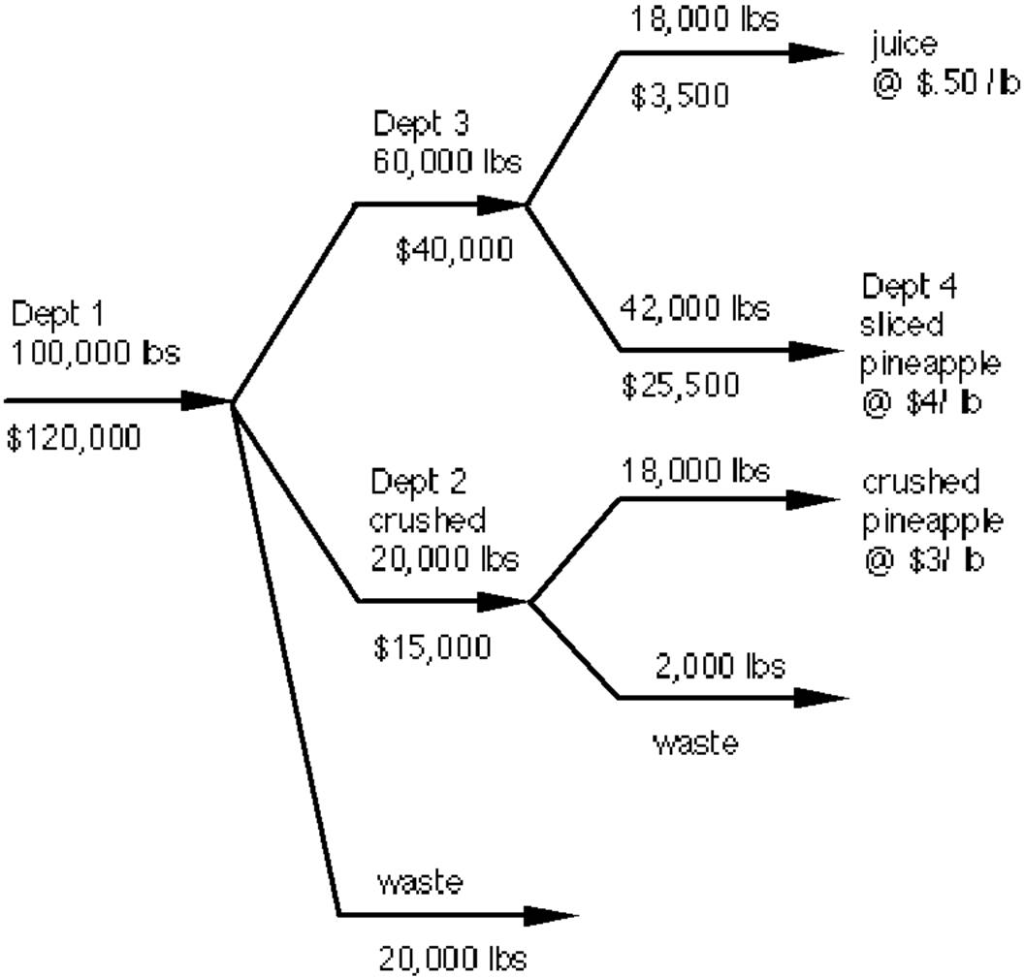
Allocation of joint costs between sliced and crushed pineapples:
| Crushed | Sliced | |||
| Sales value 42,000 @ $4 (Sliced) | $168,000 | (18,000@ $3) | $54,000 | |
| 18,000 @ $.5(Juice) | 9,000 | |||
| $177,000 | $54,000 | |||
| Less: Selling cost of juice | $3,500 | |||
| Additional costs (Dept.3) | 40,000 | |||
| (Dept.4) | 25,500 | 69,000 | ||
| (Dept.2) | 15,000 | |||
| Net realizable value at split-off | $108,000 | $39,000 |
| Estimated Net RealizableValue | Percent | Allocation of Joint Costs | |
| $120,000 | |||
| Sliced Pineapple | $108,000 | 73.47 | 88,164 |
| Crushed Pineapple | 39,000 | 26.53 | 31,836 |
| $147,000 | 100.00 | $120,000 |
44) Don Phelps recently started a dry cleaning business. He would like to expand the business and have a coin-operated laundry also. The expansion of the building and the washing and drying machines will cost $100,000. The bank will lend the business $100,000 at 12 percent interest rate. Don could get a 10 percent interest rate loan if he uses his personal house as collateral. The lower interest rate reflects the increased security of the loan to the bank, because the bank could take Don’s home if he doesn’t pay back the loan. Don currently can put money in the bank and receive 6 percent interest.
Required:
Provide arguments for using 12 percent, 10 percent, and 6 percent as the opportunity cost of capital for evaluating the investment.
Answer:
The 12% rate that the bank wants to charge without the security of the home mortgage probably best reflects the risk of the project. Therefore, the 12% interest rate is probably the most appropriate discount rate to use.
The 10 percent rate reflects the interest rate that Don Phelps would have to pay if he uses his personal house as collateral. This rate reflects the interest rate for Don’s total portfolio of assets including his house.
The 6% rate reflects the interest rate that Don receives in interest for his bank deposits. If Don decided to use his own cash and not borrow money for the investment. Don’s forgone opportunity of using the cash would be the 6% interest if no other investment were available.
45) Donovan Steel has two profit centers: Ingots and Stainless Steel. These profit centers rely on services supplied by two service departments: electricity and water. The profit centers’ consumption of the service departments’ outputs (in millions) is given in the following table:
| Service Departments | Profit Centers | ||||
| Service Depts | Electricity | Water | Ingots | StainlessSteel | Total |
| Electricity | 2,500kwh | 2,500kwh | 3,000kwh | 2,000kwh | 10,000kwh |
| Water | 1,000 gal. | 800gal. | 1,000gal. | 2,000gal. | 4,800gal. |
The total operating costs of the two service departments are:
| Electricity | $80 million |
| Water | 60 million |
| Total cost | $140 million |
Required
a) Service department costs are allocated to profit centers using the step-down method. Water is the first service department allocated. Compute the cost of electricity per kilowatt-hour using the step-down allocation method.
Answer:
Using the step-down allocation method starting with the Water service department results in a cost per kilowatt hour of $0.019, calculated as follows:
| Service Departments | Electricity | Water | Ingots | Stainless Steel | Total |
| Water consumed | 1,000 gal | — | 1,000gal | 2,000gal | 4,000 gal |
| % of cost | 25% | — | 25% | 50% | 100% |
| Allocated cost of Water Department | $15 million | — | $15 million | $30 million | $60 million |
| Electricity operating cost | $80 million | — | — | — | — |
| Total cost to be allocated | $95 million | — | — | — | $95 million |
| Electricity consumed (millions) | — | — | 3,000kwh | 2,000kwh | 5,000kwh |
| Cost per kwh | — | — | — | — | $.019/kwh |
| Electricity costs allocated to profit centers | — | — | $57 million | $38 million | $95 million |
| Electricity + Water costs allocated to profit centers | — | — | $72 million | $68 million | $140million |
b) Critically evaluate this allocation method.
Answer:
There are several problems with using the step-down method:
Arbitrariness. If, instead of starting with the Water department, Electricity was the first department allocated, the cost per kilowatt is lower for two reasons. First, no water costs are included in the electricity charge and second, more kilowatt hours are used in the allocation base because Water’s use of kilowatts is included. Specifically, the cost per kilowatt hour is roughly half of that when Electricity includes Water charges ($.0107 versus $.019) and is computed as:
| Service Departments | Profit Centers | ||||
| Service Departments | Electricity | Water | Ingots | Stainless Steel | Total |
| Electricity consumed (millions) | — | 2,500kwh | 3,000kwh | 2,000kwh | 7,500 kwh |
| % of cost | — | 33% | 40.0% | 27% | 100% |
| Electricity operating cost | $80 million | — | — | — | $80 million |
| Cost per kwh | — | — | — | — | $.0107/kwh |
| Allocated cost of Electricity Department | — | $26.4million | $32.0million | $21.6million | $80 million |
| Water operating cost | — | $60 million | — | — | $60 million |
| Total cost to be allocated | — | $86.66million | — | — | — |
| Water consumed | — | — | 1,000gal | 2,000gal | 3,000 gal |
| % of cost | — | — | 33% | 67% | 100% |
| Water costs allocated to profit centers | — | — | $28.5million | $57.9million | $86.4million |
| Electricity + Water costs allocated to profit centers | — | — | $60.5million | $79.5million | $140 million |
Notice that under both cases, the entire $140 million of service department costs are allocated to the two profit centers. Because the cost per kilowatt hour varies so much depending on which method is used, it leads to the belief that the accounting system is arbitrary.
Incentive effects. Clearly, the managers’ consumption of electricity will differ if the transfer price is $.019 per kwh versus $.0107 per kwh. If the opportunity cost to the firm of supplying another kwh differs from the allocated cost, then the managers of the profit centers will use either too much or too little electricity. Neither of these cost allocations is a market-based transfer price. If the market price is below these cost-based transfer prices, the profit center managers have incentives to go outside the firm to purchase electricity. Likewise, if the market price is above the cost-based transfer price, the profit center managers have incentive to stay with the inside Electricity department when outside purchase is warranted
Conflicts of interest. Starting with the Water department’s costs, Ingots receives $72 million of cost..
Starting with the Electricity department’s costs, Ingots can lower their allocation to $60.5 million of service costs. Thus, Ingots has the incentive to argue for starting with Electricity costs and Stainless Steel has the incentive to argue for starting with Water costs. This creates a conflict between the two profit centers that will only be resolved by (costly) senior management intervention.
46) The Downey Screen Plant of Allington Windows manufactures new and replacement screens. The plant produces more than 500 different screen sizes and offers four different aluminum frame colors. Plant OH is absorbed to each screen produced using the square inches of the screen as the allocation base. The single plantwide OH rate, estimated before the year begins, is based on a flexible budget divided by budgeted volume. Volume is measured in square inches of the screens produced. The following table summarizes operations for the year:
| Budgeted variable OH (per sq in) | $0.01 |
| Actual OH incurred | 4,287,482 |
| Budgeted fixed OH | 3,594,240 |
| Overabsorbed OH | 797,759 |
| Actual volume (sq in) | 141,256,700 |
Required:
Calculate the budgeted volume amount (in screen square inches) Downey Screen Plant used in computing the plant wide OH rate for the year.
Answer:
Actual OH absorbed = Over-absorbed OH + Actual OH incurred
= 797,759 + 54,287,482 = $5,085,241
OH rate = Actual OH absorbed / Actual volume = 5,085,241 / 141, 256,700 = $0.036
OH rate = (Budgeted fixed OH + Budgeted variable OH x Budgeted volume) / Budgeted volume
0.036 = (3,594,240 + 0.01 x BV) / BV
Solve for BV (Budgeted volume)
0.036 BV = 3,594,240 + 0.01 BV
0.026 BV = 3,594,240
BV = 138,240,000 sq inches.
47) Dr. Na Gu plans to open a radiology office that provides CAT scans. She can leave the CAT scanner for $1,200 per month plus $45 for each imaging session. In addition to the $45 lease cost per imaging session. Dr. Gu must purchase film for each session at a cost of $55. She plans to charge $250 for each session. Dr GU has identified a suitable office that she can rent for $1,400 per month. The monthly cost of a receptionist is $2,400 and two radiology technician are $3,200 each per month. Office furnishings, phones, and office equipment cost $600 per month. She expects that her salary will be $15,000 per month.
Required:
a) How many imaging sessions per month must Littleton Imaging conduct in order for the office to break-even?
Answer:
| Fee | 250 |
| Film | -55 |
| Lease | -45 |
| Contribution margin | 150 |
| Fixed cost per month | |
| Office rent | 1400 |
| Receptionist | 2400 |
| 2 technicians | 6400 |
| CAT scanner lease | 1200 |
| Office furniture, phone & equipment | 600 |
| Radiologist | 15000 |
| Total | 27,000 |
| Break-even (FC/ Contribution margin) | 180 |
b) How many imaging sessions per month must Littleton Imaging conduct in order for the office to yield an after-tax profit of $5,000 if the tax rate is 25 percent?
Answer:
To calculate the number of sessions required to yield an after-tax-profit of $5,000 (with a 25 percent tax rate), solve the following equation for Q (number of sessions):
5000 = (CM x Q – FC) x (1-%)
5000 / 0.75 + FC =CM x Q
Or
Q = (5000 / 0.75 + FC) / CM
Q = (6,666.67 + 27000) / 150
Q = 33,666.7 / 150
Q = 224.44 sessions
c) Dr. Gu expects that the office will perform 200 imaging sessions per month. How many must she charge per session to break even?
Answer:
TO calculate the break-even price, given Dr. Gu expects to conduct 200 sessions per month, solve the following equation for F (fee per session):
200 x F = 55 x 200 + 45×200 +27000”200 x F = 100 x 200 + 27000
200 x F = 20000 + 27000
F = 47000 / 200
F = 235
48) Dr. Lucy Zang, a noted local podiatrist, plans to open a retail shoe store specializing in hard-tp-find footwear for people with feet problems such as bunions, flat feet, mallet toes, diabetic feet, and so forth. Because of the wide variety of foot ailments and shoe sizes needed, Dr. Zang estimates that she would have to stock a large inventory of shoes, perhaps as much as $1.5 million (at her cost). She found a 4,000 square foot store in a popular mall that provides adequate retail space and storage for her inventory. Store improvements including carpeting, lighting, shelving, computer terminals, and so forth, require an additional $0.2 million investment. Initial advertising, hiring expenses, legal fees, and working capital are projected to add another $0.1 million of initial investment. To finance this $1.8 million investment, Dr. Zang and her family will invest $).4 million,a nd the balance of the $1.4 million will be borrowed from a bank.
The mall charges rent of $40 per square foot per year, payable in equal monthly installments, plus 3 percent of her retail sales. So, to rent the 4,000-square foot store, the annual rent is $160,00 or $13,333 per month PLUS 4 percent of her sales. Besides the rent, Dr. Zang estimates other monthly expenses for labor, utilities, and so on to be $38,000. These expenses will not vary with the amount of shoes sales. She plans to mark up the shoes 100 percent, so a pair of shoes she buys wholesale for $110 will be sold at retail for $220. Based on her research, she expects monthly retail sales to be $150,000, but in any given month, total sales can be $80,000 or $220,000 with equal probability.
Dr. Zang talks to her local banker and lays out her business plan, the banker tells her the bank would make a three-year interest only loan at 10 percent interest, with the principal of $1.4 million due in three-years (or it could be refinanced). The high interest rate of 10 percent was caused by th rather large risk of default due to the substantial fixed costs in the business plan. The banker explains that the monthly rent ($13,333), other expenses ($38,000), and interest ($11,667), or $63,000, require the shoe store to generate a fairly large minimum level of sales to pay these expenses.
Required:
a) Calculate the amount of sales the Happy Feet store must do each month to break even.
Answer:
Break-even sales is calculated using the following formula
Profits = 0 = Revenues – COGS – FC
0= R- 0.5R – 63,000 – 0.03R
0.47 = 63,000
b) After calculating the break-even point in part (a), Dr. Zang still believes that her Happy Feet store can be commercially successful and provide a valuable service to her patients. She goes back to the mall leasing agent and asks if the mall would take a lower fixed monthly rental amount and a larger percentage fee of her sales. The mall leasing agent (who happens to have sore feet and believes the Happy Feet store will drive new customers to his mall) say the mall would accept a rental fee os $1,000 per month plus 12.5 percent of her monthly sales. While Dr. Zang likes the idea of dropping her monthly rent from $13,333 to $1,000, she feels that raising the percentage of sales from 3 percent to 12.5 percent is a bit steep. But she goes back to the bank and presents the revised rental agreement. The banker says the bank would lower the annual interest rate from 10 percent to 9 percent if dr. Zang accepts the new lease agreement. Both the original lease and the new lease are for three years and can be renegotiated at the end of the three year. Should Dr. Zang accept the new lease agreement ($1,000 per month plus 12.5 percent) or the original lease terms ($13,333 per month plus 3 percent? Support your recommendation with both a written analysis and a quantitative analysis backing up your recommendation.
Answer:
Dr. Zang should probably accept the revised lease agreement. The following table shows that she actually makes less money ($750 per month) at her expected sales level of $150,000 per month if she accepts the revised rental agreement of $1,000 per month plus 12.5 percent of sales. However, the revised lease agreement reduces her risk of bankruptcy.
| 13,333 + 3% Lease | $1,000 + 12.5% Lease | |
| Revenues | 150,000 | 150,000 |
| COGS | 75,000 | 75,000 |
| Fixed rent | 13,333 | 1000 |
| Lease fee as % of sales | 4500 | 18750 |
| Interest on bank loan | 11667 | 10500 |
| Other costs | 38000 | 38000 |
| Profitts | 7500 | 6750 |
Note that depreciation on the store improvements are excluded from the calculation of profits since we are really interested in looking at cash flows from the business. Besides, depreciation is the same under both lease agreements, and hence does not affect the decision
The slightly lower profit of $750 per month is a fairly low price to pay to lower the venture’s operating leverage by making the landlord a pseudo partner in Happy Feet. The following table illustrates the effect on profits if revenues fluctuate between Dr. Zang’s $80,000 and $220,000 estimates.
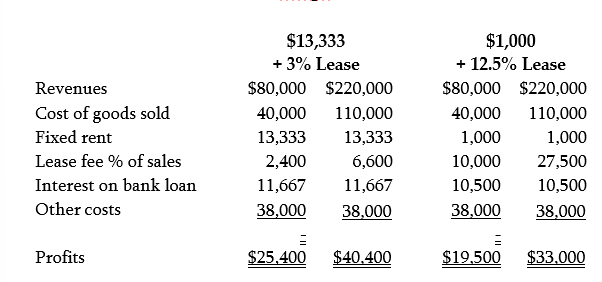
Here we see that if sales are only $80,000, the revised lease results in a smaller loss (-$19,500) than under the original lease (-$25,400). If sales are $220,000, the store generates $7,400 more under the original lease than the revised lease. But given Dr. Zang’s limited working capital, the roughly $5,000 smaller loss when sales are low could be important, especially if there are a number of months of low sales until the store becomes established. Moreover, if the sales are substantially above Dr. Zang’s estimates, the lease can be renegotiated in three years.
49) Duff’s Baking Company (DBC) produces Monster cookies. DBC’s beginning inventory has 22,000 Monster cookies that are 100% complete as to materials and 30% complete as to conversion costs. During the month, 380,000 Monster cookies were started into production. Ending inventory is 35,000 cookies which are 100% complete as to materials and 40% complete as to conversion costs. Beginning work in process inventory consisted of $78,450 of which $31,600 was materials and $46,850 was conversion costs. Materials added during the month were $290,000 while conversion costs during the month totaled $353,200. Which is not true for DBC for the month?
Answer: The unit cost for conversion costs is $.995
Explain:
Total units to account for 22,000 (beginning WIP) + 3080,000 (started) = 402,000 units
Units completed and transferred out = 402,000 – 35,000 = 367,000 units
Materials= 367,000 completed + 35,000 ending x 100% = 381,000 EUP (True)
Materials cost per unit = (31,600 + 290000) / 402000 = 0.80/ unit
Conversion cost per unit = (46850 + 353200) / 381000 = 1.05/ unit
(Since the true cost is $1.05, the option stating $.995 is incorrect/not true)
50) During its first month of operations, a manufacturer incurs the following costs in dollars related to activities within its factory:
Direct materials costs $5,000
Indirect materials $2,000
Direct labor $15,000
Indirect labor $3,000
Factory rent $10,000
Depreciation on factory equipment $8,000
What are the manufacturer’s total product costs for the month?
Answer:
Total MOH = 3000 + 10000 + 8000 = 23,000
Total Product cost = 5000 + 15000 + 23000 = 43,000
51) During its first month of operations, a manufacturer incurs the following costs (in dollars) related to activities within its factory:
Direct materials $15,000
Direct labor $30,000
Manufacturing overhead $40,000
What amount should be reported as cost of goods sold on the income statement if 5,000 units are produced and 4,000 are sold?
Answer:
Total product cost = 15,000 + 30,000 + 40,000 = 85,000
Cost per unit = 85,000 / 5,000 units produced = $17/ unit
COGS = 4,000 x $17 = $68,000
52) Each week Walters Company produces 15,000 pounds of Product A and 30,000 pounds of Product B by incurring a joint cost of $400,000. These two products can be sold as is or processed further. Further processing of either product does not delay the production of subsequent batches of the joint product.
Data regarding these two products are as follows:
| Product A | Product B | |
| Selling price per pound without further processing | $12.00 | $9.00 |
| Selling price per pound with further processing | $15.00 | $11.00 |
| Total separate weekly variable costs of further processing | $50,000 | $45,000 |
Required:
To maximize Walters Company’s manufacturing contribution margin, how much total separate variable costs of further processing should be incurred each week?
Answer:
| Product A | Product B | |
| Selling price per pound with further processing | $15.00 | $11.00 |
| Selling price per pound without further processing | (12.00) | (9.00) |
| Incremental revenue per pound | $3.00 | $2.00 |
| Number of pounds | × 15,000 | × 30,000 |
| Total incremental revenue | $45,000 | $60,000 |
| Incremental cost of processing further | $50,000 | $45,000 |
The incremental cost of processing further is greater than the incremental revenue for product A, so product A should not be processed further. Product B, however, should be processed further at a cost of $45,000.
Notice the joint cost of $400,000 being sunk does not enter the analysis
53) Eaststar manufactures and distributes a complete line of home appliances worldwide. Lynn Tweedie is the U.S. Space Saver Dishwasher product manager for Eaststar Appliances. Her responsibilities include pricing, planning, and sales of Eaststar’s Space Saver dishwasher in the United States. It is the end of the third quarter and Tweedie is deciding how many Space Saver washers to produce in the fourth quarter. Given sales from the first three quarters and orders for the last quarter, she expects total sales for the year to be 73,000 washers at $200 per unit. There are 12,000 washers in inventory at a (LIFO) cost of $90 per washer. The factory produced 58,000 washers in the first three quarters of this year and Tweedie is considering ordering an additional 10,000, 15,000, or 20,000 washers in the fourth quarter. The plant’s capacity can easily accommodate any of these volume levels without affecting fixed costs or variable cost per unit. The variable manufacturing cost of the washer is $75 and the plant has fixed annual costs of $1.3 million. Manufacturing overhead is allocated to dishwashers based on units.
Tweedie’s selling and administrative expenses consist of $15 of variable cost per washer and fixed cost of $2.92 million. The dishwasher division has a 17 percent weighted-average cost of capital and invested capital (not including inventories) of $18 million. Eaststar uses full absorption costing.
Required:
a) Prepare a table showing annual accounting earnings prepared under absorption costing for the Space Saver dishwasher for annual production levels of 68,000, 73,000, and 78,000 washers.
Answer:
Annual earnings for various production levels is given in the following table:
| 4th quarter production | 10,000 | 15,000 | 20,000 |
| 1st 3 quarters production | 58,000 | 58,000 | 58,000 |
| Annual production | 68,000 | 73,000 | 78,000 |
| Expected sales (units) | 73,000 | 73,000 | 73,000 |
| Revenues | $14,600,000 | $14,600,000 | $14,600,000 |
| Cost of sales from beg inventory1 | (450,000) | 0 | 0 |
| Variable manufacturing costs | (5,100,000) | (5,475,000) | (5,475,000) |
| Fixed manufacturing cost | (1,300,000) | (1,300,000) | (1,216,667) |
| Variable selling cost3 | (1,095,000) | (1,095,000) | (1,095,000) |
| Net income | $3,735,000 | $3,810,000 | $3,893,333 |
5,000 units x $90/ unit = 450,000
$1,300,000 x (73,000 / 78,000) = 1,216,667
73,000 x $15 = 1,095,000
b) If Lynn Tweedie’s bonus depends on reported accounting earnings from Space Saver dishwashers, what production quantity is she likely to select for the fourth quarter?
Answer:
Tweedie is likely to produce 20,000 washers in the fourth quarter or 78,000 for the year as this level maximizes reported profit.
c) Prepare a table computing the valuation of the ending inventory (under LIFO) for annual production levels of 68,000, 73,000, and 78,000 washers.
Answer:
The ending inventory values for various production levels are:
| Annual production | 68,000 | 73,000 | 78,000 |
| Beginning inventory | 12,000 | 12,000 | 12,000 |
| Production | 68,000 | 73,000 | 78,000 |
| Less: Sales | (73,000) | (73,000) | (73,000) |
| Ending inventory | 7,000 | 12,000 | 17,000 |
| Ending Inventory @ LIFO cost: | |||
| Units from the beginning inventory | 7,000 | 12,000 | 12,000 |
| Valued at $90/washer | $630,000 | $1,080,000 | $1,080,000 |
| Units from current year production | 0 | 0 | 5,000 |
| Valued at current year cost: | |||
| ($75 +$1,300,000/78,000= $91.6666) | $458,333 | ||
| Total inventory value at cost (LIFO) | $630,000 | $1,080,000 | $1,538,333 |
d) If Lynn Tweedie’s bonus depends on residual income from Space Saver dishwashers, what production quantity is she likely to select for the fourth quarter?
Answer:
Residual income for various production levels:
| Annual production | 68,000 | 73,000 | 78,000 |
| Total inventory value at cost (LIFO) | $630,000 | $1,080,000 | $1,538,333 |
| Invested capital excluding inventories | 18,000,000 | 18,000,000 | 18,000,000 |
| Total invested capital | $18,630,000 | $19,080,000 | $19,538,333 |
| Times weighted average cost of capital | 0.17 | 0.17 | 0.17 |
| Residual income1 | $567,900 | $566,400 | $571,817 |
Residual income = Net income – 15% x total invested capital
Based on the above data, Tweedie is likely to produce 78,000 washers, since this level maximizes her residual income.
e) How would your answer change in part (d) if Tweedie’s bonus was based on return on assets?
Answer:
ROA for various production levels:
| Annual production | 68,000 | 73,000 | 78,000 |
| Net income | $3,735,000 | $3,810,000 | $3,893,333 |
| Divided by Total invested capital | $18,630,000 | $19,080,000 | $19,538,333 |
| ROA | 20.05% | 19.97% | 19.93% |
If Tweedie is rewarded based on ROA she is likely to produce 69,000 washers for the year.
54) Easton Diagnostics is a large medical testing laboratory that services a four-county region. Easton runs a van that picks up specimens from clinics and hospitals and takes them to the Easton laboratory where various tests are conducted. Easton currently has a large chemical blood analysis system. This system runs a battery of standard tests for which Easton is reimbursed $750 per blood sample. The cost structure of the current blood analysis system consists of annual fixed costs (lease payment or $1.6 million, supervisor costs of $400,000, and occupancy costs of $100,000) and variable costs per blood sample (direct labor, including transporting the blood samples, technicians, and so forth of $175, direct materials of $125, and a royalty fee of $150). [Note: THe current equipment is leased for $1.6 million per year plus $150 (royalty) for every blood sample analyzed.]
A competing vendor has approached Easton Diagnostics with a comparable system that performs the same set of tests. The reliability and quality of both the proposed and the existing systems are the same. The competing vendor is willing to lower the annual lease payment to $1.2 million but raise the royalty fee by $30 per blood sample to $180. Both the existing and proposed leases have the same contractual terms in all other respects. If Easton adopts the competing vendor’s proposal, the current fee it chagres ($750) and the direct labor costs per blood sample ($175) are unaffected. However, the proposed equipment adds $10 per blood sample analyzed to direct materials.
Required:
a) How does Easton Diagnostic’s break even point for standard blood tests change if the competing vendor’s proposal is accepted?
Answer:
As computed in the following table, if the proposal is accepted, the break-even point falls from 7,000 blood samples to 6,538 samples as computed in the following table:
| Current Equipment | Proposed Equipment | |
| Price | 750 | 750 |
| Variable Costs | ||
| Direct labor | 175 | 175 |
| Direct material | 125 | 135 |
| Royalty fee | 150 | 180 |
| Total VC | 450 | 490 |
| Fixed costs | ||
| Lease | 1,600,000 | 1,200,000 |
| Supervision | 400,000 | 400,000 |
| Occupancy costs | 100,000 | 100,000 |
| Fixed costs | 2,100,000 | 1,700,000 |
| Contribution margin | 300 = 750 – 450 | 260 = 750 – 490 |
| Break even | 7000 = 2.1M / 300 | 6538 = 1.7M / 260 |
b) Easton Diagnostic currently analyzes 10,300 blood samples per year, and this number has remained constant over the past few years. Moreover, Easton management does not foresee any growth in the number of standard blood tests it performs. Make a recommendation to management as to whether Easton should stay with its existing blood analysis equipment t=or accept the competing vendor’s proposal. Justify your recommendation. (Assume that there are no cancellation payments on the existing equipment and there are no costs of converting from the existing equipment to the new equipment other than to costs described in the problem).
Answer:
The table below shows that at an annual volume of 10,300 blood samples, Easton makes $12,000 more by staying with its existing equipment than by accepting the competing vendor’s proposal. However, such a recommendation ignores the fact that staying with the existing lease adds $400,000 of operating leverage to Easton compared to the vendor’s proposal, thereby increasing the chance of financial distress. If Easton has sufficient net cash flow that the chance of financial distress is very remote, then there is no reason to worry about the higher operating leverage of the existing lease and management should reject the proposal. However, if Easton’s net cash flow has significant variation such that financial distress is a concern, then the proposed equipment lease that lowers operating leverage by $400,000 should be accepted if the expected costs of financial distress fall by more than $12,000 per year.
| Current Equipment | Proposal Equipment | |
| Price | 750 | 750 |
| Total variable costs | 450 | 490 |
| Contribution margin (1) | 300 | 260 |
| FC (2) | 2,100,000 | 1,700,000 |
| Annual volume (3) | 10,300 | 10,300 |
| X (3) = (4) | 3,090,000 | 2,678,000 |
| Total Profit (4) – (2) | 990,000 | 978,000 |
55) Easy Go Company manufactures a line of electric garden tools that are sold in general hardware stores. The company’s controller, Amy Tait, has just received the sales forecast for the coming year for Easy Go’s three products: weeders, hedge clippers, and leaf blowers. Easy Go has experienced considerable variations in sales volumes and variable costs over the past two years, and Harlow believes the forecast should be carefully evaluated from a cost-volume-profit viewpoint. The preliminary budget information for the next year is presented below.
| Weeders | Hedge Clippers | Leaf Blowers | |
| Unit sales | 50,000 | 50,000 | 100,000 |
| Unit selling price | $28.00 | $36.00 | $48.00 |
| Variable manufacturing cost per unit | 13.00 | 12.00 | 25.00 |
| Variable selling cost per unit | 5.00 | 4.00 | 6.00 |
For the next year, Easy Go’s fixed factory overhead is budgeted at $2 million, and the company’s fixed selling and administrative expenses are forecast to be $600,000. Easy Go has a tax rate of 40 percent.
Required:
a) Determine Easy Go Co.’s budgeted net income for next year.
Answer:
Easy Go Co.’s budgeted net income for next year.
| Easy Go Company Budgeted Net Income for Next Year | ||||
| Weeders | Hedge Clippers | Leaf Blowers | Total | |
| Unit selling price | $28.00 | $36.00 | $48.00 | |
| Variable manufacturing cost | $13.00 | $12.00 | $25.00 | |
| Variable selling cost | 5.00 | 4.00 | 6.00 | |
| Total variable costs | $18.00 | $16.00 | $31.00 | |
| Contribution margin | $10.00 | $20.00 | $17.00 | |
| Unit sales | 50,000 | 50,000 | 100,000 | |
| Total Contribution | $500,000 | $1,000,000 | $1,700,000 | $3,200,000 |
| Fixed factory overhead | 2,000,000 |
| Fixed selling and administrative expense | 600,000 |
| Total fixed costs | 2,600,000 |
| Income before taxes | 600,000 |
| Income taxes @ 40% | 240,000 |
| Budgeted net income | $360,000 |
b) Assuming that the sales mix remains as budgeted, determine how many units of each product Easy Go must sell in order to break even next year.
Answer: The number units of each product Easy Go must sell in order to break even next year
| Unit Contribution | Sales Proportion | Proportional Contribution | |
| Weeders | $10 | 0.25 | $2.50 |
| Hedge Clippers | 20 | 0.25 | $5 |
| Leaf Blowers | 17 | 0.50 | 8.50 |
| Proportional contribution margin/bundle | $16.00 | ||
| Total unit sales to break-even | = | Total fixed costs Proportional contribution |
| = | $2,600,000$16 | |
| = | 162,500 units |
| Sales Proportion | Total UnitSales | Product Line Sales | |
| Weeders | .25 | 162,500 | 40,625 |
| Hedge Clippers | .25 | 162,500 | 40,625 |
| Leaf Blowers | .50 | 162,500 | 81,250 |
c) Determine the total dollar sales Easy Go must sell next year in order to earn an after-tax net income of $450,000.
Answer:
Total dollar Easy Go must sell next year in order to earn an after-tax net income of $450,000
| Selling Price | Sales Proportion | Proportional Selling Price | |
| Weeders | $28.00 | .25 | $ 7.00 |
| Hedge Clippers | 36.00 | .25 | 9.00 |
| Leaf Blowers | 48.00 | .50 | 24.00 |
| Proportional selling price | $40.00 | ||
| Contribution margin rate | = | Proportional contribution Proportional selling price |
| = | $16 $40 | |
| = | 40 percent |
Total dollar sales | = | Fixed costs + After-tax income ÷ (1 – tax rate) Contribution margin rate |
= | $2,600,000 +$450,000 .6.4 | |
| = | $3,350,000.4 | |
| = | $8,375,000 |
d) After preparing the original estimates, Easy Go determines that its variable manufacturing cost of leaf blowers will increase 20 percent and the variable selling cost of hedge clippers can be expected to increase $1 per unit. However, Easy Go has decided not to change the selling price of either product. In addition, Easy Go learns that its leaf blower is perceived as the best value on the market, and it can expect to sell three times as many leaf blowers as any other product. Under these circumstances, determine how many units of each product Easy Go will have to sell to break even in next year.
Answer:
The number of units of each product Easy Go will have to sell to break even in next year:
| Unit Contribution | Sales Proportion | Proportional Contribution | |
| Weeders | $10.00 | .20 | $2.00 |
| Hedge Clippers1 | 19.00 | .20 | 3.80 |
| Leaf Blowers2 | 12.00 | .60 | 7.20 |
| Total proportional contribution margin | $13.00 | ||
Total unit sales to break-even | = | Total fixed costs Proportional contribution |
= | $2,600,000$13 | |
| = | 200,000 units |
| Sales Proportion | Total UnitSales | Product Line Sales | |
| Weeders | .20 | 200,000 | 40,000 |
| Hedge Clippers | .20 | 200,000 | 40,000 |
| Leaf Blowers | .60 | 200,000 | 120,000 |
i) Variable selling costs increase; thus the unit contribution decreases to $19 [#6 – ($12 + 4 + 1)]
ii) The variable manufacturing cost increase 20 percent; thus, the unit contribution decrease to $12 [$48 – (1.2 x 25) – 6
e) Explain the limitations of cost-volume-profit analysis that Amy Tait should consider when evaluating Easy Go’s next year’s budget.
Answer:
Amy Tait should consider the following limitations when using cost-volume-profit analysis to evaluate Easy Go Company’s budget. This type of analysis assumes that:
+ All costs are either fixed or variable or can be broken down into fixed and variable components.
+ All costs are linear in the relevant range, i.e., variable costs change in total with a change in activity and fixed costs remain the same at all levels of output and sales in the relevant range.
+ Sales price will not change and sales demand is unlimited at the unit selling prices
56) The Eastern University Business School teaches some undergraduate business courses for students in the Eastern University College of Arts and Science (CAS). The 6,000 undergraduates generate 2,000 undergraduate student course enrollments in business courses per year. The B-school and CAS are treated as profit centers in that their budgets contain student tuition revenues as well as costs. The deans have discretion to set tuition and salaries and determine hiring as long as they operate with no deficit (revenues = expenses). Undergraduate tuition is $12,000 per year and each student takes eight courses per year. Average undergraduate financial aid amounts to 20% of gross tuition. The current transfer price rule is gross tuition per course less average financial aid.
This transfer price rule gives net tuition to the B-school as a revenue and deducts an equal amount from the CAS budget. The CAS dean argues that the current system is grossly unfair. CAS must provide costly services for undergraduates to maintain a top-rated undergraduate program. For example, career counseling, academic advising, sports programs, and the admissions office are costs that must be incurred if undergraduates are to enroll at Eastern. Therefore, the CAS dean argues, the average cost of these services per undergraduate student course enrollment should be deducted from the tuition transfer price. These undergraduate student services total $9.6 million per year.
Required:
a) Calculate the current revenue the B-school is receiving from undergraduate business courses. What will it be if the CAS dean’s proposal is adopted?
Answer:
| Transfer price [$12,000/8 × (1 – .20)] | $1,200 |
| Number of undergraduate enrollments | 2,000 |
| Current tuition transfer to Business School | $2,400,000 |
| Total undergraduate course enrollments/ year (6,000 x 8) | 48,000 |
| Undergraduate student services | 9,600,000 |
| Student Services per course enrollment | $200 |
| Student Services charged to Business School ($200 x 2,000) | $400,000 |
| Revised tuition transfer to Business School | 2,000,000 |
b) Discuss the pros and cons of the CAS dean’s proposal.
Answer:
The CAS proposal will increase the CAS budget by $400,000 and will reduce the number of courses the business school offers. By how many courses, we don’t know.
Ultimately the question comes down to what is the opportunity cost of providing the business course? Presumably, the business school does not have excess capacity among its teaching staff. The undergraduate courses will have to be staffed at some incremental cost to the business school. These staff require additional office space and support (e.g., secretarial, photocopying, computers, etc.). Therefore, the opportunity cost to the business school is these incremental costs to them. Unless they hire faculty of comparable quality to their existing faculty, there will be a brand-name loss of business school reputation.
undergraduate business courses, which presumably increases the demand for the undergraduate degree. One advantage of the current system is it is fairly simple to administer. One problem with the CAS dean’s proposal is how does one determine the “etc.” For example, what prevents the CAS dean from classifying a math professor as spending 30 percent of her time advising students and thereby allocating 30 percent of her salary to “undergraduate student services” charged to the business school? How does one prevent the allocated costs from creeping up as the CAS dean reclassifies more and more expenses as “student services”?
c) As special assistant to the B-school dean, prepare a response to the proposed tuition transfer pricing scheme.
Answer:
i) Business school courses have a higher opportunity cost than undergraduate courses in the sense that B-School faculty have high salaries and hence a higher opportunity cost of time; the opportunity cost of B-School faculty teaching undergraduate courses is similarly higher. If Ph.D. students teach the undergraduate courses, they too have an opportunity cost of their time because teaching lengthens the time until they graduate and begin earning higher salaries.
ii) Undergraduates taking a B-School course may use B-School services such as the computing center, placement services, business library, and executive seminars. This use reduces the amount of such services available to the MBA population and imposes an opportunity cost on the B-school.
iii) Tuition at Eastern University can only be sustained at the higher level of $12,000 per year because undergraduates know that the undergraduate program is a back door way into “cheap” (to them) B-School courses.
iv) Take the $9.6 million student services and split it into fixed and variable cost components. Allocate to the business school only its share of the variable cost component. But again, how will these “variable” costs be monitored to avoid their increasing in future years?
57) Eastern University prides itself on providing faculty and staff a competitive compensation package. One aspect of this package is a faculty and staff child tuition benefit of $4,000 per child per year for up to four years to offset the cost of a college education. The faculty or staff member’s child can attend any college or university, including Eastern University, and receive the tuition benefit. If a staff member has three children in college one year, the staff member receives a $12,000 tuition benefit. This money is not taxed to the individual staff or faculty member.
Eastern University pays the benefit directly to the university where the staff/faculty member’s child is enrolled or if the student is attending Eastern, it reduces the amount of tuition owed by the faculty/staff member. The university then charges this payment to a benefits account. This benefits account is then allocated back to the various colleges and departments based on total salaries in the college or department.
Required:
Evaluate the pros and cons of the present university accounting for tuition benefits. What changes would you recommend making?
Answer:
Pros: The major advantage of the tuition benefit is that it provides tax-free income to faculty and staff. This can reduce the total compensation cost to the University by the amount of the tax savings, or else the staff receives a windfall gain if their base pay is not adjusted to reflect this additional income.
The current accounting treatment via the benefits account is simple. College tuition benefits are not completely “free” to each college. When making hiring decisions, deans of the colleges will take into consideration the average cost of the tuition benefit. If a large number of faculty/staff in one college are drawing the benefit, their budget is not unduly burdened in this year.
Cons: The problem with the present scheme is that the individual colleges are not charged with the actual cost of the tuition benefits they generate. Deans have incentive to hire staff with college-bound children since they do not bear 100% of the cost. Salary administration is made more difficult. Since a particular dean does not pay the full cost of the tuition benefit of each individual faculty/staff in his or her college, the dean is not aware of the benefit the faculty/staff is drawing, and thus is less likely to adjust the base pay, making it more likely that the faculty/staff receives a windfall gain from the tuition benefit. The deans of each college do not take into account the full cost of hiring/retaining a staff/faculty member with several college-bound children.
Proposal: Each college should be charged for the actual tuition benefits paid for children of faculty/staff in its college
58) Economic Darwinism:
Answer: Explains why some inefficient accounting practices persist
59) Economic precepts fundamental to agency theory include all of the following, except
Answer:
People strive to maximize benefits to their community
60) Economic value added (EVA):
Answer:
Is a variant of residual income
Is a registered trademark owned by Stern Steward & CO.
61) Economic value added (EVA).
Answer: Measures the total return after deducting the cost of all capital employed by the firm
62) The Elements of Cost Volume Profit
The M Company’s variable costs are 75% of the sales price per unit and their fixed costs are $240,000. If the company earned $60,000 before taxes in selling 150,000 units, what was the sales price per unit?
Answer
Variable cost per unit = 75% price
per unit Or, V= 0.75 P
Before tax profit = Total contribution margin less Fixed costs
$60,000 = 150,000 x (P-V) – FC
60,000 = 150,000 x (P-0.75P) – $240,000
300,000 = 150,000 x 0.25P
300,000 = 37,500 P
P= $8.
63) Eldorado Emerald (EE) mines and processes emeralds in its mines throughout the world. Large rocks are mined, these large rocks are gently crushed and any emeralds are sifted out. The emeralds are then sorted, graded, cut, and polished. The joint cost per ton of rock is $18,000. The following table summarizes the number of emeralds per ton of mined rock, the additional costs to package and sell each emerald after it’s polished and graded, and the selling price for each grade of emerald.
| AAA | AA | A | |
| Number of stones per ton | 35 | 50 | 90 |
| Sales price/ emerald | 400 | 150 | 60 |
| Additional costs to package and sell each emerald | 125 | 60 | 10 |
Answer: The manager responsible for Grade A emeralds will select the allocation by relative sales value method
64) Eli Goldratt advocates that all manufacturing costs other than materials be treated as operating expenses for the period. Periodic profits would be calculated as:
| Sales | xxx |
| Less cost of material | xxx |
| Less all nonmaterial operating expense | xxx |
| Net income | xxx |
Operating data for last year are:
| Units produced | 12,000 |
| Unit sales | 10,000 |
| Material cost/unit produced | $0.45 per unit |
| Labor cost/unit produced | 0.35 |
| Overhead/unit produced | 0.38 |
There is no beginning inventory.
Required:
a) Compare profits under absorption costing and Goldratt’s method.
Answer:
The following table shows that profits are lower by $1,460 if computed using Goldratt’s suggestion:
| AbsorptionCosting | Goldratt’s Proposal | ||
| Materials | ($.45 × 10,000) | $4,500 | $4,500 |
| Labor | ($.35 × 10,000) | 3,500 | |
| ($.35 × 12,000) | 4,200 | ||
| Overhead | ($.38 × 10,000) | 3,800 | |
| ($.38 × 12,000) | 4,560 | ||
| Total expenses | $11,800 | $13,260 |
b) Evaluate Goldratt’s proposal.
Answer:
Goldratt’s proposal extends variable costing to the writing off of direct labor and variable overhead cost when incurred. The proposal creates strong incentives against building inventories. Labor and overhead costs in inventories are written off against earnings instead of being capitalized into inventory. Thus, profits and assets are lower when inventories are added compared to full absorption costing. Since product costs contain labor and overhead, calculating product costs using only materials understates true product costs
65) Encryption, Inc. (EI), sells and maintains fax encryption hardware and software. EI hardware and software are attached to both sending and receiving fax machines that encode/decode data, preventing anyone from wiretapping the phone line to receive a copy of the fax.
Two EI product groups (Federal Systems and International) manufacture and sell the hardware and software in different markets. Both are profit centers.
Federal Systems contracts with federal government agencies to manufacture, install, and service EI products. Existing contracts call for revenues of $1 million per quarter for the next eight quarters.
International is currently seeking foreign buyers. Expected quarterly revenues will be $1 million, but with equal likelihood revenues can be $1.5 or $0.5 million in any given quarter.
Federal Systems and International each have their own products that differ in some ways but share a common underlying technology. Fax encryption is a new technology and offers new markets. Transferring manufacturing and marketing ideas across products and customers provides important synergies.
The variable cost of Federal Systems and International is 50 percent of revenues. The only fixed cost in EI is its Engineering Design group.
Engineering Design is EI’s R…D group. It designs new hardware and software that Federal Systems and International sell. Quarterly expenses for Engineering Design will be $0.60 million for the next two years. These expenses do not vary with revenues or production costs.
Engineering Design costs are to be included in calculating profits for the Federal Systems and International groups. Two ways of assigning the Engineering Design costs to Federal Systems and International are (1) group revenues, and (2) an even 50-50 split.
Required:
a) Prepare financial statements for Federal Systems and International illustrating the effects of the alternative ways of handling Engineering Design costs.
Answer:
The following financial statement calculates the profits of the two divisions using the two alternative cost allocations schemes.
| Engineering Design Allocated on Sales (Panel A) and 50-50 Split (Panel B) | ||||
| Panel A: Engineering Design Allocated on Sales | ||||
| International Sales =$1,500 | International Sales =$500 | |||
| Federal Systems | International | Federal Systems | International | |
| Sales | $1,000 | $1,500 | $1,000 | $500 |
| Variable Cost | 500 | 750 | 500 | 250 |
| Engineering Design | 240 | 360 | 400 | 200 |
| Net Income | $260 | $390 | $100 | $50 |
| Panel B: 50-50 Split | ||||
| International Sales =$1,500 | International Sales =$500 | |||
| Federal Systems | International | Federal Systems | International | |
| Sales | $1,000 | $1,500 | $1,000 | $500 |
| Variable Cost | 500 | 750 | 500 | 250 |
| Engineering Design | 300 | 300 | 300 | 300 |
| Net Income (loss) | $200 | $450 | $200 | ($50) |
b) Which method of assigning Engineering Design costs do you favor? Why?
Answer:
I prefer to allocate Engineer Design costs based on sales (Panel A). First, it is a non-insulating allocation scheme, meaning that each divisions’ profits vary inversely with the other’s profits. For example, Federal System’s profits will either be $260 or $100, even though their sales and costs remain constant over time. With an even split (Panel B), Federal System’s profits do not vary, they remain at $200. Non-insulating schemes encourage cooperation among divisions by giving each division an incentive to improve other divisions’ sales and thereby their own profits. Second, the non-insulating scheme reduces the risk International bears and is likely to result in more efficient risk sharing. For example, consider the range of profits each division faces under the two schemes:
| Federal | Intl | Total | |
| Panel A (non-insulating): Range | $160 | $340 | $500 |
| Panel B (insulating): Range | 0 | $500 | $500 |
In panel A, Federal System’s net income is either $260 or $100, a range of $160. Whereas in Panel B, Federal System’s net income is always $200, a range of zero. The insulating method (panel B) imposes all the risk on International. The non-insulating method spreads some of the risk to Federal Systems. Some may argue that it is not “fair” to Federal to bear some of International’s risk. Certainly, Federal will have to be paid to bear this risk via a risk premium.
However, by imposing this risk on Federal it creates incentives for Federal to cooperate with International by sharing production, marketing, and selling ideas
66) Equity Corp. paid a consultant to study the desirability of installing some new equipment. The consultant recently submitted the following analysis:
| Cost of new machine | 100,000 |
| Present value of after-tax revenues from operation | 90,000 |
| Present value of after tax operating expenses | 20000 |
| Present value of depreciation expenses | 87500 |
| Consulting fees and expenses | 750 |
The corporate tax rate is 40 percent. Should Equity Corp. accept the project?
Answer:
The consulting fees are a sunk cost and are not used in this decision.
| PV operating revenues (after tax) | 90000 |
| PV operating expenses (after tax) | (20000) |
| PV tax savings from depreciation 0.40 x 87500 | 35000 |
| Cost of machine | (100000) |
| Net present value | 5000 |
Equity Corp should install the equipment
67) ETB plans to manufacture a slim bamboo hard case for the Apple iPad, which will be sold for $65. ETB estimates that it can produce and sell between 3,000 and 5,000 bamboo cases a month. The following data summarize ETB’s cost structure at various output (sales) levels:
| Production (units) | 3,000 | 3,500 | 4,500 | 5,000 |
| Variable manufacturing cost | $36,000 | $35,000 | $36,000 | $60,000 |
| FIxed manufacturing cost | 60,000 | 60,000 | 60,000 | 60,000 |
| Variable selling and admin cost | 26,100 | 28,000 | 31,500 | 35,000 |
| Fixed selling and admin cost | 40,000 | 40,000 | 40,000 | 40,000 |
| Total | 162,100, | 163,000 | 167,500 | 195,000 |
Required:
a) What monthly production (sales) level minimizes the average cost of the bamboo iPad case?
Answer:
The following table calculates that average cost of the iPad bamboo case is minimized by producing 4,500 cases per month.
| Monthly Production and Sales | ||||
| Production (units) A | 3,000 | 3,500 | 4,500 | 5,000 |
| Total cost B | 162,100 | 163,000 | 167,500 | 195,000 |
| Average cost =B/ A | 54.03 | 46.57 | 37.22 | 39 |
b) How many bamboo iPad cases should ETB produce monthly?
Answer:
The following table calculates net income of the four production (sales) levels.
| Monthly Production and Sales | ||||
| Production (units) (A) | 3,000 | 3,500 | 4,500 | 5,000 |
| Revenue = (A) x$ 65 | 195,000 | 227,500 | 292,500 | 325,000 |
| Total cost | 162,100 | 163,000 | 167,500 | 195,000 |
| Net income | 32,900 | 64,500 | 125,000 | 130,000 |
Based on the above analysis, the profit maximizing production (sales) level is to manufacture and sell 5,000 iPad cases a month. Selecting the output level that minimizes average cost (4,500 cases) does not maximize profits
67) Evergreen Nursery and Landscape has two profit centers: Nursery and Landscape. Nursery buys young evergreen trees, grows them for a year, and then sells them to Landscape. Landscape then sells and plants them for residential customers. Nursery only sells its trees to Landscape, and Landscape only buys trees from Nursery. Landscape faces the following demand curve per month for planted trees by residential customers.
| Trees Sold | Price per tree |
| 2 | $260 |
| 3 | 240 |
| 4 | 220 |
| 5 | 200 |
| 6 | 180 |
| 7 | 160 |
| 8 | 140 |
| 9 | 120 |
The demand curve in the table can be represented as P = 300 – 20!
Nursery has variable costs of $10 per tree and fixed costs of $210 per month. Landscape has variable costs of $50 per tree (before paying Nursery a transfer price for the tree) and fixed costs of $290 per month.
Required:
a) Assume the owner of Evergreen Nursery and Landscape knows all the costs of both divisions and the demand curve. If the owner sets the price for trees planted by Landscape, what final price for a planted tree would the owner set to maximize her profits and how many trees per month get planted?
Answer:
The following table shows that the owner maximizes her profits by setting the price at $180 per tree and planting six trees per month
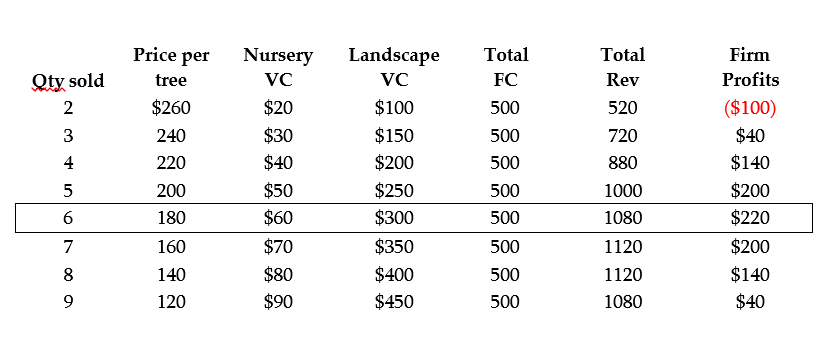
b) Suppose the owner does not know the demand curve faced by Landscape, but she does know each division’s fixed and variable costs. What transfer price would the owner set to maximize her profits?
Answer:
Setting the transfer price at Nursery’s variable cost of $10 per tree will cause Landscape to buy six trees from Nursery and plant them for $180 per tree, the same solution obtained in part (a) where the owner selects the price. The table below illustrates that this maximizes Landscapes’ profits
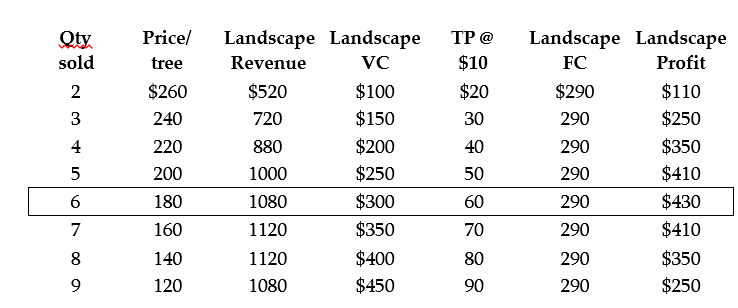
However, since Nursery only receives its variable cost of $10 per tree, Nursery reports a loss of its fixed costs of $210. The sum of the two divisions’ profits ($430 and $210) is the firm’stotal profit of $220 as in part (a)
c) Suppose that Nursery sets the transfer price at $75 per tree. How many trees will Landscape purchase from Nursery and plant per month in order to maximize Landscape’s profits (including the transfer price of $75 per tree?
Answer:
At a transfer price of $75 per tree, Landscape will charge $220 per planted tree and will plant four trees per month to maximize its profits. The table below illustrates that Landscape maximizes its profit at this price-quantity relation when confronted with a $75 transfer price
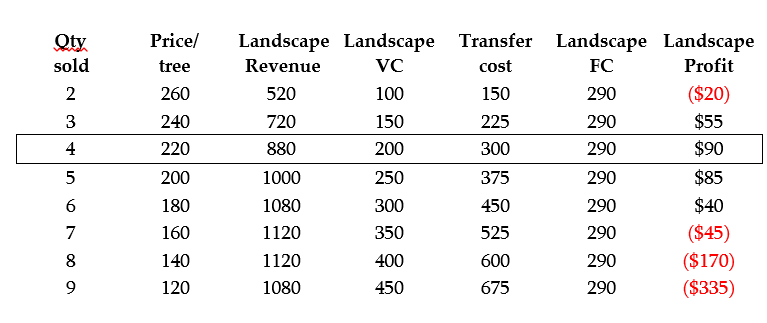
d) What is Nursery;s profit from setting a transfer price of $75, assuming Landscape maximizes its profits as in part (c )?
Answer:
From part (c ), Landscape buys 4 trees from Nursery at $75 per tree. Accordingly, Nursery’s profits are:
| Revenue (4 @ $75) | 300 |
| Variable cost (4 @ $10) | (40) |
| Fixed cost | (210) |
| Net Income | $50 |
e) Compare the firm-wide profits that result from the transfer price chosen in part(b), and the firmwide profits that result from a $75 transfer price chosen in part (c ), and explain why they are either the same or different.
Answer:
Using variable cost as the transfer price results in the same firm-wide profits of $220 as if the owner made the pricing decision in Lanscaping. In part (b), with a transfer price of $10, Landscape reports a profit $430 and Nursery reports a loss of $210, so total profits are again $220. If Nursery sets the transfer price at $75, Landscape buys and plants fewer trees and even though Nursery is now making a profit of $50, Landscape’s profits fall to $90. The combined profit of the entire firm is now $140.
68) Exotic Roses, owned by Margarita Rameriz, provides a variety of rare rose bushes to local nurseries that sell Rameriz’s roses to the end consumer (landscapers and retail customers). Rameriz grows the roses from cuttings that she has specifically cultivated for their unusual characteristics (color, size, heartiness, and resistance to disease). Margarita’s roses are in great demand as evidenced by the wholesale price she charges nurseries, $15 per potted plant. Exotic Roses has the following cost structure (variable costs are per potted plant):
| Fixed Costs per Year | Variable Costs | |
| Plant materials | $0.50 | |
| Pot | 0.30 | |
| Labor | $8,000 | 0.70 |
| Utilities | 9,000 | |
| Rent | 7,500 | |
| Other costs | 2,500 |
Required:
a) How many potted rose plants must Exotic Roses sell each year to break even?
Answer:
Fixed costs total $27,000 per year and variable costs are $1.50 per plant. The break-even number of potted roses is found by solving the following equation for Q:
Profits = $15Q – 1.50Q – 27,000 = 0
Q = 27,000/ (15 – 1.50) = 27,000/ 13.50 = 2,000 plants
b) If Rameriz wants to make profits of $10,000 before taxes per year, how many potted rose plants must be sold?
Answer:
To make $10,000 of profits before taxes per year, solve the following equation for Q:
Profits = $15Q – 1.50 Q – 27,000 = 10,000
Q= 37,000/ (15 – 1.50) = 37,000/ 13.50 = 2,740.74 plants
c) If Rameriz wants to make profits of $10,000 after taxes per year, how many potted rose plants must be sold assuming a 35 percent income tax rate?
Answer:
To make $10,000 of profits AFTER taxes per year, solve the following equation for Q:
Profits = [$15Q- $1.50Q – $27,000] x (1-0.35) = $10,000
= [$15Q – 1.50Q-27,000] = $10,000/0.65 = $15,384
Q = $42,384.62/ $13.50 = 3,139.60 plant
69) The Fancy Umbrella Company makes beach umbrellas. The production process requires 3 square meters of plastic sheeting and a metal pole. The plastic sheeting costs $0.50 per square meter and each metal pole costs $1.00. At the beginning of the month, the company has 5,000 square feet of plastic and 1,000 poles in raw materials inventory. The preferred raw material amount at the end of the month is 3,000 square feet of plastic sheeting and 600 poles. The company has 300 finished umbrellas in inventory at the beginning of the month and plans to have 200 finished umbrellas at the end of the month. Sales in the coming month are expected to be 5,000 umbrellas.
Required:
a) How many umbrellas must the company produce to meet demand and have sufficient ending inventory?
Answer:
Number of umbrellas that must be produced:
| Sales + Ending Inventory – Beginning Inventory |
| 5,000 + 200 – 300 |
| 4,900 umbrellas |
b) What is the cost of materials that must be purchased?
Answer:
Materials needed to produce 4,900 umbrellas:
| Poles | 4,900 | poles |
| Plastic sheeting (3 sq. meters/pole) (4,900 poles) | 14,700 | square meters |
Materials that must be purchased = usage + ending inventory – beginning inventory = Poles 4,900 + 600 – 1000 = 4,500 poles
Plastic sheeting 14,700 + 3,000 – 5,000 = 12,700
Square Meters Cost of material that must be purchased:
| Poles (4,500 poles) ($1/pole) | $4,500 |
| Plastic sheeting (12,700 sq. meters) ($0.50/sq. meter) | $6,350 |
| Total cost of materials purchased | $10,850 |
70) Fantastic Diapers made 3,000 batches this month. According to the plan, each batch needs 45 minutes of direct labor, which is paid $12.50 per hour, including benefits. Payroll records showed that 2,100 labor hours were worked and that 50 cents more per hour was paid. Which is true?
a) The direct labor rate variance is $1,050 fav
b) The direct labor rate variance is $1,125 unfav
c) The direct labor efficiency variance is $1,875 fav
d) The direct labor efficiency variance is $1,875 unfav
Answer: None of the above
DL labor rate variance = (#12.50 – $13) x 2100 hours = $1,050 Unfavorable.
DL efficiency variance = (2100 hours – 2,250 hours) x $12.00 = $1,950 Favorable.
71) Fegox Firinghi (FF) produces flip flops. Each flip-flop requires 2 lbs of Flub and 1 lb of Fleeb, which are planned to cost $8 and $3 per lb. respectively. During the month of May, FF purchased 22,000 lbs of Flub for $194,000 and 13,000 lbs of Fleeb for $42,000. All materials were consumed in producing 10,500 good flip flops.
a) Which is true?
Answer: Direct material price variances total $6,950 unfav.
| Actual price for Flub | = $194,000/ 22,000 lbs | = | $8.18 | |
| Actual price for Fleeb | = $42,000/ 13,000 | = | $3.23 | |
| Price variance for Flub | = ($8.18 – $8.00) × 22,000 lbs | = | $3,960 | unfav |
| Price variance for Fleeb | = ($3.23 – $3) × 13,000 lbs | = | $2,990 | unfav |
| Total price variance | $6,950 | unfav |
b)
Which is true?
Answer:
Direct materials quantity variances total $15,500 unfav.
| Standard quantity for actual output for Flub | = 10,500 × 2 = 21,000 lbs | ||
| Standard quantity for actual output for Fleeb | = 10,500 lbs | ||
| Quantity variance for Flub | = (22,000 – 21,000) × 8 = | $8,000 | unfav |
| Quantity variance for Fleeb | = (13,000 – 10,500) × 3 = | $7,500 | unfav |
| Total direct materials quantity variance | $15,500 | unfav | |
PART F
71) The firm’s information system:
Answer: May include other information such as customer satisfaction surveys, in addition to financial information.
Electric Generator
72) A firm that purchases electric power from the local utility is considering the alternative of generating its own electricity. The current cost of obtaining the firm’s electricity from its local utility is $42,000 per year. The cost of a steam generator (installed) is $140,000 and annual maintenance and fuel expenses are estimated at $22,000. The generator is expected to last for 10 years, at which time it will be worthless. The cost of capital is 10 percent and the firm pays no taxes.
Required
a) Should the firm install the electric generator? Why or why not?
Answer:
Investment = $140,000
Annual savings = (42,000 – 22000) =20,000
NPV = -140,000 + (6.145) (20,000)
= – 17,100
The generator should ne be purchased because it has a negative net present value.
b) The engineers have calculated that with an additional investment fo $40,000, the excess steam from the generator can be used to hear the firm’s buildings. The current cost of heating the buildings with purchased steam is $21,000 per year. If the generator is to be used for heat as well as electricity, additional fuel and maintenance costs of $10,000 per year will be incurred. Should the firm invest in the generator and the heating system? SHow all calculation.
Answer:
The NPV of using the generator for both electric power and heating evaluated:
Total investment = 140,000 + 40,000 = 180,000
Total Annual Savings = (42,000 + 21,000) – (22,000 + 10,000) = 31,000
NPV = -180,000 + (6.145) (31,000)
= 10,495
The generator should be purchased and used for both electrical generations and heating.
73) Cost Behavior Patterns
For each of the following questions draw a graph that depicts how costs vary with volume. Completely label each graph and axis.
Plant XXX works a 40-hour week. Management can vary the number of employees. Currently, 200 employees are being paid $10 per hour. The plant is near capacity. To increase output, a second 40-hour shift is being considered. To attract employees to the second shift, a 20 percent wage premium will be offered. Plot total labor costs as a function of labor hours per week.
Answer
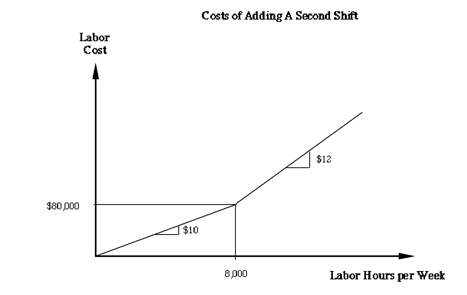
b) Plant YYY has a contract with the Texas Gas COmpany to purchase up to 150 million cubic feet of natural has per month for a flat fee os $1.5 million. Additional gas can be purchased for $0.0175 per cubic foot. Plant YYY manufactures aluminum cans. One thousand ans require 10 cubic feet of gas. Plot total gas costs as a function of can production.
Answer:
1000 cans = 10 cubic feet of gas
100 cans = 1 cubic foot of gas
1 can = 0.01 cubic foot.
Marginal cost/ can = 0.01 cubic ft/ can x 0.175/ cu. Ft = 0.00175
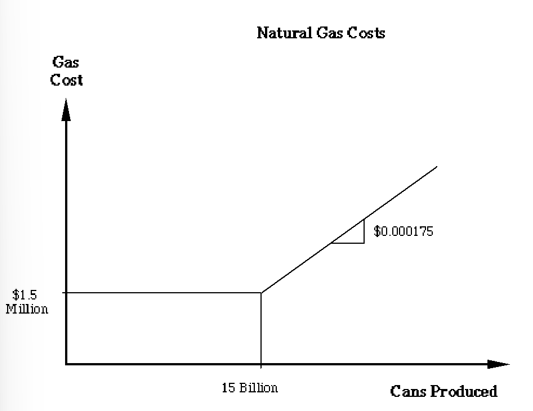
c) Use the same facts as in part (b), but plot the gas cost per can as a function of can production.
Answer:
The question does not specify whether to plot marginal gas cost per can or average gas cost per can. Therefore, there are two possible answers
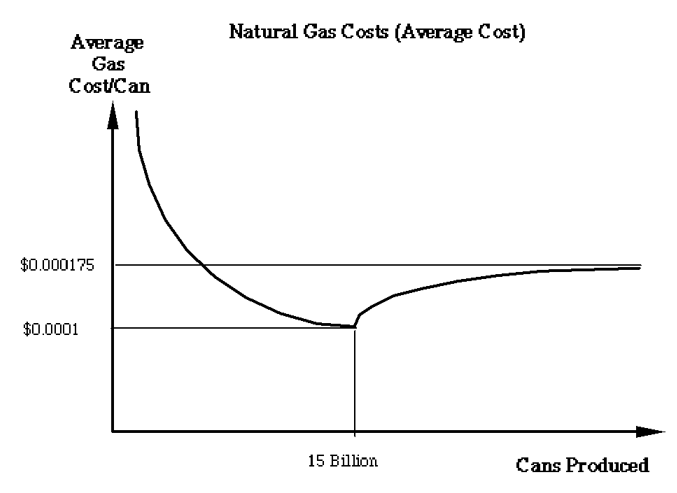
The question does not specify whether to plot marginal gas cost per can or average gas cost per can. Therefore, there are two possible answers.
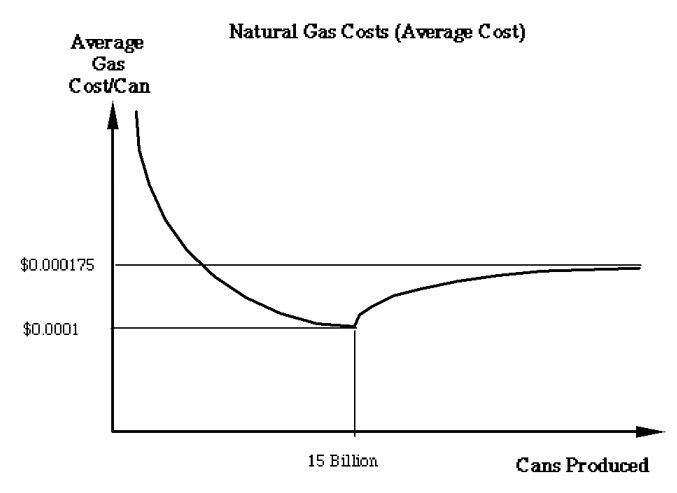
Marginal gas cost per an is
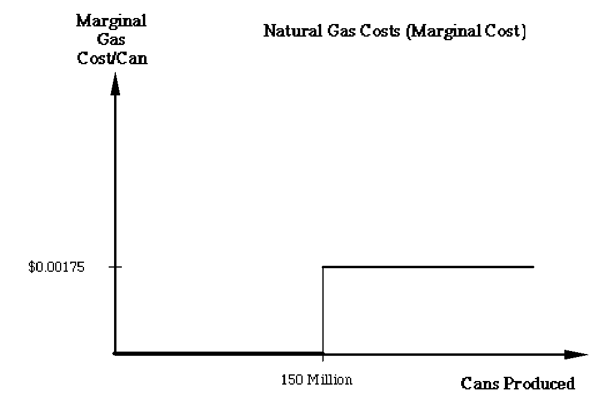
73) The First Church has been asked to operate a homeless shelter in part of the church. To operate a homeless shelter the church must hire a full time employee for $1,200/month to manage the shelter. In addition, the church would have to purchase $400 of supplies/month for the people using the shelter. The space that would be used by the shelter is rented for wedding parties. The church averages about 5 wedding parties a month that pay rent of $200 per party. Utilities are normally $1,000 per month. With the homeless shelter, the utilities will increase to $1,300 per month.
What is the opportunity cost to the church of operating a homeless shelter in the church?
a) The monthly opportunity cost of operating a homeless shelter is:
| Full-time employee | $1,200 |
| Supplies | 400 |
| Use of space (forgone revenue: 5 parties ×$200/party) | 1,000 |
| Increase in utilities $1,300 – $1,000 | 300 |
| Total | $2,900 |
74) Five departments of National Training Institute, a nonprofit organization, share a rented building. Four of the departments provide services to educational agencies and have little or no competition for their services. The fifth department, Technical Training, provides educational services to the business community in a competitive market with other nonprofit and private organizations. Each department is a cost center. Revenues received by Technical Training are based on a fee for services, identified as tuition.
All five departments have dedicated space as listed in the accompanying table. Common shared space, including hallways, restrooms, meeting rooms, and dining areas, is not included in these allocations. National Training Institute rents space at $10 per square foot.
| Allocation Table | |||
| Department | Square Footage | Percentage of Space | Revenue |
| Administration | 13,500 | 9.0% | $3,600,000 |
| Support services | 46,500 | 31.0 | 11,000,000 |
| Computer services | 12,000 | 8.0 | 8,800,000 |
| Technical training | 6,000 | 4.0 | 1,900,000 |
| Transportation | 72,000 | 48.0 | 4,700,000 |
| Total allocated | 150,000 | 100.0% | $30,000,000 |
| Common space | 50,000 | ||
In addition to its assigned space, the technical training department offers training during off-hours using many of the areas allocated to other departments. Technical Training also uses off-site facilities for the same purpose. About 50 percent of its training activities are in off-site facilities, which have excess capacity, charge no rent, and are available only during off-hours.
John Daniels, the administration department’s business manager, proposed a rental allocation plan based on each department’s percentage of dedicated square footage plus the same percentage of the common space. The technical training department would be charged an additional amount for the space it uses during off-hours that is dedicated to other departments. This additional amount would be based on planned usage per year.
Jane Richards, director of technical training, claims this allocation method will cause her to increase the price of services. As a result, she will lose business to competition. She would rather see the allocation method use the percentage of department revenue in relation to total revenue.
Required:
Comment on Daniels’s and Richards’s proposed rent allocation plans. Make appropriate recommendations.
| Allocations: | ||||
| Rent Costs | ||||
| Department | Revenue | %Revenue | % of Space | % of Revenue |
| Administration | $3,600,000 | 12% | $180,000 | $240,000 |
| Support services | 11,000,000 | 37% | 620,000 | 740,000 |
| Computer services | 8,800,000 | 29% | 160,000 | 580,000 |
| Technical training | 1,900,000 | 6% | 80,000 | 120,000 |
| Transportation | 4,700,000 | 16% | 960,000 | 320,000 |
| Total allocated | $30,000,000 | 100.0% | $2,000,000 | $2,000,000 |
The square footage allocation plan places a cost burden on Technical Training that it can avoid paying. Since Technical Training has the ability to move off-time training to other sites at no additional cost, rent should not be charged to them for off-time space usage. The opportunity costs of the off-time use of the facility are currently zero. Unless other uses are developed, these opportunity costs would remain at zero.
Rent Allocation
Mr. Daniels’ plan distributes rent based on space allocated. His plan provides incentive for departments to use and request space efficiently. Departments would know rent costs during budget preparation time (assuming space allocations do not change). Since allocated space is the cost driver here, this plan distributes rental costs appropriately.
Ms. Richards’ allocation plan places more of the burden of rent on those departments that generate the most revenue. Since these same departments have little or no competition, and are cost centers, the costs would be passed along as part of their service fee. The Transportation department would be the only department that would not have an increase under Mrs. Richards’ plan.
From the information provided, it is unknown whether or not the customers of the other departments would tolerate the service fee changes necessary to make up for such increases. This rent allocation plan penalizes the departments that generate greater revenue and yet may not require additional space.
Under this plan departments can request and use space inefficiently. Departments can hold onto space they are not using yet not pay the costs. This agency problem does not exist under the space allocation plan.
Recommendation:
i) Rent allocation should be based on space expected to be used during the coming year. Do not charge Technical Training additional costs for off-time use
75) The Flower City Grocery is faced with the following capital budgeting decision. Its display freezer system must be repaired. The cost of this repair will be $1000, and the system will be usable for another five years. Alternatively, the firm could purchase a new freezer system for $5,000 ad sell the old one for $500. The new freezer system has more display space and will increase the profits attributable to frozen by 30 percent. Profits for that department were $5,000 in the last fiscal year. The company’s csot of capital is 9 percent. Ignoring taxes, what should the firm do?
Answer:
| Old Machine | |
| Outflow | |
| Repair | (1000) |
| Inflow | |
| PV of Profits @ 5000/ yr for 5 yrs, r = 0.09 (3.890) | 19450 |
| Net present value of keeping old machine | 18450 |
| New Machine | |
| Outflow | |
| Purchase | (5000) |
| Inflow | |
| Sale of old machine | 25285 |
| $500 Why or why not? R for 5 years, r= 0.09 (3.890) | |
| Net Present value of purchasing new machine | 20785 |
| NPv new – NPV old | 2335 |
Purchasing the new machine is the better choice
76) The following figures were taken from the records of Welling Co. for the current year.
At the end of the year, two jobs were still in process. Details about the two jobs include:
| Job A | Job B | |
| Direct labor | $10,000 | $28,000 |
| Direct materials | $32,000 | $22,000 |
| Machine hours | 2,000 | 3,500 |
| Direct labor hours | 1,000 | 2,000 |
Welling Co. applies overhead at a budgeted rate, calculated at the beginning of the year. The budgeted rate is the ratio of budgeted overhead to budgeted direct labor costs. Budgeted figures for the current year were:
| Budgeted direct labor costs | $250,000 |
| Budgeted overhead | $187,500 |
Actual figures were:
| Direct labor | $350,000 |
| Overhead | $192,500 |
| Finished goods inventory | $75,000 |
| Cost of goods sold | $550,000 |
There were no opening inventories. It is the practice of the company to prorate any over/under-absorption of overhead to finished goods inventory, work in process, and cost of goods sold based on the total dollars in these categories.
Required:
a) Compute the cost of work in process before over/under-applied overheads are prorated.
Answer:
Overhead rate | = | Budgeted overheads Budgeted direct labor costs | = | $187,500 $250,000 | = $0.75/direct labor $ |
| Work-In-Process: | Job A | Job B | Total |
| Direct Labor | $10,000 | $28,000 | $38,000 |
| Direct Materials | $32,000 | $22,000 | $54,000 |
| Overhead ($0.75 × Labor $) | $7,500 | $21,000 | $28,500 |
| Total | $49,500 | $71,000 | $120,500 |
b) Prepare a schedule of finished goods inventory, work in process, and cost of goods sold after over/under-applied overheads are prorated.
Answer:
| Actual overhead incurred | $192,500 |
| Overhead applied ($350,000 × $0.75) | $262,500 |
| Over-applied | $70,000 |
The following proration of the over-applied overhead is based on total costs in work-in-process, finished goods, and cost of goods sold. A more technically correct method is to base the allocation on the amount of overhead in each of these accounts.
Unadjusted amt. | Over-applied overhead | Adjusted amt. | ||
| Work-In-Process | $120,500 | (16%) | ($11,200) | $109,300 |
| COGS | 550,000 | (74%) | (51,800) | $498,200 |
| Finished Goods | 75,000 | (10%) | (7,000) | $68,000 |
| $745,500 | (100%) | ($70,000) | $675,500 | |
c) What is the difference in operating income if the over/under-applied overhead is charged to cost of goods sold instead of being prorated to finished goods inventory, work in process, and cost of goods sold?
Answer:
Operating Income will increase by $11,200 + 7,000 = $18,200. This amount represents the over-applied overhead prorated to work-in-process and finished goods. If all the over-applied overhead is charged to cost of goods sold then operating income will go up by the amount prorated to work-in-process and finished goods
77) The following information is for the third quarter of this year.
| Planned | Actual | |||
| Production | 92,000 | units | 87,000 | units |
| Direct labor hours | 506,800 | DLhrs | 380,000 | DLhrs |
| Fixed manufacturing overhead | $205,000 | $182,400 | ||
| Variable manufacturing overhead | $910,000 | $841,500 | ||
| Standard direct labor hour per unit | 5.5 | |||
Required:
Calculate the following three overhead variances:
a) Overhead volume variance
b) Overhead efficiency variance
c) Overhead spending variance
| Expected overhead | $205,000 (fixed) + $910,000 (variable) | $1,150,000 |
| Expected volume | 92,000 units × 5.5 dl hrs per unit | 506,000 dl hrs |
| Overhead rate | $1,150,000 ÷ 506,000 dl hrs | $2.2727 per dl hr |
| Variable overhead rate | $910,000 ÷ 506,000 dl hrs | $1.80 per dl hr |
| Standard volume | 5.5 dl hrs × 87,000 units | 478,500 dl hrs |
Flexible budget = $205,000 + $1.80 per dl hr x direct labour hours
| Overhead spending variance | = | $1,023,900 – ($205,000 + $1.80 × 380,000 dl hrs) |
| = | $134,900 unfavorable | |
| Overhead efficiency variance | = | $1.80 per dl hr × (actual volume – standard volume) |
| = | $1.80 × (380,000 – 478,500) | |
| = | $177,300 favorable | |
| Overhead volume variance | = | flexible budget at standard volume-overhead absorbed |
| = | ($205,000 + $1.80 × 478,500) -$2.2727 × 478,500 | |
| = | $21,187 favorable |
78) The following investment opportunities are available to an investment center manager:
| Project | Initial Investment | Annual Earnings |
| A | $800,000 | $90,000 |
| B | 100,000 | 20,000 |
| C | 300,000 | 25,000 |
| D | 400,000 | 60,000 |
Required:
a) If the investment manager is currently making a return on investment of 16 percent, which project(s) would the manager want to pursue?
Answer:
The ROI of the four projects are:
| A: $90,000/$800,000 | = | 11.25% |
| B: $20,000/$100,000 | = | 20.00% |
| C: $25,000/$300,000 | = | 8.33% |
| D: $60,000/$400,000 | = | 15.00% |
The manager would only want to accept projects that would raise the existing ROI above 16 percent. Only project B would raise the existing ROI
b) If the cost of capital is 10 percent and the annual earnings approximate cash flows excluding finance charges, which project(s) should be chosen?
Answer:
All projects with an ROI greater than the cost of capital of 10 percent should be chosen. Therefore, projects A, B, and D should be chosen
c) Suppose only one project can be chosen and the annual earnings approximate cash flows excluding finance charges. Which project should be chosen?
Answer:
The project with the highest residual income should be chosen. The residual incomes of the four projects are:
| A 90,000 – (0.10) (800,000) | = | $10,000 |
| B. $20,000 – (0.10) (100,000) | = | 10,000 |
| C. 25,000 – (0.10) (300,000) | = | (5,000) |
| D. 60,000 – (0.10) (400,000) | = | 20,000 |
Project D has the highest residual income and should be chosen
79) For Dehli Inkstone, is it worth implementing a full-fledged ABC system, based upon the findings for these two products?
Answer:
No, the proportions of the different inputs consumed by each product are not sufficiently different to make ABC worthwhile
The correct calculations are shown below.
In summary, ABC overheads charged to the Masterpiece were $26.19. Using DLH, the charge was $26.70, $27.38 for DL$ and $27.69 for MH. Thus B seems plausible.
However, as the exercise demonstrated, a substantial amount of calculation (and for the firm, considerable resources expended in investigation and implementation) were incurred for little benefit in this case. The panel below shows that each product’s weighted consumption of resources was relatively stable, and thus the difference between ABC costs and the other cost bases was between 50c and $1.50.
| Standard | Masterpiece | Total | |||
| Output | 15,357 | 60% | 10,238 | 40% | 25,595 |
| Input | |||||
| Materials | 1.838 | 60% | 1.838 | 40% | 47,050 |
| Packaging | 0.375 | 60% | 0.375 | 40% | 9,598 |
| Inspections | 2 | 60% | 2 | 40% | 51,190 |
| Machine hours | 1.338 | 52% | 1.859 | 48% | 39,580 |
| Labor hours | 3.409 | 53% | 4.450 | 47% | 97,911 |
| Labor dollars | $50.75 | 52% | $69.50 | 48% | $1,490,909 |
ABC is probably not a good investment in this case. However, where utilization of resources differs dramatically (let’s say Standard used the vast majority of labor hours and Masterpiece used the vast majority of machine hours, etc.), then ABC is superior than the other costing approaches at matching costs to resources consumed
80) For Industries operates a cafeteria for its employees. The operation of the cafeteria requires fixed costs of $4,700 per month and variable costs of 40percent of sales. Cafeteria sales are currently averaging $12,000 per month.
Fox has an opportunity to replace to cafeteria with vending machines. Gross customer spending at the vending machines is estimated to be 40 percent greater than current sales because the machines are available at all hours. By replacing the cafeteria with vending machines. Fox would receive 16 percent of the gross customer spending and avoid all cafeteria costs. How much does monthly operating income change if Fox Industries replaces the cafeteria with vending machines?
Answer:
Current Cafeteria Income
| Sales | $12,000 | |
| Variable costs (40% × 12,000) | (4,800) | |
| Fixed costs | (4,700) | |
| Operating Income | 2,500 |
Vending Machine Income
| Sales (12,000 x 1.4) | $16,800 | |
| Fox’s share of sales (.16 × $16,800) | 2688 | |
| Increase in operating income = 2688 – 2500 | 188 |
81) Francois French manufactures cheese, which he normally sells at €20/kg, on which sales commission of 5% is paid. Plant capacity is 7,500 kg/month. Income tax is levied at 30%
| Fixed costs | Costs per kg. | ||
| Plant depreciation | €8,000 | Direct materials | €4 |
| Other plant costs | 15,000 | Direct labor | 2 |
| Corporate salaries | 10,000 | Var. factory O/H | 3 |
| Advertising | 3,000 | ||
a) Assuming sufficient demand, which strategy achieves this goal?
i) Sell 7,100 kgs at the present price
ii) Pay the dairy $1/ kg less and sell 7,500 kgs
iii) Sell 8,000 kgs at $20.79/ kg
iv) Sell 7,500 kgs at the present price and eliminate the sales commission
Answer: None of the above
b) The number of kilograms to sell to break-even is: 3,600
Answer:
Break-even quantity = Total FC/ Contribution margin per unit = 36,000/ 10 = 3,600 kgs.
Contribution margin per unit = Price –(Dr Mat + Dr Lab + Var OH) – Sales Commission = 20 – (4+2+3) – (5% x 20) = 10
c) If sales are 5,000 kgs, which of the following is true?
Answer:
i) Total contribution margin is 50,000
ii) Ratio of total contribution margin to net income before tax is 3.57
iii) Taxes oayave are 4,200
iv) Operating leverage is 42%
Answer: All of the above
| Total contribution margin (€10 CM × 5,000 kgs) | €50,000 |
| – Total fixed cost | -36,000 |
| Net income before tax | €14,000 |
| – Tax @ 30% | -4,200 |
| Net income after tax | €9,800 |
Ratio of total contribution margin to net income before taxes = 50,000/14,000 = 3.57
Operating leverage = Total fixed cost/ Total cost 36,000/5,000 kgs x (10 +36,000) = 42%
Explain:
Sales Commission = 5% of $20 = 1
Total VC per kg = 4 + 2 + 3 + 1 = $10/kg
Total Contribution Margin = $20 – $10 = $10
Total contribution margin for 5000 kg = 5000 * 10 = $50,000.
Fixed costs: 8000 + 15000 + 10000 + 3000 = $36,000
Net income before tax = 50,000 – 36,000 = $14,000
Ratio of total CM to net income before tax = 50000 / 14000 = 3.57
Taxes payable = 30% of 14,000 = $4,200.
Operating leverage = Contribution Margin / Net Income Before Tax = 50000 / 14000 = 3.57
d) Francois French wants to increase after-tax profits to $35,000. Assuming sufficient demand, which strategy achieves this goal?
Answer:
i) Sell 7000 kgs at the present price
ii) Pay the dairy $1/kg less and sell 7,500 kgs
iii) Sell 8,000 kgs at $20,79/kg
iv) Sell 7,500 kgs at the present price and eliminate the sales commission.
🡪 Answer: None of the above
While Choice C meets the profit target, it exceeds plant capacity. To generate an after tax profit of $35,000 require a before-tax profit of $50,000 ($35,000/ 7). So to cover the fixed costs of $36,000 and the after-tax profits of $50,000, the total contribution margin must be $86,000. If the price were set at 20.79 (and assuming you can sell 8,000 kgs at this price) then $20,79 –(4 +2+3) – 1.06 = 10.75 x 8,000 = 86,000
81) Fuller Aerosols manufactures six different aerosols can products (room deodorants, hair sprays, furniture polish, and so forth) on its fill line. The fill line mixes the ingredients, adds the propellant, fills and seals the cams, and packs the cans in cases in a continuous production process. These aerosol products are then sold to distributors. The following table summarizes the weekly operating data for each product.
| AA143 | AC747 | CD887 | FX881 | HF324 | KY662 | |
| Price/ case | 37 | 54 | 62 | 21 | 34 | 42 |
| Fill time/ case (minutes) | 3 | 4 | 5 | 2 | 3 | 4 |
| FC (per product per wk) | 900 | 240 | 560 | 600 | 1800 | 600 |
| Cases ordered/ wk | 300 | 100 | 50 | 200 | 400 | 200 |
| VC/case | 28 | 50 | 48 | 17 | 28 | 40 |
Each product has fixed costs that pertain only to that product. If the product is discontinued for the week, the product’s fixed costs are not incurred that week.
Required:
a) Calculate the break-even volume for each product
Answer:
| AA143 | AC747 | CD887 | FX881 | HF324 | KY662 | |
| FC | 900 | 240 | 560 | 600 | 1800 | 600 |
| Price | 37 | 54 | 62 | 21 | 34 | 42 |
| VC | 28 | 50 | 48 | 17 | 28 | 40 |
| CM = P- VC | 9 | 4 | 14 | 4 | 6 | 2 |
| BE volume =FC / CM | 100 | 60 | 40 | 150 | 300 | 300 |
b) Suppose the aerosol fill line can operate only 70 hours per week. Which products should be manufactured?
Answer:
With 70 hours (or 4200 minutes) of capacity per week, all the products can be manufactured. However, since only 200 cases of KY662 are ordered and KY662 has a break-even quantity of 300 cases, KY662 should not be produced even though there is excess capacity (4200 minutes)
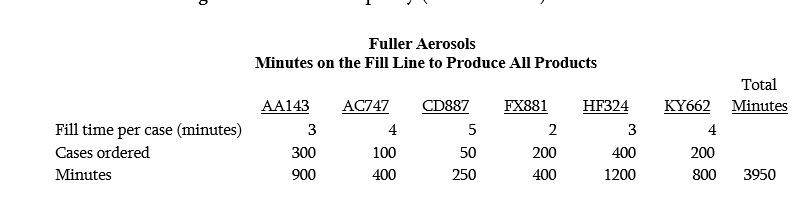
An aerosol product should only be produced if its contribution margin times the number of units sold exceeds its FC.
| AA143 | AC747 | CD887 | FX881 | HF324 | KY662 | |
| CM | 9 | 4 | 14 | 4 | 6 | 2 |
| Cases ordered | 300 | 100 | 50 | 200 | 400 | 200 |
| Contribution | 2700 | 400 | 700 | 800 | 2400 | 400 |
| FC | 900 | 240 | 560 | 600 | 1800 | 600 |
| Profit (loss) = Contribution – FC | 1800 | 160 | 140 | 200 | 600 | -200 |
c) Suppose the aerosol fill line can operate only 50 hours per week. Which products should be manufactured?
Answer:
Given a capacity constraint on the aerosol fill line, products should be produced that maximize total profits (including the fixed costs). The following table lists the order in which the products should be produced and the quantity of each produced. Products AA143, AC747, FX881, and HF324 are produced to meet demand. After producing these four products to meet demand, 100 minutes remain to produce 20 cases out of the 100 cases ordered of CD887. Making 20 cases of CD887 is below CD887’s break-even volume of 40 cases, so no CD887 should be produced. And KY662 is not produced because it does not cover its fixed costs at the number of cases demanded (200). The following table derives the solution
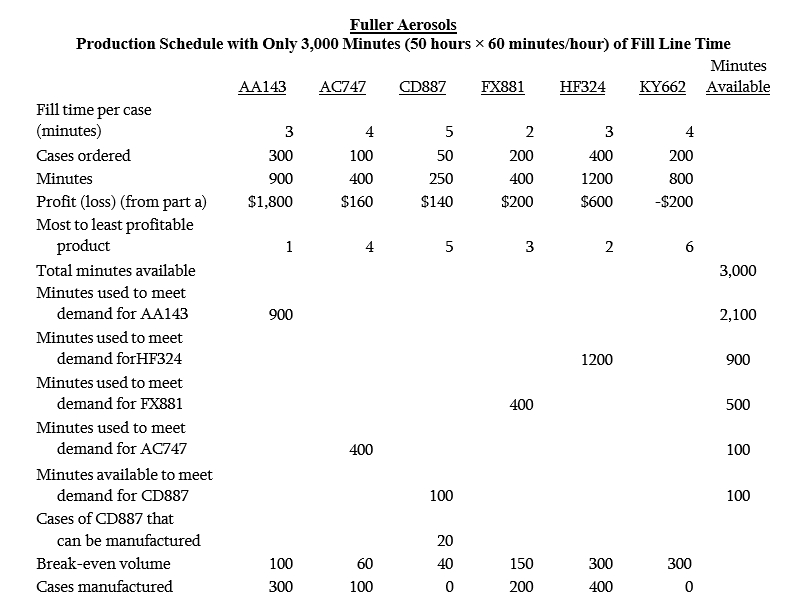
82) Fundamental tenets of economics include all of the following, except:
Answer: People strive to maximize benefits to their community.
83) Furious Fred expects cash flows from an investment as follows:
Yr 1: $3,000; Yr 2: $5,000; Yr 3: $8,000.
using an opportunity cost of capital of 5.6%, the present value is
Answer:
| PVi | = FVi × PVFi |
| $14,118 | = $3,000 × (1 + .056)-1 + $5,000 × (1.056)-2+ $8,000 × (1.056)-3 |
Explain: Calculate the PV of Each Cash Flow
Year 1 = 3,000 / ((1+0.056)^1) = 2,840.91
Year 2 = 5,000 / ((1+0.056)^2) = 4,482.41
Year 3 = 8000 / ((1+0.056)^3) = 6,794.92
Sum all present values = $14,118.24
84) A furniture company using accrual accounting purchased 20 sofas in November 2011. In December 2011, 8 of the 20 sofas were sold to customers. The customers all signed contracts agreeing to pay half the amount owed in February 2012 and the remaining half in March 2012. At the time of sale, the company was reasonably sure the customers would pay the amount owed:
The furniture company pays its salespeople a commission on each sofa sold, with commissions for December 2011 sales paid in January 2012.
The furniture company paid $3,000 for advertising that ran in the local newspaper in November 2011.
In which month should advertising costs be expensed ?
Answer: November 2011
PART G
85) Gino Potestio, owner of Napoli Pizzeria, is evaluating leasing an espresso/cappuccino machine. A number of patrons have inquired about espresso and cappuccino beverages. Napoli currently does not offer these beverages. Gino believes adding these beverages will increase the demand for his pizzas. A good espresso/ cappuccino machine can be leased for $300 month. Each espresso/ cappuccino will sell for $3 and the coffee and mill will average $1 per serving. No additional labor cost is needed because the restaurant staff has enough idle time to prepare and serve the espresso/ cappuccino. Gino estimates that the machine will add about $75 of additional pizza profits per month.
Required:
a) How many espresso/ cappuccino beverages must Napoli sell to break even?
Answer:
The break-even number of servings per month is:
(300 – 75) / (3-1) = 225 / 2 = 112.5 servings
b) Gino does not want to offer espresso/ cappuccino beverages unless he makes at least $1,000 per month after taxes including the additional sales of pizzas from adding espresso/ cappuccino beverages. Napoli’s income tax rate is 20 percent. How many servings of espresso/ cappuccino must Gino sell to meet his after-tax profit goal?
Answer:
To generate $1000 after taxes Gino needs to sell 881.73 servings of espresso/ cappuccino
Profit after tax = [Revenues – Expenses] x (1-0.20)
1000 = [3N + 75 – $1N – 300] x (1-0.20)
1000 = [2N – 225] x 0.80
1000 / 0.80 = $2N – 225
1250 = $2N – 225
$2N = 1475
N = 737.50
86) Given the following division performance indicators, which is true?
| Division | |||
| A | B | C | |
| Sales | $500 | ||
| Net profit | $10 | $20 | |
| Net assets | $80 | ||
| Return on sales | 6.0% | 4.0% | |
| Asset turnover | 10 | 5 | |
| Return on assets | 15.0% | ||
Answer:
A’s sales are 66.7% bigger than C’s
| Division | |||
| A | B | C | |
| Sales | $500.0 | $333.3 | $300.0 |
| Net profit | $10.0 | $20.0 | $12.00 |
| Net assets | $50.0 | $66.7 | $80.0 |
| Return on sales | 2.0% | 6.0% | 4.0% |
| Asset turnover | 10.0 | 5.0 | 3.8 |
| Return on assets | 20.0% | 30.0% | 15.0% |
| Return on sales = Net profit/Sales | |||
| Asset turnover = Sales/Net assets | |||
| Return on assets = Net profit/Net assets | |||
87) The Gold Bay Hotel is in the process of developing a master budget and pro-forma financial statements. The beginning balance sheet for the current fiscal year is estimated to be:
| Gold Bay Hotel Estimated Balance Sheet Current Year | |||
| Cash | $20,000 | Accounts Payable | $20,000 |
| Accounts Receivable | 30,000 | Notes Payable | 500,000 |
| Facilities | 3,010,000 | Capital Stock | 100,000 |
| Accumulated Dep. | (1,100,000) | Retained Earnings | 1,340,000 |
| Total Assets | $1,960,000 | Total Equities | $1,960,000 |
During the year the hotel expects to rent 30,000 rooms. Rooms rent for an average of $90 per night. The hotel expects to sell 40,000 meals during the year at an average price of $20 per meal. The variable cost per room rented is $30 and the variable cost per meal is $8. The fixed costs not including depreciation is expected to be $2,000,000. Depreciation is expected to be $500,000. The hotel also expects to refurbish the kitchen at a cost of $200,000, Which is capitalized (included in the facility account). Interest of the note payable is expected to be $50,000 and $100,000 of the note payable will be retired during the year. The ending accounts receivable amount is expected to be $40,000 and the ending accounts payable is expected to be $30,000.
Required:
Prepare pro-forma financial statements for the end of the current year.
| Expected sales: | |
| Room rental (30,000 rooms) ($90/room) | $2,700,000 |
| Meals (40,000 meals) ($20/meal) | 800,000 |
| Total Sales | 3,500,000 |
| Variable costs | |
| Rooms (30,000 rooms) ($30/ room) | 900,000 |
| Meals (40,000 meals) ($8/ meal) | 320,000 |
| Total Variable costs | $1,220,000 |
| Gold Bay Hotel Estimated Income StatementCurrent Year | |
| Sales | $3,500,000 |
| Variable costs | (1,220,000) |
| Fixed costs (not including depreciation) | (2,000,000) |
| Depreciation | (500,000) |
| Interest expense | (50,000) |
| Expected Loss | ($270,000) |
| Gold Bay Hotel Estimated Cash Flow StatementCurrent Year | ||
| Cash flows from operations: | ||
| Net Loss | ($270,000) | |
| Depreciation | 500,000 | |
| Increase in accounts receivable | (10,000) | |
| Increase in accounts payable | 10,000 | |
| Total | $230,000 | |
| Cash flow for investments: | ||
| Refurbish kitchen | (200,000) | |
| Cash flow from financial transactions: | ||
| Retirement of note | (100,000) | |
| Net cash outflows = 230,000 – 200,000 – 100,000 | (70,000) | |
| Beginning cash balance | -200,000 | |
| Ending cash balance | ($50,000) |
| Gold Bay Hotel Estimated Balance Sheet 12/31/Current Year | |||
| Cash | ($50,000) | Accounts Payable | $30,000 |
| Accounts Receivable | 40,000 | Notes Payable | 400,000 |
| Facilities | 3,210,000 | Capital Stock | 100,000 |
| Accumulated Dep. | (1,600,000) | Retained Earnings | 1,070,000 |
| Total Assets | $1,600,000 | Total Equities | $1,600,000 |
88) Gorgeous George is evaluating a three-year investment in an oil-change franchise, which costs $25,000 paid up front. Projected net operating cash flows are $40,000 per year. If Gorgeous George buys shares instead of the franchise, he expects an annual return of 15%. Which is true?
Answer: The net present value of the franchise is $66,329
| NPV | = Sum PV(Op Cash Flows) – Investment |
| $66,329 | = $91,329 – $25,000 |
PV = PMI [(1-(1-r))/r)]
[1-(1+ 0.15) ^-3]/ 0.15 = 2,28323
PV of cash flows:
40,000 x 2.28323 = 91,329
NPV = 91,329 – 25,000 = 66,329
89) Grammy Girl Products (GGP) has two divisions, Bones and Biscuits, both of which usually have independence in sourcing and pricing decisions. There is an unlimited supply of raw bones. Biscuits manufactures, amongst other items, a specialty product called BisBone. The BisBone formula requires 70% bone meal and 30% cereal per lbs, plus a dollop of meat flavoring.
BisBone is usually sold in 20-lbs cases and processed bones in 5-lbs packs. Cost and sales pricing data appears below.
| BisBone | Bones | |
| Sales price, per case (pack) | $100.00 | $20.00 |
| Raw bones, per lbs | $1.50 | |
| Bone meal, per lbs (external seller) | $3.00 | |
| Cereals, per lbs | $0.50 | |
| Meat flavoring, per case | $3.00 | |
| Processing, per lbs | $1.00 | $0.80 |
| Packaging, per case (pack) | $1.25 | $0.75 |
| Overheads, per case (pack), 40% fixed | $10.00 | $7.00 |
In lieu of its normal processing, Bones sometimes grinds raw bones into bone meal (grinding costs $.05 per lbs) When bone meal is sold to Biscuits, bulk packaging is used which costs $1 per 100 lbs sack; when sold to other firms, it is packed in 50lbs containers, costing $3 each.
Bones prices the container product at $180. Biscuits just received an order for 800 cases of one of its specialty products, BisBone, and is contemplating purchasing bone meal from its sister division
a) If Bones is operating below capacity, what is the minimum price that it should quote Biscuits per sack of bone meal to maximize GGP’s profits?
Answer: $240.
When below capacity, and the internal order does not lead to exceeding capacity, the minimum transfer price should recover Bones’ variable costs.
| Bone meal, 100 lbs sackInternal sale | |
| Raw bones | $1.50 |
| Grinding | $0.05 |
| Variable overheads, per lbs | $0.84 |
| Cost per lbs | $2.39 |
| Cost per 100 lbs package | $239.00 |
| Bulk package | $1.00 |
| Minimum price, below capacity | $240.00 |
b) If Bones is at capacity and has sufficient outside customers for the containers, what is the minimum price that it should quote Biscuits per sack of bone meal to maximize GGP’s profits?
Answer: $355
When Bones has other customers for bone meal, the minimum price that makes GGP no worse off (i.e., indifferent), covers the variable costs of the internal transfer and the contribution margin foregone on the external sales.
| Bone meal, 50 lbs container External sale, short run | ||
| Sales price | $180.00 | |
| Cost per package | $1.50 | |
| Grinding | $0.05 | |
| Variable overheads, per lbs | $0.84 | |
| Cost per lbs | $2.39 | |
| Cost per 50 lbs | $119.50 | |
| Bulk container | $3.00 | |
| Total variable costs | -$122.50 | |
| Contribution Margin (CM) | $57.50 | |
| Min price = Total variable costs internal sale | $240.00 | |
| + CM foregone × 2 | $115.00 | |
| $355.00 | ||
c) Should Biscuits buy bone meal from Bones at the price calculated in the above questions?
Answer:
No, because it is $0.55 per lb more costly than its external supplier’s
No. Biscuit’s transfer price is $3.55 per lb. However, Biscuits can buy from an outside supplier for $3 per lb
d) Should GGP encourage an internal transaction for this order if Bones has outside customers for the bone meal, and, if so, at what price?
Answer:
No. Because GGP will be worse off.
If Bones is operating below capacity, there is a saving of $0.60 per case on an internal purchase, which leaves room for the two divisions to negotiate a price. However, when it is at capacity and there are outside customers ready to pay Bones’ regular price, GGP is worse off by 55 cents per pound not sold to third parties.
| Cases | Lbs percase | Total lbs | ||
| Total pounds in order | 800 | 20 | 16,000 | |
| Proportion bone meal | 70% | |||
| Pounds of bone meal needed for order | 11,200 | |||
| Outside | Bones | Per lb | Total | |
| GGP cost if Biscuit buys from | $3.00 | $2.40 | ||
| Cost savings on an internal purchase | $0.60 | |||
| Bones’ foregone CM on external sale | $1.15 | |||
| Net loss | $0.55 | $6,160 |
PART H
90) Hardley sells mamburgers. He faces fixed costs of $18,000 per month and variable production and marketing costs of $2.50 per mamburger. Market research has developed the following demand schedule. Which price/volume combination should Hardley choose?
Answer: Price $12, Qty: 7000
| Price | Qty |
| 14 | 5000 |
| 12 | 7000 |
| 10 | 8000 |
| 8 | 10,000 |
Explain:
Price = $12
Qty = 7000
Rev = 7000 x 12 = 84000
VC = Qty x marketing costs = 7000 x 2.50 = 17,500
FC = $18,000
Net Profit = Rev – VC – FC = 84,000 – 17,500 – 18,000 = 48,000
91) Hardley sells mamburgers. He faces fixed costs of $18,000 per month and variable production and marketing costs of $2 per mamburger. Market research has developed the following demand schedule. Which price/volume combination should Yardley choose?
Answer:
Price $10; Quantity: 5,500
| Price | Qty | CM/unit | TCM |
| 12 | 4,000 | 10 | $40,000 |
| 10 | 5,500 | 8 | $44,000 |
| 8 | 7,000 | 6 | $42,000 |
Hardley should choose the price/volume combination that maximizes total contribution margin (TCM). Selling 5,500 mamburgers at $10, with CM of $8, yields TCM of $44,000.
92) Harriet Harvester (HH) plans to buy a haymaker. It costs $17,500 and is expected to last for five years. She presently hires 6 workers at $1,000 per month for each of the three harvesting months each year. The equipment would eliminate the need for two workers. HH uses straight-line depreciation and projects a salvage value of $2,500. Her tax rate is 25% and opportunity cost of funds is 3.3%. Which is true?
Answer:
NPV is $8,464
| Yr 0 | 1 | 2 | 3 | 4 | 5 | |
| INV | -$17,500 | |||||
| Labor savings | $6,000 | $6,000 | $6,000 | $6,000 | $6,000 | |
| Tax @ 25%= 6000 x 25% | -1,500 | -1,500 | -1,500 | -1,500 | -1,500 | |
| Tax shield of depreciation= (17,500 – 2,500)/ 5 = 3,000 x 25% = 750 | 750 | 750 | 750 | 750 | 750 | |
| Salvage value | 2,500 | |||||
| Net cash flows | -$17,500 | $5,250 | $5,250 | $5,250 | $5,250 | $7,750 |
| NPV @ 3.3% | $8,464 | PV | @3.3% | $6,589 |
*** S-L depreciation = (HC – Salvage)/Life = ($17,500 – $2,500)/5 = $3,000.
PV of annual cash flows
= (1 – (1+ 33%)^ – 5)/ 0.033 = 4.5407
PV = 5,250 x 4.5407 = $23,838.89
PV of salvage value = 2,500 x (1 + 0.033) ^ -5 = $2,125.39
NPV = – 17,500 + 23,838.89 + 2,125.39 = 8,464.28
93) Hercules Hair Restorer Inc. (HHRI) makes many varieties of hair restoration products which are sold under well-known marketing labels. A single batch contains 10,000 8-oz. bottles and takes two days to make. Typically 15 batches are completed per month, for different brands. Basic cost data for the month of January appears below:
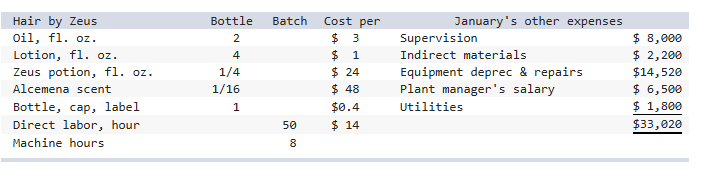
a) If overhead for January is calculated per machine hour, which is false?
Answer: The full cost of 20 bottles is $385.80 and The hourly overhead absorption rate will increase to $2,201.33
Explain
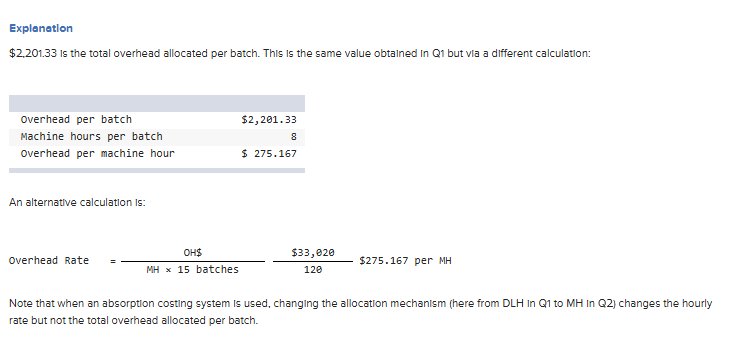
b) If HHRI uses for overhead allocation a dual rate system, whereby fixed overhead is allocated on the basis of direct labor hours and variable overhead is allocated on the basis of machine hours, which is true?
Answer: if this scheme is employed, the full cost per batch is $196,762.70
c) The new CEO has decided that 25% of the production target of 200 batches per year will be a new product, whose information appears below.
If HHRI makes 204 batches in the planned sales mix, which is true (to nearest $)?
Answer: Product Jove’s total full costs are $9,386,191
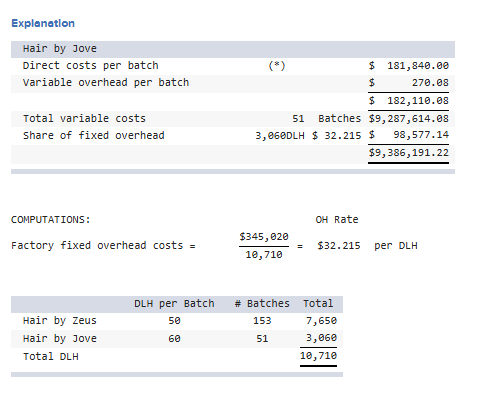
d) The new CEO has decided that 25% of the production target of 200 batches per year will be a new product, whose information appears below. If HHRI uses for overhead allocation a dual rate system, whereby fixed overhead is allocated on the basis of direct labor hours and variable overhead is allocated on the basis of machine hours, which is true?
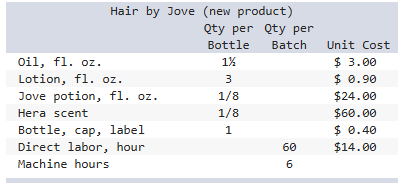
i) The introduction of the Jove product will not affect the costing of the Zeus product
ii) The introduction of the Jove product will cause the rate per labor hour to increase
iii) The introduction of the Jove product will cause the rate per machine hour to fall
iv) Full cost for the Zeus product will change by less than 2 cents per bottle
Answer: None of the choices are correct
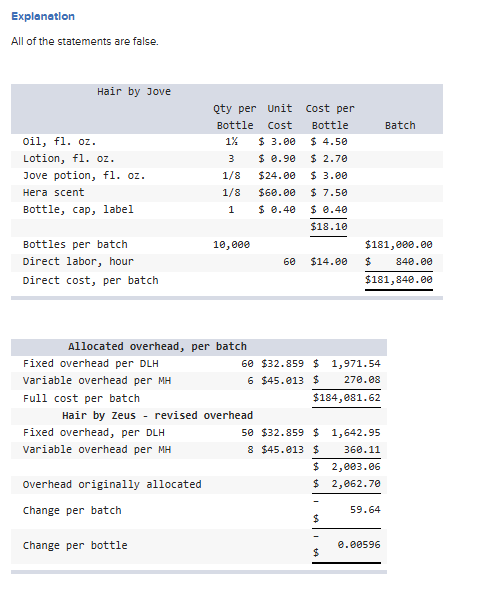
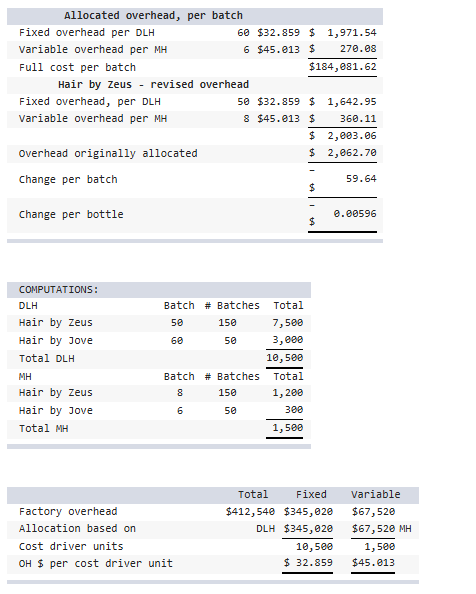
e) HHRI appoints a new CEO, who decides to increase production targets to 200 batches per year. She also hires a management accountant who decides to apply fixed overhead based on normal capacity and does some research into cost behavior. Basic product data still applies. New information appears below. If HHRI uses a plant-wide rate based on a single cost pool, which of the following statements is true?
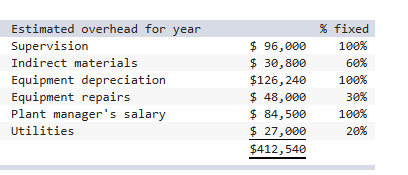
Answer: If machine hours are used as the cost driver, the full cost per bottle is $19.676
And If direct labor hours are used as the cost driver, the full cost per batch $196,762.70
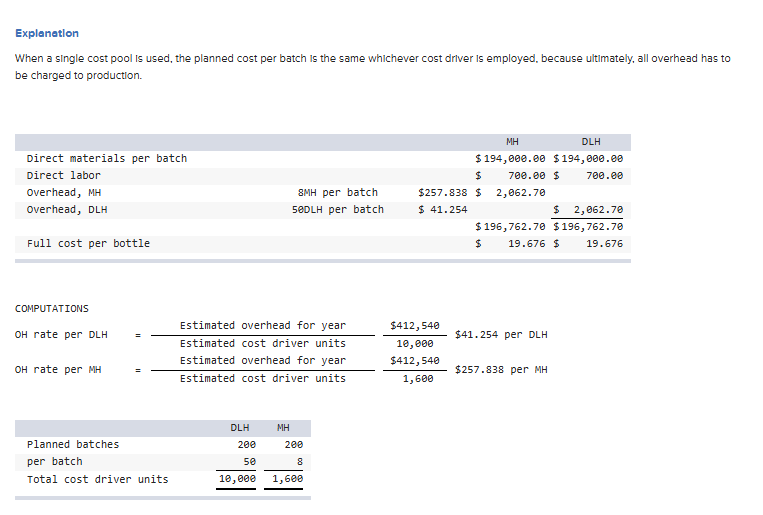
94) Hercules Hair Restorer Inc. (HHRI) makes many varieties of hair restoration products which are sold under well-known marketing labels. A single batch contains 10,000 8 oz. bottles and takes two days to make. Typically 15 batches are completed per month, for different brands. Basic cost data for the month of January appears below.
| Hair by Zeus | Bottle | Batch | Cost per | January’s other expenses | |
| Oil, fl. oz. | 2 | $3 | Supervision | $8,000 | |
| Lotion, fl. oz. | 4 | $1 | Indirect materials | $2,200 | |
| Zeus potion, fl. oz. | 1/4 | $24 | Equipment depreciation & repairs | $14,520 | |
| Alcemena scent | 1/16 | $48 | Plant manager’s salary | $6,500 | |
| Bottle, cap, label | 1 | $0.4 | Utilities | $1,800 | |
| Direct labor, hour | 50 | $14 | $33,020 | ||
| Machine hours | 8 | ||||
a) The firm uses actual absorption costing and allocates overhead on the basis of direct labor hours. For batches made in January, which is true?
Answer:
The full cost of 20 bottles is $393.80
| Hair by Zeus Job cost sheet | |||||
| Direct materials | Bottle | Cost | Cost | ||
| Oil, fl. oz. | 2 | $3 | $6.00 | ||
| Lotion, fl. oz. | 4 | $1 | $4.00 | ||
| Zeus potion, fl. oz. | 1/4 | $24 | $6.00 | ||
| Alcemena scent | 1/16 | $48 | $3.00 | ||
| Bottle, cap, label | 1 | $0.40 | $0.40 | ||
| Direct material per bottle | $19.40 | ||||
| Bottles per batch | 10,000 | $194,000.00 | |||
| Conversion costs, per batch | |||||
| Direct labor | 50 | $14 | $700.00 | ||
| Overheads, per DLH | 50 | $44.027 | $2,201.33 | ||
| Full cost per batch | $196,901.33 | ||||
| Full cost per bottle | $19.69 | $393.80 | |||
| 20bottles | |||||
| Overhead Rate: | |||||
| OH$ | $33,020 | $33,020 | = $44.027 | per DLH | |
| DLH | 50 × 15 | 750 | |||
b) If overheads for January are calculated per machine hour, which is false?
Answer: The full cost of 20 bottles is $385.80 and . The hourly overhead absorption rate will increase to $2,201.33
The hourly overhead absorption rate will increase to $2,201.33
$2,201.33 is the total overheads allocated per batch. This is the same value obtained in Q1 but via a different calculation:
| Overhead per batch | $2,201.33 |
| Machine hours per batch | 8 |
| Overhead per machine hour | $275.167 |
An alternative calculation is:
| Overhead Rate = | OH$ | $33,020 | $275.167 | per MH |
| MH | 120 |
Note that when an actual costing system is used, changing the allocation mechanism (here from DLH in Q1 to MH in Q2) changes the hourly absorption rate but not the total overheads allocated per batch
c) Why is actual costing of overheads less accepted than normal costing?
Answer:
Monthly allocation of actual overheads leads to unusually low or high product costs when monthly output differs from the annual average
d) HHRI appoints a new CEO, who decides to increase production targets to 200 batches per year. She also hires a management accountant who decides to apply normal costing and does some research into cost behavior. Basic product data still applies. New information appears below.
| Estimated overheads for year | % fixed | |
| Supervision | $96,000 | 100% |
| Indirect materials | $30,800 | 60% |
| Equipment depreciation | $126,240 | 100% |
| Equipment repairs | $48,000 | 30% |
| Plant manager’s salary | $84,500 | 100% |
| Utilities | $27,000 | 20% |
| $412,540 |
If HHRI uses a plant-wide rate based on a single cost pool, which of the following statements is true?
Answer:
iii) If machine hours are used as the cost driver, the full cost per bottle is $19.762
iv) If direct labor hours are used as the cost driver, the full cost per batch $192,762.70
When a single cost pool is used, the planned cost per batch is the same whichever cost driver is employed, because ultimately, all overheads have to be charged to production
| MH | DLH | ||||
| Direct materials per batch | $190,000.00 | $190,000.00 | |||
| Direct labor | $700.00 | $700.00 | |||
| Overheads, MH | 8 | MHper batch | $257.838 | $2,062.70 | |
| Overheads, DLH | 50 | DLHper batch | $41.254 | $2,062.70 | |
| $192,762.70 | $192,762.70 | ||||
| Full cost per bottle | $19.762 | $19.762 | |||
| COMPUTATIONS | ||||
OH rate per DLH= | Estimated overheads for year | $412,540 | $41.254 | per DLH |
Estimated cost driver units | 10000 | |||
| OH rate per MH= | Estimated overheads for year | 412540 | $257.838 | per MH |
Estimated cost driver units | 1600 |
| DLH | MH | |
| Planned batches | 200 | 200 |
| per batch | 50 | 8 |
| Total cost driver units | 10,000 | 1,600 |
Hercules Hair Restorer Inc. (HHRI) appoints a new CEO, who decides to increase production targets to 200 batches per year. She also hires a management accountant who decides to apply normal costing and does some research into cost behavior. Basic product data (from Q1) still applies. New information appears below.
| Estimated overheads for year | % fixed | |
| Supervision | $96,000 | 100% |
| Indirect materials | $30,800 | 60% |
| Equipment depreciation | $126,240 | 100% |
| Equipment repairs | $48,000 | 30% |
| Plant manager’s salary | $84,500 | 100% |
| Utilities | $27,000 | 20% |
| $412,540 |
e) If HHRI uses for overhead allocation a dual rate system, whereby fixed overheads are allocated on the basis of direct labor hours and variable overheads are allocated on the basis of machine hours, which is true?
Answer:
If this scheme is employed, the full cost per batch is $192,762.70
Even with a dual rate overhead allocation scheme, the batch cost does not change.
| Bottles per batch | 10,000 | $190,000.00 | |
| Direct labor | 50 | $14 | $700.00 |
| Prime costs per batch | $190,700.00 | ||
| Allocated overheads, per batch | |||
| Fixed overheads, per DLH | 50 | $34.502 | $1,725.10 |
| Variable overheads per MH | 8 | $42.200 | $337.60 |
| Full cost per batch | $192,762.70 |
| COMPUTATIONS: | ||||
| Estimated overheads for year | Total | Fixed | Variable | |
| Supervision | $96,000 | $96,000 | $0 | |
| Indirect materials | $30,800 | $18,480 | $12,320 | |
| Equipment depreciation | $126,240 | $126,240 | $0 | |
| Equipment repairs | $48,000 | $14,400 | $33,600 | |
| Plant manager’s salary | $84,500 | $84,500 | $0 | |
| Utilities | $27,000 | $5,400 | $21,600 | |
| $412,540 | $345,020 | $67,520 | ||
| Allocation based on | DLH | 10,000 | 1,600 | MH |
| Fixed OH $ per cost driver unit | $34.502 | $42.200 |
f) The new CEO has decided that 25% of the production target of 200 batches per year will be a new product, whose information appears below.
| Hair by Jove (new product) | |||
| Qty per Bottle | Qty per Batch | Unit Cost | |
| Oil, fl. oz. | 1½ | $3.00 | |
| Lotion, fl. oz. | 3 | $0.90 | |
| Jove potion, fl. oz. | 1/8 | $24.00 | |
| Hera scent | 1/8 | $60 | |
| Bottle, cap, label | 1 | $0.40 | |
| Direct labor, hour | 60 | $14.00 | |
| Machine hours | 6 |
the same dual rate scheme from Q5 is applied, which is true?
i) The introduction: If HHRI makes 204 batches in the planned sales mix, which is true (to nearest $)?
Answer:
Product Jove’s total full costs are $9,386,191
| Hair by Jove | ||||
| Direct costs per batch | (*) | $181,840.00 | ||
| Variable overheads per batch | $270.08 | |||
| $182,110.08 | ||||
| Total variable costs | 51 | Batches | $9,287,614.08 | |
| Share of fixed overheads | 3,060 | DLH | $32.215 | $98,577.14 |
| $9,386,191.22 |
| COMPUTATIONS: | OH Rate | ||
| Factory fixed overhead costs | $345,020 | =$32.215 | per DLH |
| 10,710 |
| DLH per Batch | # Batches | Total | |
| Hair by Zeus | 50 | 153 | 7,650 |
| Hair by Jove | 60 | 51 | 3,060 |
| Total DLH | 10,710 |
95) Home Auto Parts is a large retail auto parts store selling the full range of auto parts and supplies for do-it yourself auto repair enthusiasts. The store is arranged with three prime displays in the store: front door, checkout counters, and ends of aisles. These display areas receive the most customer traffic and contain special stands that display the merchandise with attractive eye-catching designs. Each display area is set up at the beginning of the week and runs for one week. Three items are scheduled next week for special display areas: Texcan Oil, windshield wiper blades, and floor mats. The accompanying table provides information for the three promotional areas scheduled to run next week:
| Planned Displays for Next Week | |||
| Ends of Aisles | Front DOor | Checkout Counter | |
| Item | Texcan Oil | Wiper blades | Floor mats |
| Sales price | 69¢/can | 9.99 | 22.99 |
| Projected weekly volume | 5,000 | 200 | 70 |
| Unit cost | 62¢ | 7.99 | 17.49 |
Based on past experience, management finds that virtually all display-areas sales are made by impulsive buyers. The display items are extra purchases by consumers attracted by the exhibits.
Before the store manager sets up the display areas, the distributor for Armadillo car wax visits the store. She says her firm wants its car wax in one of the three display areas and is prepared to offer the product at a unit cost of $2.50. At a retail price of $2.90, management expects to sell 800 units during the week if the wax is on special display.
Required:
a) Home Auto has not yet purchased any of the promotion items for next week. Should management substitute the Armadillo car wax for one of the three planned promotion displays? If so, which one?
Answer:
The question involves computing the opportunity cost of the special promotions being considered. If the car wax is substituted, what is the forgone profit from the dropped promotion? And which special promotion is dropped? Answering this question involves calculating the contribution of each planned promotion. The opportunity cost of dropping a planned promotion is its forgone contribution: (retail price less unit cost) × volume. The table below calculates the expected contribution of each of the three planned promotions.
| Planned Displays for Next Week | |||
| Ends of Aisles | Front DOor | Checkout Counter | |
| Item | Texcan Oil | Wiper blades | Floor mats |
| Projected volume (week) | 5,000 | 200 | 70 |
| Sales price | 69¢/can | 9.99 | 22.99 |
| Unit cost | 62¢ | 7.99 | 17.49 |
| Contribution margin | 7¢ (0.69-0.62) | $2.00 | $5.50 |
| Contribution (margin x volume) | $350 | 400 | 385 |
Texcan oil is the promotion yielding the lowest contribution and therefore is the one Armadillo must beat out. The contribution of Armadillo car wax is
| Selling price | 2.90 |
| Less; Unit cost | 2.50 |
| Contribution margin | 0.40 |
| X expected volume | 800 |
| Contribution | 320 |
Clearly, since the Armadillo car wax yields a lower contribution margin than all three of the existing planned promotions, management should not change their planned promotions and should reject the Armadillo offer.
b) A common practice in retailing is for the manufacturer to give free units to a retail store to secure desirable promotion space or shelf space. The Armadillo distributor decides to sweeten the offer by giving Home Auto 50 free units of car wax if it places the Armadillo wax on display. Does this change your answer to part (a)?
Answer:
With 50 free units of car wax, Armadillo’s contribution is:
| Contribution from 50 free units (50 x $2.90) | $145 | ||
| Contribution from remaining 7750 units: | |||
| Selling price | 2.90 | ||
| Less: Unit cost | 2.50 | ||
| Contribution margin | 0.40 | ||
| X expected volume | 750 | 300 | |
| Contribution | 445 | ||
With 50 free units of car wax, it is now profitable to replace the oil display area with the car wax. The opportunity cost of replacing the oil display is its forgone contribution ($350), whereas the benefits provided by the car wax are $445.
96) Honey Lake Summer Camp
For many years the Honey Lake Summer Camp had used the number of campers per week to estimate weekly costs. The summer camp is open for ten weeks during the summer with a different number of campers each week. July is busiest with June and the end of August least busy. Costs from the last week of summer camp in Year 1 are used to estimate costs for Year 2 for pricing purposes. The following costs occurred during the last week of Year 1 and the costs of each cost category are expected to be the same for Year 2:
| WeeklyCost | |
| Supervisor’s salary | $400 |
| Cook’s salary | 300 |
| Camp counselor salaries (1 for each occupied cabin, each ofwhich hold 10 campers) (5 counselors × $200/counselor) | 1,000 |
| Food (50 campers × $100/camper) | 5,000 |
| Supplies (50 campers × $20/camper) | 1,000 |
| Utilities (50 campers × $10/camper) | 500 |
| Insurance (50 campers × $20/camper) | 1,000 |
| Property tax ($10,000/10 weeks) | 1,000 |
| Weekly total | $12,200 |
Cost per camper: $12,200/50 campers = $244/camper
The Honey Lake Summer Camp expects 75 campers during the second week of July.
Required:
a) What is the expected cost of that week using the average cost?
Answer:
The average cost per camper using last year’s last week of camp is $244/camper. The total expected cost using that average cost is:
(75 campers) ($244/camper) = $18,300
b) What is the expected cost of that week using ABC?
Answer:
ABC recognizes how the costs would change with different uses of activities and changing numbers of campers. In particular.
| Weekly Cost | |
| Supervisor’s salary | $400 |
| Cook’s salary | 300 |
| Camp counselor salaries (1 for each occupied cabin, each ofwhich hold 10 campers) (8 counselors × $200/counselor) | 1,600 |
| Food (75 campers × $100/camper) | 7,500 |
| Supplies (75 campers × $20/camper) | 1,500 |
| Utilities (75 campers × $10/camper) | 750 |
| Insurance (75 campers × $20/camper) | 1,500 |
| Property tax ($10,000/10 weeks) | 1,000 |
| Weekly total | $14,550 |
97) Honolulu Enterprises has two decentralized divisions (Coconut and Guava) that have decision making responsibility over the amount of resources invested in their divisions. Recent financial extracts for both divisions are presented below.
| Coconut | Guava | |
| Fixed Assets, gross | 4500 | 7200 |
| Accumulated depreciation | 2700 | 2160 |
| Other Assets | 900 | 1350 |
| Liabilities | 900 | 1800 |
| Sales | 12150 | 12960 |
| Net Income after tax | 1330 | 1810 |
| Average age of fixed assets (years) | 15 | 5 |
*Net income is after tax but before interest
Honolulu’s weighted average cost of capital (WACC) is 15% and the company uses residual income as a method to evaluate performance. Which of the following statements is correct?
Answer: Coconut’s ROI will be raised by divesting of a project with a 20% ROI but its RI will be lower.
Explain:
Net Invested Capital (Coconut) = 4500 -2700 + 900 = 2700
Current ROI (Coconut) = NI / Net Invested Capital = 1330 / 2700 = 49.26%
Current RI (Coconut) = Net Income – (WACC x Net Invested Capital)
Current RI (Coconuit) = 1330 – (0.15 x 2700) = 1330 – 405 = 925
98) How does management accounting differ from financial accounting?
Answer:
Management accounting is used primarily for internal planning, control, and evaluation.
PART I
99) Identify all the correct statements:
Answer To align the interests of managers and owners, owners must design systems to monitor and reward management behavior that increases the firm’s profits
100) In the 1800s, Australia, was a colony of England and most of its trade was with England. Australia primarily exported agricultural products such as wheat and imported manufactured goods scuh as steel, machinery, and textiles. The volume of trade measured in British pounds (£ ) was roughly equal in the senses that exports equaled imports.
….
Consider the following facts for a particular ship in ENgland with a shipment of Australian cargo for England.
The ship has contracted to sail to Australia and return with a cargo of Australian wheat. The ship has no cargo scheduled for London to Sydney.
The wheat shipping contract calls for paying the captain and crew £ 4,900 for the round trip. The wheat seller will arrange for and pay Australian dock hands £ 250 to load the wheat in Sydney, and the wheat purchaser will arrange for and pay English dock hands to unload the wheat in London. The ship’s crew does not load or unload the cargo.
To sail to Australia, the ship requires 10 tons of ballast (1 ton = 2,000 pounds)
Stone can be quarried in England, transported to the docks, and loaded as ballast for £ 40 per ton. In Sydney, the stone can be unloaded and hauled away for £ 15 per ton.
Wrought iron bars of 10 foot lengths can also be used as ship ballast. Wrought iron bars can be purchased i England at £ 1.20 per bar. Each bar weighs 20 pounds. Wrought iron bars sell for £ 0.90 per bar in Sydney. The csot of loading the wrought iron in London is £ 15 per ton, and the cost of unloading it and transporting it to the Sydney market is £ 10 per ton.
Required:
i) Wrote a memo to the ship’s captain describing what actions he should take with respect to using stone or wrought iron as ballast. Assume that interest rates are zero and all prices and quantities are known with certainty. Support your recommendation with a clearly labeled financial analysis.
Answer:
Recommendation: The ship captain should be indifferent (at least financially) between using stone or wrought iron as ballast. The total cost (£550) is the same.
| Stone as ballast | |
| Cost of purchasing and loading stone | $40 |
| Cost of unloading and disposing of stone | 15 |
| 55 | |
| Ton required | X 10 |
| Total cost | 550 |
| Wrought iron as ballast | |
| Number of bars required | |
| 10 tons of ballast x 2,000 pounds/ ton | 20,000 pounds |
| Weight of bar | / 20 pounds/ bar |
| = | 1000 bars |
| Loss per bar (1.20 – 0.90) | 0.30 |
| X number of bars | 1000 |
| =300 | |
| Cost of loading bars (15 x 10) | 150 |
| Cost of unloading bars (10 x 10) | 100 |
| Total cost | 550 |
ii) Why do you think the price of wrought iron is lower in Sydney than in London?
Answer:
The price is lower in Sydney because the supply of wrought iron relative to demand is greater in Sydney because of wrought iron’s use as ballast. In fact, in equilibrium, ships will continue to import wrought iron as ballast as long as the relative price of wrought iron in London and Sydney make it cheaper (net of loading and unloading costs) than stone
101) In January of year 1, a company began doing business as a corporation in order to sell technology-related accessories and services. During its first month of operations, the following events occurred:
January 1 – The corporation received $1,000,000 in cash in exchange for stock issued to stockholders.
January 3 – The corporation borrowed $250,000 from bank. The loan is a four-year loan with an interest rate of 12 percent, payable each year on January 1 beginning in year 2.
January 5 – The corporation purchased equipment to be used in the business for $200,000 cash.
January 8 – The corporation purchased inventory costing $200,000 by paying $120,000 in cash. The remainder was put on credit accounts with suppliers. January 15 – The corporation hired five employees. Each employee will be paid $1,000 at the end of each month.
January 30 – The corporation paid $6,000 cash for a one-year insurance policy. The policy period will begin on February 1, year 1
Required😐
a) What will be the impact of the January 5 event on the company’s balance sheet on that date?
Answer: Equipment will increase $200,000, and cash will decrease $200,000
b) What will be the impact of the January 31 event on the company’s balance sheet on that date?
Answer: Prepaid insurance will increase $6,000, and cash will decrease $6,000
102) In January of year 1, a company began doing business as a corporation in order to sell technology-related accessories and services. During its first month of operations, it focused on obtaining the financing needed to start its operations.
In February of year 1, the company sold inventory costing $25,000 for $75,000 cash.In February of year 1, the company provided technology-related services worth $10,000. Customers paid a total of $4,000 in cash for these services and promised to pay the remainder the following month.
a) What will be the total impact of these services provided on the company’s balance sheet other than an increase in cash of $4,000?
Answer:
Accounts receivable will increase $6,000
Retained earnings will increase $10,000
b) What is a common category in a statement of cash flows?Answer: Cash from investing activities
103) In which of the following circumstances is a moral hazard problem described?
Answer: Kate L. makes a claim under her homeowners insurance for damage from a hurricane and includes in her claim a pool pump that was broken prior to the hurricane
104) In which scenario would activity-based costing be more appropriate than traditional costing?
Answer:
A company produces five different products. The products are highly differentiated and have significantly different demands for their use of overhead costs
105) The Independent Underwriters Insurance Co. (IUI) established a systems department two years ago to implement and operate its information technology system. IUI believed that its own system would be more cost-effective than the service bureau it had been using.
IUI’s three departments – claims, records, and finance – have different requirements with respect to hardware and other capacity-related resources and operating resources. The system was designed to recognize these differing demands. It was also designed to meet IUI’s long-term capacity. The excess capacity designed into the system is being sold to outside users until IUI needs it. The estimated resource requirements used to design and implement the system are shown in the following schedule.
| Hardware and Other Capacity-Related Resources | Operating Resources | |
| Records | 30% | 60% |
| Claims | 50 | 20 |
| Finance | 15 | 15 |
| Expansion (outside use) | 5 | 5 |
| Total | 100% | 100% |
IUI currently sells the equivalent of its expansion capacity to a few outside clients.
When the system became operational, management decided to redistribute total expenses of the systems department to the user departments based upon actual computer time used. The actual costs for the first quarter of the current fiscal year were distributed to the user departments as follows:
| Department | Percentage Utilization | Amount |
| Records | 60% | $330,000 |
| Claims | 20 | 110,000 |
| Finance | 15 | 82,500 |
| Outside | 5 | 27,500 |
| Total | 100% | $550,000 |
The three user departments have complained about the cost distribution since the systems department was established. The records department’s monthly costs have been as much as three times the costs experienced with the service bureau. The finance department is concerned about the costs distributed to the outside user category, because these allocated costs form the basis for the fees billed to outside clients.
James Dale, IUI’s controller, decided to review the distribution method by which the systems department’s costs have been allocated for the past two years. The additional information he gathered for his review is reported in Tables 1, 2, and 3. Dale has concluded that the method of cost distribution should be changed to reflect more directly the actual benefits received by the departments. He believes that hardware and capacity-related costs should be allocated to the user departments in proportion to their planned, long-term needs. Any difference between actual and budgeted hardware costs should remain with the systems department.
The remaining costs for software development and operations would be charged to the user departments based upon actual hours used. A predetermined hourly rate based upon the annual budget data would be used.
The hourly rates proposed for the current fiscal year are as follows:
| Function | Hourly Rate |
| Software development | $30 |
| Operations | |
| Computer related | $200 |
| Input/output related | $10 |
Dale plans to use first-quarter activity and cost data to illustrate his recommendations. The recommendations will be presented to the systems department and the user departments for their comments and reactions. He then expects to present his recommendations to management for approval.
Required:
a) Prepare a schedule to show how the actual first-quarter costs of the systems department will be charged to the users if James Dale’s recommended method is adopted
b) Explain whether James Dale’s recommended system for charging costs to the user departments will
i) Improve cost control in the systems department
Answer:
The new charging system is a form of transfer pricing and should improve cost control in the Systems Department (if the rates are valid) because inefficiencies can no longer be passed on to the user departments. Thus, the Systems Department would be forced to watch its costs more closely.
ii) Improve planning and cost control in the user departments
Answer:
The recommended system for charging costs to user departments should improve planning and cost control in the user departments. The users will request service only if its benefits exceed its cost because the user charge is dependent upon services received and not Service Department costs
iii) Be a more equitable basis for charging costs to user departments
Answer:
The recommended system for charging costs to user departments appears more equitable than the present system because it is an insulating allocation scheme. No longer will the cost of serving one user affect the charge to other users. However, this reduces the incentives for the users to cooperate
Table 1
Systems Department costs and activity levels
| First Quarter | ||||||
| Annual Budget | Budget | Actual | ||||
| Hours | Dollars | Hours | Dollars | Hours | Dollars | |
| Hardware and other capacity-related costs | — | $600,000 | — | $150,000 | — | $155,000 |
| Software development | 18,750 | 562,500 | 4,725 | 141,750 | 4,250 | 130,000 |
| Operations | ||||||
| Computer related | 3,750 | 750,000 | 945 | 189,000 | 920 | 187,000 |
| Input/output related | 30,000 | 300,000 | 7,560 | 75,600 | 7,900 | 78,000 |
| $2,212,500 | $556,350 | $550,000 | ||||
Table 2
Historical Utilization by Users
| Operations | |||||||
| Hardware and Other | Software Development | Computer | Input/Output | ||||
| Capacity Needs | Range | Average | Range | Average | Range | Average | |
| Records | 30% | 0-30% | 12% | 55-65% | 60% | 10-30% | 20% |
| Claims | 50 | 15-60% | 35 | 10-25% | 20 | 60-80% | 70 |
| Finance | 15 | 25-75% | 45 | 10-25% | 15 | 3-10% | 6 |
| Outside | 5 | 0-25% | 8 | 3-8% | 5 | 3-10% | 4 |
| 100% | 100% | 100% | 100% | ||||
Table 3
Utilization of Systems Department’s Services for First Quarter (in Hours)
| Operations | |||
| Software Development | Computer Related | Input/Output | |
| Records | 425 | 552 | 1,580 |
| Claims | 1,700 | 184 | 5,530 |
| Finance | 1,700 | 138 | 395 |
| Outside | 425 | 46 | 395 |
| Total | 4,250 | 920 | 7,900 |
This problem, while couched as a cost allocation issue, is in effect a transfer pricing problem a.
| Records | Claims | Finance | Outside | Total Charges | Net Allocated | Total Costs | |
| Hardware and | |||||||
| other capacity related costs | $45,000(1) | $75,000(5) | $22,500(9) | $7,500(13) | $150,000 | $5,000 | $155,000 |
| Software development | 12,750(2) | 51,000(6) | 51,000(10) | 12,750(14) | 127,500 | 2,500 | 130,000 |
| Computer | |||||||
| related operations | 110,400(3) | 36,800(7) | 27,600(11) | 9,200(15) | 184,000 | 3,000 | 187,000 |
| Input/output related operations | 15,800 (4) | 55,300 (8) | 3,950 (12) | 3,950 (16) | 79,000 | (1,000) | 78,000 |
| $189,950 | $218,100 | $105,050 | $33,400 | $540,500 | $9,500 | $550,000 |
| (1) | $150,000 | × | .30 | (5) | $150,000 | × | .50 | (9) | $150,000 | × | .15 | (13) | $150,000 | × | .05 |
| (2) | $30 | × | 425 | (6) | $30 | × | 1,700 | (10) | $30 | × | 1,700 | (14) | $30 | × | 425 |
| (3) | $200 | × | 552 | (7) | $200 | × | 184 | (11) | $200 | × | 138 | (15) | $200 | × | 46 |
| (4) | $10 | × | 1,580 | (8) | $10 | × | 5,530 | (12) | $10 | × | 395 | (16) | $10 | × | 395 |
| (1) | $150,000 | × | .30 | (5) | $150,000 | × | .50 | (9) | $150,000 | × | .15 | (13) | $150,000 | × | .05 |
| (2) | $30 | × | 425 | (6) | $30 | × | 1,700 | (10) | $30 | × | 1,700 | (14) | $30 | × | 425 |
| (3) | $200 | × | 552 | (7) | $200 | × | 184 | (11) | $200 | × | 138 | (15) | $200 | × | 46 |
| (4) | $10 | × | 1,580 | (8) | $10 | × | 5,530 | (12) | $10 | × | 395 | (16) | $10 | × | 395 |
106) Identify all the correct statements:
Answer: To align the interests of managers and owners, owners must design systems to monitor and reward management behavior that increases the firm’s profits
107) IFLAX manufactures commercial brushes in two operating divisions (O1 and O2) and has two service departments (Human Resources and Janitorial/Maintenance). The two service departments’ costs are allocated to the two operating departments. Human Resources’ costs of $600,000 are allocated based on the number of employees, and Janitorial/Maintenance costs of $800,000 are allocated based on square footage. The following table summarizes the number of employees and the square footage in each division and department.
| Service Depts. | Operating Divs. | |||||
| HR | Janitorial/ Maintenance | O1 | O2 | Total | AllocationBase | |
Human Resources | 0 | 50 | 550 | 400 | 1,000 | EmployeesSquare footage |
| Janitorial/Maintenance | 10 | 0 | 200 | 390 | 600 | (000s) |
Required:
a) Allocate the costs of the two service departments to the two operating divisions using the direct allocation method.
Answer:
Direct allocation method:
| O1 | O2 | Total | |
| HR % | 57.89% | 42.11% | 100.00% |
| Janitorial/Maintenance% | 33.90% | 66.10% | 100.00% |
| O1 | O2 | Total | |
| HR allocations | $347.37 | $252.63 | $600.00 |
| Janitorial/Maintenance allocations | $271.19 | $528.81 | $800.00 |
| $618.55 | $781.45 | $1,400.00 |
b) Allocate the costs of the two service departments to the two operating divisions using the step-down allocation method where Human Resources is allocated first and Janitorial/Maintenance is allocated second.
Answer:
Step-down allocation (Human Resource first)
| Janitorial/ Maintenance | O1 | O2 | Total | |
| HR % | 5.00% | 55.00% | 40.00% | 100.00% |
| Janitorial/Maintenance% | 33.90% | 66.10% | 100.00% | |
| HR allocations | $30.00 | $330.00 | $240.00 | $600.00 |
| Janitorial/Maintenance allocations | $281.36 | $548.64 | $830.00 | |
| $611.36 | $788.64 | $1,430.00 |
c) Allocate the costs of the two service departments to the two operating divisions using the step-down allocation method where Janitorial/Maintenance is allocated first and Human Resources is allocated second.
Answer:
Step-down allocation (Janitorial/Maintenance first)
| Human Resources | O1 | O2 | Total | |
| Janitorial/Maintenance% | 1.67% | 33.33% | 65.00% | 100.00% |
| HR % | 57.89% | 42.11% | 100.00% | |
| Janitorial/Maintenance allocations | $13.33 | $266.67 | $520.00 | $800.00 |
| HR allocations | $355.09 | $258.25 | $613.33 | |
| $621.75 | $778.25 | $1,413.33 |
d) Compute the Human Resource Department cost per employee under the three allocation methods (direct allocation, step-down allocations where Human Resources is first, and the step-down method where Janitorial/Maintenance is first).
Answer:
Cost per employees:
| i) | Direct Allocation: |
| $600,000/950 employees = $631.58 | |
| ii) | Step-down – Human Resources first: |
| $600,000/1,000 employees = $600 | |
| iii) | Step-down – Janitorial/Maintenance first: |
| ($600,000 + 13,333)/950 = $645 |
e) Compute the Janitorial/Maintenance cost per square foot under the three allocation methods (direct allocation, step-down allocations where Human Resources is first, and the step-down method where Janitorial/Maintenance is first)
Answer:
Cost per square foot:
| i) | Direct Allocation: |
| $800,000/590 sq. ft. = $1,355.93 | |
| ii) | Step-down – Human Resources first: |
| $830,000/590 = $1,406.78 | |
| iii) | Step-down – Janitorial/Maintenance first: |
| $800,000/600 = $1,333.33 |
f) Briefly discuss the various factors IFLAX management should consider in choosing how to allocate the two service department costs to the two operating divisions.
Answer:
In considering how to (or even whether to) allocate the two service department costs, management should consider:
Taxes. Will the allocations affect IFLAX’s tax liability?
Decision Making. How are key decisions in the firm, such as pricing and outsourcing affected by the allocated service department costs? If the purpose of the cost allocation is to provide accurate estimates of opportunity cost, then either one of the two step down methods more accurately captures the resource consumption pattern than the direct allocation method.
Decision Control. If the purpose of the allocation is to change managers’ incentives (control) as to how they consume the service departments, then the allocation method with the highest tax rate will result in less of this department being utilized by the other divisions
108) An insurance company has the following profitability analysis of its services:
| Life Insurance | Auto Insurance | Home Insurance | |
| Revenues | $5,000,000 | $10,000,000 | $3,000,000 |
| Commissions | (1,000,000) | (2,000,000) | (600,000) |
| Payments | (3,000,000) | (7,300,000) | (2,000,000) |
| Common Costs | (500,000) | (500,000) | (500,000) |
| Profit | $500,000 | $200,000 | ($100,000) |
The common costs are fixed, are distributed equally among the services, and are not avoidable if one of the services is dropped.
Required:
What is the profitability of the remaining services if all services with losses are dropped?
Answer:
If home insurance is dropped because of a loss, the remaining services have the following profit given the reallocation of unavoidable common costs.
| Life Insurance | Auto Insurance | |
| Revenues | $5,000,000 | $10,000,000 |
| Commissions | (1,000,000) | (2,000,000) |
| Payments | (3,000,000) | (7,300,000) |
| Fixed Costs | (750,000) | (750,000) |
| Profit | $250,000 | ($50,000) |
If auto insurance is dropped because of a loss, the profit of life insurance is:
| Life Insurance | |
| Revenues | $5,000,000 |
| Commissions | (1,000,000) |
| Payments | (3,000,000) |
| Fixed Costs | (1,500,000) |
| Profit | ($500,000) |
The reallocation of the unavoidable common cost has made the remaining service unprofitable.
109) An internal accounting system should:
Answer: a) Provide information to enable costs to be minimized;
b) Provide financial accounting data for external reporting purposes
c) provide management accounting information for decision-making
d) provide data for tax purposes
110) Internal control systems:
Answer: Include anti-fraud measures
111) An investment project involves the purchase of equipment at a cost of $100 million. For tax purposes, the equipment has a life of five years and will be depreciated on a straight-line basis. Inflation is expected to be 5 percent and the real interest rate is 5 percent. The tax rate is 40 percent.
What is the present value of the depreciation tax shield for the machine?
Answer:
Depreciation per year = 100/ 5 = 20 Tax shield / yr = 20 x 0.40 = 8 million
Tax shield is nominal. Nominal interest rate = (1 + real rate) (1 + inflation) – 1
= (1.05)^2 – 1 = 0.1025
Pv of tax shield = 8 x (Present Value of annuity for 5 years @ 10.25%)
= 30,134 million
112) The Itagi Computer Company from Japan is looking to build a factory for making Wi-Fi routers in the United States. The company is concerned about the safety and well-being of its employees and wants to locate in a community with good schools. The company also wants the factory to be profitable and is looking for subsidies from potential communities. Encouraging new business to create jobs for citizens is important for communities, especially communities with high unemployment
Wellville has not been very well since the shoe factory left town. The city officials have been working on a deal with Itagi to get the company to locate in Wellville. Itagi officials have identified a 20 acre undeveloped site. The city has tentatively agreed to buy the site for $50,000 for Itagi and not require any payment of property taxes on the factory by Itagi for the first five years of operation. The property tax deal will save Itagi $3,000,000 in taxes over the five years. This deal was leaked to the local newspaper. The headlines the next day were: “Wellville Gives Away $3,000,000 + to Japanese Company”.
Required:
a) Do the headlines accurately describe the deal with Itagi?
Answer:
The headlines are not an accurate portrayal of the deal with Itagi. The analysis should consider the alternative of not having Itagi come to town. Compared to the alternative, Wellville is only paying $50,000 to buy the land and losing the property taxes on 20 acres of undeveloped land, which is probably quite small.
b) What are the relevant costs and benefits to the citizens of Wellville of making this deal?
Answer:
The opportunity benefits to the town of Wellville include increased jobs and increased property taxes after the first five years. The opportunity costs include increased congestion and the cost of increased city services. The problems associated with becoming a larger community should also be considered.
113) Internal accounting systems, including performance measures, affect behavior. It is often suggested that people pay attention to the dimensions of their work performance that are measured and rewarded. When, if ever, should these systems be revised?
Answer:
Sometimes: whenever it can be shown that significant dysfunctional result exist
114) Internal resources, such as the legal department, training department, information technology, tend to be under-utilized, leading to a death spiral, when :
Answer:
a) managers may choose whether to purchase the service internally or externally
b) the internal pricing system seeks to recover sunk costs
c) managers may decide to reduce the quantity of services used
d) the internal pricing system utilizes full costs
All of the above
115) An investment project involves the purchase of equipment at a cost of $100 million. For tax purposes, the equipment has a life of five years and will be depreciated on a straight-line basis. Inflation is expected to be 5 percent and the real interest rate is 5 percent. The tax rate is 40 percent. “What is the present value of the depreciation tax shield for the machine?
Answer:
Depreciation per year = 100 / 5 = 20
So tax shield per year = 20 / 0.40 = 8 million
The tax shield is nominal. Nominal interest rate = (1 + real rate) (1 + inflation) – 1
= (1.05)^2 – 1 = 0.1025
PV of tax shield = 8 (present value of annuity for 5 years = 30134 million
PART J
116) Jason Rocks is a small rock quarry that produces five different sizes of stones, from small crushed stones (#1 stones) to large (three-inch) rocks (#5 stones). The stones are first mined and sorted into the five grades. Once the stones are mined and sorted, they can be sold to a local distributor either washed or unwashed. Jason Rocks mines and sorts 500 tons of stone each day and is a price taker in the local stone market. The following table contains the percentage of each type of stone quarried each day and the market prices at which Jason Rocks can sell its five types of stones as either washed or unwashed:
Selling Prices (per Ton)
| Type of Stone | % of Daily Production | Unwashed | Washed |
| #1 | 10% | $210 | $219 |
| #2 | 20 | 185 | 192 |
| #3 | 20 | 150 | 170 |
| #4 | 35 | 145 | 155 |
| #5 | 15 | 160 | 165 |
Daily mining and sorting costs total $75,000 (including labor, equipment depreciation, royalties, utilities, insurance, taxes, and administration), allocated by the tonnage of each stone type produced. Additionally, washing costs $8 per ton and delivery to the local distributor costs $7 per ton. Jason Rocks allocates the mining and sorting costs based on the tons of each type of stone produced.
Jason Rocks does not have to sell all of the types of stones it produces. ANy unsold stones are left in the quarry at no additional cost after they have been mined and sorted. The owners of Jason Rocks want to maximize the quarry’s net cash flows.
Required:
a) For each of the five stone types, calculate the total cost of one ton of unwashed stones in inventory
b) For each of the five stone types, calculate the total cost of one ton of washed stones in inventory
Answer: a) & b) The total cost per unwashed and washed ton of each type of stone
Allocated joint cost per ton = 75,000 / 500 = $150 per ton
| Type of stone | % of daily production | Tons per days | Allocated Joint Cost | Allcoated Joint cost/ unwashed ton | Total cost/ washed ton |
| #1 | 10% | 500 x 10 = 50 | 75000x 10% = 7500 | 150 | =150+8 = 158 |
| #2 | 20% | = 500 x 20 = 100 | 15000 | 150 | 158 |
| #3 | 20% | 500 x 20 = 100 | 15000 | 150 | 158 |
| #4 | 35% | 500 x 35% = 175 | 26250 | 150 | 158 |
| #5 | 15% | 500x 15% = 75 | 11250 | 150 | 158 |
| Total | 100% | 500 | 75000 |
c) What is the reported profit per ton of each type of unwashed stone that is sold?
Answer: The reported profit per ton of each type of unwashed stone:
| Type of stone | Price/ ton unwashed | Cost/ ton unwashed & delivered | Reported Profit |
| #1 | $210 | 150 + 7 = 157 | 210 – 157 = 53 |
| #2 | 185 | 157 | 28 |
| #3 | 150 | 157 | -7 |
| #4 | 145 | 157 | -12 |
| #5 | 160 | 157 | 3 |
d) What is the reported profit per ton of each type of washed stone that is sold?
Answer: The reported profit per ton of each type of washed stone:
Total cost per washed ton sold = $150 (joint cost) + $8 (washing cost) = $7 (delivery cost) = 165
| Type of stone | Price/ ton unwashed | Cost/ ton washed & delivered | Reported Profit |
| #1 | $219 | 165 | 219 – 165 = 54 |
| #2 | 192 | 165 | 27 |
| #3 | 170 | 165 | 5 |
| #4 | 155 | 165 | -10 |
| #5 | 165 | 165 | 0 |
e) Which of the five stone types should be sold as washed stones, and which stone types should be sold as unwashed stones? Which stone type(s) should not be sold?
Answer: All of the stones should be sold because each stone’s selling price (either washed or unwashed) is far in excess of the out-of-pocket cost needed to wash and deliver the stone. The following table provides the incremental cash flow per ton from delivering either washed or unwashed stones.
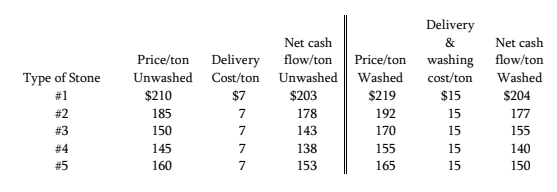
After comparing the net cash flow per ton of washing or not washing each stone, the following table provides the firm-value maximizing decision for each stone:
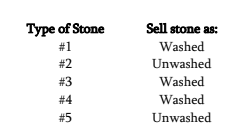
f) The owners of Jason Rocks learnt that new environmental and safety regulations have been enacted that will raise its operating costs to $85,000 per day. The owners do not expect these regulations to affect the selling prices of the washed and unwashed stones, nor do they expect them to affect the costs of washing and delivering the stones. Given this new information, how do your answers in part (e) change?
Answer:
Given the facts as described in the problem, Jason Rocks should stop operating the quarry in the long run. Increasing the daily joint cost from $75,000 to $85,000 does not change any of the marginal decisions regarding which stones to wash and which ones not to wash. The decision to further process each stone is determined entirely by the selling prices and the incremental costs to process further. These are not changing. However, the increase in the joint cost to $85,000 now makes the entire operation unprofitable as detailed in the following table.
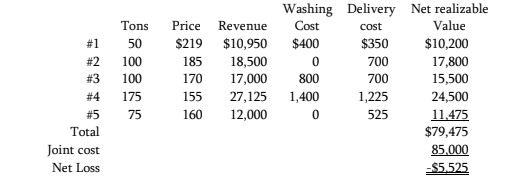
However, some of the joint cost includes historical cost depreciation and allocated costs. Jason Rocks might still be cash flow positive in the short-run and will still want to operate. But in the long-run, when the equipment has to be replaced, they will have to shut down, unless selling prices have changed
117) Jasper Inc. is considering two mutually exclusive investments. Alternative A has a current outlay of $300,000 and returns $100,300 a year for five years. Alternative B has a current outlay of $150,000 and returns $55,783 a year for five years.
Required:
a) Calculate the internal rate of return for each alternative
Answer:
The internal rate of return is the discount rate that equates the present values of the inflows to the outflows. Or, for project A:
0 = -300,000 + 100,300 x Annuity Factor (IRR=?, t=5)
300,000 = 100,300 x Annuity Factor (IRR =?, t=5)
2.991 = Annuity Factor (IRR =?, t=5)
Looking in the present value of an annuity rate, IRR = 20%
Project B:
0= -150,000 + 55,783 x Annuity Factor =?, t=5)
150,000 = 55,783 x Annuity Factor (IRR =?, t=5)
2.689 = Annuity Factor (IRR =?, t=5)
Looking in the annuity tables, IRR = 25%
b) Which alternative should Jasper take if the required rate of return for similar projects in the capital market is 15 percent?
Both projects have IRRs greater than the required rate of return. Using the IRRs as a measure then, we should take alternative B since it has the highest net present value.
| A | B | |
| Annual cash flows | 100300 | 55783 |
| NPV @ 16% | 328382 | 182634 |
| Less initial outlay | 300000 | 150,000 |
| NPV | 28382 | 32634 |
118) Jen and Barry opened an ice cream shop in Eugene. It was a big success, so they decide to open ice cream shops in many cities including Portland. They hire Dante to manage the shop in Portland. Jen and Barry are considering two different sets of performance measures for Dante. The first set would grade Dante based on the cleanliness of the restaurant and customer service. The second set would use accounting numbers including the profit of the shop in Portland.
What are the advantages and disadvantages of each set of performance measures?
Answer:
Cleanliness and customer service are important to the success of the ice cream shop. The advantage of using cleanliness and customer service as performance measures is to motivate managers to make the business appealing to customers. These customers will be more likely to return and frequent other outlets of the company. Another advantage of using cleanliness and customer service as performance measures is their controllability by the manager. The disadvantage of using cleanliness and customer service as performance measures is that managers will discount the costs of providing customer service. Without some measure of cost or profit as part of the manager’s performance measure, a manager will be less likely to make the appropriate cost/benefit trade-off.
The benefit of using profit as a performance measure is that profit tends to include all aspects of operating the business. To improve profit, the manager should also be motivated to improve customer service because profit will increase with satisfied customers. If revenues and costs are accurately measured, then managers will make the appropriate cost/benefit trade-offs if evaluated on profit. One disadvantage of using profit as a performance measure is that profit is not completely controllable by the manager. There are uncontrollable environmental factors, such as the economy of Portland, that affect profit. Also, revenues and costs may not be appropriately measured in the short-run. If costs used to calculate profit don’t reflect the opportunity cost, the manager may be motivated to make inappropriate decisions, such as postponing maintenance
119) Jim Shoe, chief executive officer of Jolsen International, a multinational textile conglomerate, has recently been evaluating the profitability of one of the company’s subsidiaries, Pride Fashions, Inc., located in Rochester, New York.
The Rochester facility consists of a dress division and a casual wear division.
Tesoro’s Casuals, produces comfortable cotton casual clothing.
Jolsen’s chief financial officer, Pete Moss, has recommended that the casual wear division be closed. The year-end financials Shoe just received show that Tesoro’s Casuals has been operating at a loss for the past year, while Daneille’s Dresses continues to show a respectable profit. Shoe is puzzled by this fact because he considers both managers to be very capable. The Rochester site consists of a 140,000-square-foot building where Tesoro’s Casuals and Daneille’s Dresses utilize 70 percent and 30 percent of the floor space, respectively. Fixed overhead costs consist of the annual lease payment, fire insurance, security, and the common costs of the purchasing department’s staff. Fixed overhead is allocated based on percentage of floor space. Housing both divisions in this facility seemed like an ideal situation to Shoe because both divisions purchase from many of the same suppliers and have the potential to combine materials ordering to take advantage of quality discounts. Furthermore, each division is serviced by the same maintenance department. However, the two managers have been plagued by an inability to cooperate due to disagreements over the selection of suppliers as well as the quantities to purchase from common suppliers. This is of serious concern to Shoe as he turns his attention to the report in front of him.
| Tesoro’s Casuals ($000s) | Daneille’s Dresses ($000s) | |
| Sales revenue | $500 | $1,000 |
| Expenses: | ||
| Direct materials | ($200) | ($465) |
| Direct labor | (70) | (130) |
| Selling expenses (all variable) | (100) | (200) |
| Overhead expenses: | ||
| Fixed overhead | (98) | (42) |
| Variable overhead | (40) | (45) |
| Net income before taxes | $(8) | $118 |
Required:
a) Evaluate Pete Moss’s recommendation to close Tesoro’s Casuals
Answer:
Assuming that Tesoro’s 70 percent of the plant cannot be used for any other purpose and cannot be subleased, then Moss’ recommendation is inappropriate. If Tesoro’s is closed, Daneille’s will have to bear the full fixed overhead expense of $140.
| Daneille’s | |
| Sales Revenue | $1,000 |
| Expenses: | |
| Direct Materials | (465) |
| Direct Labor | (130) |
| Selling Expenses | (200) |
| Overhead Expenses: | |
| Fixed Overhead | (140) |
| Variable Overhead | (45) |
| Net Income Before Taxes | $20 |
Furthermore, Mr. Moss’ recommendation is inappropriate based on the fact that Tesoro’s is covering its variable costs.
| Tesoro’s | |
| Sales Revenue | $500 |
| Expenses: | |
| Direct Materials | (200) |
| Direct Labor | (70) |
| Selling Expenses | (100) |
| Overhead Expenses: | |
| Variable Overhead | (40) |
| Net Income Before Taxes, Bonuses & Fixed Overhead | $90 |
An evaluation of the profitability of Tesoro depends on the opportunity cost attached to the space Tesoro is using. If this space is worth more than $0.92 per square foot per year ($90,000 +70% x 140,000 square feet), then Tesoro should be shut down.
b) Should the overhead costs be allocated based on floor space or some other measure? Justify your answer.
Answer:
One of Shoe’s major concerns is that the two divisions take advantage of quantity discounts and other benefits of cooperation. Allocating costs based on floor space insulates the two divisions and inhibits the cooperation that Shoe desires. Thus, a non-insulating cost allocation method is more appropriate. One solution is basing cost allocations on the profits for both divisions. This gives both division managers the incentive to reduce costs and participate in mutual monitoring, and also achieves Shoe’s goal of increased cooperation. The table below shows each division remains profitable after allocating fixed overhead using profits before allocations. The table assumes bonuses remain the same as before.
| Tesoro’s Casuals | Daneille’s Dresses | |
| Sales Revenue | $500 | $1000 |
| Expenses: | ||
| Direct Materials | (200) | (465) |
| Direct Labor | (70) | (130) |
| Selling Expenses | (100) | (200) |
| Variable Overhead | (40) | (45) |
| Net Income Before Taxes & Fixed Overhead | $90 | $160 |
| Fixed Overhead | (50) | (90) |
| Net Income/Loss Before Taxes | $40 | $70 |
120) JLT Systems sells and installs a firewall program to protect mobile apps from hacking an e-tailer’s servers. Each sale and installations requires JLT to incur a variable cost to sell and install the JLT firewall. JLT has a linear cost structure meaning that JLT has a fixed cost each month and a variable cost per sale and installations that does not vary with the number of sales and installs. At 200 sales and installs per month, JLT’s average cost is $2,700 per sale and install. JLT incurs fixed costs of $400,000 per month.
Required:
a) What is JLT’s variable cost per sale and install?
Answer:
Since we know that average cost is $2,700 at 200 unit sales, then Total Cost (TC) divided by 200 is $2,700. Also, since JLT has a linear cost curve, we can write, TC=FC+VxQ where FC is fixed cost, V is variable cost per unit, and Q is quantity sold and installed. Given FC = $400,000, then:
TC/ Q = (FC + VxQ) / Q = AC
(400,000 + 200V) / 200 = 2,700
400,000 + 200 V = 540,000
V = $700
b) JLT Systems sets the price for its firewall software at the market price of $2,000 per sales and installation. Being a small competitor in this market, JLT is a price take, and varying the number of JLT sales and installs does not affect the market price of $2,000. JLT Systems wants to show an after-tax profit of $18,000 per month and has an income tax rate of 30 percent. How many sales and installs per month does JLT need to make to achieve its after-tax profit goals?
Answer:
Given the total cost curve from part a, a tax rate of 20%, and a $2,000 selling price, and an after-tax profit target of $18,000, we can write:
($2000Q – $400,000 – $700Q) x (1-20%) = $18,000
1300Q – 400,000 = 18,000 / 0.80= 22,500
1300 Q = 422,500
Q= 325
In other words, to make an after-tax profit of $18,000, JLT must have 325 sales and installs per month
c) Instead of being a price take as in part (b), now assume that JLT faces the following demand schedule. (JLT’s demand curve is represented by the equation:P = 2600 – 2Q)
What is JLT Systems profit maximizing number of sales and installs of its firewall software per month?
| Quantity | Price |
| 250 | 2100 |
| 275 | 2050 |
| 300 | 2000 |
| 325 | 1950 |
| 350 | 1900 |
| 375 | 1850 |
| 400 | 1800 |
| 425 | 1750 |
| 450 | 1700 |
| 475 | 1650 |
| 500 | 1600 |
| 525 | 1550 |
| 550 | 1500 |
Answer:
The simplest (and fastest way) to solve for the profit maximizing quantity given the demand curve is to write the profit equation, take the first derivative, set it to zero, and solve for Q.
Total Revenue = P xQ = (2600 -2Q) Q =2600Q -2Q^2
Marginal Revenue is derivative of Total Revenue = 2600 -4Q
Set MR = MC
2600-4Q=700
The same solution is obtained if you set marginal revenue (where MR is 2600 – 4Q) equal to marginal cost (700), and again solve for Q, or
2600 – 4Q = 700
Q = 475
The more laborious solution technique is to use a spreadsheet and identify the profit maximizing price quantity combination
| Quan | Price | Revenue | Total Cost =400K + 700Q | Profit = TR – TC |
| 250 | 2100 | 525,000 | 575,000 | (50,000) |
| 275 | 2050 | 563,750 | 592,500 | (28,750) |
| 300 | 2000 | 600,000 | 610,000 | (10,000) |
| 325 | 1950 | 633,750 | 627,500 | 6,250 |
| 350 | 1900 | 665,000 | 645,000 | 20,000 |
| 375 | 1850 | 693,750 | 662,500 | 31,250 |
| 400 | 1800 | 720,000 | 680,000 | 40,000 |
| 425 | 1750 | 743.750 | 697,500 | 46,250 |
| 450 | 1700 | 765,000 | 715,000 | 50,000 |
| 475 | 1650 | 783,750 | 732,500 | 51,250 |
| 500 | 1600 | 800,000 | 750,000 | 50,000 |
| 525 | 1550 | 813,750 | 767,500 | 46,250 |
| 550 | 1500 | 825,000 | 785,000 | 40,000 |
As before, we again observe that 475 sales and installs maximize profits
121) Job Cost Flows
The job cost sheet for 1,000 units of toy trucks is:
| Job Number 555 | |||||||
| Date Started 4/13 | |||||||
| Date Completed 6/18 | |||||||
| Raw Materials | Direct Labor | ||||||
| Date | Type | Cost | Qty. | Amount | Cost | Hours | Amount |
| 4/13 | 565 | $3 | 1,000 | $3,000 | $18 | 20 | $360 |
| 5/24 | 889 | 1 | 4,000 | 4,000 | 12 | 10 | 120 |
| 6/18 | 248 | 2 | 1,000 | 2,000 | 15 | 100 | 1,500 |
| Totals | $9,000 | 130 | $1,980 | ||||
| Total direct materials | $9,000 |
| Total direct labor | 1,980 |
| Overhead (130 direct labor hours @$10/hour) | 1,300 |
| Total Job Cost | $12,280 |
All of the materials for the job were purchased on 4/10. The batch of 1,000 toy trucks is sold on 7/10.
What are the costs of this job order in the raw materials account, the work-in-process account, the finished goods account, and the cost of goods account on 4/30, 5/31, 6/30 and 7/31?
Answer:
| Raw materials | ||
| 4/30 | $9,000 – $3,000 | $6,000 |
| 5/31 | $9,000 – $3,000 – $4,000 | $2,000 |
| 6/30 | 0 | |
| 7/31 | 0 | |
| Work-in-process | ||
| 4/30 | $3,000 + $360 + (20 hrs.) ($10/hr.) | $3,560 |
| 5/31 | $3,000 + $360 + $4,000 + $120 + (30 hrs.)($10/hr.) | $7,780 |
| 6/30 | 0 | |
| 7/31 | 0 | |
| Finished goods | ||
| 4/30 | 0 | |
| 5/31 | 0 | |
| 6/30 | $12,280 | |
| 7/31 | 0 | |
| Cost of goods sold | ||
| 4/30 | 0 | |
| 5/31 | 0 | |
| 6/30 | 0 | |
| 7/31 | $12,280 |
122) Joint Products Inc. produces two joint products, X and V, using a common input. These are produced in batches. The common input costs $8,000 per batch. To produce the final products (X and V), additional processing costs beyond the split-off point must be incurred. There are no beginning inventories. The accompanying data summarize the operations:
| Product X | Product V | |
| Quantities produced per batch | 200 lb | 400 lb |
| Additional processing costs per batch beyond split-off | 1800 | 3400 |
| Unit selling prices of completely processed products | $40/ lb | $10 |
| Ending inventory | 2,000 lb | 1,000 lb |
Required:
a) Compute the full cost of the ending inventory using net realizable value to allocate joint cost.
Answer: Inventory values calculated using net realizable value:
| Product X | Product V | Total | |
| Sales value per batch | 8000 = 200 x 40 | 4000 = 400 x 10 | 12000 |
| Less: Additional processing costs | (1800) | (3400) | (5200) |
| NRV | 6200 | 600 | 6800 |
| % of NRV | 91.2% | 8.8% | 100% |
| Allocated joint cost | 7296 | 704 | 8000 |
| Processing + allocated joint cost | 9096 | 4104 | |
| Number of pounds/ batch | 200 | 400 | |
| Cost per pound | 45.48 | 10.26 | |
| Units in ending inventory | 2000 | 1000 | |
| Ending inventory value | $90,960 | 10260 | 101220 |
These ending inventory valuations are above market value, indicating that the overall operation is unprofitable. Because of the financial accounting rule that says that inventory must be valued at the lower of cost or market, the inventory values are $40 and $10 respectively, and the ending inventory values are:
Ending Inventory: $80,000 | $10,000 | $90,000
Inventory values calculated using pounds:
| Product X | Product V | Total | |
| Pounds per batch | 200 | 400 | 600 |
| %^ of batch | 33.33% | 66.66% | 100% |
| Allocated joint cost | 2667 | 5333 | 8000 |
| Processing cost | 1800 | 3400 | |
| Total cost | 4467 | 8733 | |
| Number of pounds/ batch | 200 | 400 | |
| Cost per pound | 22.33 | 21.83 | |
| Units in ending inventory | 2000 | 1000 | |
| Ending inventory value | 44670 | 21830 | 66500 |
b) If the selling prices at the split-off point (before further processing) are $35 and $1 per pound of X and V, respectively, what should the firm do regarding further processing? Show calculations
Answer:
Currently, the firm is losing money processing the joint products. Each beatch has joint costs of $8,000 plus additional processing costs of $5,200 or tal costs of $13,200. Each batch generates revenues of $12,000, thus producing a loss of $1,200.
The table below indicates X should be sold before additional processing whereas V should be processed further.
| Further Processing | Product X | Product V |
| Revenues | 8000 | 4000 |
| Additional costs | 1800 | 3400 |
| NRV | 6200 | 600 |
| Sale of intermediate product | 7000 | 400 |
| Optimal decision | Sell | Process further |
123) Mr. Jones intends to retire in 20 years at the age of 65. As yet, he has not provided for retirement income, and he wants to set up a periodic savings plan to do this. If he makes equal annual payments into a savings account that pays 4 percent interest per year, how large must his payments be to ensure that after retirement he will be able to draw $30,000 per year from this account until he is 80?
Answer:
PV = 30000 x Annuity Facgor (r = 0.04, t = 15)
= 30000 x 11.118
= 333540
Now we need to calculate the annual savings required that will grow to this retirement amount using the future value of an annuity table.
333,540 = payment x Future Annuity Factor (r= 0.04, t =20)
333540 = Payment x 29.778
Payment = 11,200
124) John invested $12,000 in the stock of Hyper Cyber Eight years later, Hyper Cyber’s shares reached $125,000, but John held onto the shares in the belief that their price would double in the next five years. Unfortunately, Hyper Cyber did not double. Rather the market value of John’s shares today is $4,000. If the shares were sold and the proceeds invested in another investment, they would likely earn 5% per annum.
Which of the following terms and values is correct?
Answer: $12,000 is the opportunity cost.
$12,000 is the sunk cost
125) Joint costs in different industries may be allocated using any of the following methods, except:
Answer:
relative profitability of pine planks, plywood, chips and sawdust at the split-off point
Notes: because chips and sawdust are not likely to be treated as joint products. They are likely treated as byproducts
126) Joint costs in different industries may be allocated using any of the following methods, except:
a) relative cubic footage of gases from a gas exploration process
b) relative sales values of fresh tomatoes, pulp tomatoes and tomato juice at the split-off point
c) relative sales value of maple wood planks, plywood, and chips (for smoking meat) at the split-off point
d) relative net realizable values at the split-off point of gold, silver, copper found in 100 tons of mining ore
Answer: All of the choices
127) J.P. Max is a department store carrying a large and varied stock of merchandise. Management is considering leasing part of its floor space for $72 per square foot per year to an outside jewelry company that would self merchandise. Two areas currently in use are being considered.: home appliances (1,000 square feet) and televisions (1,200 square feet). These departments had annual profits of $64,000 for appliances and $82,000 for televisions after allocated fixed occupancy costs of $7 per square foot were deducted. Allocated fixed occupancy costs include property taxes, mortgage interest, insurance, and exterior maintenance for the department store.
Required:
Considering all the relevant factors, which department should be leased and why?
Answer:
| Home appliances | Televisions | |
| Profits after fixed cost allocations | $64,000 | $82,000 |
| Allocated fixed costs | 7,000 (7x 1000) | 8,400 (7 x 1,200) |
| Profits before fixed cost allocations | 71,000 | 90,400 |
| Lease payments | 72,000 ($72 x 1000) | 86,400 (72 x 1,200) |
| Forgone Profits | -1,000 | 4,000 |
We would rent out the Home Appliance department, as lease rental receipts are more than the profits in the Home Appliance department. On the other hand, profits generated by the Television Department are more than the lease rentals if leased out, so we continue running the TV department. However, neither is being charged inventory holding costs, which could easily change the decision.
Also, one should examine externalities. What kind of merchandise is being sold in the leased store and will this increase or decrease overall traffic and hence sales in the other departments?
128) The Jung Corporation’s budget calls for the following production:
| Quarter 1 | 45,000 units |
| Quarter 2 | 38,000 units |
| Quarter 3 | 34,000 units |
| Quarter 4 | 48,000 units |
Each unit of production requires three pounds of direct material. The company’s policy is to begin each quarter with an inventory of direct materials equal to 30 percent of that quarter’s direct material requirements.
Required:
Compute budgeted direct materials purchases for the third quarter.
| Direct material for 3rd quarter production (34,000 × 3) | 102,000lbs. |
| + Ending Inventory: 30% of Quarter 4 production(48,000 × 3 × 30%) | 43,200lbs. |
| – Beginning Inventory: 30% of Quarter 3 production(34,000 × 3 × 30%) | (30,600lbs.) |
| Budgeted direct materials for Quarter 3 | 114,600lbs. |
129) Just One Inc. has two mutually exclusive investment projects, P and Q, shown next. Suppose the market interest rate is 10 percent.
| project | Initial Investment | Year 1 | Year 2 | IRR | NPV (r=10%) |
| P | -200 | 140 | 128.25 | 22.4$ | 33.26 |
| Q | -100 | 80 | 56.25 | 25 | 19.21 |
Ranking of projects differs, depending on the use of IRR or NPV measures. Which project should be selected? Why is the IRR ranking misleading?
Answer:
The original IRR ranking is misleading because the scale of each project is different. While Q has the higher IRR, it is a smaller project and yields fewer dollars of net present value
PART K
130) Karpoff Kremes (KK) planned to sell 40,000 Kings at $20 each and 20,000 Kweens at $15 each. Actual sales of the former were 45,000 and 25,000 of the latter, at $19 and $16 respectively
a) Which is true of KK?
Answer:
The price variance is $20,000 unfav
| Kings | Kweens | Total | |
| Budget | |||
| Quantity | 40,000 | 20,000 | |
| Price | $20 | $15 | |
| Actual | |||
| Quantity | 45,000 | 25,000 | |
| Price | $19 | $16 | |
| Price Variance | $1 × 45,000 U | $1 × 25,000F | |
| $45,000 U | $25,000 F | $20,000 unfav | |
| Quantity Variance | |||
| 5,000 × $20 F | 5,000 × $15 F | ||
| $100,000 F | $75,000 F | $175,000 fav | |
b) Which is true of KK’s mix variance?
Answer: $8,333 unfav
| Kings | Qweens | Total | |
| Actual mix % | 0.64285 | 0.357142 | |
| Std mix % | 0.66667 | 0.333333 | |
| Difference | × 0.02380 | × 0.023809 | |
| Total actual units sold | × 70000 | × 70000 | |
| Std price | × $20 | × $15 | |
| Mix Variance | ($33,333.33) U | $25,000.00 F | ($8,333.33) U |
c) Which is true of KK’s sales variance?
Answer: $183,333 fav
| Kings | Qweens | Total | |
| Total actual units sold | 70,000 | 70,000 | |
| Total std units sold | 60,000 | 60,000 | |
| Difference | 10,000 | 10,000 | |
| Std mix % | × 0.66667 | × 0.33333 | |
| Std price | × $20 | × $15 | |
| Sales Variance | $133,333 F | $50,000 F | $183,333 F |
131) King Khan Corporation (KKC) manufactures kongs and kangs, the production of which requires considerable energy. Power generation department costs amounted to $4 million this month, for a total of 50 million kilowatt hours (kwh) supplied to the plant. Analysis shows that 40% of power generation costs are fixed. This month the Kang Dept. made 5 million kangs, each using 4 kwh, and the Kang Dept. made 4 million kangs, each using 6 kwh.
Required:
a) If KKC uses the simplest algorithm to allocate power costs, which is not true?
Answer:
Kang will be charged $2.18 million
| Kong Department | Kang Department | Plant | |
| Production, millions | 5 | 4 | |
| Unit power consumption, kwh | 4 | 6 | |
| Total million kwh used | 20 | 24 | |
| % of total Power consumed | 20 | 24 | |
| Total charge ($ millions) | $1.82 | $2.18 | $4.00 |
b) In the following month, the power generation department costs amounted to $4.3 million for 51 million kwh. Kong Dept.’s usage was the same, but the Kang Dept. increased output to 4.1 million kangs, each using the standard power allowance. If KKC employs an insulating cost allocation mechanism, and fixed costs are shared equally, which is true?
Answer:
Kang will be charged $2.29 million
Fixed costs = $4 million x 40% = $1.6 million.
At a different but very similar level of activity (51 as opposed to 50 million kwh), the fixed costs should remain the same, unless there is a clear evidence of a step-fixed cost function.
| (all millions) | Kong Department | Kang Department | Plant | ||
| Production | 5 | 4.1 | |||
| Unit power consumption, kwh | 4 | 6 | |||
| Total million kwh used | 5x 4= 20 | 24.6 | |||
| Share of fixed costs | 50% | $0.80 | 50% | $0.80 | $1.60 |
| Share of variable costs | 20 | 1.21 | 24.6 | 1.49 | 2.70 |
| 44.6 | 44.6 | 4.30 | |||
| Total allocation | 2.01 | 2.29 | |||
132) Kosmic Kan produces Kaos, a leading edge computer game. It is implementing a balanced scorecard to assess performance across multiple dimensions. Which is not an appropriate measure?
Answer: Customer: Add customer value
133) Kraft Foods Group used to sponsor a car in the NASCAR races. Like other major corporations that sponsor sports events, Kraft believes that the public’s awareness of its products is enhanced by sponsoring a NASCAR. For the right to have “Kraft” displayed prominently on the automobile, Kraft pays the racing team an annual fee.
Kraft is organized around a number of business units that are profit centers. Senior management at Kraft believes that since the various business units at Kraft receive the benefits of the NASCAR exposure through greater name recognition, and hence greater sales, the costs of the program should be allocated back to the business units and ultimately to all Kraft products. The cost of the NASCAR program is allocated back to the Kraft business units based on sales revenue. Suppose the allocation is 10 percent of revenues.
That is, for every $1 of revenue, the business unit is allocated $0.10 of cost from the NASCAR car.
One of Kraft’s business units sells Velveeta processed cheese in cartons containing 200 32 ounce packages. The following table summarizes possible pricing levels, cartons sold at that price, and costs for the various number of cartons.
| Price | Number of Cartons Sold | Total Cost |
| $564 | 218 | $71,800 |
| 562 | 219 | 71,900 |
| 560 | 220 | 72,000 |
| 558 | 221 | 72,100 |
| 556 | 222 | 72,200 |
| 554 | 223 | 72,300 |
| 552 | 224 | 72,400 |
| 550 | 225 | 72,500 |
| 548 | 226 | 72,600 |
Required:
a) What price-quantity combination maximizes the profits of the Velvetta, ignoring the allocation of NASCAR?
Answer:
Profit maximizing price-quantity combination with no Nascar allocation is P* = $550 and Q* = 225, as computed in the following table:
Price | Number of Cartons Sold | Revenue | Total Cost | Net Income |
| $564 | 218 | $122,952 | $71,800 | $51,152 |
| 562 | 219 | 123,078 | 71,900 | 51,178 |
| 560 | 220 | 123,200 | 72,000 | 51,200 |
| 558 | 221 | 123,318 | 72,100 | 51,218 |
| 556 | 222 | 123,432 | 72,200 | 51,232 |
| 554 | 223 | 123,542 | 72,300 | 51,242 |
| 552 | 224 | 123,648 | 72,400 | 51,248 |
| 550 | 225 | 123,750 | 72,500 | 51,250 |
| 548 | 226 | 123,848 | 72,600 | 51,248 |
b) If $0.10 of the NASCAR is allocated for every dollar of Velvetta revenue, what price-quantity combination of Velvetta maximizes profits after allocating NASCAR costs?
Answer:
Profit maximizing price-quantity combination with the Nascar costs allocated as 10 percent of revenue is P* = $556 and Q* = 222, as computed in the following table:
Price | Number of Cartons | Net Income | Allocated on Revenue | Income after Allocation |
| $564 | 218 | $51,152 | $12,295 | $38,857 |
| 562 | 219 | 51,178 | 12,308 | 38,870 |
| 560 | 220 | 51,200 | 12,320 | 38,880 |
| 558 | 221 | 51,218 | 12,332 | 38,886 |
| 556 | 222 | 51,232 | 12,343 | 38,889 |
| 554 | 223 | 51,242 | 12,354 | 38,888 |
| 552 | 224 | 51,248 | 12,365 | 38,883 |
| 550 | 225 | 51,250 | 12,375 | 38,875 |
| 548 | 226 | 51,248 | 12,385 | 38,863 |
c) What price-quantity combination of Velvetta maximizes profits after allocating NASCAR costs using total costs (instead of revenues), where for every dollar of total costs, $0.20 of NASCAR costs are allocated?
Answer:
Profit maximizing price-quantity combination with the Nascar costs allocated as 20 percent of total costs is P* = $560 and Q* = 220, as computed in the following table:
Price | Number of Cartons | Net Income | Allocated on Total Cost | Income after Allocation |
| $564 | 218 | $51,152 | $14,360 | $36,792 |
| 562 | 219 | 51,178 | 14,380 | 36,798 |
| 560 | 220 | 51,200 | 14,400 | 36,800 |
| 558 | 221 | 51,218 | 14,420 | 36,798 |
| 556 | 222 | 51,232 | 14,440 | 36,792 |
| 554 | 223 | 51,242 | 14,460 | 36,782 |
| 552 | 224 | 51,248 | 14,480 | 36,768 |
| 550 | 225 | 51,250 | 14,500 | 36,750 |
| 548 | 226 | 51,248 | 14,520 | 36,728 |
d) Instead of allocating the NASCAR based on revenues, it is allocated based on profits before allocated costs. For every $1.00 of profits before allocated costs, $0.30 of NASCAR costs are allocated. Now what price-quantity combination maximizes Velvetta profits after allocating NASCAR costs?
Answer:
Profit maximizing price-quantity combination with the Nascar costs allocated as 30 percent of profits (before allocated costs) is P* = $550 and Q = 225, as computed in the following table:
Price | Number of Cartons | Net Income | Alloc. on Profit | Income after Allocation |
| $564 | 218 | $51,152 | $15,346 | $35,806 |
| 562 | 219 | 51,178 | 15,353 | 35,825 |
| 560 | 220 | 51,200 | 15,360 | 35,840 |
| 558 | 221 | 51,218 | 15,365 | 35,853 |
| 556 | 222 | 51,232 | 15,370 | 35,862 |
| 554 | 223 | 51,242 | 15,373 | 35,869 |
| 552 | 224 | 51,248 | 15,374 | 35,874 |
| 550 | 225 | 51,250 | 15,375 | 35,875 |
| 548 | 226 | 51,248 | 15,374 | 35,874 |
e) Should NASCAR costs be allocated to the business units, and if so, what allocation scheme should be used (revenues, costs, or profits)?
Answer:
The Nascar’s costs should be allocated to help constrain the total spent on such allocations. If the business units are not getting benefits from these expenditures, they will let senior management know. Revenues should be the allocation base if the business units generate a firm-wide externality by increasing their revenues. Costs should be the allocation base if there are cost-based externalities such as more congestion in purchasing or human resources as more costs are generated. A profit-based allocation does not distort the price-quantity combination and hence is best if there are no cost or revenue externalities
PART L
134) Labor Variances
Hospital Software sells and installs computer software used by hospitals for patient admissions and billing. Every sale requires that Hospital Services modify its proprietary software for the specific demands of the client. Prior to each installation, Hospital Software estimates the number of hours of programming time each job will require and the cost of the programmers. Programmers record the amount of time they spend on each modification, and variance reports are prepared at the end of each installation.
For the Denver General Hospital account, Hospital Software estimates the following labor standards:
| Standard Hours | Standard Rate per Hour | |
| Junior programmer | 85 | $23 |
| Senior programmer | 33 | $31 |
After the job was completed, the following costs were reported:
Compute the actual wage rates given the actual hours and actual cost:
| Actual Cost | Actual Hours | Actual Rate/hr | |
| Junior programmer | $2,352 | 98 | $24 |
| Senior programmer | $1,044 | 36 | $29 |
| Wage Rate Var. ΔW × Ha | Labor Eff.Var.ΔH × Hs | Total Labor Var. | |
| Junior programmer | ($24 – 23) × 98 | (98 – 85) × $23 | |
| $98 U | $299 U | $397 U | |
| Senior programmer | ($29 – 31) × 36 | (36 – 33) × $31 | |
| $72 F | $93 U | $21 U | |
| Total labor variance | $26 U | $392 U | $418 U |
135) Last year CCB Medical Technologies (CCB) introduced a proprietary orthopedic surgical saw that is used in a variety of orthopedic applications. However, its largest demand is in hip replacement surgeries. The electric reciprocating saw’s patented technology (including the blade) reduces noise and vibration and increases precision cutting, thereby reducing postoperative complications. CCB manufactures and sells both the saw and blades. CCB blades are designed and engineered specifically for the CCB saw, and CCB saws are designed to only be used with CCB blades. When an orthopedic surgeon performs a surgery, each blade is dedicated to one particular patient and, once used, the blade is discarded. Surgeons often use two or three blades during surgery on a patient. CCB saws sell for $2,000 each and CCB blades sell for $450 per blade.
CCB manufactures both the saw and blades in the same factory. The following table summarizes the variable and direct costs of the saws and blades and the number of units of each product produced and sold last year.
| Saws | Blades | |
| Units produced | 330 | 12,000 |
| Units sold | 300 | 9,000 |
| Beginning inventory | 0 | 0 |
| Direct labor per unit | $54.00 | $12.00 |
| Direct materials per unit | $185.00 | $38.00 |
| Variable manufacturing overhead per unit | $22.00 | $8.00 |
CCB uses an activity-based costing system to assign fixed manufacturing overhead to the saws and blades. There are three fixed manufacturing overhead cost pools in the ABC system: batch costs, product-line engineering costs, and other factory overhead. The following describes the ABC methodology:
- Batch costs ($173,000 last year): Batch costs are allocated to the two product lines based on the number of batches manufactured during the year. Saws are produced in batch sizes of 10 saws per batch and blades are manufactured in batch sizes of 500 blades per batch
- Product-line engineering costs ($724,000 last year): Product-line engineering costs are assigned to the two product lines (saws and blades) after a survey of the engineers inquiring how they spent their time. Based on last year’s survey, $289,000 was assigned to saws and $435,000 was assigned to blades.
- Other factory overhead ($330,000): Other factory overhead consists of all other fixed manufacturing overhead not included in either batch costs or product-line engineering costs. These costs are allocated to the saws and blades based on direct labor cost.
Required:
a) Compute CCB’s unit manufacturing costs and operating margins (revenues less cost of goods sold) for last year for the saws and blades using the activity-based costing methodology described above.
Absorption costing operating margins (revenues less cost of goods sold) of saws and blades
| Saws | Blades | Total | |
| Direct labor per unit | $54.00 | $12.00 | |
| Direct materials per unit | $185.00 | $38.00 | |
| Variable overhead per unit | $22.00 | $8.00 | |
| Selling price | $2,000.00 | $450.00 | |
| Units produced | 330 | 12,000 | |
| Units sold | 300 | 9,000 | |
| Batch size | 10 | 500 | |
| Number of batches | 33 | 24 | 57 |
| Batch costs | $173,000 | ||
| Cost per batch | $3,035.09 | ||
| Batch cost per unit manufactured | $303.51 | $6.07 |
| Saws | Blades | Total | |
| Product line engineering cost | $289,000 | $435,000 | $724,000 |
| Product line cost per unit manufactured | $875.76 | $36.25 | |
| Total direct labor | $17,820 | $144,000 | $161,820 |
| Other factory overhead | $330,000 | ||
| Other factory overhead per DL $ | $2.0393 | ||
| Other factory OH per unit | $110.12 | $24.47 | |
| Total ABC cost per unit manufactured | $1,550.39 | $124.79 | |
| ABCOperating margin: | |||
| Revenues | $600,000.00 | $4,050,000.00 | $4,650,000.00 |
| Cost of goods sold | 465,116.61 | 1,123,126.30 | 1,588,242.91 |
| Operating margin | $134,883.39 | $2,926,873.70 | $3,061,757.09 |
b) Having seen the ABC income statements prepared in part (a), CCB management wants to see how the operating margins (revenues less cost of goods sold) for the saws and blades would look if traditional absorption costing is used where the total fixed factory overhead is allocated to the saws and blades using direct labor dollars.
Answer:
Absorption costing operating margins (revenues less cost of goods sold) of saws and blades:
| Saws | Blades | Total | |
| Direct labor per unit | $54.00 | $12.00 | |
| Direct materials per unit | $185.00 | $38.00 | |
| Variable OH per unit | $22.00 | $8.00 | |
| Selling price | $2,000.00 | $450.00 | |
| Units produced | 330 | 12,000 | |
| Units sold | 300 | 9,000 | |
| Absorption Costing | |||
| Batch cost | $173,000 | ||
| Product line engineering cost | $724,000 | ||
| Other factory overhead | $330,000 | ||
| Total fixed manufacturing OH | $1,227,000 | ||
| Total direct labor | $161,820 | ||
| Fixed mfg OH per DL $ | $7.5825 | ||
| Allocated fixed mfg OH per unit | $409.45 | $90.99 | |
| Total cost per unit manufactured | $670.4549 | $148.9900 | |
| Operating margin | $398,863.52 | $2,709,090.10 | $3,107,953.62 |
c) Make a recommendation to management as to whether ABC (part a) or traditional absorption costing (part b) should be used. Justify your recommendation.
Answer:
Management may prefer the absorption costing method because it increases operating margin by about $40,000. However, this is just a temporary artifact caused by the fact that some of the fixed costs ended up in inventory because more units of saws and blades were produced than sold. When these units are sold, these higher fixed costs in inventory will flow through to income. A better argument for using absorption costing is recognizing that absorption costing better supports the firm’s strategy of price discrimination. CCB sells a bundled product – saws and blades. CCB wants to sell saws at a “low” price in order to generate more blade sales. One way to do this is to “under cost” the saws and “over cost” blades. Absorption costing accomplishes this better than ABC
136) A lawyer allocates overhead costs based on his hours working with different clients. The lawyer expects to have $200,000 in overhead during the year and expects to work on clients’ cases 2,000 hours during the year. In addition, she wants to pay herself $50 per hour for working with clients. In other words, the lawyer’s billing rate is the sum of her hourly fee ($50) and a fee to recover the expected overhead spread over 2,000 hours. The lawyer, however, does not bill all of her clients based on covering overhead costs and her own salary. Some clients pay her on contingency fees. If the lawyer works with a client on a contingency fee basis, the lawyer receives half of any settlement for her client. During the year the lawyer works 1,200 hours that are billable to clients.
The remaining hours are worked on a contingency basis. The lawyer wins $300,000 in settlements for his clients of which she receives half. Actual overhead was $210,000.
Required:
What does the lawyer earn during the year after expenses?
Answer:
Overhead application rate = $200,000/2,000 hours = $100/hour
Billing rate = $100/ hour + $50/ hour = $150/ hour
| Billing revenue ($150/hour) (1,200 hours) | $180,000 |
| Contingency fees (.50) ($300,000) | 150,000 |
| Actual overhead costs | (210,000) |
| Lawyer’s earnings | $120,000 |
137) Leslie Mittelberg is considering the wholesaling of a leather handbag from Kenya. She must travel to Kenya to check on quality and transportation. The trip will cost $3,000. The cost of the handbag is $10 and shipping to the United States can occur through the postal system for $2 per handbag or through a freight company which will ship a container that can hold up to a 1,000 handbags at a cost of $1,000. The freight company will charge $1,000 even if less than 1,000 handbags are shipped. Leslie will try to sell the handbags to retailers for $20. Assume there are no other costs and benefits.
Required:
a) What is the break-even point shipping through the postal system?
Answer:
Through the postal system, the variable cost per unit is $10 + $2 = $12. Therefore, the break-even point is:
$3,000/ ($20 – $12) = 375 handbags
b) How many units must be sold if Lesile uses the freight company and she wants to have a profit of $1,000?
Answer:
The fixed costs through the freight company are $3,000 + $1,000 or $4,000 if fewer than 1,000 bags are purchased. The only variable cost is the $10 purchase cost. To make a profit of $1,000. Leslie must buy and sell:
(4,000 + 1000)/ (20 – 10) = 500 handbags.
c) At what output level would the two shipping methods yield the same profit?
Answer:
The two methods would yield the same profit for the following quantity of handbags
($20 – 12)(Quantity) – $3,000 = (20-10)(Quantity) – $4,000
Quantity = 500 handbags.
d) Suppose a large discount store asks to buy an additional 1,000 handbags beyond normal sales. Which shipping method should be used and what is the minimum sales price Leslie should consider in selling those 1,000 handbags?
Answer:
The 1,000 handbags will be most cheaply transported by container. Leslie’s trip expenses of $3,000 will occur anyway, so they are not relevant for pricing the special order. The incremental cost of the additional 1,000 handbags is the cost of the container ($1,000) and the purchase cost of the handbags ($10/handbag)(1,000 handbags) or a total of $11,000. If the special order has no other effect on long term sales, then Leslie should accept a sales price above the $11,000 incremental cost, or above $11 per bag.
138) Lovell processes cut trees into various wood products, veneers, lumber, wood chips, and so forth. Each of the products can be sold immediately upon processing the trees, or processed further and sold as a finished product. The following table lists the five products produced from each batch of trees, the tons of each product per batch, and the prices for the intermediate and finished products. The net cash outflow to convert each intermediate product into a finished product is $12 per ton. The net cash outflow to process one batch of trees into the separate wood products is $800.
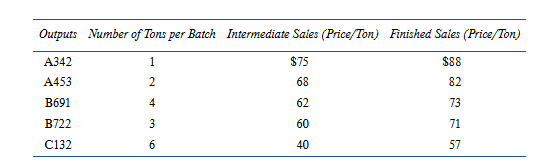
Required:
a) Given that Lovell processes batches of trees into the five wood products, which of the five wood products should be sold as intermediate products (i.e., not processed further), and which ones should be sold as finished products (i.e., processed further)?
Answer: The following table demonstrates that all joint products should be processed further, except B691 and B722
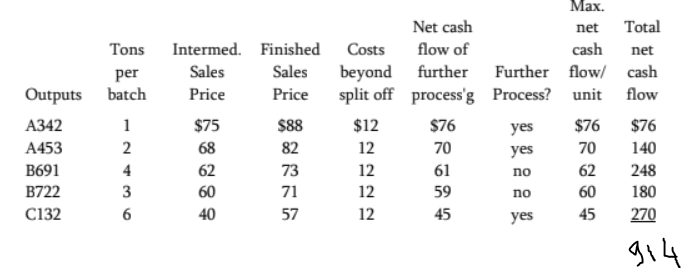
b) If Lovell’s cost to process trees into the five wood products is $800, should Lovell process trees?
Answer:
Each batch yields net cash flows after the split-off point of $914. Therefore, Lovell should process trees if the joint processing cost is $800. Each batch yields net cash flows of $114.
c) Assuming that the quantities and prices in the preceding table do not change, how high can the $800 cost to process one batch rise before Lovell stops processing trees into the five wood products?
Answer:
Lovell should continue to process trees as long as the joint processing cost is below $914 and the selling prices of the intermediate and finished wood products and the costs beyond the split-off point do not change.
d) Assuming that the cost to process trees into the five wood products is $800, and given your decisions in part (a), calculate the profit per ton of each of the five wood products after allocating the $800 processing cost to the five wood products using:
(1) Tons of wood products produced
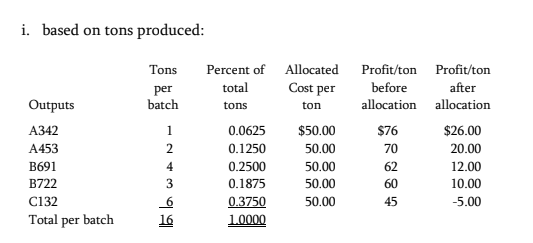
(2) Net realizable value of wood products produced:
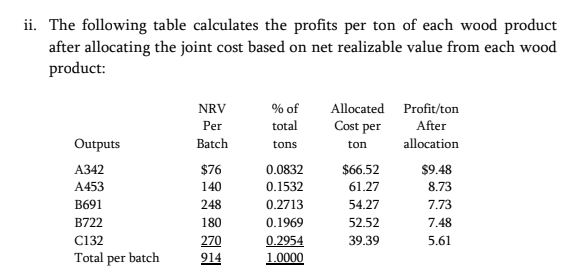
e) Given the allocations of the $800 cost of processing trees in part (d), would you want to change any of your decisions in part (a), assuming your objective is to maximize the net cash flows for Lovell?
Answer: NO
f) Describe how the allocation of the $800 cost of processing trees into the five wood products affected your decisions in parts a) and (b)
Answer:
The allocation of the $800 did not affect the decisions in parts (a) – (c). All these decisions do not require the allocation of joint costs
139) A lump sum of $5,000 is invested at 10% per year for five years. The company’s cost of capital is 8%. Which is true?
Answer:
The investment has a future value of $8,053
$5,000 (1+0.1)^5 = $8.053
PART M
140) Magellan Bank has five service departments (telecom, information management, building occupancy, training, and human resources). The bank uses a step-down method of allocating service department costs to its three lines of business (retail banking, commercial banking, and credit cards). The following table contains the utilization rates of the five service departments and three lines of business. Also included in this table are the direct operating expenses of the service departments (in millions of dollars).
Direct operating expenses of each service department do not contain any allocated service costs from the other service departments. For example, telecom spent $3.5 million dollars and provided services to other units within Magellan Bank. Information management consumed 15 percent of telecom’s services.
The order in which the service departments are allocated is also indicated in the table. The telecom department costs are allocated first, followed by information management, and the costs of the human resources department are allocated last.
| MAGELLAN BANK Utilization Rates and Direct Operating Expenses of the Service Departments (Dollars in Millions) | |||||||||
| Service Departments | Lines of Business | ||||||||
| Direct Op.Exp. | Telecom | Info Mgmt. | Building Occ. | Training | HR. | Retail Bank | Com. Bank | CCs | |
| 1.Telecom | $3.5 | — | 0.15 | 0.05 | 0.05 | 0.05 | 0.20 | 0.15 | 0.35 |
| 2. Info Mgmt. | 9.8 | 0.20 | — | 0.05 | 0.10 | 0.10 | 0.20 | 0.20 | 0.15 |
| 3. Bldg Occ | 6.4 | 0.05 | 0.10 | — | 0.05 | 0.10 | 0.50 | 0.10 | 0.10 |
| 4.Training | 1.3 | 0.15 | 0.15 | 0.05 | — | 0.05 | 0.10 | 0.30 | 0.20 |
| 5. HR | 2.2 | 0.10 | 0.10 | 0.20 | 0.05 | — | 0.20 | 0.20 | 0.15 |
Required:
a) Using the step-down method and the order of departments specified in the table, what is the total allocated cost from information management to credit cards, including all the costs allocated to information management?
Answer:
The first step is to allocate Telecom’s costs to Information Management (IM):
| Telecom direct operating expenses | $3,500,000 |
| IM’s share of Telecom’s services | 0.15 |
| Costs allocated to IM | $525,000 |
| IM’s Direct operating expenses | 9,800,000 |
| Total IM costs to be allocated | $10,325,000 |
Next, calculate Credit Card’s share of IM services, ignoring Telecom’s use of IM (20 percent). Telecom’s utilization must be ignored in order that all the service department’s costs can be stepped down.
Credit Card’s share of IM: 15% ÷ (100% – 20%) = 18.75%
IM cost allocated to credit cards: $10,325,000 × 18.75% = $1,935,938
b) Information management costs are allocated based on terabytes of storage used by the other service departments and lines of business. If, instead of being second in the step-down sequence, information management became fifth in the sequence, would the allocated cost per terabyte increase or decrease? Explain precisely why it increases or decreases.
Answer:
The calculated cost per terabyte increases if IM is moved to the end of the sequence for two reasons. First, IM receives allocated costs from all four of the other service departments rather than just Telecom. Thus, the numerator in the overhead rate formula is higher. Second, the denominator is smaller because the only users of IM services are now the three lines of business
c) If instead of using the step-down method of allocating service department costs, Magellan uses the direct allocation method, what is the total allocated cost from information management to credit cards, including all the costs allocated to information management? (Note: Information management remains second in the list.)
Answer:
Using the direct allocation method, IM is not allocated any other service department costs and does not allocate any of its costs to the other service departments. Thus, all of its $9.8 million are allocated directly to the three lines of business. Using only the lines of business utilization rates, the percentage of Credit Card division’s use of IM is 0.15 ÷ (0.20 + 0.20 + 0.15) = 27.27%.
This leads to an allocated IM cost to Credit Cards of $2,672,460 (27.27% × $9.8 million)
141) Magnetic resonance imaging (MRI) is a noninvasive medical diagnostic device that uses magnets and radio waves to produce a picture of an area under investigation inside the body. A patient is positioned in the MRI and a series of images of the rea (say, the knee or abdomen) is generated. Radiologists then read the resulting image to diagnose cancers and internal injuries. The MRI at Memorial Hospital has the following projected operating data for next year:
Memorial Hospital serves 2 types of patients: elderly, whose hospital bills are covered by governments (state and federal reimbursement), and other patients, who are covered by private insurance (such as BCBS). About one third of Memorial’s patients are elderly. Elderly patients using MRI services normally require more time per MRI image. The typical elderly patient requires one hour of MRI time to produce the 10 MRI images needed for the radiologist. Other patients only require about 45 minutes per patient to generate the 10 MRI images.
| FC | VC | Total Cost | |
| Equipment lease | 150000 | 150000 | |
| Supplies | 97000 | 97000 | |
| Labor | 145000 | 182000 | 327000 |
| Hospital administration | 63000 | 63000 | |
| Total projected costs | 606000 | 279000 | 885000 |
| Number of images | 33600 | ||
| Number of hours | 2800 |
Required:
a) Calculate Memorial Hospital’s projected cost per MRI image
Answer: 885,000 / 33600 images= $26.34/ image
b) Calculate Memorial Hospital’s projected cost per hour of MRI time
Answer: 885,000 / 2800 hours = $316.07 / hour
c) Suppose a typical elderly patient at Memorial Hospital requires 10 MRI images and takes one hour of MRI time. Calculate the cost of providing this service of Memorial Hospital calculates MRI costs based on cost per image.
Answer: 10 images x 26.34 = 263.40
d) Suppose a typical elderly patient at MH requires 10 MRI images and takes one hour or MRI time. Calculate the cost of providing this service if MH calculates MRI costs based on cost per hour of MRI time.
Answer: 1 hour x 316.07 = 316.07
e) Should MH calculate the cost of MRI services based on the cost per image or the cost per MRI hour? Explain why.
Answer: If MH’s primary use of accounting costs is third party reimbursement, then they should use cost per hour. This results in a larger reimbursement from the government (316.07) than cost per image (263.40)
142) The maintenance department’s costs are allocated to other departments based on the number of hours of maintenance use by each department. The maintenance department has fixed costs of $500,000 and variable costs of $30 per hour of maintenance provided. The variable costs include the salaries of the maintenance workers. More maintenance workers can be added if greater maintenance is demanded by the other departments without affecting the fixed costs of the maintenance department. The maintenance department expects to provide 10,000 hours of maintenance.
Required:
a) What is the application rate for the maintenance department?
Answer:
Total expected costs are $500,000 + ($30/hour) (10,000 hours) = $800,000 The application rate is $800,000/10,000 hours = $80/hour
b) What is the additional cost to the maintenance department of providing another hour of maintenance?
Answer:
The additional cost to the maintenance department of providing another hour of maintenance is the variable cost of $30/hour
c) What problem exists if the managers of other departments can choose how much maintenance to be performed?
Answer:
The other departments will under-use the maintenance department because the application rate of $80/hour is much greater than the additional costs of providing maintenance
d) What problem exists if the other departments are allowed to go outside the organization to buy maintenance services?
Answer:
If departments are allowed to go outside the organization to buy maintenance services, fewer in-house maintenance hours will be used. This will cause the application rate to become even higher if the fixed cost is included
143) Management accountants:
Answer: Internal consultants and corporate cops
144) A manufacturer produces three products: A, B, and C.The company uses the following information to determine activity rates for each pool:
| Cost | Pool 1 | 2 | 3 | Total |
| Cost | 300,000 | 20000 | 10000 | 330,000 |
| 20000 hours | 500 pounds | 100 moves |
Data concerning the three products appear below:
| Cost Driver | Products A | B | C | Total |
| Number of hours | 10,000 | 7,500 | 2,500 | 20,000 |
| Number of pounds | 150 | 250 | 100 | 500 |
| Number of moves | 20 | 30 | 50 | 100 |
What is the total amount of overhead applied to product A
Answer:
Pool 1 = 300,000 / 20,000 = $15/hr
Pool 2 = 20,000 / 500 pounds = $40/ pound
Pool 3 = 10,000 /100 moves = $100/move
OH from hours = $15 x 10,000 = 150,000
OH from pound = 150 x 40 = 6000
OH from moves = 20 x 100 = 2000
Total Applied OH (product A) = 150,000 +6000 + 2000 = 158,000
145) The Maple Way Golf Course is a private club that is owned by the members. It has the following managers and organizational structure:
Eric Olson: | General manager responsible for all the operations of the golf course and other facilities (swimming pool, restaurant, golf shop). |
| Jennifer Jones: | Manager of the golf course and responsible for its maintenance. |
| Edwin Moses: | Manager of the restaurant. |
Mabel Smith: | Head golf professional and responsible for golf lessons, the golf shop, and reserving times for starting golfers on the course. |
| Wanda Itami: | Manager of the swimming pool and family recreational activities. |
| Jake Reece: | Manager of golf carts rented to golfers. |
Required:
Describe each of the managers in terms of being responsible for a cost, profit, or investment center and possible performance measures for each manager.
Answer:
Eric Olson is the general manager of the golf course, but probably has not been given the decision rights to expand the facilities. Therefore, Eric would be considered a profit center manager. Other than profit on the whole course, Eric could be evaluated based on member satisfaction, quality of facilities, and demand for new membership.
Jennifer Jones is responsible for maintaining the golf course. She has no direct control over revenue, so her position could be considered a cost center. But the quality of the course is an important factor in bringing in golfers.
Therefore, revenue from the golf course could also be included in her performance measure. Other performance measures include the quality of the golf course, number of days the course is open, and membership satisfaction.
Edwin Moses is the manager of the restaurant, which has both revenues and costs and should be considered a profit center. Other than profit, performance measures could include diversity of menu, quality of the menu, and usage of the facility by members.
Mabel Smith is the head golf pro and responsible for the golf shop and golf lessons. She should be treated as a profit center because she controls both revenues and costs. Other than profit, she should be evaluated based on number of lessons given and satisfaction of members.
Wanda Itami is manager of the swimming pool and family recreational activities. Other than some swimming lessons, most of these activities are not revenue generating. Therefore, Wanda’s position would be treated as a cost center. In addition to costs, her performance measures would include time the pool is open and satisfaction of members.
Jake Reece manages the golf carts. Golfers are charged extra for golf carts. Jake probably also makes the decision on how many golf carts to have and is responsible for maintaining the golf carts. Therefore, Jake might be treated as an investment center or a profit center. The profit per golf cart or return on the investment in golf carts could be used as a performance measure.
Customer satisfaction is also an important performance measure
146) Match each accounting term with its definition:
Answer:
Reliable – Information that can be verified
Relevant – Information having to do with the matter at hand
Material – Information that is important enough to make a difference
Conservatism – Information related to recognizing losses as they occur
147) Measer Enterprises produces energy-efficient light bulbs and operates in a highly competitive market in which the bulbs are sold for $4.50 each. Because of the nature of the production technology, the firm can produce only between 10,000 and 13,000 units per month, in fixed increments of 1,000 units. Measer has the following cost structure:
| Production and Cost Data | ||||
| Units Produced | ||||
| 10,000 | 11,000 | 12,000 | 13,000 | |
| Factory cost, variable | $37,000 | $40,800 | $44,600 | $48,400 |
| Factory cost, fixed | 9,000 | 9,000 | 9,000 | 9,000 |
| Selling cost, variable | 6,000 | 6,600 | 7,400 | 8,200 |
| Administration, fixed | 6,000 | 6,000 | 6,000 | 6,000 |
| Total | $58,000 | $62,400 | $67,000 | $71,600 |
| Average unit cost | $5.80 | $5.67 | $5.58 | $5.51 |
Required:
At what output level should the firm operate?
Answer:
| Rate of Production and Sale (000’s units) | ||||
| 10,000 | 11,000 | 12,000 | 13,000 | |
| Sales @$4.50/unit | $45,000 | $49,500 | $54,000 | $58,500 |
| Total Costs | 58,000 | 62,400 | 67,000 | 71,600 |
| Profit (Loss) | ($13,000) | ($12,900) | ($13,000) | ($13,100) |
Notice, minimizing average unit costs is not the basis for choosing output levels. Average unit costs are minimized at 13 million units.
An alternative way to solve the problem is to calculate contribution margin, as below:
| OUTPUT LEVELS | ||||
| 10,000 | 11,000 | 12,000 | 13,000 | |
| Variable Cost | $43,000 | $47,400 | $52,000 | $56,600 |
| Average Variable Cost/unit | $4.30 | $4.31 | $4.33 | $4.35 |
| Contribution margin/unit | $.20 | $.19 | $.17 | $.15 |
| Contribution margin (units × output level) | $2,000 | $2,090 | $2,040 | $1,950 |
The preceding table indicates that maximizing contribution margin (not contribution margin per unit) also gives the right answer. At 11 million units, $2,090 is being generated towards covering fixed costs.
Minimizing average variable cost gives the wrong answer
148) The MedView brochure said, “Only 45 scans per month to cover the monthly equipment rental of $18,000.” The footnote at the bottom of the brochure read: *”Assumes a reimbursable fee of $475 per scan”.
The MedView brochure refers to a new radiology imaging system that MedView rents for $18,000 per month. A “scan” refers to one imaging session that is billed at $475 per scan. Each scan involves giving the patient a chemical injection and requires exposing and developing an X-ray negative.
Required
a) What variable cost per scan is MedView assuming in calculating the 45-scans-per-month amount?
Answer:
The brochure gives the break-even point and the question asks us to calculate variable cost per unit. Or,
BE = Fixed Cost/ (Price– Variable Cost.)
45 = ($18,000/ ($475 – Variable cost)
VC = $75/ scan
b) Is the MedView brochure really telling the whole financial picture? What is it omitting?
Answer:
The brochure is overlooking the additional fixed costs of office space and additional variable (or fixed) costs of the operator, utilities, maintenance, insurance and litigation, etc. Also overlooked is the required rate of return (cost of capital). Calculating the break-even point for the machine rental fee is very misleading.
149) Mesopotamian Materials Inc. (MMI) has two decentralized divisions (Ur and Babylon) that have decision making responsibility over the amount of resources invested in their divisions. Recent financial extracts for both divisions are presented below:
| Ur | Babylon | |
| Fixed assets, gross | $2,500 | $4,000 |
| Accumulated depreciation | $1,500 | $1,200 |
| Other assets | $500 | $750 |
| Liabilities | $500 | $1,000 |
| Sales | $6,750 | $7,200 |
| Net income after tax* | $743 | $1,008 |
| Average age of fixed assets (years) | 15 | 5 |
*** Net income is after tax but before interest.
MMI’s weighted average cost of capital (WACC) is 11.5%. The MMI measures division performance based on the book value of net assets. The producer price index 15 years ago was 100, 116 five years ago, and currently is 125.
a) Using historical costs, which is true?
Answer:
Ur’s return on net assets (RONA) is 74%
| Ur | Babylon | |
| Gross fixed assets | $2,500 | $4,000 |
| Accumulated depreciation | -$1,500 | -$1,200 |
| Net fixed assets | $1,000 | $2,800 |
| Other assets | $500 | $750 |
| Total assets | $1,500 | $3,550 |
| Liabilities | -$500 | -$1,000 |
| Net assets | $1,000 | $2,550 |
| RONA = Net income/ Net Assets | $743/ $1,000 | $1,008 / 2,550 |
| Return on net assets (historical) | 74.3% | 39.5% |
b) Ur can increase its ROI by:
Answer:
i) Increasing product contribution margin
ii) Increasing sales volume
iii) Reducing discretionary expenses
iv) taking on debt
ALL OF THE ABOVE
c) Using historical costs, which is true?
Answer:
At a WACC of 25%, Ur’s residual income is higher than Babylon’s by $122
| Ur | Babylon | Diff | |
| Net income after tax | $743 | $1,008 | |
| Cost of capital (WACC @ 25% on net assets) | -$250 | -$638 | |
| Residual income | $493 | $371 | $122 |
d) Which is true, when fixed asset costs are adjusted upward for inflation?
Answer: Babylon’s RONA is 35.8%
| Price adjusted data | Ur | Babylon |
| Gross fixed assets | $3,125 | $4,310 |
| Accumulated depreciation | $1,875 | $1,293 |
| Net fixed assets | $1,250 | $3,017 |
| Other assets | $500 | $750 |
| Total assets | $1,750 | $3,767 |
| Liabilities | $500 | $1,000 |
| Net Assets | $1,250 | $2,767 |
| Ur | Babylon | |
| Revised depreciation | $125 | $259 |
| Original SL dep | $100 | $240 |
| = increase in depreciation expense | $25 | $19 |
| Original net income | $743 | $1,008 |
| Additional depreciation | $25 | $19 |
| Price adjusted net income | $718 | $989 |
| RONA = | Net income | $718 | $989 |
| Net assets | $1,250 | $2,767 | |
| Return on net assets (adjusted) | 57.4% | 35.8% | |
| Price adjusted Asset turnover (net) | 5.40 | 2.60 | |
| Return on gross assets (adjusted) | 41.0% | 26.3% | |
| Return on sales (adjusted) | 10.6% | 13.7% | |
| COMPUTATIONS | Ur | Babylon | |
| Implied SL depreciation (historical) | $100 | $240 | |
| Years depreciated = Acc Dep/SL dep | 15 | 5 | |
| Price adjustment = | PPI today | 125 | 125 |
| PPI purch yr | 100 | 116 | |
| Price adjustment multiplier = | 1.25 | 1.08 | |
| Price adjusted cost | $3,125 | $4,310 | |
| Implied life (assuming 0 salvage value) | 25 | 16.7 | |
| Adjusted S L depreciation = | Adj cost | $125 | $259 |
| Life | |||
| Adjusted Accum. depreciation | |||
| = yrs depreciated × adj dep | $1,875 | $1,293 | |
150) Micro Enterprises has the capacity to produce 10,000 widgets a month, and currently makes and sells 9,000 widgets a month. Widgets normally sell for $6 each, and cost an average of $5 to make, including fixed costs. The monthly fixed costs are $18,000. Coyote has offered to buy 1,500 widgets (all or nothing) for $4 each.
a) Should the offer be accepted?
Answer: No, (indifferent or worse) because the opportunity costs equal the gains.
b) The accountant has determined that the excess production (beyond capacity) can be accommodated in the short term by incurring an incremental (fixed) cost of $800. Should Coyote’s offer be accepted?
Answer Yes, because the contribution from the sale exceeds the incremental costs;
Explain:
Total Cost for Current Production = 9000 units x 5 = 45,000
Total VC = Total Cost – FC = 45000 – 18000 = 27000
VC per unit = 27000 / 9000 = 3
Analyze
Incremental Revenue = 15000 units x 4 =6000
Less: Incremental VC = 1500 x 3 = (4500)
CM = 6000 – 4500 = 1500
Less: Incremental FC = Additional Capacity cost = (800)
Net incremental Profit = CM – Incremental FC = 1500 – 800 = 700
c) On this information alone, should Micro accept the offer?
Answer: Yes, because it makes $1 per unit in the short run
Total FC / Current production = 18000 / 9000 = $2 unit
VC = Average Total Cost – FC = 5-2 = 3
CM = 4-3 = 1
d) What is the “cost” per unit in the context of evaluating the offer from Coyote Corp.?
Answer: 3
Determine Excess Capacity: Maximum Capacity – Current Sales = 10000 – 9000 = 1000
Calculate Total Current Costs: Current Sales x Average cost = 9000 x 5 = 45000
Isolate Total VC = Total Cost -FC = 45000 – 18000 = 27000
VC = Total VC / Current Units = 27000 /9000 = 3
e) What other factors should be taken into consideration?
i) The impact on the normal selling price of $6
ii) Will an additional shift be needed to complete the order?
iii) Are future orders from Coyote likely
iv) Does the special price comply with the Robinson-Patman Act?
Answer: All of the above
151) Micro Enterprises planned to produce 120,000 lerts per year. Annual overhead, of which 32.5% is variable, is estimated at $320,400. Each lert takes 1.2 machine hours and 3 labor hours to produce. The firm allocates overhead by direct labor hours.
You review the accounting records at the end of the year. You learn that Micro made 125,000 lerts in the year, using 356,000 direct labor hours. Actual overhead expenditures totaled $333,333. Which is true with respect to Under/Over-applied overhead?
Answer: Under-applied overhead is $16,493 and should be charged to Cost of Goods Sold
Explanation:
Est. total DLH = Planned lerts = 120,000 x Planned DLH per lert 3 = 360,000
OH rate = Est. factory overhead costs/ Est. DLH = 320400/360000 = 0.89 per DLH
Micro Enterprises:
Total OH applied = Actual DLH used 356,000 x DLH rate per DLH 0.89 = 316,840 Under-applied OH = Actual OH 316,840 – Actual OH 333,333 = 16,493
As the under-=applied oH is < 5 percent of OH cost for the year, it is customary to make the entry to close this account directly to the COGS account. The under-applied OH is debited to the COGS, thus increasing COGS
152) Microelectronics is a large electronics firm with multiple divisions. The circuit board division manufactures circuit boards, which it sells externally and internally. The pone division assembles cellular phones and sells them to external customers. Both divisions are evaluated as profit centers. The firm has the policy of transferring all internal products at market prices.
The selling price of cellular phones is $400, and the external market price for the cellular phone circuit board is $200. The outlay cost for the phone division to complete a phone (not including the cost of the circuit board) is $250. The variable cost of the circuit board is $130.
Required:
a) Will the phone division purchase the circuit boards from the circuit board division?
Answer:
As long as the Phone Division is evaluated as a profit center and Microelectronics does not intervene somehow, the Phone Division will not purchase the circuit boards from the Circuit Board division because the Phone Division will lose money on each phone.
| Selling price of phones | 400 | |
| Transfer price of boards (market) | 200 | |
| Other costs to complete phone | 250 | 450 |
| Incremental cash flow (loss) to Phone Division | (50) |
b) Suppose the circuit board division is currently manufacturing and selling externally 10,000 circuit boards per month, and has the capacity to manufacture 15,000 boards. From the standpoint of Microelectronics, should 3,000 additional boards be manufactured and transferred internally?
Answer:
Yes, Firm profits are higher assuming the excess capacity of 5,000 boards per month has no other use.
| Selling price of phones | 400 | |
| Incremental (variable) cost per board | 130 | |
| Other costs to complete phone | 250 | 380 |
| Incremental cash flow (loss) | 20 |
c) Discuss what transfer price should be set for part (b)
Answer:
The transfer price must be set in such a way as to induce the two parties to make the transfer. In essence, the transfer price must give incentives to the Circuit Board Division to want to make the transfer and give incentives to the Phones Division to buy. In other words, the following two constraints must be satisfied:
Circuit Board Division = TP > 130 (VC)
Phone Division = TP < 150 (selling price – costs to complete)
Where TP = transfer price
Therefore, any transfer price between $130 and $150 will induce the two divisions to make the transfer. However, $130 is best as it induces transfer even if the phone price declines $19
d) List the three most important assumption underlying your analysis in parts (b) and (c )
Answer:
There are three important assumptions.
If the Circuit Board Division currently has 5,000 units of excess capacity (33 percent), why is it selling circuit boards externally at $200. Might it not be better to lower the price of the circuit boards to say $190 (depending on the price elasticity of demand) and use up the excess capacity this way rather than by producing boards for the Phones Division at the internal transfer price? That is, the decision to transfer the boards internally assumes the opportunity cost of the excess capacity is zero.
The answer in part (c) assumes that any price between $130 and $150 is equally useful. This assumes the Phones Division will not adjust its selling price (and thus number of phones sold) based on its marginal costs (including the transfer price).
Variable costs per board ($130) and per phone ($250) do not change with volume.
Other assumptions include:
There is a market for another 3,000 phones/ month
- After including fixed costs, the divisions are profitable
- Derived demand from additional phones does not drive down prices for circuit boards
- Creating an exception to the rule in this case does not lead to future transfer pricing disputes
153) Micro Enterprises has the capacity to produce 10,000 widgets a month, and currently makes and sells 9,000 widgets a month. Widgets normally sell for $6 each, and cost an average of $5 to make, including fixed costs. The monthly fixed costs are $18,000. Coyote Corp. has offered to buy 1,000 widgets at $4 eac.
a) What is the “cost” per unit in the context of evaluating the offer from Coyote Corp.?
Answer:
Average cost $5 – (18,000 / 9000 units) = $3
b) On this information alone, should Micro accept the offer?
Answer: Yes, because it makes $1 per unit in the short run. Sales price $4 minus Variable cost $3 = $1
c) What other factors should be taken into consideration?
Answer:
i) The impact on the normal selling price of $6
ii) Will an additional shift be needed to complete the order?
iii) Are future orders from Coyote likely?
iv) Does the special price comply with the Robinson-Patman Act?
d) Assuming the same story, but Coyote’s offer is for 1,500 unites (all or nothing), should the offer be accepted?
Answer: No, (indifferent or worse) because the opportunity costs equal the gains
154) Micro Enterprises planned to produce 120,000 lerts per year. Annual overheads, of which 32.5% are variable, are estimated at $320,400. Each lert takes 1.2 machine hours and 3 labor hours to produce. The firm allocates overhead by direct labor hours.
a) In February, when 11,000 lerts were produced, 32,000 direct labor hours were recorded and expenditures on overheads amounted to $29,650. Which is true for this month?
Answer:
Overhead applied is $28,480
| Micro Enterprises | Lerts |
| Actual DLHs | 32,000 |
| × OH Rate per DLH | $0.89 |
| Total overheads applied | $28,480 |
| COMPUTATIONS: | OHRate | ||
| Est. factory overhead costs | $320,400 | = $0.89 | per DLH |
| Est. DLH | 360,000 |
| Planned lerts | 120,000 |
| Planned DLH per lert | 3 |
| Est. total DLH | 360,000 |
Overheads are applied at the planned overhead absorption rate per DLH times actual DLHs used
b) In March, when 11,500 lerts were produced, 33,500 direct labor hours were recorded and expenditures on overheads amounted to $31,200. Which is true for this month?
Answer:
Under-applied overheads are $1,385
| Actual DLHs used | 33,500 |
| × OH rate per DLH | $0.89 |
| = Total overhead applied | $29,815 |
| Actual overhead | $31,200 |
| Under-applied overhead | $1,385 |
c) You review the accounting records at the end of the year. You learn that Micro made 125,000 lerts in the year, using 356,000 direct labor hours. Actual overhead expenditures totaled $333,333.
Answer:
Under-applied overhead is $16,493 and should be charged to Cost of Goods Sold
| Micro Enterprises | Lerts |
| Actual DLH used | 356,000 |
| × OH Rate per DLH | $0.89 |
| = Total overhead applied | $316,840 |
| Actual overheads | $333,333 |
| Under-applied overhead | $16,493 |
As the under-applied overhead is a about 5 percent of overhead cost for the year, it is customary to make the entry to close this account directly to the Cost of Goods Sold (CGS) account. The under-applied overhead is debited to the CGS account, thus increasing CGS
155) Midstate University is trying to decide whether to allow 100 more students into the university. Tuition is $5,000 per year. The controller has determined the following schedule of costs to educate students:
| Number of Students | Total Costs |
| 4,000 | $30,000,000 |
| 4,100 | 30,300,000 |
| 4,200 | 30,600,000 |
| 4,300 | 30,900,000 |
The current enrollment is 4,200 students. The president of the university has calculated the cost per student in the following manner: $30,600,000/4,200 students = $7286 per student. The president was wondering why the university should accept more students if the tuition is only $5,000.
Required:
a) What is wrong with the president’s calculation?
Answer:
The president of the university has calculated the average cost of each student. If the decision is to add more students, the president should be looking at the marginal cost of another student. The marginal cost can be approximated by the variable cost as long as the university is below capacity.
b) What are the fixed and variable costs of operating the university?
Answer:
The cost of adding 100 students is $300,000. Therefore, the variable cost per unit is $300,000/100, or $3,000.student
156) Mirtha Mudflat has sufficient funds to choose one of two investments. The same amount will be invested in either case. Choice one: ten year $100,000 5% Treasury bonds issued to yield 4% per annum, the market rate. Choice two: a risky bond of the same amount that has expected cash flows of $9,000 per year for the same period.
a) Assume Mirtha purchased the risky bond for $105,000 and the market rate is 6%. Which is false?
Answer: None of the above
Explain:
PV = 9000 x [ {1-(1+0.06)^-10) / 0.06] + 100,000 / ((1+0.06)^10) = 122,080
Net Present Value is NPV = 122,080 – 105,000 = 17,080
b) What is the issue price of the Treasury bond?
Answer: 108,110
Explain:
Annual Coupon Payment = 5% x 100,000 = 5,000
Lump-sum face value = $100,000 paid at the end of Year 10
Market Discount rate (r ) = 45 = 0.04
TIme to Maturity (n) = 10 years
PV of Annual Coupon payments (Annuity) = 5,000 x [(1-(1 + 0.04)^-10)/ 0.04\
= 5,000 x 8.110896 = 40,554.48
Present Value of Principal Face Value = $100,000 / (1+0.04)^10 = $67,556.42
Total Bonus Issue Price = PV Coupons + PV Principal
Total Bonus Issue Price = 40,554.48 + 67,556.42 = 108,110.90
c) What is the risk premium that makes Mirtha indifferent between the two investments?
Answer: 3.8%
Explain:
The risky bond provides $9,000 annual cash flows (9% coupon) and returns the $100,000 principal at maturity in Year 10. We set up the Present Value formula to find its internal rate of return (r ):
108,110.90 = 9,000 x [{1 -(1+r)^-10) / r] + $100,000 /((1+r)^-10)
R = 7.80%
Calculate the Risk Premium
Risk Premium = Risky Bond Yield – Risk Free Market Yield
Risk Premium = 7.80% – 4% = 3.80%
157) Mirtha Mudflat has sufficient funds to choose one of two investments. The same amount will be invested in either case. Choice one: ten year $100,000 5% Treasury bonds issued to yield 4% per annum, the market rate. Choice two: a risky bond of the same amount that has expected cash flows of $9,000 per year for the same period
a) What is the issue price of the Treasury bond?
Answer:
$108,100
| Par value * PVF | = $100,000 * (1.04)-10 | = | $67,556 |
| Annuity * PVFAn | = $5,000 * (1 – (1.04)-10) /.04 | = | $40,554 |
| $108,110 |
b) What is the risk premium that makes Mirtha indifferent between the two investments?
Answer: 3.80%
Solve for the issue price of the bond:
| Par value * PVF | = $100,000 * (1.04)-10 | = | $67,556 |
| Annuity * PVFAn | = $5,000 * (1 – (1.04)–10)/.04 | = | $40,554 |
| $108,110 |
Then, solve for the IRR, then subtract riskless rate:
| INV | = Annuity * PVFAn + Bond maturity * PVF |
| PVFAn | = (INV – PV bond)/Annuity |
| = ($108,110 – $47,171)/$9,000 = 6.77104(IRR = x%, t = 10) | |
| IRR -riskless | = 7.8% – 4% = 3.8% |
c) Assuming Mirtha purchased the risky bond above for $105,000 and the market rate is 6%, which is false?
Answer: None of the above.
| Yr 0 | 1 | 2 – 9 | 10 | |
| INV | $105,000 | |||
| OPCF | $9,000 | $9,000 | $9,000 | |
| Par | 100,000 | |||
| Net cash flows | $105,000 | $9,000 | $9,000 | $109,000 |
NPV $17,080; PV $122,080; IRR 8.25%
Payback is not accomplished by the annual cash flows ($9,000; 10 years).
The payback shortfall is covered by the redemption of the bond
158) Mistical Herbals processes exotic plant materials into various fragrances and biological pastes used by perfume and cosmetic firms. One particular plant material, Xubonic root from the rain forest in Australia, is processed yielding four joint products: QV3, VX7, HM4, and LZ9. Each of these joint products can be sold as is after the joint production process or processed further. The following table describes the yield of each joint product from one batch, the selling prices of the intermediate and further processed products, and the costs of further processing each joint product. The joint cost of processing one batch of Xubonic root is $30,000.
| QV3 | VX7 | HM4 | LZ9 | |
| Number of ounces per batch | 100 | 80 | 125 | 195 |
| Cost of further processing | $2,400 | $400 | $2,500 | $2,800 |
| Selling price of unprocessed intermediate product per ounce | $62 | $49 | $102 | $47 |
| Selling price of final product after further processing per ounce | $85 | $57 | $127 | $61 |
Required:
a) Allocate the $30,000 joint cost per batch to each of the joint products based on the number of ounces in each joint product.
Answer:
Allocated joint cost is $60 per ounce ($30000 / 500 ounces)
| QV3 | VX7 | HM4 | LZ9 | Total | |
| % of batch by ounce | 20% | 16% | 25% | 39% | 100% |
| Allocated joint cost | $6,000 | $4,800 | $7,500 | $11,700 | $30,000 |
b) To maximize firm value, which of the joint products should be processed further and which should be sold without further processing?
Answer:
Decisions to process further:
| QV3 | VX7 | HM4 | LZ9 | |
| Incremental revenue per ounce from further processing | $23 | $8 | $25 | $14 |
| Number of ounces per batch | 100 | 80 | 125 | 195 |
| Incremental revenue from further processing | $2,300 | $640 | $3,125 | $2,730 |
| Cost of further processing | $2,400 | $400 | $2,500 | $2,800 |
| Decision to process further | NO | YES | YES | NO |
c) Based on your analysis in part (b) regarding the decisions to process further or not, should Mistical Herbals process batches of Xubonic root into the four joint products? Support your decision with a quantitative analysis and indicate how much profit or loss Mistical Herbals makes per batch.
Answer:
Batches of Xubonic root should be produced because each batch yields profits of $3,200.
| QV3 | VX7 | HM4 | LZ9 | Total | |
| Revenue from further processing or immediate sale | $6,200 | $4,560 | $15,875 | $9,165 | |
| Cost of further processing | 0 | 400 | $2,500 | 0 | |
| Net realizable value | $6,200 | $4,160 | $13,375 | $9,165 | $32,900 |
| Joint cost of processing a batch | $30,000 | ||||
| Profit per batch | $2,900 |
d) Suppose the joint cost of $30,000 is allocated using the net realizable value of each joint product. Calculate the profits (loss) per joint product after allocating the joint cost using net realizable value.
Answer:
Profit after allocating joint cost using net realizable value:
| QV3 | VX7 | HM4 | LZ9 | Total | |
| NRV | $6,200 | $4,160 | $13,375 | $9,165 | $32,900 |
| % of NRV | 18.84% | 12.64% | 40.65% | 27.86% | 100% |
| Allocated joint cost | $5,653 | $3,793 | $12,196 | $8,357 | $30,000 |
| Net income per batch | $547 | $367 | $1,179 | $808 | $2,900 |
e) Explain how the use of joint cost allocations enhances or harms the decision to process joint products.
Answer:
Joint cost allocations do not enhance the decision of whether to further process joint products or not.
Joint cost allocations based on net realizable value does not harm the decision process, but it does not add anything. The decisions in part (b) to process each joint product further or sell after the split off point were made without any joint cost allocations.
159) The Mojave Water Agency (MWA) sets water policy and water rates for a desert area that faces a severe water shortage. It has 200,000 customers who are charged $100 per month for the first 20,000 cubic feet (cu.ft) and 1 cent per cu.ft thereafter. The average customer bill is $200 per month. It costs the agency ¼ cent per cu.ft to monitor and bill for usage. The MWA wants to cut costs by replacing metered billing with a flat fee which would be added to each property owner’s real estate tax bill. Which is true?
Answer:
The proposed policy will be cheaper to operate and will lead to increased water usage
160) Molton Waste Removal now only collects garbage from private residences (houses) because it does not own trucks with the capacity of lifting nd emptying garbage dumpsters used by apartment complexes. To lease, license, insure, and get the various permits to operate a refuse collection truck with a fork-lift capable of emptying a dumpster costs $54,000 per month. This includes the cost of the driver, fuel, and oil. Molton prices each apartment complex based on the number of apartment units in the complex based on a standard of 25 units. The following table indicates how Molton expects the number of apartment customers to vary with the price (per 25 apartment units)
| Number of customers | Price per month |
| 100 | 1560 |
| 105 | 1538 |
| 110 | 1516 |
| 115 | 1494 |
| 120 | 1472 |
| 125 | 1450 |
| 130 | 1428 |
| 135 | 1406 |
| 140 | 1384 |
| 145 | 1362 |
(Table is based on the demand curve P= 2000 – 4.4Q)
In other words, if Molton wants 100 apartment customers, it will set the price at $1,560 per 25 units per month. If an apartment has 50 units, then at this price point, this apartment complex pays $3,120 ( 2 x $1,560) per month. Since garbage is collected once per week at each apartment complex, the single truck has the capacity to handle up to 145.25 unit apartment complexes per month.
Molton uses a landfill in the county to dispose of the waste. The landfill charges $1,750 per truck load of garbage the size Molton would acquire. Molton estimates that 10 apartment complexes (each with 25 units0 will fill the truck once and will require dumping at the landfill. And, Molton will remove the refuse at each 25 unit complex exactly four times per month. Each 25-unit apartment complex requires Molton to lease a dumpster that can be lifted and emptied by its fork-lift-equipped garbage truck. Molton can lease these dumpsters for $200 per month per 25-unit dumpster.
Required:
a) What us Molton’s monthly fixed cost of adding an apartment complex refuse disposal service to its existing residential services? ANd what is Moltin’s monthly variable cost of servicing each 25 unit apartment complex?
Answer:
Fixed costs are given in the problem to be $54,000 per month. Variable cost per 25-unit apartment complex consists of the leased dumpster of $200 per month plus the landfill cost that varies with the number of apartment complexes ($1750 per truckload consisting of ten 25-unit apartment complex or $175 per complex).
But since each complex is visited four times each month, each complex generates 4 × $175 or $700 per month. So variable cost per complex is $900 per month
b) Given the demand curve Molton expects to face in the apartment refuse collection business. What price should it choose to maximize profits, and how much profit will it make at this price?
Answer:
The following table calculates profits at the various price-quantity combinations and shows that the profit maximizing price-quantity combination is $1,450 and 125 customers.
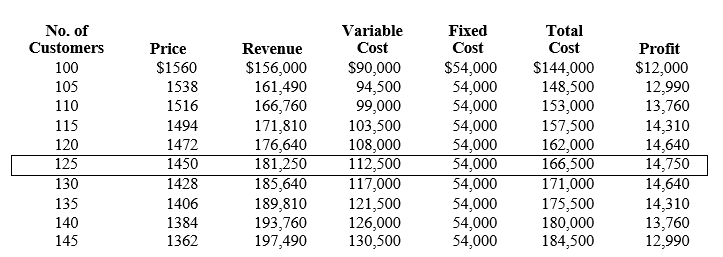
Instead of using a spreadsheet, one can write down the equation for profits, substitute in the demand curve for P, and find its optimum by taking the derivative with respect to quantity and setting it to zero :
Profit =PQ – 900Q – $54,000
Demand Curve = P= 2000 -4.4Q
Profits = (2000 – 4.4Q) x Q – 900Q – $54,000
Profits = 2000Q -4.4Q^2 – 900Q – $54,000
Derivative of the profit equation
2000 – 8.8Q – 900 =0
8.8Q = 1100
Q* = 125
P* = 2000 -4.4 x 125
P* = 1,450
Maximum profit
Max Profit = PQ – 900Q – $54,000
Max Profit = 1450 x 125 – 900 x 125 – 54,000
Max Profit = 181,250 – 112,500 – 54,000
Max Profit = 14,750
c) Based on the profit maximizing price computed in part (b), what is the break-even point at this price?
Answer:
The profit maximizing price from part (b) is $1,450. The break-even quantity at this price is given by:
Break-even quantity = FC / Contribution margin
= 54,000 / (1450 – 900)
= 98.18 25 -unit apartment complexes
d) After preparing the analysis in part (b), Molton discovers it has forgotten to include an additional cost of $72,000 per year to cover the cost of the new person needed to contact potential apartment complexes, sign contracts for waste removal, and manage the apartment refuse collection business. After incorporating the $72,000 cost of the manager to market and manage the apartment collection business, how do your answers to part (b) and (c ) change? In other words, what price should Molton set to maximize profits. How much profit will Molton make at this price, and what is the break-even point at this new price?
Answer:
The profit maximizing price does not change ($1,450) because the $6,000 per month of additional fixed cost ($72,000 ÷ 12 months) does represent additional marginal cost. Profits are lower by the $6,000 per month and will be $8,750 per month. Break-even at the price of $1,450 becomes:
Break-even quantity = (54,000 + 6,000) / (1450 – 900)
= 109.10 25-unit apartment complexes
e) Discuss why your answers in parts (a) and (C ) are either the same or differ from your answers in part (d).
Answer:
The profit maximizing price is determined by finding the price where marginal revenue equals marginal cost. The additional fixed cost of $6,000 is not a marginal cost, and hence does not alter the profit maximizing price. However, fixed costs do enter the pricing decision to determine whether to sell the service or not. Since Molton is still generating positive profits of $8,750 per month, Molton should still enter the apartment refuse collection business. Break-even quantity at a price of $1,450 is higher because fixed costs are higher.
161) Moran Health Care is a large hospital system outside Chicago that offers both hospital (inpatient) and clinic (outpatient) services. It has a centralized admissions office that admits and registers clients, some of whom are seeking inpatient hospital services and others outpatient services. Moran uses a standard cost system to control its labor costs. The standard labor time to admit an inpatient is 15 minutes.
Outpatient admissions have a standard labor time of 9 minutes. The standard wage rate for admissions agents is $14.50 per hour. During the last week, the admissions office admitted 820 inpatients and 2,210 out-patients. Actual hours worked by the admissions agents last week were 540 hours, and their total wages paid were $8,235.
Required:
a) Prepare a financial report that summarizes the operating performance (including the efficiency) of the admissions office for last week.
Answer:
The following table summarizes the direct labor variances for the admissions office.
| In-patients | Out-patients | |||
| Standard labor rate per hour | $14.50 | |||
| Standard labor time/patient | 15 | 9 | ||
| × Number of patients admitted | 820 | 2,210 | ||
| Standard labor minutes for admissions | 12,300 | 19,890 | 3,2190 | |
| ÷ Minutes per hour | 60 | |||
| Standard labor hours of admissions | 536.5 | |||
| Standard labor cost | $7,779.25 | |||
| Actual labor cost | 8,235.00 | |||
| Total labor variance | $455.75 | Unfav | ||
| Actual labor cost | $8,235.00 | |||
| ÷ Actual hours | 540 | |||
| Actual wage rate | $15.25 | |||
| Wage rate variance: ($15.25 -$14.50) × 540 | $405.00 | Unfav | ||
| Labor Efficiency Variance:(540 – 536.5) × $14.50 | 50.75 | Unfav | ||
| Total labor variance | $455.75 | Unfav | ||
b) Based on the financial report you prepared in (a), write a short memo summarizing your findings and conclusions from this report.
Answer:
The data from last week indicate that the admissions office had an unfavorable labor variance of $455.75, most of which is due to an unfavorable wage variance of $405. Instead of paying $14.50 per hour, the actual wage rate was $15.25, or 5 percent higher than the standard. Even though we paid $0.75 per hour more than standard, the actual number of admission hours required was still about the same as standard. Thus, the higher wages did not produce more efficient admissions. While the total unfavorable wage rate variance of $405 appears small, it might indicate an unfavorable trend. For example, labor markets might be tighter than previously expected. If all our other labor wage rate standards are similarly too low, then the total hospital administrative budget could be understated
162) Mystic Herbals processes exotic plant materials into various fragrances and biological pastes used by perfume and cosmetic firms. One particular plant material, Xubonic root from the rain forest in Australia, is processed yielding four joint products: QV3, VX7, HM4 and LZ9. Each of these joint products can be sold as is after the joint production process or processed further. The following table describes the yield of each joint product from one batch, the selling prices of the intermediate and further processed products, and the costs of further processing each joint product. The joint cost of processing one batch of Xubonic root is $30,000
| QV3 | VX7 | HM4 | LZ9 | |
| Number of ounces per batch | 100 | 80 | 125 | 195 |
| Cost of further processing | 2400 | 400 | 2500 | 280 |
| Selling price of unprocessed intermediate product per ounce | 62 | 49 | 102 | 47 |
| Selling price of final product after further processing per ounce | 85 | 57 | 127 | 61 |
Required:
a) Allocate the $30,000 joint cost per batch to each of the joint products based on the number of ounces in each joint product.
Answer: Allocated joint cost is $60 per ounce ($30,000 / 500 ounces)
Total number of ounces = 100 + 80 + 125 + 195 = 500
| QV3 | VX7 | HM4 | LZ9 | Total | |
| % of batch per ounce | 20% = 100/5000 | 16% = 80 /500 | 25% = 125 /500 | 39% = 195/500 | 100% |
| Allocated joint cost | 6000 = 100 x 60 | 4800 = 80 x60 | 7500 = 125 x 60 | 11700 = 195 x 60 | 30000 |
b) To maximize firm value, which of the joint products should be processed further and which should be sold without further processing?
Answer: Decisions to process further:
| QV3 | VX7 | HM4 | LZ9 | |
| Incremental revenue per ounce from further processing | 23 = 85-62 | 8 = 57-49 | 25 = 127-102 | 14 = 61-47 |
| Number of ounces per batch | 100 | 80 | 125 | 195 |
| Incremental revenue from further processing | 2300 = 23 x 100 | 640 = 8 x 80 | 3125 | 2730 |
| Cost of further processing | 2400 | 400 | 2500 | 2800 |
| Decisions to process further | No | Y | Y | N |
| Final market value | 100 x 85 = 8500 | 80x 57 = 4560 | 125 x 127 = 15875 | 195 x 61 = 11895 |
| Total final market value = | 40830 |
c) Based on your analysis in part b), regarding the decisions to process further or not, should Mystic Herbals process batches of Xubonic root into the four joint products? Support your decision with a quantitative analysis and indicate how much profit or loss Mystic Herbals makes per batch.
Answer: Batches of Xubonic root should be produced because each yields profits of $3,200
| QV3 | VX7 | HM4 | LZ9 | Total | |
| Number of ounces per batch | 100 | 80 | 125 | 195 | |
| Times: Selling price of unprocessed intermediate product per ounce | 62 | 49 | 102 | 47 | |
| = Revenue from further processing or immediate sale | 6200 | 4560 | 15875 | 9165 | |
| Cost of further processing | 0 | 400 | 2500 | 0 | |
| NRV | 6200 | 4160 | 13375 | 9165 | 32900 |
| Joint cost of processing a batch | 30000 | ||||
| Profit per batch | 2900 |
d) Suppose the joint cost of $30,000 is allocated using the net realizable value of each joint product. Calculate the profits (loss) per joint product after allocating the joint cost using net realizable value.
Answer: Profit after allocating joint cost using
| QV3 | VX7 | HM4 | LZ9 | Total | |
| NRV | 6200 | 4160 | 13375 | 9165 | 32900 |
| % of NRV | 18.84% = 6200/32900 | 12.64% | 40.65% | 27.86% | 100% |
| Allocated joint cost | 5653 = 18.84% x 30,000 | 3793 | 12196 | 8357 | 30000 |
| Net Income | 547 = 6200-5653 | 367 | 1179 | 808 | 2900 |
e) Explain how the use of joint cost allocation enhances or harms the decision to process joint products.
Answer: Joint cost allocations do not enhance the decision to further process joint products. NRV does not harm the decision process, but it does not add anything. The decision in part (b) to process each joint product further or sell after the split off point were made without any joint cost allocations
PART N
163) The National Direct Student Loan (NDSL) program allows college students to borrow funds from the federal government. The contract stipulation that the annual percentage rate of interest is 0 percent until 12 months after the student ceases his or her formal education (defined as at least half-time enrollment). At that time, interest becomes 4 percent per year. The maximum repayment period is 10 years. Assume that the student borrows $10,000 in the beginning of the first year of college and completes his or her education in four years. Loan repayments begin one year after graduation.
Required:
A) Assuming that the student elects the maximum payment period, what are the uniform annual loan repayments?
Answer:
PV = Payment x ANuity factor (r ,t =10)
10,000 = Payment x 8.111
1233 = Payment
b) If the rate of interest on savings deposits is 6 percent, what is the minimum amount the student has to have in a bank account one year after graduation to make the loan payment calculated in part (a)?
Answer:
PV = Payment x Annuity factor (r=0.06, t =10)
= 1233 x 7.360 = 9075
c)Are recipients of the NDSL program receiving a subsidy? If so, what is the present value of the subsidy when the loan is taken out?
Answer:
Yes, the NDSL recipients are receiving a subsidy. Recall that five years have passed since the student received the $10,000 loan. The present value of the annual loan repayments ($1,233) amounts to
Present value pf repayments = 9075 x PV (r=0.06,t= 5)
= 9075 x 0.747 = 6779
Present value of subsidy = 10000 – 6779 = 3221
164) News.com is a website that offers users access to current national and international news stories. News.com does not charge users a fee for accessing the site, but rather charges advertisers $0.05 per hit to the website. A”hit” is a user that logs on the website.
News.com is considering two alternate Internet service providers(ISPs) that will link News.com’s computer system to the World Wide Web – NetCom and Globallink.These firms are identicalin access speeds and the number of users able to connect to the site per minute. Both ISPs are equally reliable. NetCom proposes to charge $3,000 per month plus 0.01 per hit to News.com. Globallink proposes to charge $2000 per month plus $0/02 per hit. Assume that the only costs News.com incurs are the access fees charged by ISP/
Required:
a) Calculate the number of hits to its website needed to break even if News.com uses NetCom
b) Calculate the number of hits to its website to break even if News.com uses Global link
Answer:
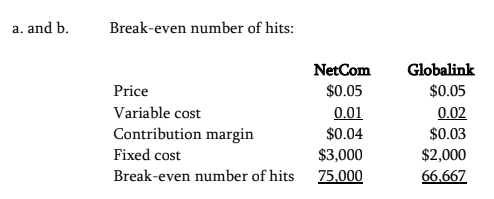
c) Which ISP do uou recommend that news.com use? Explain why?
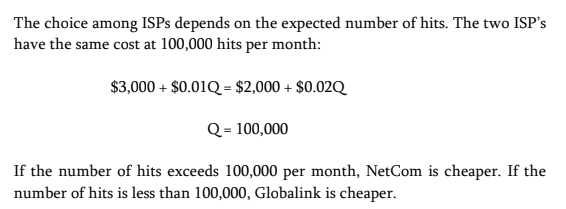
d) Monthly demand (in November of hits) for News.com expected to be either 50,000 if the economy is slumping or 150,000 or (150,000 if the economy) is booming, each equality probable. Which ISP ssould News.com choose and sky?.
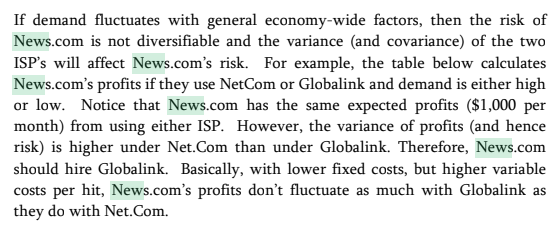
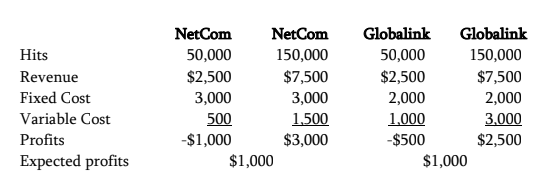
165) Nieder Toyota is a car dealership that has been in business for 40 years at the same 20-acre location selling and servicing new and “pre-owned” (used) Toyotas. Two years ago, Nieder Toyota replaced its aging showroom and service center with a new, state-of-the art facility. When Ms. Nieder’s father started the dealership, the business was on the outskirts of town. Now with city sprawl, the dealership is located on a busy commercial street surrounded by other dealership, restaurants, and shopping centers.
Suppose a new car is sold for $45,000 ($500 over dealer cost) and the buyer receives a trade-in allowance on his old car of $8,000 and pays the difference in cash. That used car is then sold for $10,000. The dealer makes $500 on the new car and $2,800 on the used car. Nieder also offers parts and service for the new and pre-owned cars it sells.
The new building cost $12 million and the land cost $900,000. The following table summarizes the land and building utilization by each department, each department’s net income, and other net assets invested in each department.
| New Cars | Pre-owned cars | Parts and Service | Total | |
| Percent of land | 50% | 40% | 10% | 100% |
| Percent of building | 30% | 10% | 60% | 100% |
| Department income | 600,000 | 1,725,000 | 1,813,000 | 4,138,000 |
| Other assets | 2,500,000 | 6,700,000 | 1,300,000 | 10,500,000 |
For example, the new car department occupies 50 percent of the land and 30 percent of the building. It had net income of $600,000 and other assets of $2,500,000. Other assets consist of all inventories and receivables invested in the department. For example, the new car department has a substantial inventory of new cars. Each department’s income consists of all revenues and expenses directly traceable to that department. Income taxes are not included in each department’s net income reported in the table. Nieder TOyota uses the trade-in allowance of used cars taken in trade as the transfer price of used cars in calculating the net incomes of the new and pre-owned car departments.
Required:
a) Calculate the residual income of each of the three division of Nieder Toyota.
Answer:
The residual incomes of the three departments are calculated in the following table
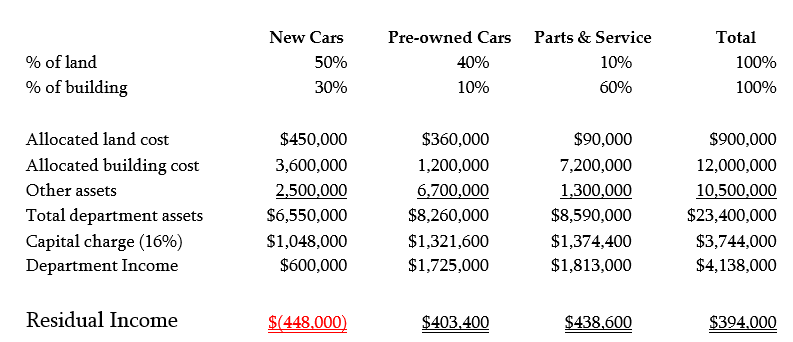
b) Discuss the relative profitability of the three departments. Which is making the most money and which is making the least amount of money?
Answer:
It appears as though the new car department is losing money and the pre-owned and parts and service departments are making money. But this ignores the synergies/interdependencies among the departments (see part c)
c) Discuss whether the residual incomes of the three department capture the true profitability of each department. What problem do you see in the way Ms. Nieder is evaluating the performance of three department managers and of Nieder Toyota as a whole?
Answer:
The new car department appears to be losing money because most of the profit from transactions involving trade-ins gets assigned to the pre-owned car department when the trade-in allowance is used as the transfer price. Using the example in the problem, the new car department only makes $500 on the new car and the pre-owned car department makes $2,800 on the used car. But the used car department cannot make this profit unless the new car department sells a new car and takes a used car in trade, usually at a substantial discount from market. Neider Toyota is selling a joint product consisting of new cars and a resale market for new car buyers’ used cars. New cars could show a profit if Neider would give the new car department some of the profits made from selling the used car. For example, suppose the used car taken in trade has a fair market value of $9,200. The new car department gave the new car buyer $8,000 for his used car. The new car department should receive $1,200 of profit from this trade-in and when the used car department sells the used car for $10,800 it would show a profit of $1,600. That is, instead of using the trade-in allowance as the transfer price of the used car, the transfer price should be the fair market value of the used car. Also, the profits in the parts and service departments are due partially to the sales of cars made by the new and pre-owned car departments. Customers tend to bring their cars needing service back to the dealerships where they are purchased. There is no simple, obvious way to allocate the profits of the service department back to the new and used car department. Moreover, some new and used car customers choose where to purchase or not purchase their cars based on their past dealings with the service department. Providing high quality car service often generates new and used car sales.
Another problem in the way Neider Toyota is calculating residual income is the cost assigned to the land. Neider owns twenty acres of land in what has become a very valuable commercial area. The land was purchased 40 years ago for $900,000. Certainly, the value of the land has appreciated. Yet, the cost assigned to the three departments for their use of the land is only
$144,000 (16% × $900,000). Suppose this land is now worth $5 million. Ms. Neider is forgoing $800,000 (16% × $5 million) of income if she were to sell the land and invest it in similarly risky assets returning 16 percent a year. Viewed this way, she actually lost $406,000 ($800,000 – $394,000) before taxes by operating the dealership
166) Nixon & Ross, a law firm, is about to install a new accounting system that will allow the firm to track more of the overhead costs to individual cases.
Overheads are currently allocated to individual client cases based on billable professional staff salaries. Attorneys working on client cases charge their time to “billable professional staff salaries.” Attorney time spent in training, law firm administrative meetings, and the like is charged to an overhead account titled “unbilled staff salaries.”
The following is a summary of the costs for the current year:
| Billable professional staff salaries | $4,000,000 |
| Overhead | 8,000,000 |
| Total costs | $12,000,000 |
The overhead costs were as follows:
| Secretarial costs | $1,500,000 |
| Staff benefits | 2,750,000 |
| Office rent | 1,250,000 |
| Telephone and mailing costs | 1,500,000 |
| Unbilled staff salaries | 1,000,000 |
| Total costs | $8,000,000 |
Under the new accounting system, the firm will be able to trace secretarial costs, staff benefits, and telephone and mailing costs to specific clients.
The following are the costs incurred on the Lawson Company case:
| Billable professional staff salaries | $150,000 |
| Secretarial costs | 25,000 |
| Staff benefits | 13,500 |
| Telephone and mailing costs | 8,000 |
| Total costs | $196,500 |
Required:
a) Calculate the current year’s overhead application rate under the old cost accounting system.
Answer:
| Overhead Professional Staff | = | $8 million$4 million | = | 200% of staff salaries |
b) How would this application rate change if the secretarial costs, staff benefits, and telephone and mailing costs were reclassified as direct costs instead of overhead, and overhead was assigned based on direct costs (instead of staff salaries)? Direct costs are defined as billable staff salaries plus secretarial costs, staff benefits, and telephone and mailing costs.
Answer:
| Office Rent | ||||
| + Unbilled salariesDirect | = | $1.25 + 1$4 + 1.5 +2.75 + 1.5 | = | 23% of Direct costs |
| Costs |
c) Use the overhead application rates from (a) and (b) to compute the cost of the Lawson case.
Answer:
The Lawson Company case (using over head application rate from (a))
| Billable professional staff salaries | $150,000 |
| Applied overhead (200% of Salaries) | 300,000 |
| Total costs | $450,000 |
The Lawson Company case (using overhead application rate from (b))
| Billable professional staff salaries | $150,000 |
| Secretarial cost | 25,000 |
| Staff benefits | 13,500 |
| Telephone costs | 8,000 |
| Total direct costs | 196,500 |
| Applied overhead (23% of direct costs) | 45,195 |
| Total costs | 241,695 |
d) Nixon & Ross bills clients 150 percent of the total costs of the job. What will be the total billings to the Lawson Co. if the old overhead application scheme is replaced with the new overhead scheme?
Answer:
| The Lawson Company case | Old Scheme | New Scheme |
| Total costs | $450,000 | $241,695 |
| Total billings (150% of total costs) | $675,000 | $362,543 |
e) Steve Nixon, managing partner, has commented that replacing the old allocation system with the direct charge method of the new accounting system will result in more accurate costing and pricing of cases. Evaluate the new system.
Answer:
Nixon & Ross will be able to more accurately trace direct costs to the various cases using the new accounting system. It is preferred that costs be traced to each individual case as accurately as possible. In this respect the application rate under the first method is less preferred than the one derived from the second method.
However, the practice of charging the clients a fixed markup over total costs is not the optimum pricing policy. Though it is easier to charge clients a standard markup, it does not allow the firm to price discriminate between clients. Since law firms have market power in their areas of specialization, they are in a position to charge different prices to different clients.
Applying the same markup to each client ignores the firm’s market power.
PART O
167) One should always be wary of using unit costs for decision-making, because unit costs:
Answer:
a) disguise the true nature of how costs vary with production
b) can be multiplied by a different number of units, suggesting that the cost data is scalable
c) generate misleading results when the company faces an increasing cost curve
d) ignore step-fixed costs
All of the above
168) Of the following statements, which is true?
Answer:
a) Real estate taxes are an example of joint costs
b) The costs of harvesting a pineapple plantation are additional processing costs
c) Common costs are incurred only in disassembly
d) Joint cost allocations are helpful in assessing a product’s profitability
Answer: None of the above
169) On May 1, 2011, a company using accrual accounting purchased equipment costing $500,000. It expects the equipment to have a useful life of five years. At the time of purchase, the company also purchased a one-year insurance policy on this equipment, which cost $6,000?
How much insurance expense should the company have recognized for the year ending in 2011?
Answer:
Monthly insurance expense = $6,000/ 12 mons = $500/ month
Insurance expense = $500 x 8 mons = $4,000
170) An October 25, 1999, article in BusinessWeek by D. Brady, “Why Xerox Is Struggling,” reported:
President and Chief Executive G. Richard THoman is abig-picture guy. For the past two years, he has preached a digital revolution at the copier giant.
Get down to the detail, though, and it’s clear that the reveolution isn’t going as planned: In both copiers and printers, Xerox is losing ground. On October 18, the company announced lower than expected earnings and the stock price tumbled more than 13% on that day. Xeros stock is down 60% from its recent high of $60 in July. Xeros blamed the bad news on short-term surprises: Sagging productivity in the sales force after a big reorganization as well as weakness in Brazil. But the sheer scope of bad news shocked even Thoman, who told investors in a conference call that he was “disappointed and sad about this quarter.”
Thoman took the top job in April and vowed annual earnings growth in the “mid-to-high teens.”
Beginning November 1, 1999, Xerox factories increased their hours from five eight-hour days a week to six ten-hour days a week through the end of the year. The factory managers were told to build inventories in expectation of higher sales in the fourth quarter of 1999. Fourth-quarter sales were expected to be higher because of anticipation that the new sales force reorganization would increase sales.
Required:
Offer an alternative reason(s) for Xerox’s decision to increase output in tis factories.
Answer:
By building inventories and using absorption costing, Xerox shifts some of its fixed manufacturing costs from cost of goods sold to inventories. This decreases cost of goods sold and increases net income as long as average unit costs are decreasing. This is a short-term strategy to boost accounting earnings and earnings will reverse as soon as inventories are depleted. This strategy is unlikely to mislead the stock market. Since the higher inventories must be disclosed as part of the financial statements, the market is not likely to be fooled by such over production.
Note: In May, 2000 Richard Thoman was replaced as CEO. The previous CEO, Paul Allaire returned as CEO and Anne Mulcahy was promoted to president and chief operating officer. Paul Allaire described the change as, “We are grateful for Rick’s contributions in leading the company through a period of major repositioning. However, both Rick and the board felt it best for the company to move forward with an experienced Xerox team that will lead Xerox people and efficiently execute the strategy.
171) Oppenheimer Visuals
Oppenheimer Visuals manufactures state-of-the-art flat-panel plasma display screens that large computer companies like Dell and Gateway assemble into flat-panel monitors. …
Two different technologies exist that can produce the unique groove pattern. One technology has a fixed cost of $34,000 per day and variable cost of $400 per panel. The fixed cost of the two technologies consist entirely of three -year leases for equipment to produce the panels. Both technologies are equally reliable and produce panels of equal quality. The only difference between the two technologies is their cost structures.
Because Oppenheimer holds a patent on the new YN polarized glass flat-panel displays, it has some market power and expects to sell the new display panels to computer companies based on the following demand schedule:
| Price per Display panel | Quantity (per day) |
| 760 | 60 |
| 740 | 65 |
| 720 | 70 |
| 700 | 75 |
| 680 | 80 |
| 660 | 85 |
| 640 | 90 |
| 620 | 95 |
| 600 | 100 |
| 580 | 105 |
| 560 | 110 |
In other words, if Oppenheimer sets the price per panel at $760, it expects to sell 60 panels per day. If it sets the price at $560, it expects to sell 110 panels per day.
Required:
a) To maximize firm value, should Oppenheimer Visuals choose technology 1 or technology 2 to manufacturer the new flat-panel display?
Answer:
The following table shows that Technology 2 yields the highest firm value:
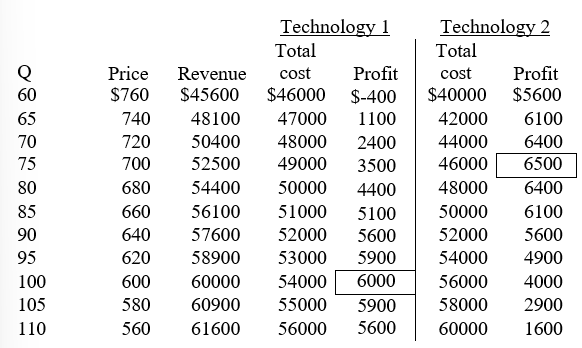
Fixed cost = $16,000
Variable cost = 400 x 75 = 30,000
b) Given the technology choice ou made in part (a), what price should Oppenheimer charge to the new flat-panel display?
Answer:
They should set the price at $700 per panel and sell 75 panels per day.
c) Using Oppenheimer Visuals as an example, explain what is meant by the often used expression, “All costs are variable in the long run.”
Answer:
The fixed cost of technology 2 of $16,000 per day was chosen as part of the profit maximizing production technology. Oppenheimer could have chosen technology 1 and had a higher fixed cost and lower variable cost. But given the demand curve the firm faces, they chose technology 2. So, at the time they selected technology 2, the choice of fixed costs had not yet been determined and was hence “variable” at that point in time.
172) Opportunity Costs:
Answer: Reflect the benefit of the next best alternative
173) Order the steps in the decision cycle from first (1) to last (5)
Answer:
i) Prepare Financial Statements
ii) Analyze Financial Statements
iii) Gather Information
iv) Make Decision
v) Implement Decision
174) The organizational process of budgeting performs several important functions. Which is true?
Answer:
a) Assigns decision rights
b) Shares knowledge
c) Forces planning
d) Measures performance
All of the above
175) Outback Opals mines and processes opals from its Australian opal mines. The process consists of removing large chunks of stones, carefully splitting the stories and removing the opals, and then cutting and polishing the stones. Finally, the opals are sorted and graded (O, II, III). the Grade I opals are sent to Outback’s US. subsidiary for sale in the United States. The Grade II opals are sold through Outback’s Hong Kong subsidiary, and the Grade III opals are sold in Australia. It costs 35,000 Australian dollars to mine, cut, polish, and sort a batch of opals. The following table summarizes the number of stones in each batch mined, the additional costs to package and sell each stone after it is polished and graded, the selling price of each grade of stone (in Australian dollars), and the income tax rates that apply to any income derived from stones sold in the country of final sale.
| Grade I | Grade II | Grade III | |
| Number of stones per batch | 70 | 105 | 175 |
| Additional costs to package and sell each stone | $250 | $120 | 5 |
| Selling price per stone | 800 | 300 | 110 |
| Income tax rate | 25% | 15% | 45% |
| Country of final sale | US | Hong Kong | Australia |
Required:
Calculate the joint cost per stone of each grade of opal (I,II, III) using the number of stones in each batch to allocate the $35,000 joint mining, cutting, polishing, and sorting costs.
Answer: Allocated joint cost per stone using the number of stones:
| Grade I | Grade II | Grade III | Total | |
| Number of stones per batch (a) | 70 | 105 | 175 | 350 |
| Percent of stone | 20% | 30% | 50% | 100% |
| Allocated cost to each grade (a) x (b) | 7000 | 10500 | 17500 | 35000 |
| Allocated joint cost per stone (b) | 100 | 100 | 100 |
Alternatively, $35,000/ 350 stones = $100 per stone
b) Calculate the joint cost per stone of each grade of opal (I, II, III) using the NRV of each grade of stones (before taxes) to allocate the $35,000 joint ming, cutting, polishing, and sorting costs.
Answer: Allocated joint cost per stone (before taxes) using NRV.
| Grade I | Grade II | Grade III | Total | |
| Selling price per stone | 800 | 300 | 110 | |
| Additional cost to package and sell each stone | (250) | (120) | (5) | |
| NRV per stone | 550 | 180 | 105 | |
| X Number of stones/ batch (i) | 70 | 105 | 175 | |
| NRV/ batch (ii) | 38500 | 18900 | 18375 | 75775 |
| Percent of NRV/ batch (iii) = (ii) / 75775 | 50.81% | 24.94% | 24.25% | 100% |
| Allocated cost to each grade (iv) = (iii) x 35,000 | 17784 | 8729 | 8488 | 35,000 |
| Allocated joint cost/ batch = (iv) / (i) | 254.05 | 83.13 | 48.50 |
c) Which method of allocating the joint cost of $35,000 (number of stones or NRV) should Outback Opals use? Explain why.
Answer:
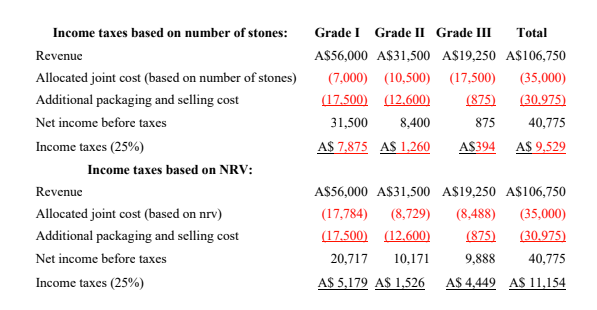
We use the number of stones method.
While the NRV method is better for internal decision-making, Outback Opals should use the Number of Stones (Physical Volume) method because it minimizes the global tax liability.
Impact of International Tax Jurisdictions: pre-tax net income across the company remains identical under both methods ($40,775). However, how joint costs are allocated shift profits between three countries with vastly different tax rates (US= 25%, HK = 15%, Australia =45%)
Tax Cost Comparison:
Number of stones method = Total Global Tax = $9529
NRV Method = Total Global Tax = $11,154
The Financial benefit: Choosing the Number of Stones method reduces total corporate income taxes by $1,625 per batch, assuming all 3 national tax authorities permit this accounting method.
176) Overland Steel operates a coal-burning steel mill in New York State. Changes in the state’s air quality control laws will result in this mill’s incurring a $1,000 per day fine (which will be paid at the end of the year) if it continues to operate. The mill currently operates every day of the year.
The mill was built 20 years ago at a cost of $15 million and has a remaining undepreciated book value of $3 million. The expected remaining useful life of the mill is 30 years.
The firm can sell the mill to a developer who wants to build a shopping center on the site. The buyer will pay $1 million for the site if the company estimated at $650,000.
Alternatively, the firm could install pollution control devices and other modernization devices at an initial outlay of $2.75 million. These improvements do not extend the useful life or salvage value of the plant, but they do reduce net operating costs by $25,000 per year in addition to eliminating the $1000 per day fine. Currently, the net cash flows of operating the plant are $450,000 per year before any fines.
Assume:
(i) the market rate of interest is 14 percent.
ii) There are no taxes.
iii) The annual cash flow estimates given above are constant over the next 30 years.
iv) At the end of the 30 years, the mill has an estimated salvage value of $2 million whether or not the population equipment has been installed.
Required:
Evaluate the various courses of action available to management and make a recommendation. Support your conclusions with neatly labeled calculations where possible.
Answer:
PV of Annuity 30 years 14% = 7.003
PV of $1 in 30 years 14% = 0.020
Alternatives
(i) Keep running and pay fine:
NPV
(-365,000 + 450,000) x 7.003 = 595,255
+ Salvage 0.020 x 2000,000 = 40,000
NPV = 595,255+ 40,000 = 635,255
ii) Pollution devices installed:
NPV =
(450,000 + 25,000) x 7.003 = 3,326,425
+ Salvage 0.020 x 2,000,000 = 40,000
Less initial outlay (2750,000)
NPV = 616,425
iii) Sell it: Purchase Price = 1,000,000
Less: Demolition Costs =(650,000)
NPV = 1000,000 – 650,000 = 350,000
Alternative (1) is best if all the costs the company incurs are confined to the fine and there are no adverse publicity costs, lawsuits, or reduction in firm brand-name capital
177) Overhead Variances
Overhead is applied on the basis of direct labor hours. Three direct labor hours are required for each product unit. Planned production for the period was set at 8,000 units. Manufacturing overhead for the period is budgeted at $204,000, of which 30 percent is fixed. The 26,200 hours worked during the period resulted in production of 8,500 units. Manufacturing overhead cost incurred was $220,500.
Required:
Calculated the following three overhead variances:
a) Overhead volume variance
b) Overhead efficiency variance
c) Overhead spending variance
| Expected overhead | $204,000 [$61,200 (fixed) + $142.800 (variable)] |
| Expected volume | 8,000 units or 24,000 direct labor hours (dl hrs) |
| Overhead rate | $204,000 ÷ 24,000 dl hrs = $8.50 per dl hr |
| Variable overhead rate | $142,800 ÷ 24,000 dl hrs = $5.95 per dl hr |
| Standard volume | 3 dl hrs × 8,500 units = 25,500 dl hours |
| Flexible budget = $61,200 + $5.95 per dl hr × direct labor hours | |
| Overhead spending variance | = | $220,500 – ($61,200 + $5.95 × 26,200 dl hrs) |
| = | $3,410 unfavorable | |
| Overhead efficiency variance | = | $5.95 per dl hr × (actual volume – standard volume) |
| = | 5.95 x (26,200 – 25,500) = $4,165 Unfav | |
| Overhead volume variance | = | flexible budget at standard volume-overhead absorbed |
| = | ($61,200 + 5.95 x 25,500) – 8.50 x 25,500 | |
| = | $3,825 Fav |
178) The Overhead volume variance:
Answer:
as a performance measure encourages overproduction
PART P
179) Pamela in Bamplona makes-bull repellent scent according to a traditional Spanish recipe, which normally sells at €9 (Euros) per unit. Normal production volume is 10,000 ounces per month. Average cost is €5 per ounce., of which €2 is direct material and €1 is variable conversion cost. This product is seasonal. After July, demand for this product drops to 6,000 ounces monthly. In November, Umberto offers to buy 1,500 ounces for €6,000.
a) If Pamela accepts the order, she must design a special label for Umberto at a cost of €500. Each label will cost 25 cents to make and apply. Pamela should:
Answer: Accept the order, at a gain of €625.
| Selling Price | €4.00 |
| Less: Variable cost | -3.00 |
| Less: Label | -0.25 |
| Contribution margin per unit | 0.75 |
| Times Number of Units | 1500 |
| Total Contribution margin | €1,125 |
| Direct fixed costs (design) | -500 |
| Increase in total contribution margin | €625 |
b) Now assume that the order is received in July, peak season. If Pamela accepts the order, she will turn away regular customers who order 500 ounces. Pamela should:
Answer: Accept the order if Umberto raises the price higher than €6.58/ounce.
| Selling Price | €9.00 |
| Less: Variable cost (normal) | -3.00 |
| Contribution margin per unit | €6.00 |
| Times Number of Units lost | 500 ounces |
| Lost contribution margin | €3,000 |
180) Pamela in Bamplona makes bull-repellent scent according to a traditional Spanish recipe, which normally sells at €9 (Euros) per unit. Normal production volume is 10,000 ounces per month. Average cost is €5 per ounce, of which €2 is direct material and €1 is variable conversion cost. This product is seasonal. After July, demand for this product drops to 6,000 ounces monthly. In November, Umberto offers to buy 1,800 ounces for €8,100.
If Pamela accepts the order, she must design a special label for Umberto at a cost of €800. Each label will cost 30 cents to make and apply. Pamela should
Answer: accept the order, at a gain of €1,360
Explain: Base VC = 2 + 1 = $3 per ounce.
Analyze:
Incremental Rev = Offered Total Price = 8,100
Less: Incremental Scent VC = 1800 ounces x 3 = 5,400
Less: Incremental Label VC = 1800 ounces x 0.30 = 540
Less: Incremental Fixed Label Design cost = Flat fee for special design = 800
Net Incremental gain = 8100 – 5400 – 54 – 800 = 1,360
181) Pamela in Bamplona makes bull-repellent scent according to a traditional Spanish recipe, which normally sells at €9 (Euros) per unit. Normal production volume is 10,000 ounces per month. Average cost is €5 per ounce, of which €2 is direct material and €1 is variable conversion cost. This product is seasonal. After July, demand for this product drops to 6,000 ounces monthly. In November, Umberto offers to buy 1,800 ounces for €8,100. If Pamela accepts the order, she must design a special label for Umberto at a cost of €800. Each label will cost 30 cents to make and apply.
Now assume that the order is received in July, peak season. If Pamela accepts the order, she will turn away regular customers who order 800 ounces. Pamela should
Answer: accept the order if Umberto raises the price higher than €6.41/ounce
Explain:
Regular CM per ounce = 9 – 3 = $6 ounce.
Total Opportunity cost = 800 x 6 = 4800
Calculate Total minimum revenue required to break-even
Scent VC = 1800 ounces x 3 = 5400
Label VC = 1800 x 0.30 = 540
Label Fixed Design cost = One time design fee = 800
Opportunity cost = Lost profit from regular customers = 4800
Minimum Required Revenue = 5400 + 540 + 800 +4800 = 11,540
Minimum Price per Ounce = Minimum Required Revenue 11540 / Special Order Qty 1,800 ounces = $6.41
182) Partial financial information for a company is as follows:
| Current Assets | 36543 |
| Total Assets | 58719 |
| Current Liabilities | 24824 |
| Total Liabilities | 48561 |
| Stockholders’ equity | 10158 |
| Sales | 46997 |
| Net Income | 37561 |
| Market value of shares | 41316 |
What is the price-earnings (PE) ratio for this company?
Answer: 41316 / 37561 = 1.10
183) The Parvis Paramount Pigsty (PPP) raises pigs, from which a variety of pork products are processed.
The herd features the Danish Yorkshire, which typically reaches 105 kgs at maturity. The following table summarizes the production process of producing Porktry, Porfekt, and Porkatoo from one pig.
| Porktry | Porfekt | Porkatoo | |
| Weight, in kgs | 45 | 20 | 35 |
| Sale price, kg | €22.50 | €84.00 | €28.00 |
| Processing costs per kg | €0.30 | €2.52 | €0.40 |
Previous research has indicated that raising a Danish Yorkshire from breeding to disposition costs an average of €3 per kg. The ratio of pig parts to products is relatively inflexible; as yet, bio-engineering has failed to produce pigs with other than four legs. Of the statements below, which is true of the allocation of the joint costs?
Answer:
By relative net realizable values, Porfekt is allocated € 135.09
| Porktry | Porfekt | Porkatoo | Total | |
| Sales revenues | 1,012.50 | 1,680.00 | 980.00 | 3,672.50 |
| Additional processing costs | (607.50) | (1,008.00) | (490.00) | (2,105.50) |
| Net realizable value | 405.00 | 672.00 | 490.00 | 1,567.00 |
| Joint costs | ||||
| Allocated by weight | 141.75 | 63.00 | 110.25 | 315.00 |
| Allocated by relative sales value | 86.84 | 144.10 | 84.06 | 315.00 |
| Allocated by net realizable value | 81.41 | 135.09 | 98.50 | 315.00 |
184) Peluso Company, a manufacturer of snowmobiles, is operating at 70 percent of plant capacity. Peluso’s plant manager is considering manufacturing headlights, which are now being purchased for $11 each (a price that is not expected to change in the near future). The Peluso plant has the equipment and labor force required to manufacture the headlights. The design engineer estimates that each headlight requires $4 of direct materials and $3 of direct labor.
Peluso’s plant overhead rate is 200 percent of direct labor dollars, and 40 percent of the overhead is fixed cost.
Required:
If Peluso Co. manufactures the headlights, how much of a gain (loss) for each headlight will result?
Answer:
| Purchase price saved | $11.00 |
| Direct labor and materials | (7.00) |
| Variable overhead(200% × $3 × 60%) | ($3.60) |
| Projected savings from making | $0.40 |
The $0.40 gain from making the headlights assumes that increasing volume does not cause variable overhead per unit to rise as congestion costs increase. Also, the “excess” capacity consumed by manufacturing the headlights is assumed (implicitly) to have no opportunity cost.
185) Performance measures:
Answer: Are critical in designing a reward system
186) Peter Pontificator is proposing to purchase a paddle machine, which will cost $1 million, last eight years and have a salvage value of 20%. Given a tax rate of 35%, and a cost of capital of 6%.
a) What is the present value of the tax shield if straight-line depreciation is used?
Answer: $217,343
SL depreciation = (HC – Salvage)/ Life = (1,000,000 – 200,000) /8 = 100,000
Annual tax shield = 35% x 100,000 = 35,000 per year
PV of Annuity of 35,000 per year at 6% for 10 years = 217,343
PV IFA 6%,8= (1-(1 + 6%)^-8)/ 0.06 = 6.2098
PV = 35,000 x 6.2098 = 217,343
b) If double-declining balance depreciation is used, an PP switches to straight-line depreciation in year 6, the present value of the depreciation tax shield is:
Answer:
$287,506
Double declining rate = 2 x (1/ life) = 2 x (1/8) = 25%
The depreciable amount = purchase price. Salvage value is ignored in this method
| Yr 1 | Yr 2 | Yr 3 | Yr 4 | ||
| Double declining dep | $250,000 | (1M – 250,000) x 25%= $187,500 | $140,625 | $105,469 | |
| Depreciation tax shield | 35% | $87,500 | $65,625 | $49,219 | $36,914 |
| Yr 5 | Yr 6 | Yr 7 | Yr 8 | ||
| Double declining dep | $79,102 | $79,102 | $79,102 | $79,102 | |
| Depreciation tax shield | $27,686 | $27,686 | $27,686 | $27,686 | |
| NPV | $287,506 |
187) Peter Pontificator is proposing to purchase a paddle machine, which will cost $5 million, last ten years and have a salvage value of $80,000. Given a tax rate of 21%, and a cost of capital of 8%.
a) If double-declining balance depreciation is used, and PP switches to straight-line depreciation in year 6, the present value of the depreciation tax shield is:
Answer: 287,506
Explain
Double-Declining Balance DDB rate = 2/ Asset life = 2/8 = 25% = 0.25
Determine Annual Depreciation Schedule
Year 1 = 1,000,000 x 25% = 250,000 (Ending Book value = 750,000)
Year 2 = 750,000 x 25% = 187,500 (Ending BV = 562,500)
Year 3 = 562,500 x 25% = 140,625 (Ending BV = 421,875)
Year 4 = 421,875 x 25% = 105,469 (Ending BV = 316,406)
Year 5 = 316,406 x 25% = 79,102 (Ending BV = 237,304)
Year 6,7 and 8 (each) = 237,304 / 3 = 79,101
| Year | Depreciation | Tax Shield (Depreciation x 35%) | PV Factor at 6% | PV |
| 1 | 250,000 | 87,500 | 0.9434 | 82,547 |
| 2 | 187,500 | 65,625 | 0.8900 | 58,406 |
| 3 | 140,625 | 49,219 | 0.8396 | 41,325 |
| 4 | 105,469 | 36,914 | 0.7921 | 29,239 |
| 5 | 79,102 | 27,686 | 0.7473 | 20,688 |
| 6 | 79,101 | 27,685 | 0.7050 | 19,517 |
| 7 | 79,101 | 27,685 | 0.6651 | 18,413 |
| 8 | 79,101 | 27,685 | 0.6274 | 17,371 |
| Total | 287,506 |
b) What is the present value of the tax shield if straight-line depreciation is used?
Answer: 693,286
Explain:
Annual Depreciation = {Cost – Salvage Value)/ Useful Life
Annual Depreciation = (5,000,000 – 80,000) / 10 = 492,000
Annual tax Shield = Annual Depreciation x Tax rate = 492,000 x 0.21 = 103,320
Present Value of the Tax Shield = Annual tax Shield x [ (1 – (1+r)^-n) / r ]
= 103,320 x [(1-(1+0.08)^-10) / 0.08]
= 693,285.61 = 693,286
188) Phipps manufactures circuit boards in Division Low in a country with a 30 percent income tax rate and transfers them to Division High in a country with a 40 percent income tax. AN import duty of 15 percent of the transfer price is paid on all imported products. The import duty is not deductible in computing taxable income. The circuit boards full cost is $1,000 and variable cost is $700. They are sold by Division High for $1,200. The tax authorities in both countries allow firms to use either variable cost or full cost as the transfer price.
Required:
Analyze the effect of full-cost and variable cost transfer pricing methods on Phipps’ cash flows.
Answer:
| Transfer Pricing Methods | ||
| Full cost | Variable cost | |
| Low Country taxes | ||
| Transfer Price | 1000 | 700 |
| Less; Cost | (1000) | (1000) |
| Taxable income | 0 | (300) |
| Income Taxes (or refund) (30%) | 0 | (90) |
| High Country Taxes | ||
| Sales Price | 1200 | 1200 |
| Less: Transfer Price | (1000) | (700) |
| Taxable Income | 200 | 500 |
Assuming Phipps has positive taxable income in Low Country against which to offset the loss of transferring the boards at variable cost, then the variable cost transfer pricing method minimizes the combined tax liability
189) Picture Maker is a freestanding photo kiosk consumers use to download their digital photos and make prints. Shashi Sharma has a small business that leases several Picture Makers from the manufacturer for $120 per month per kiosk, and she places them in high-traffic retail locations. Customers pay $0.18 per print. (The kiosk only makes six- by eight-inch prints.) Sharma has one kiosk located in the Sanchez Drug Store, for which Sharma pays Sanchez $80 per month rent. Sharma checks each of her kiosks every few days, refilling the photographic paper and chemicals, and collects the money.
Sharma hires a service company that cleans the machine, replaces any worn or defective parts, and resets the kiosk’s settings to ensure the kiosk continues to provide high-quality prints. This maintenance is performed monthly and is independent of the number of prints made during the month.
The average cost of the service runs about $90 per month, but it can vary depending on the extent of repairs and parts required to maintain the equipment.
Paper and chemicals are variable costs, and maintenance, equipment lease, and store rent are fixed costs. If the kiosk is malfunctioning and the print quality deteriorates, Sanchez refunds the customer’s money and then gets his money back from Sharma when she comes by to check the paper and chemical supplies. These occasional refunds cause her variable costs per print for paper and chemicals to vary over time.
The following table reports the results from operating the kiosk at the Sanchez Drug Store last month. Budget variances are computed as the difference between actual and budgeted amounts. An unfavorable variance (U) exists when actual revenues fall short of budget or when actual expenses exceed the budget. Last month, the kiosk had a net loss of $23, which was $87 more than budgeted.
| Sanchez Drug Store Kiosk Last Month | |||
| Actual Results | Variancefrom Budget | (U =unfavorable F = favorable) | |
| Revenue | $360 | $108 | U |
| Expenses: | |||
| Paper | $65 | $13 | F |
| Chemicals | 28 | 2 | U |
| Maintenance | 90 | 10 | F |
| Equipment lease | 120 | 0 | |
| Store rent | 80 | 0 | |
| Total expenses | $383 | $21 | F |
| Net Income (loss) | ($23) | ($87) | U |
Required:
a) Prepare a schedule that shows the budget Sharma used in calculating the variances in the preceding report.
Answer:
Since the budget variance = Actual – Budget
Rearranging gives Budget = Actual – Variance, or:
| Actual Results | Variancefrom Budget | Budget | |
| Revenue | $360 | $108 U | $468 |
| Expenses: | |||
| Paper | $65 | $13 F | $78 |
| Chemicals | 28 | 2 U | 26 |
| Maintenance | 90 | 10 F | 100 |
| Equipment lease | 120 | 0 | 120 |
| Store rent | 80 | 0 | 80 |
| Total expenses | $383 | $21 F | $404 |
| Net income (loss) | ($23) | ($87) | $64 |
b) How many good prints were made last month at the Sanchez Drug Store kiosk?
Answer:
Since actual revenues were $360, and each print cost $0.18, then $360 ÷ $0.18 = 2,000
c) Prepare a flexible budget for the Sanchez Drug Store kiosk based on a volume of 2,000 prints?
Answer:
The budget in part (a) reports revenues of $468. With each print generating revenues of $0.18, the budget in part (a) is based on 2,600 prints ($468 ÷ $0.18). Using the 2,600 prints amount, the budgeted cost of paper ($78), and the budgeted cost of chemicals ($26) we can calculate the budgeted variable cost of paper to be $0.03 per print ($78 ÷ 2,600) and the budgeted variable of chemicals to be $0.01 per print ($26 ÷ 2,600). The flexible budget based on 2,000 prints is:
| Budget Based on 2,000 Prints | ||
| Revenue | $360 | |
| Expenses: | ||
| Paper ($0.03) | $60 | |
| Chemicals ($0.01) | 20 | |
| Maintenance | 100 | |
| Equipment lease | 120 | |
| Store rent | 80 | |
| Total expenses | $380 | |
| Net income (loss) | ($20) | |
190) Expected, Standard, and Actual Labor Hours.
The Pizza Company makes two types of frozen pizzas: pepperoni and cheese. The Pizza Company allocates overhead to these two products based on the number of direct labor hours. The direct labor hours per unit for making a pepperoni pizza is 5 minutes or 1/12 of an hour.
The direct labor hours per unit for making a cheese pizza is 4 minutes or 1/15 of an hour. At the start of the year the Pizza Company expected to make 12,000 pepperoni pizzas and 6,000 cheese pizzas. During the year, the Pizza Company actually made 9,000 pepperoni pizzas and 7,500 cheese pizzas. The time cards indicate that direct laborers worked for 1,300 hours. What are the total expected direct labor hours, standard direct labor hours, and actual direct labor hours?
| Expected number of direct labor hours: | |
| Pepperoni (12,000) (1/12) | 1,000 |
| Cheese (6,000) (1/15) | 400 |
| Total | 1,400 |
| Standard number of direct labor hours: | |
| Pepperoni (9,000) (1/12) | 750 |
| Cheese (7,500) (1/15) | 500 |
| Total | 1,250 |
| Actual number of direct labor hours: | 1,300 |
191) Pluton makes particular plastics for sale to the public and the government.
Basic cost data for a 100-pound drum of one particular product called Xentra appears below:
| Qty | Cost | |
| Chemical Xeta, gals | 15 | $25.00 |
| Chemical Thenta, gals | 35 | $27.50 |
| Base material, lbs | 20 | $1.00 |
| 100-lb lined drum | 1 | $51.83 |
Variable factory overheads are estimated to be $1,200,000 per month, when 1,000,000 pounds of various products are produced. The plant employs 20 chemical workers who typically work 175 hours each per month and are paid $24 per hour. Other workers are classified as indirect and are included in fixed overheads. The highly automated plant typically runs 21,000 machine hours per month. The preparation of one 100 lbs batch of Xentra needs ten minutes of direct labor and 75 minutes of machine time. Fixed manufacturing overheads total $3,500,000 per month. Forty percent of these fixed manufacturing overheads are labor-related costs and the balance are machine-related costs.
a) Assuming normal production levels, what is the direct materials and direct labor cost (i.e., the prime cost) per drum?
Answer:
$1,413.33
The direct materials and direct labor cost per drum:
| XENTRA: Unit cost sheet per drum | |||
| Qty | Cost | Total | |
| Chemical Xeta, gals | 15 | $25.00 | $375.00 |
| Chemical Thenta, gals | 35 | $27.50 | $962.50 |
| Base material, lbs | 20 | $1.00 | $20.00 |
| 100-lb lined drum | 1 | $51.83 | $51.83 |
| Direct labor, hr | 1/6 | $24 | $4.00 |
| Prime cost per drum | 1,413.33 | ||
b) Assuming normal production levels, what is the conversion cost (direct labor and overhead) per drum?
Answer:
$315.67
Conversion cost is the sue of direct labor and factory overheads per drum.
| Conversion costs | Qty | Cost | Total |
| Direct labor, hr | 1/6 | $24.00 | $4.00 |
| Variable overheads | 100 | $1.20 | $120.00 |
| Allocated fixed overheads* | |||
| Labor-based, per DLH | 1/6 | $400.00 | $66.67 |
| Machine based per MH | 1 ¼ | $100 | $125.00 |
| Conversion cost per drum | $315.67 |
| OH allocation rate | |||
| *Variable Mfg OH: lbs | $1,200,000 | $1.20 | per lb |
| lbs | 1,000,000 | ||
| *Fixed Mfg OH: DLH | $1,400,000 | $400.00 | per DLH |
| DLH | 3,500 | ||
| *Fixed Mfg OH: MH | $2,100,000 | $100.00 | per MH |
| MH | 21,000 | ||
Some students may allocate the labor-based overheads on the basis of direct labor dollars. While the intermediate values differ, as shown below, the final answer is then same.
$1,400,000 OH$ / $84,000 DL$ = $16.667 per DL$.
One drum uses 10 minutes of DL costed at $24/DLH. So $16.667 * $24 / 6 = $66.67 per drum
c) Assuming normal production levels, what is the full cost per drum?
Answer:
$1,725.00
| Prime cost per drum | $1,413.33 |
| Allocated overheads | |
| Variable overheads, per lbs | $120.00 |
| Fixed overheads: | |
| Direct labor-based, per DLH | $66.67 |
| Machine-based, per MH | $125.00 |
| Full cost per drum | $1,725.00 |
d) A government agency wants to purchase 200 drums of Xentra at cost plus a flat fee. Which allocation method gives the profit-maximizing result?
Answer:
Allocating overheads per pound
| Current method: | Allocated overheads per drum |
| Current method: | Allocated overheads per drum | ||||
| Variable overheads, per lb | $120.00 | ||||
| Fixed overheads: | |||||
| Direct labor-based, per DLH | $66.67 | ||||
| Machine-based, per MH | $125.00 | ||||
| $311.67 | |||||
| Total overheads | |||||
| Variable | $1,200,000 | ||||
| Fixed | $3,500,000 | ||||
| Total overheads | $4,700,000 | ||||
| Units per drum | |||||
| Overhead$ | |||||
| Total pounds | 1,000,000 | OH$/lb | $4.70 | 100 | $470.00 |
| Total DLH | 3,500 | OH$/DLH | $1,342.86 | 1/6 | $223.81 |
| Total MH | 21,000 | OH$/MH | $223.81 | 1 1/4 | $279.76 |
e) If Pluton select the cost allocation method indicated by your answer, how much will profits increase on this order compared with the present system?
Answer:
Change by $31,666.67
| Increase in profits | |
| Additional overhead per drum ($470.00- $311.67) | $158.33 |
| # Drums | × 200 |
| Increase in reimbursed costs | $31,666.67 |
f) Assuming Pluton selects the cost allocation method as per pound, how much will profits increase on this order compared with allocating overhead per drum (the current system)?
Answer: Change by $31,666
Explain
Additional overhead per drum (470 – 311.67) = 158.33 x 200 drums = 31,666
191) PPX is a specialized packaging company that packages other manufacturers’ products. Other manufacturers ship their products to PPX in bulk. PPX then packages the products using high-speed, state-of-the-art packaging machines and ships the packaged products to wholesalers. A typical order involves packaging small toys in see-through plastic and cardboard containers.
PPX uses a flexible budget to forecast annual plantwide overhead, which is then allocated to jobs based on machine hours. The annual flexible overhead budget is projected to be $6 million of fixed costs and $120 per machine hour. The budgeted number of machine hours for the year is 20,000.
At the end of the year, 21,000 machine hours were used and actual overhead incurred was $9.14 million.
Required:
a) Calculate the overhead rate set at the beginning of the year.
Answer:
Plantwide overhead rate | = | Estimated overhead Estimated machine hours |
= | $6 million + $120 × 20,00020,000 machine hours | |
| = | $420 per machine hour |
b) Calculate the amount of over/under-absorbed overhead for the year.
Answer:
| Actual overhead incurred | $9,140,000 |
| Overhead applied:21,000 hours × $420/machine hour | $8,820,000 |
| Under-applied Overhead | $320,000 |
c) The company’s policy is to write off any over/under-absorbed overhead to cost of goods sold. Will net income rise or fall this year when the over/under-absorbed overhead is written off to cost of goods sold?
Answer:
Writing off $320,000 of under-absorbed overhead to cost of goods sold increases cost of goods sold and thereby decreases net income. Because actual products produced absorbed too little overhead, these unabsorbed dollars lower reported profits when taken to cost of goods sold
192) A present investment of $50,000 is expected to yield receipts of $8,330 a year for seven years. What is the internal rate of return on this investment?
Answer:
0= (50,000) + 8330 x Annuity Factor (IIR =?, t=7)
6.002 = Annuity Factor (IRR =?, t=7)
IRR = 4%
193) The president of the company is not convinced that the interest expense should be excluded from the calculation of the net present value. He points out that, “Interest is a cash flow. You are supposed to discount cash flows. We borrowed money to completely finance this project. Why not discount interest expenditures?” The president is so convinced that he asks you, the controller, to calculate the net present value including the interest expense.
How can you adjust the net present value analysis to compensate for the inclusion of the interest expense?
Answer:
Many possible ways exist for examining this problem. From a theoretical perspective, of course, interest expense (like dividends) is excluded because it is captured in the discount rate.
But here is another way of viewing an investment. An investment that is entirely debt-financed is a positive NPV project if, at the end of the project, there is excess cash after paying the interest and the principal of the debt.
This can be seen in the following equation where early cash flows are re-invested at a rate “r” to pay off the principal of the loan at the end of n periods, which is also the length of the project.
(CF1) (1 + r) ^n-1 + (CF2)(1 + r) ^n-2 +…+ (CFn) > or < Investment (- Principal)
Where CF1 = Cash flows in period 1 including interest payments.
if the left hand side of the equation is greater than the right hand side of the equation, the investment has a positive NPV and is acceptable. This analysis assumes complete debt financing to capture all of the opportunity cost of using cash.
194) Prestige manufactures a line of female cosmetics. Including lipsticks, face creams, eyeliners, and so forth. Prestige manufactures its own products to maintain proprietary information and to assure high-quality standards. They have just developed a new exfoliating masque face cream in a unique tube and applicator that they expect to sell for $12.00 per unit. To manufacture the new face cream, Prestige will have to lease new equipment. Only two companies manufacture the necessary equipment for producing the face cream, a German company and a Swedish company. The following take lists th two alternative production technologies that Prestige can use to produce the new face cream.
| Technology | German | Swedish |
| Fixed cost (annual) | 500,000 | 900,000 |
| Variable cost/ unit | 8 | 6 |
| Maximum annual capacity (units) | 215000 | 380000 |
The German equipment has an annual capacity of 215,000 units per year, whereas the Swedish equipment can produce up to 380,000 units per year. Both companies require Prestige Products to sign a five year, noncancelable lease for the annual lease payment ($500,000) for the German equipment and $900,000 for the Swedish equipment). The variable costs include the labor and material ($8 if the German equipment is used and $6 if the Swedish equipment is used).
Required:
a) Calculate the break-even point if Prestige were to lease the German equipment
b) Calculate the break-even point if Prestige were to lease the Swedish equipment.
Answer:
| German | Swedish | |
| Selling price | $12 | $12 |
| Variable cost | 8 | 6 |
| Contribution margin | =12-8 = 4 | 6 |
| FIxed costs | 500,000 | 900,000 |
| Break-even units (fixed cost/contribution margin) | 125,000 | 150,000 |
c) Which equipment (German or Swedish) should Prestige lease (and why)?
Answer:
It depends. The two technologies yield identical costs at 200,000 units:
500,000 + $8Q = 900,000 + $6Q
Or Q = 200,000
So, if annual sales are expected to be above 200,000 units, Prestige should lease the Swedish equipment and if sales are expected to be below 200,000 units Prestige should lease the German equipment. However, even if expected annual sales are slightly below 200,000 units, the Swedish equipment has higher capacity and can meet sales in excess of the German machine capacity of 215,000 units.
Therefore, it is not enough to know just what expected annual sales will be, but also its standard deviation
d) Suppose that Prestige management expects to sell 180,000 masques per year. Calculate the average cost (fixed plus variable cost) of the German and Swedish equipment at 180,000 units.
Answer:
| German | Swedish | |
| Expected volume (1) | 180,000 | 180,000 |
| Variable cost (2) | 8 | 6 |
| Total variable cost (3) = (1) x (2) | 1440000 | 1080000 |
| FIxed costs | 500,000 | 900,000 |
| Total cost | 1940000 | 1980000 |
| Expected volume | 180000 | 180000 |
| Average cost | 10.78 | 11.00 |
e) What is operating leverage and what is the relation between operating leverage and firm value?
Answer:
Operating leverage is the amount of fixed costs in the firm’s cost structure. One way to measure operating leverage is the ratio of fixed to total cost. The higher the firm’s operating leverage, the greater the variability of the firm’s net income to changes in volumes. Firms with little operating leverage can cut variable costs as volume declines, and because these firms have little fixed costs, net income remains positive. So, operating leverage affects the firm’s risk, bankruptcy likelihood, and hence firm value
195) Printing Press (PP) is operating close to capacity. The sales department earns commissions of 8% on sales. Setup charges amount to $60 per item, plus variable costs of $1 per copy. When capacity is reached, PP can still meet the order, but incurs overtime charges and other variable overhead of 25 cents per copy. The production manager complains that the sales staff promise delivery within very tight deadlines in order to secure orders, which means that overtime and other variable overhead has to be paid. A recent rush order for 100 engraved wedding invitations was secured at the normal price of $200. Which is true?
Answer:
Sales staff would coordinate rush orders with production if the excess charges were to be charged against their sales commission.
Currently, sales staff have no incentive to secure normal orders, nor to charge a non-commissionable rush premium, nor to coordinate orders with production scheduling. If production could charge the rush-related overtime and variable overhead costs to the sales department, the rush order phenomenon would disappear. In this example, sales commissions of $16 ($200 × 8%) are exceeded by the rush costs of $25 (100 copies × 25 cents), and PP is made worse.
This rush order generates $200 in revenue, but incurs $201 in costs.
PART R
196) R&D Inc has the following data for the current year (millions):
| Earnings before R&D expenditures | 21.5 |
| Interest expense | 0.0 |
| R&D expenditures | 6.0 |
| Total invested capital(excluding R&D assets) | 100 |
| Weighted average cost of capital | 14% |
Assume the tax rate is zero.
Required:
a) R&D Inc. writes off R&D expenditures as an operating expense. Calculate R&D Inc.’s EVA for the current year.
Answer:
EVA if R&D is written off is:
| Earnings before R&D expenditures | 21.5 | |
| R&D expenditures | 6.0 | |
| Earnings after expensing R&D | 15.5 | |
| Total invested capital (excluding R&D assets) | 100 | |
| Weighted average cost of capital | 14% | |
| Capital cost | (14.00) | |
| EVA | 1.5 |
b) R&D Inc. decides to capitalize R&D and amortize it over three years. R&D expenditures for the last three years have been $6.0 million per year. Calculate R&D Inc.’s EVA for the current year after capitalizing the current year and previous years R&D and amortizing the capitalized R&D balance.
Answer:
R&D is capitalized and amortized over a three-year life:
The following table calculates the capitalization and amortization of R&D
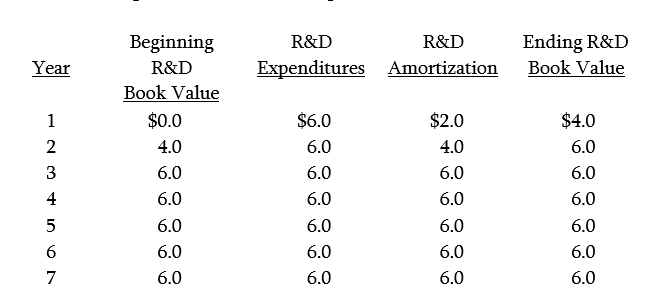
Notice that after the second year, R&D Inc. is adding new R&D assets of $6.0 million and writing off R&D amortization of $6.0 million per year. The only difference is that the invested capital is larger by $6.0 million of R&D assets.
| Earnings before R&D expenditures | 21.5 | |
| Amortization of R&D assets | 6.0 | |
| Earnings after R&D amortization | 15.5 | |
| Total invested capital (including R&D assets) | 106 | |
| Weighted average cost of capital | 14% | |
| Capital cost | (14.84) | |
| EVA | 0.66 |
c) In the specific case of R&D Inc., how does capitalizing and amortizing R&D expenditures instead of expensing R&D affect the incentive for managers approaching retirement to underspend on R&D at R&D Inc.
Answer:
Since the firm is spending a constant amount on R&D each year, capitalizing versus expensing R&D produce the same earnings after capitalization and amortization. Both methods charge earnings for $6 million. The only differential effect capitalization and amortization has is on the capital charge (14% × $6 million). Under R&D expensing, cutting R&D by $1 million gives the manager immediate savings of $1 million and thus $1 million more EVA.
Under R&D capitalization/amortization, cutting R&D by $1 million translates into lower amortization this year of $333,333 ($1 million ÷ 3) plus a lower capital cost of $93,333 ($666,667 million ending book value x 14%), or a total savings this year of $426,666. Capitalization/amortization still gives the manager an incentive to under spend on R&D, but the incentive is smaller. Therefore, capitalization/amortization reduces the incentives of managers to cut R&D. (Note: the preceding calculations assume that the EVA capital charge of 14% is applied to the ending book value of the R&D asset. Slightly different numbers result if the 14% is applied to the average of the beginning and ending book values of the R&D asset, but the same conclusion obtains – capitalization/amortization reduces, but does not eliminate incentive of managers approaching retirement to under spend on R&D).
197) The reciprocal allocation method is the most precise yet infrequently used. Which of the following is not true?
Answer: The reciprocal method requires the significant computing power of large computers to solve simultaneous equations, thus putting it out of reach of most companies
198) A review of skilled engineering labor rates and variances at Kumisomo Industries revealed the following: Actual wage per hour was ¥15,000, as opposed to ¥13,000 planned. Actual labor hours per unit produced were 1.2 compared with 1.4 hours planned. If during a period 1,000 units were produced, which of the following is false?
Answer:
The DL wage rate variance is ¥2,400 favorable.
The wage rate variance is unfavorable.
DL wage rate variance = (¥15,000 – ¥13,000) × 1.2 hours per unit × 1,000 units = ¥2,400 unfav.
DL efficiency variance = (1,200 hours – 1,400 hours) × ¥13,000 = ¥26,000 fav
199) Roberts Machining specialize in fabricating metal racks that hold electronic equipment such as telephone switching units, power supplies, and so forth. A new rack, th 1160, is scheduled to begin production. The die used to fabricate this rack cost Roberts $49,000 to design and build. Rack 1160 is a specialized custom product only for GTE. GTE and Roberts have a one-year contract where Roberts agrees to manufacture and GTE agrees to purchase a fixed number of 1160 racks over the next 12 months for a fixed price per rack. The 1160 rack will not be produced beyond one year. This contract generates profits of $358,000 (after deducting the die’s cost of $49,000). ROberts’ s accounting system recorded all expenditures for the 1160 die as a fixed asset with a one-year life. If this die is scrapped today or in one-year’s time, it has a scrap value of $6,800.
Easton, another metal fabricator, has offered to buy the 1160 die rom Roberts for $588,000 and will supply 1160 racks to GTE, GTE has agreed to this supplier substitution. ROberts estimates that if it sells the 1160 tools and dies to Easton, it will lose a current cash equivalent of $192,000 of future profits that would have been generated from GTE and similar customers, but now this business will go to Easton.
Required:
a) List all the alternatives in ROberts’ opportunity set with respect to the 1160 die.
Answer:
The opportunity set consists of:
a) Use die to produce #1160 racks and then scrap the die.
b) Use die to produce #1160 racks, but do not scrap the die.
c) Do not produce #1160 racks. Scrap the die immediately
d) Sell the die to Easton
e) Do not produce and do not scrap die
b) Calculate the net cash flows associated with each alternative in Roberts’s opportunity set listed in part (a).
Answer:
Cash flows of each alternative (assuming GTE does not sue Roberts for breaching contract and ignoring discounting):
(i) Use die to produce #1160 racks and then scrap the die
| Accounting profit | 358,000 |
| Add back cost of die | 49,000 |
| Scrap | 6800 |
| Net cash flow | 413,800 |
(ii) Use die to produce #1160 racks, but do not scrap the die
| Accounting profit | 358,000 |
| Add back cost of die | 49,000 |
| Net Cash flow | 407,000 |
iii) Do not produce #1160 racks. Scrap the die immediately
Net cash flow = 6,800”
iv) Sell the die to Easton
| Accounting profit | 588,000 |
| Less lost future profits | -192,000 |
| Net Cash flow | 396,000 |
v) Do not produce and do not scrap the die
Net cash flow = $0
c) What is the opportunity cost of each alternative in the opportunity set listed in part (a)?
Answer:
Opportunity cost of each alternative.
(i ) Use the die to produce #1160 racks and then scrap the die = $407,000
(ii) Use die to produce #1160 racks, but do not scrap the die = $413,800
iii) DO not produce #1160 racks. Scrap the die immediately = 413,800
iv) Sell the die to Easton = $413,800
v) DO not produce and do not scrap die = $413,800
d) What action should Roberts take with respect to the 1160 die?
Answer:
Roberts should reject Easton’s offer and produce the #1160 rack as specified in its contract. This alternative has the lowest opportunity cost (or equivalently, it has the greatest net cash flow)
200) Royal Holland Line
Royal Holland is a cruise ship company. It currently has six ships and plans to add two more. It offers luxury passenger cruises in the Caribbean, Alaska, and the Far East. Management is currently addressing what to do with an existing ship, the S.S. Amsterdam, when she is replaced by a new ship.
The S.S Amsterdam was built 20 years ago for $100 million. For accounting purposes, she was summed to have a 20-year life and hence is now fully depreciated. To replace the S.S. Amsterdam would cost $500 million, but her current market value is $371,250,000. The Holland Line can borrow or lend money at 10 percent.
The S.S. Amsterdam is now sailing the Caribbean and will be replaced next year by a new ship. The S.S. Amsterdam might be moved to the Mediterranean for a new seven-day Greek island tour. A seven-day cruise would depart Athens Sunday night, stop at four ports before returning to Athens Sunday morning, and prepare for a new cruise that afternoon. The S.S. Amsterdam can carry as many as 1,500 passengers. The accompanying data summarize the operating cost for this seven-day cruise.
| Variable cost | Fixed Cost | |
| Labor | 60,000 | 80,000 |
| Food | 236,000 | 10,500 |
| Fuel | 177,000 | |
| Port fees and services | 62,000 | |
| Marketing, advertising, promotion | 240,000 | |
| Supplies | 28,000 | 38,000 |
| Totals | 324,000 | 607,500 |
Required:
a) Assuming the seven-day Greek Island cruise can be priced at an average of $1,620, calculate the break-even number of passengers per cruise using the data provided.
Answer:
Before the break-even point can be calculated, the variable cost per passenger is computed as:
Variable cost per passenger = 324,000 / 1,200 = $270
Contribution margin per passenger = 1,620 – 270= 1,350
Break-even number of passengers = FC / CM
= 607,500 /1,350 = 450 passengers
b) What major cost component is not included in management’s estimates?
Answer:
The cost of the ship itself is not included. The weekly opportunity cost of the Mediterranean cruise is not using the ship elsewhere. One alternative use is to sell the ship and invest the proceeds. Since no other information is provided regarding alternative uses of the ship and assuming there are no capital gains taxes on the sale proceeds, the weekly opportunity cost of the ship is:
| Sales proceeds | 371,250,000 |
| X Interest rate | X 10% |
| 37,125,000 | |
| / number of weeks. year | / 50 |
| Weekly opportunity cost | 742,500 |
c) If you were to include the omitted cost component identified in part (b), recalculate the break-even point for the S.S. Amsterdam’s Greek island cruise.
Answer:
The revised break-even including the cost of the ship:
Total fixed cost = 607,500 + 742,500 = 1,350,000
Break-even = 1,350,000 / 1,350 = 1,000 passengers
d) Passengers purchase beverages, souvenirs, and services while on the ship. The ship makes money on the purchases,. If the ship line has a margin of 50 percent on all such on-board purchases, how much would the average passenger have to purchase for the break-ven point to be 900 passengers?
Answer:
Let C = contribution margin from additional sales
900 = 1,350,000 / 1,350 + C
900 (1350 + C) = 1350000
900 C = 1350000 – 1350 x 900
C = (1350000 / 900) – 1350”=
C = 150
Additional purchases per passenger = 150 / 0.50 = $300
PART S
201) Developing Additional Variances for Performance Evaluation
Saidwell Company manufactures washers and dryers on a single assembly line in its main factory. The market has deteriorated over the last five years and competition has made cost control very important. Management has been concerned about the materials costs of both washers and dryers. There have been no model changes in the past two years, and economic conditions have allowed the company to negotiate price reductions for many key parts.
Saidwell uses a standard cost system in accounting for materials. Purchases are charged to inventory at a standard price, and purchase discounts are considered an administrative cost reduction. Production is charged at the standard price of the materials used. Thus, the price variance is isolated at time of purchase as the difference between gross contract price and standard price multiplied by the quantity purchased. When a substitute part is used in production, a price variance equal to the difference in the standard prices of the materials is recognized at the time of substitution. The quantity variance is the actual quantity used compared with the standard quantity allowed, with the difference multiplied by the standard price.
The materials variances for several of the parts Saidwell uses are unfavorable. Part #4121 is one item that has an unfavorable variance. Saidwell knows that some of these parts are defective and will fail. The failure is discovered during production. The normal defective rate is 5 percent of normal input. The original contract price of this part was $0.285 per unit; thus, Saidwell set the standard unit price at $0.285. The unit contract purchase price of Part #4121 was increased to $0.325 from the original $0.285 due to a parts specification change. Saidwell chose not to change the standard; it treated the increase in price as a price variance. In addition, the contract terms were changed from payment due in 30 days to a 4 percent discount if paid in 10 days or full payment due in 30 days. These new contractual terms were the consequence of negotiations resulting from changes in the economy.
Data regarding the use of Part #4121 during December are as follows:
| Purchases of Part #4121 | 150,000 units |
| Unit price paid for purchases of Part #4121 | $0.325 |
| Requisitions of Part #4121 from stores for use in products | 134,000 units |
| Substitution of Part #5125 for Part #4121 to use obsolete stock (standard unit price of Part #5125 is $0.35) | 24,000 units |
| Units of Part #4121 and its substitute (Part #5125) identified as defective | 9,665 units |
| Standard allowed usage (including normal defective units) of Part #4121 and its substitute based on output for the month | 153,300 units |
Saidwell’s material variances related to Part #4121 for December were reported as follows:
| Price variance | $7,560.00U |
| Quantity variance | 1,339.50U |
| Total materials variances for Part #4121 | $8,899.50U |
Bob Speck, the purchasing director, claims the unfavorable price variance is misleading. Speck says that his department has worked hard to obtain price concessions and purchase discounts from suppliers. In addition, Speck says engineering changes in several parts have increased their prices, even though the part identification has not changed. These price increases are not his department’s responsibility. Speck declares that price variances no longer measure purchasing’s performance.
Jim Buddle, the manufacturing manager, thinks the responsibility for the quantity variance should be shared. Buddle states that manufacturing cannot control quality associated with less expensive parts, substitutions of material to use up otherwise obsolete stock, or engineering changes that increase the quantity of materials used.
The accounting manager, Mike Kohl, suggests that the computation of variances be changed to identify variations from standard with the causes and functional areas responsible for the variances. Kohl recommends the following system of materials variances and the method of computation for each:
| Variance | Method of Calculation |
Economics variance | Quantity purchased times the changes made after standards were set. Standards were the result of negotiations based on changes in the general economy. |
| Engineering change variance | Quantity purchased times change in price due to part specifications changes. |
| Purchase price variance | Quantity purchased times change |
Substitutions variance | Quantity substituted times the difference in standard price between original part and part substituted. |
Excess usage variance | Standard price times the difference between the standard quantity allowed for production minus actual parts used (reduced for abnormal scrap). |
| Abnormal failure rate variance | Abnormal scrap times standard price. |
Required:
a) Discuss the appropriateness of Saidwell Company’s current method of variance analysis for materials and indicate whether the claims of Bob Speck and Jim Buddle are valid.
Answer:
Isolation of the materials price variance at the time of purchase is appropriate because it records the entire amount of the variance in the correct period. The claims of Bob Speck and Jim Buddle, however, are valid.
Speck is correct in stating that the price variance is misleading and does not measure his department’s performance. Purchase discounts are price concessions obtained by the Purchasing Department for which the Purchasing Department should receive credit.
Buddle is correct in stating that the responsibility for the quantity variance should be shared. An analysis of increased quantities may indicate that there has been a purchase of inferior parts. This is the responsibility of the Purchasing Department.
The substitution of materials to use up otherwise obsolete stock is the result of actions or decisions of Purchasing, Engineering, or both, and should be charged to the responsible department(s).
b) Compute the materials variances for Part #4121 for December using the system recommended by Mike Kohl.
Answer:
| Economics variance | = | (Quantity purchased) × (Negotiation changes – contract terms) |
| = | 150,000 × [($.285 + $.04) × .04] | |
| = | $1,950 favorable | |
| Engineering change variance | = | (Quantity purchased) × (Price change from specifications) |
| = | 150,000 × $.04 | |
| = | $6,000 unfavorable | |
| Purchase price variance | = | (Quantity purchased) × (Other price changes) |
| = | 150,000 x $0 = $0 | |
| Substitutions variance | = | (Quantity substituted) × (Difference in standard price) |
| = | 24,000 × ($.35 – $.285) | |
| = | $1,560 unfavorable | |
Excess usage variance | = | (Standard price) × [(Standard quantity allowed) – (Actual usage reduced for abnormal scrap)] |
| = | $.285 × [153,300 – (134,000 + 24,000 – 2,365*)] | |
| = | $665.48 unfavorable | |
| Abnormal failure rate variance | = | (Abnormal spoilage) × (Standard price) |
| = | 2,365* × $.285 | |
| = | $674 unfavorable |
| Units | |
| *Total spoilage | 9,665 |
| Normal spoilage (153,300 × 0.5/1.05) | 7,300 |
| Abnormal spoilage | 2,365 |
c) Who would be responsible for each of the variances in Mike Kohl’s system of variance analysis for materials?
The problem is a good example of some of the many causes of materials price and quantity variances and how responsibility for the causes can be assigned.
Note:
| Price variance: | |||
| Purchase of 4121 | 150,000 × (.325 – 0.285 | $6,000 | |
| Substitution of 5125 | 24,000 × (.35 – 0.285) | 1,560 | |
| $7,560 | U |
| Quantity variance: | |||
| Standard usage | 153,300 | ||
| Actual usage | |||
| required | 134,000 | ||
| 5125s | 24,000 | 158,000 | |
| Excess usage | 4,700 | ||
| Times standard price | × .285 | ||
| $1,339.50 | unfav |
The following areas would be responsible for the variances in Mike Kohl’s system of variance analysis.
| Variance | Area Responsible |
| Economics | Purchasing/corporate |
| Engineering change | Engineering |
Purchase price | Purchasing – generally Sales – in the case of a rush orderManufacturing – in the case of poor production planning |
Substitutions | Engineering – in the case of poor design or choice of partsManufacturing – in the case of failing to notify Purchasing of planned usage to be sure that a sufficient supply of a part is on hand when needed |
| Excess usage | Manufacturing |
Abnormal failure rate | Manufacturing – in the case of carelessnessPurchasing – in the case of the purchase of inferior parts |
202) Samuel Survivor is planning to save for retirement 35 years from now. He expects to live 25 years beyond that, and would like an annual retirement income of $38,500 after tax of 30%.
a) What is the lump sum needed to fund retirement, at an expected annual return of 11.2%?
Answer: $456,515
| Annual pre-taxincome | = Target income/(1 – tax rate) |
| $55,000 | = $38,500/(1 – .3) |
| PV Annuity | = Annuity * PVFAn |
| $456,515 | = $55,000 * 8.30028 |
| PVFAn | = (1 – (1 + .112)-25)/.112 |
b) How much must Samuel Survivor save each year to accumulate the lump sum found in the above question, assuming the same annual return?
i) $893
ii) 4,062
iii) 1,339
iv) 937
Answer: None of the above
| Annuity | = FV/FVFAn |
| $1,275 | = $456,515/357.888 |
| FVFAn | = ((1 + .112)35 – 1)/.112 |
203) Samuel Survivor is planning to save for retirement 35 years from now. He expects to live 25 years beyond that, and would like an annual retirement income of $38,500 after tax of 30%.
a) What is the lump sum needed to fund retirement, at an expected annual return of 11.2%?
Answer: 456,515
Explain:
Pre-tax Income Needed = After-tax Income /(1 -Tax rate) = 38,500 / (1-0.30) = 55,000
Present Value of Annuity PVA = Annuity payment x [(1 – (1+r)^-n)/ r]
Annuity Payment = 55,000
Interest rate = 11.2% = 0.112
Number of years (n) = 25 years
PVA = 55,000 x [{1 – (1+ 0.112)^-25)/ 0.112] = 456,515.26
b) How much must Samuel Survivor save each year to accumulate the lump sum needed to fund retirement, at an expected annual return of 11.2%?
Answer: None of the above
Explain:
Annual Interest rate r = 11.2% = 0.112
Accumulation Period n 35 years
Future Value of an Annuity Formula = PMT = FV / [((1+r)^n -1)/ r]
PMT = 456,515 / [((1+0.112)^35 -1) / 0.112] = 1,275.58
204) Sassy Snaps is a free-standing photo kiosk that allows customers to enter the kiosk, either alone or with up to 4 friends, and have a series of 5 pictures taken. The pictures are printed for immediate take-away by the customer. Maddie Maple leases several Sassy Snaps kiosks and has one placed in the student union at her college. She pays the union $96 per month to rent the space for her kiosk, she pays Sassy Snaps $144 per month to lease each kiosk. In addition, she pays Sassy Snaps $108 per month for a service to clean the kiosk and ensure it’s in top working condition. Each set of pictures costs $4. During October, Maddie had revenue from the college kiosk of $432, and expenses for paper of $64.80 and chemicals of $34.56.
a) If Maddie experienced an unfavorable variance of $2.16 for paper, a favorable variance of $3.24 for chemicals, and no variance for revenue, what was the budgeted amount for paper per set of pictures?
Answer: 0.58
Explain:
Actual Volume = Total Revenue / Price per Set = 432 / 4 = 108 sets
Budgeted Paper cost = Actual paper cost – Unfavorable Variance = 64.80 – 2.16 = 62.64
Budgeted Paper Rate per set = 62.64 / 108 sets = 0.58
b) If Maddie experienced an unfavorable variance of $2.16 for paper, a favorable variance of $3.24 for chemicals, and no variance for revenue, what was the budgeted amount for chemicals per set of pictures?
Answer: 0.35
Explain:
Actual Volume = Total Revenue / Price per set = 432 / 4 = 108 sets
Budgeted Chemical cost = 34.56 + 3.24 = 37.80
Budgeted Chemical rate per set = 37.80 / 108 sets = 0.35
205) Sedona Hats manufactures two different types of hat: Narrow Brim and Wide Brim. The company’s overhead costs include $72,000 for machining, $48,000 for machine set-ups, and $36,000 for inspections. Sedona produced 15,000 Narrow Brim hats and 60,000 Wide Brim hats. Sedona’s new cost accountant has compiled the following information:
| Narrow Brim | Wide Brim | |
| Direct Labor hours | 24000 | 36000 |
| Machine set-ups | 40 | 80 |
| Machine hours | 6000 | 18000 |
| Inspections | 60 | 90 |
a) If Sedona Hats uses activity-based costing, which of the following is not true?
Answer: The $48,000 for machine set-ups is considered a product-level cost.
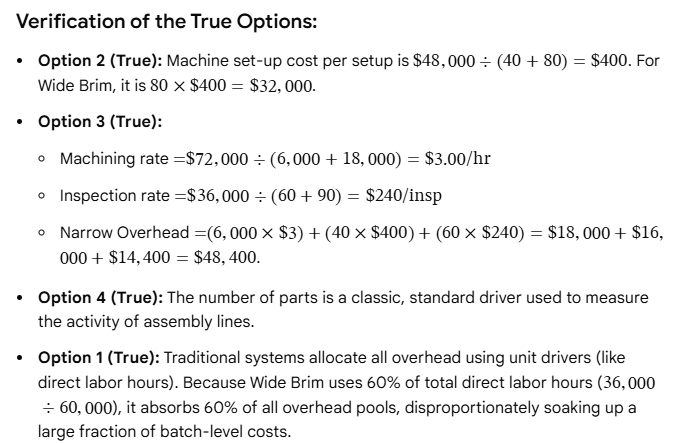
206) Several years ago, your firm paid $25,000,000 for Clean Tooth, a small, high-technology company that manufactures laser-based tooth cleaning equipment. Unfortunately, due to extensive production line and sales resistance problems, the company is considering selling the division as part of a “modernization program.” Based on current information, the following are the estimated accounting numbers if the company continues to operate the division.
| Estimated cash receipts, next 10 years | 500,000 /year |
| Estimated cash expenditures, next 10 years | 450,000/year |
| Current offer for the division from another firm | 250,000 |
Assume:
a) The firm is in the 0 percent tax bracket (no income taxes)
b) There are no additional expenses associated with the sale
c) After year 10, the division will have sales (and expenses) of 0.
d) Estimates are completely certain.
Should the firm sell the division for $250,000?
Answer:
PV = 50,000 x PV of annuity for 10 years @ r
PV depends on r.
Point of indifference = 250,000 = 50,000 x PV of annuity for 10 years @ r
PV of annuity @ r % for 10 yrs = (250,000 / 50,000) = 5000
PV of annuity for 10 years @ 14% = 5.216
PV of annuity for 10 yrs @ 16% = 4.833
If market rate of interest > 15% Keep
If market rate of interest < 15% Sell
207) Silky Smooth lotions come in three sizes:4, 8, and 12 ounces. The following table summarizes the selling prices and variable costs per case of each lotion sizes.
| Per Case | 4 Ounces | 8 ounces | 12 Ounces |
| Price | $36 | $66 | $72 |
| Variable Cost | 13 | 24.50 | 27 |
Fixed costs are $771,000. Current production and sales are 2,000 cases of 4-ounces bottles; 4,000 cases of 8-ounce bottles; and 1,000 cases of 12-ounce bottles. Silky Smooth typically sells the three location sizes in fixed proportion as represented by the preceding sales amounts.
Required:
How many cases of 4, 8, and 12-ounce lotion bottles must be produced and sold for Silky Smooth to break even, assuming that the three sizes are sold in fixed proportion?
Answer:
| Per case | 4 ounce | 8 ounce | 12 ounce | Bundle |
| Price | $36 | $66 | $72 | |
| Variable cost | 13 | 24.50 | 27 | |
| Contribution margin | 23 | 41.50 | 45 | |
| Current Production | 2000 | 4000 | 1000 | |
| Cases per bundle | 2 | 4 | 1 | |
| Contribution margin per bundle | 46 | 166 | 45 | 257 |
| Fixed cost | 771,000 | |||
| Number of bundles to break even | 3000 | |||
| Number of cases to break even | 6,000 | 12,000 | 3000 |
208) Snyder Stampings allocates overhead to products based on machine hours. It uses a flexible overhead budget to calculate a predetermined overhead rate at the beginning of the year. This rate is used during the year to allocate overhead to the various stampings produced. The following table summarizes operations for the last year.
| Budgeted fixed overhead | $3,800,000 |
| Over-absorbed overhead variance | $220,000 |
| Actual machine hours | 46,000 |
| Variable overhead per machine hour | $100 |
| Actual overhead incurred | $8,750,000 |
Required:
In setting the overhead rate at the beginning of the year, what budgeted volume of machine hours was used?
Answer:
| Over-absorbed overhead | = | Actual overhead – Overhead absorbed |
| ($220,000) | = | $8,750,000 -Overhead absorbed |
| Overhead absorbed | = | $8,970,000 |
| Overhead absorbed | = | Overhead rate × Actual machine hours |
| $8,970,000 | = | Overhead rate × 46,000 |
| Overhead rate | = | $8,970,000 ÷ 46,000 |
| = | $195/machine hour | |
| Overhead rate | = | Budgeted fixed overhead ÷ Budgeted volume + Variable overhead per machine hour |
| $195 | = | $3,800,000 ÷ Budgeted volume + $100 |
| Budgeted volume | = | $3,800,000 ÷ [$195 – $100] |
| = | 40,000 machine hours |
209) A soft drink company has three bottling plants throughout the country. Bottling occurs at the regional level because of the high cost of transporting bottled soft drinks. The parent company supplies each plant with the syrup. The bottling plants combine the syrup with carbonated soda to make and bottle the soft drinks. The bottled soft drinks are then sent to regional grocery stores.
The bottling plants are treated as costs centers. The managers of the bottling plants are evaluated based on minimizing the cost per soft drink bottled and delivered. Each bottling plant uses the same equipment, but some produce more bottles of soft drinks because of different demand. The costs and output for each bottling plant are:
| A | B | C | |
| Units Produced | 10,000,000 | 20,000,000 | 30,000,000 |
| Variable Costs | $200,000 | $450,000 | $650,000 |
| Fixed Costs | $1,000,000 | $1,000,000 | $1,000,000 |
Required:
a) Estimate the average cost per unit for each plant.
Answer:
| Plant A: ($1,000,000 +$200,000)/10,000,000 units | = | $0.1200/unit |
| Plant B: ($1,000,000 +$450,000)/20,000,000 units | = | $0.0725/unit |
| Plant C: ($1,000,000 +$650,000)/30,000,000 unit | = | $0.0550/unit |
b) Why would the manager of plant A be unhappy with using the average cost as the performance measure?
Answer:
The manager of plant A would be unhappy with using the average cost as the performance measure because the lower output of plant A means that the fixed costs (which are the same for all firms) are spread over fewer units. If the managers of the bottling plants cannot control output, then they cannot control the average cost per unit
c) What is an alternative performance measure that would make the manager of plant A happier?
Answer:
The manager of plant A would be unhappy with using the average cost as the performance measure because the lower output of plant A means that the fixed costs (which are the same for all firms) are spread over fewer units. If the managers of the bottling plants cannot control output, then they cannot control the average cost per costs.
d) Under what circumstances might the average cost be a better performance measure?
Answer: The average cost could be a good performance measure if the managers can control sales and output. By increasing sales and output, the managers can lower the average cost per unit and be rewarded accordingly.
210) Somimad Sawmill manufactures two lumber products from a joint milling process. The two products developed are mine support braces (MSBs) and unseasoned commercial building lumber (CBL). A standard production run incurs joint costs of $300,000 and results in 60,000 units of MSB and 90,000 units of CBL. Each unprocessed unit of MSB sells for $2 per unit and each unprocessed unit of CBL sells for $4 per unit.
If the CBL is processed further at a cost of $200,000, it can be sold at $10 per unit but 10,000 units are unavoidably lost (with no discernible value). The MSB units can be coated with a preservative at a cost of $100,000 per production run and then sold for $3.50 each.
Required:
a) If no further work is done after the initial milling process, calculate the cost of CBL using physical quantities to allocate the joint cost.
Answer:
Allocation using physical quantities
| MSB | CBL | Total | |
| Units @ split-off | 60,000 | 90,000 | 150,000 |
| % of physical quantity | 40% | 60% | 100% |
| Allocation of joint costs | $120,000 | $180,000 | $300,000 |
b) If no further work is done after the initial milling process, calculate the cost of MSB using relative sales value to allocate the joint cost.
Answer:
Allocation using relative sales value
| MSB | CBL | Total | |
| Revenue at split-off | $120,000 | $360,000 | $480,000 |
| % of sales value | 25% | 75% | 100% |
| Allocation of joint costs | $75,000 | $225,000 | $300,000 |
c) Should MSB and CBL be processed further or sold immediately after initial milling?
Answer:
Processing Further:
| MSB | CBL | |
| Price after processing | $3.50 | $10.00 |
| Units after processing | 60,000 | 80,000 |
| Revenue after processing | $210,000 | $800,000 |
| less: Cost of processing | 100,000 | 200,000 |
| revenue at split-off | 120,000 | 360,000 |
| Benefits of processing | -$10,000 | $240,000 |
| Process further? | NO | YES |
d) Given your decision in (c), prepare a schedule computing the completed cost assigned to each unit of MSB and CBL as charged to finished goods inventory. Use net realizable value for allocating joint costs.
Answer:
Allocation using net realizable value
| MSB | CBL | Total | |
| Revenues | $120,000 | $800,000 | |
| less: cost of processing | 0 | 200,000 | |
| NRV | $120,000 | $600,000 | $720,000 |
| % NRV | 17% | 83% | 100% |
| Joint cost | $50,000 | $250,000 | $300,000 |
| plus processing cost | 0 | 200,000 | |
| Total cost | $50,000 | $450,000 | |
| ÷ Number of units | 60,000 | 80,000 | |
| Unit cost | $0.833 | $5.625 |
211) A sound allocation system should:
Answer:
a) Be cheap and easy to administer
b) Provide incentives for cost control
c) Charge in proportion to amount used or benefit received
d) Be perceived as equitable by those who are charged
ALL of the above
212) The Spa Salon is a full-service day spa specializing in massage and manicures. One out of every three massage clients also purchases a manicure. Last month, Spa Salon did 90 massages and 30 manicures and reported the following net loss:
| Revenue | |
| Massages | 8100 |
| Manicures | 1500 |
| 9,600 | |
| Variable costs | |
| Massage | (3600) |
| Manicures | (600) |
| (4200) | |
| FIxed costs | (7020) |
| Net income (loss) | (1620) |
After reviewing the income statement fot last month, the owner was quite upset about the net loss. She thought the spa was making money.
Required:
How many massages and manicures does Spa Salon have to conduct each month to break even, assuming that the prices and variable costs of massages and manicures remain the same as last month’s, as do the fixed costs?
Answer:
The problem states that the Spa performed 90 massages and 30 manicures last month. From these data and the revenue numbers we can compute the price of a massage is $90 ($8,100 / 90) and the price of a manicure is $50 ($1,500 /30). Similarly, the variable cost of a massage is $40 ($3,600/90) and a manicure is $20 ($600/30), respectively.
Since one out of every three massage clients also purchases a manicure, a bundle of products consists of 3 massages and one manicure (with revenues of
$320 = 3 × $90 + $50 and variable cost of $140 = 3 × $40 + 20).
We can now compute the break-even number of bundles as:
Break-even bundles = FC / (P-VC) = 7020 / (320 – 140) = 39 bundles
39 bundles consists of 39 x 3 massages = 117 massages
39 bundles consists of 39 x 1 manicures = 39 manicures
To check these computations, prepare as income statement using 117 massages and 39 manicures.
| Massage revenue (117 x $90) | 10,530 | |
| Manicure revenue (39 x 50) | 1950 | |
| Total revenue | 12480 | |
| Massage variable cost (117 x 40) | 4680 | |
| Manicure variable cost (39 * $20) | 780 | |
| Fixed costs | 7020 | |
| Total costs | 12480 | |
| Profit | $0 |
213) Spring Company manufactures hard drives for computer manufacturers. At the beginning of this year Spring began shipping a much-improved hard drive, Model W899. The W899 was an immediate success and accounted for $5 million in revenues for Spring this year.
While the W899 was in the development stage, Spring planned to price it at $130. In preliminary discussion with customers about the W899 design, no resistance was detected to suggestions that price might be $130. The $130 price was considerably higher than the estimated variable cost of $70 per unit to produce the W899, and it would provide Spring with ample profits.
Shortly before setting the price of the W899, Spring discovered that a competitor had a product very similar to the W899 and was no more than 60 days behind Spring’s own schedule. No information could be obtained on the competitor’s planned price, although it had a reputation for aggressive pricing. Worried about the competitor, and unsure of the market size, Spring lowered the price of the W899 to $100. It maintained the price although, to Spring’s surprise, the competitor announced a price of $130 for its product.
After reviewing the current year’s sales of the W899, Spring’s management concluded that unit sales would have been the same if the product had been marketed at the original price of $130 each. Management has predicted that next year’s sales of the W899 would be either 85,000 units at $100 each or 60,000 units at $130 each. Spring has decided to raise the price of the disk drive to $130 effective immediately.
Having supported the higher price from the beginning, Sharon Haley, Spring’s marketing director, believes that the opportunity cost of selling the W899 for $100 should be reflected in the company’s internal records and reports. In support of her recommendation, Haley explained that the company has booked these types of costs on other occasions when purchase discounts not taken for early payment have been recorded.
Required:
a) Define opportunity cost and explain why opportunity costs are not usually recorded.
Answer:
Opportunity cost is defined as the profit that could have been realized if a particular action was not chosen. Opportunity costs occur because a firm is faced with alternative uses of resources.
Opportunity costs are not ordinarily incorporated in formal accounting systems because
+ They do not involve cash receipts or outlays (absence of a transaction)
+ The next best opportunity is often difficult to determine.
+ These types of costs often are not readily measurable
b) What is the current year’s opportunity cost?
Answer:
Opportunity cost in the current year = Units sold x Opportunity cost per unit
| Units sold | = | Revenue Unit sale price |
| = | $5,000,000$100 | |
| Revenue per unit | = | 50,000 units sold |
| Variable cost per unit | = | 50,000 × ($130 – 100) |
| Contribution margin per unit | = | $1,500,000 opportunity cost in the current year |
c) Explain the impact of Spring Company’s selection of the $130 selling price for the W899 on next year’s operating income. Support your answer with appropriate calculations.
Answer:
The selection of the $130 selling price for the W899 will increase Spring’s next year operating income by $1,050,000. This is equal to the increase in total contribution shown in the analysis of projected sales of the W899 presented below:
| $100 Selling Price | $130 Selling Price | |
| Revenue per unit | $100 | $130 |
| Variable cost per unit | 70 | 70 |
| Contribution margin per unit | $30 | $60 |
Total contribution:
| At $130 selling price60,000 units × $60 | = | $3,600,000 |
| At $100 selling price85,000 units × $30 | = | 2,550,000 |
| Net gain in total contribution | = | $1,050,000 |
214) Stahl produces and sells a single product and faces an inelastic demand curve, meaning it can sell as many units as it wants without affecting the selling price. Stahl has a cost structure consisting of fixed costs that are incurred each month, and a variable cost of $12 per unit produced that is independent of (i.e., does not vary with) the number of units produced. Stahl’s income tax rate is 30 percent, and its break-even quantity is 24,000 units each month. If Stahl produces 30,000 units during the month, it has an after tax net income of $33,600. Calculate Stahl’s selling price and monthly fixed costs.
Answer:
The formula for the break even quantity is
Q = FC /( Price per unit – VC per unit)
24,000 = FC / (P – 12)
F = 24,000P – 288,000 (1)
From the after tax data we can write down the following equation:
Profit after tax= (1-T) (PQ – VQ – FC)
Where T =tax rate = 0.30
33,600 = (1-0.30) ( 30,000 P – 30,000V – FC)
33,600 = 0.70 (30,000 P – 30,000 x 12 – F)
48,000 = 30,000 P – 360,000 – F
Substituting in eq. (1) from above yields:
48,000 = 30,000 P – 360,000 – (24,000P – 288,000)
408,000 = 30,000 P – 24,000P + 288,000
P = $20
Substituting P = $20 back into eq. 91) from above yields:
F = 24,000 x 20 – 288,000
F = 192,000
215) Standard costs:
Answer: are often set based on inputs by engineers
216) Standard costs embody targets. The targets should:
Answer:
Reflect a [articular management team’s goals
217) Step Up Inc. produces blue things and gray things. Blue things are in much greater demand in the market and the firm sells 120,000 blue things a year. Step Up Inc. sells 6,000 gray things per year in small boutiques. Things have a short shelf life. They must be distributed, sold, and consumed within two months of manufacture.
Both things use the identical production process and production facilities. Direct labor is $0.50 per thing and direct material is $0.50 per thing. Things are produced in batches. Blue things are produced in batches of 600 units and gray things in batches of 30. Each batch of things goes through the thingamajig, which is the machine that converts raw inputs into things. Each batch requires engineers to reset the machine for the next batch, calibrate settings, and test the first 10 things for product quality and conformity to standards. Even if sequential batches of the same things are made, setups must be performed for each new batch. All the overhead costs are incurred in setups. Indirect labor, indirect materials, and supplies consumed during setup cost $360,000 per year. The only costs of producing things are direct labor, direct materials, and the overhead of setups. The company is currently allocating setup costs to things based on direct labor cost.
The firm has been selling blue things for $4 per unit and gray things for $6 per unit.
But foreign competition for blue things is starting to put pressure on the $4 price.
Some competitors are selling blue things for as low as $3 per unit. Management is considering putting more emphasis on selling gray things, whose margins are higher.
On the other hand, management worries that the current system for allocating overhead costs is misrepresenting the costs of the two products because direct labor costs are not representative of the time spent by each product on the thingamajig.
Management is considering allocating setup costs using machine hours on the thingamajig. A batch of gray things requires one hour of machine time and a batch of blue things requires 20 hours of machine time.
Required:
Analyze the present situation. Is there anything wrong with the costing system? If so, should management change to the proposed allocation base of machine hours?
Answer:
In this problem, there are three possible overhead allocation bases: direct labor (present system), machine hours (the proposed system), and number of batches.
First, calculate product costs under each of the three allocation schemes.
i) Direct labor cost as the allocation base (present system).
| Bluethings | Graythings | Total | |
| Number of units | 120,000 | 6,000 | 126,000 |
| Direct labor/unit | .50 | .50 | |
| Direct labor cost | $60,000 | $3,000 | $63,000 |
| % of total direct labor cost | 95.238% | 4.762% | |
| Overhead allocated | 342,857 | 17,143 | 360,000 |
| Direct material cost | 60,000 | 3,000 | 63,000 |
| Total cost | $462,857 | $23,143 | $486,000 |
| Unit cost | $3.857 | $3.857 |
ii) Machine hours as the allocation base (proposed system):
| Bluethings | Graythings | Total | |
| Number of units/year | 120,000 | 6,000 | 126,000 |
| ÷ number of units/batch | 600 | 30 | |
| Number of batches/year | 200 | 200 | |
| × number of hours per batch | 20 | 1 | |
| Number of machine hours/year | 4000 | 200 | 4200 |
| % of total machine hours | 95.238% | 4.762% | |
| Overhead allocated | $342,857 | $17,143 | $360,000 |
| Direct labor cost | 60,000 | 3,000 | 63,000 |
| Direct material cost | 60,000 | 3,000 | 63,000 |
| Total cost | $462,857 | $23,143 | $486,000 |
| Unit cost | $3.857 | $3.857 |
iii) Number of batches as the allocation base:
| Bluethings | Graythings | Total | |
| Number of units/year | 120,000 | 6,000 | 126,000 |
| ÷ number of units/batch | 600 | 30 | |
| Number of batches/year | 200 | 200 | 400 |
| % of total batches | 50% | 50% | |
| Overhead allocated | $180,000 | $180,000 | $360,000 |
| Direct labor cost | 60,000 | 3,000 | 63,000 |
| Direct material cost | 60,000 | 3,000 | 63,000 |
| Total cost | $300,000 | $186,000 | $486,000 |
| Unit cost | $2.50 | $31.00 |
Notice that allocating overhead by either direct labor or machine hours produces identical product costs. Thus, the proposed system change will not affect decision making.
There are two cost drivers in Step Up Company. Unit volume drives direct materials and direct labor, but set-ups (number of batches) appear to drive overhead costs.
and direct labor, but set-ups (number of batches) appear to drive overhead costs. Allocating overhead using direct labor gives an incorrect impression of how overhead costs vary and distorts product costs. Overhead costs are incurred in set-ups. While run times per unit of thing is the same for blues and grays, batch sizes vary considerably. In fact, bluethings and graythings each required 200 batches.
Therefore, each product line (as opposed to each unit of product) should be allocated an equal dollar amount of overhead. If this is done, then graythings become massive losers and bluethings are seen to be profitable, even with market price of $3 per unit.
But these allocated costs using number of batches still do not necessarily represent opportunity costs. If the thing-a-majig and set-up crews are not operating at full capacity, then the opportunity cost of a batch of graythings is $30 (just variable cost).
However, if the firm is reducing the number of bluethings it can produce to make graythings (production is at capacity), then the opportunity cost of a graything is the forgone margin on a batch of bluethings plus the variable costs of the graythings. Or,
| Contribution margin on batch of bluethings ($4- 1) × 600 | $1800 | |
| Plus: Variable cost of a batch of graythings ($1 × 30) | 30 | $1,830 |
| ÷ Units of graythings per batch | 30 | |
| Opportunity cost of producing a graything | $61 |
The decision to continue to make graythings depends on i) how overhead costs vary with batches and ii) whether additional bluethings can be sold if graythings are not produced. If the size and cost of the set-up crew is invariant to the number of batches, then direct labor is probably not too bad an allocation base. If more bluethings cannot be sold, again it is not optimum to drop graythings. Graythings are covering variable cost. Just because all overhead costs are incurred in set-ups does not make set-up costs variable with number of batches.
Some of the overhead costs are sunk costs and do not vary with batches (e.g., depreciation of the “thing-a-majig”)
218) Adapting Variance Analysis to a Marketing Department
Sue Young sells fax machines for Express Fax. There are two fax machines: model 700 and model 800. At the beginning of the month, Sue’s sales budgets is as follows:
| Model 700 | Model 800 | |
| Budgeted contribution margin per unit | $200 | $300 |
| Forecasted sales in units | 100 | 100 |
| Budgeted margins | $20,000 | $30,000 |
At the end of the month, the number of units sold and the actual contribution margins are as follows:
| Model 700 | Model 800 | |
| Actual contribution margin | $150 | $350 |
| Number of units sold | 150 | 80 |
| Actual contribution | $22,500 | $28,000 |
Contribution margins have changed during the month because the fax machines are imported and foreign exchange rates have changed.
Required:
Design a performance evaluation report that analyzes Sue young’s performance for the month.
Answer:
This problem illustrates how variance analysis can be applied to non-manufacturing settings such as a marketing organization. A more thorough treatment of the topic is provided in.
| Model 700 | Model 800 | Total | |
| Variance in units sold from budget | 50 F | 20 U | 30 F |
| Variance in contribution marginper unit from budget | $50 U | $50 F | 0 |
| Difference in margin from budget broken down as: | $2,500 F | $2,000 U | $500 F |
| Mix variance | |||
| (ΔQ × CMs) 50 F × $200 | $10,000 F | ||
| 20 U × $300 | $6,000 U | $4,000 F | |
| Contribution margin variance | |||
| (ΔCM × QA) $50 U ×150 | $7,500 U | ||
| $50 F x 80 | _________ | $4,000 F | $3,500 U |
| Total Variance | $2,500 F | $2,000 U | $500 F |
Sue Young’s budgeted performance ($50,000 margin) and actual performance ($50,500) compare favorably. On model 700, she sold 50 more units producing $10,000 additional margin, but the lower contribution margin per unit reduced the overall margin by $7,500. Likewise, on the model 800, the higher price produced $4,000 additional but reduced sales that caused total margin to fall $6,000
219) Mortgage Department
Suppose you are the manager of a mortgage department at a savings bank. Under the state usury law, the maximum interest rate allowed for mortgage is 10 percent compounded annual.
Required:
a) If you granted a $50,000 mortgage at the maximum rate for 30 years, what would be the equal annual payments?
Answer:
Payments = 50,000 / (Annuity (30,0.10) = 50,000 / 9.427 = 5,303.91
b) If the current market internal rate on similar mortgage is 12 percent, how much money does the bank lose by issuing the mortgage described in part (a)?
Answer:
50,000 – (5304 x 8.055) = 50,000 – 42724 = 7276
c) The usury law does not prohibit banks from charging points. One point means that the borrow pays I present of the $50,000 loan back to the lending institution at the inception of the loan. That is, if one point is charged, the repayment are computed as in part (a), but the borrower receives only $49,5000. How many points must the bank charge to earn 12 percent on the 10 percent loan?
Answer:
(7276 / 50000) x 100 = 14.55
220) Suppose the market rate of interest is 10 percent and you have just won a $1 million lottery that entitles you to $100,000 at the end of each of the next 10 years.
Required:
a) What is the minimum lump sum cash payment you would be willing to take now in lieu of the 10-year annuity?
Answer:
The minimum lump sum you should take is the present value of the cash payments
PV = 100,000 x Annuity Factor (i=0.10, t=10)
= 100,000 x 6.145”= 614,500.
b) What is the minimum lump-sum you would be willing to accept at the end of the 10 years in lieu of the annuity?
Answer:
Looking in the future value in arrears table, the annuity factor is 15.937.
FV = 100,000 x 15.937 = 1,593,700
c) Suppose three years have passed, you have just received the third payment and you have seven left when the lottery promoters approach you with an offer to settle up for cash. What is the minimum you would accept at the end of year 3?
Answer:
This is similar to (a), this time, t=7
PV = 100,000 x Annuity Factor (i=0.10, t= 7)
= 100,000 x 4.868
= 486,800
d) How would you answer to part (a) change if the first payment came immediately (at t=0) and the remaining payment were at the beginning instead of the end of each year?
Answer:
To convert an end-of-year payment schedule to a beginning-of-year schedule, we need only multiply by 1 + r.
The minimum payment is $614,500 × 1.10 = 675,900
220) Suppose that a mining operation has spent $8 million developing an ore deposit in South America. Current expectations are that the deposit will require two years of development and will result in a realizable cash flow of $10 million at that time. The company engineer has discover a new way of extracting the one in only one year, but the procedure would necessitate an immediate outlay of $1 million.
Required
a) Compute the IRR for the new outlay. (Note: there are two solutions! One is 787 percent, find the other one)
Answer:
| Period 0 | Period | Period 2 | |
| Current situation | -8 | 0 | 10 |
| Additional expenditure | -9 | 10 | 0 |
| Difference | -1 | 10 | -10 |
Let X = 1 / (1 +IRR)
Using the equation
0 = -1 + 10X – 10X^2
IRR can be calculated using the quadratic formula
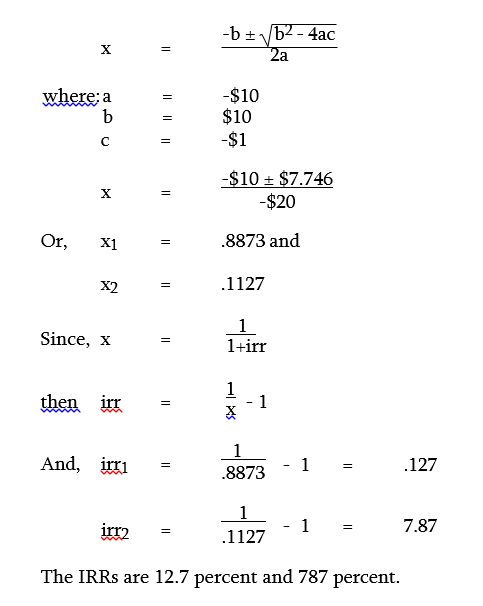
b) Based on your answer to part (a), use the IRR criterion to determine if the company should make the outlay. Assume the market interest rate is 15 percent on one- and two-year bonds.
Answer:
The bond rate of 15 percent lies between the two IRRs, making the additional outlay a positive NPV project. The company should invest the extra $1 million
221) Suppose the opportunity cost of capital is 10 percent and you have just won a $1 million lottery that entitles you to $100,000 at the end of each of the next ten years.
Required:
a) What is the minimum lump sum cash payment you would be willing to take now in lieu of the ten-year annuity?
Answer:
The minimum lump sum you should take is the present value of the cash payments.
| PV | = | $100,000 × Annuity Factor (i = .10, t = 10) |
| = | $100,000 × 6.145 | |
| = | $614,500 |
b) What is the minimum lump sum you would be willing to accept at the end of the ten years in lieu of the annuity?
Answer:
FV = $100,000 x 15.937 = $1,593,700
c) Suppose three years have passed and you have just received the third payment and you have seven left when the lottery promoters approach you with an offer to “settle-up for cash.” What is the minimum you would accept (the end of year three)?
Answer:
PV = $100,000 × Annuity Factor (i = .10, t = 7) = $100,000 x 4.868 = $486,800
d) How would your answer to part (a) change if the first payment came immediately (at t = 0) and the remaining payments were at the beginning instead of at the end of each year?
Answer:
To convert an end-of-year payment schedule to a beginning-of-year schedule, we need only multiply by 1 + r. The minimum payment is $614,500 × 1.10 = $675,900
PART T
222) The Talbott Company has received an order (#324) for 100 widgets. On January 20 the shop supervisor requisitioned 100 units of part 503 at a cost of $5 per unit and 500 units of part 456 at a cost of $3 per unit to begin work on the 100 widgets. On the same day 20 hours of direct labor at $20 per hour are used to work on the widgets. On January 21, 200 units of part 543 at $6 per unit are requisitioned and 10 hours of direct labor at $15 per hour are performed on the 100 units of widgets to complete the job. Overhead is allocated to the job based on $5 per direct labor hour.
Required:
Prepare a job order cost sheet for the 100 widgets.
| Job Order Cost Sheet 100 Widgets | |||||||
| Job Number 324 | |||||||
| Date Started 1/20 | |||||||
| Date Completed 1/21 | |||||||
| Raw Materials | Direct Labor | ||||||
| Date | Type | Cost | Qty. | Amount | Cost | Qty. | Amount |
| 1/20 | 503 | $5 | 100 | $500 | $20 | 20 hrs. | $400 |
| 1/20 | 456 | $3 | 500 | 1,500 | |||
| 1/21 | 543 | $6 | 200 | 1,200 | $15 | 10 hrs. | 150 |
| Total | $3,200 | 30 hrs. | $550 | ||||
| Total direct materials | $3,200 |
| Total direct labor | 550 |
| Overhead (30 direct labor hours @ $5/hour) | 150 |
| Total Job Cost | $3,900 |
| Divided by: Number of units in batch | 100 |
| Average cost per unit produced | $39.00 |
223) Taylor Chemicals produces a particular chemical at a fixed cost of $1,000 per day. The following table displays how marginal cost varies with output (in cases):
| Quantity (cases) | Marginal cost |
| 1 | $500 |
| 2 | 400 |
| 3 | 325 |
| 4 | 275 |
| 5 | 325 |
| 6 | 400 |
| 7 | 500 |
| 8 | 625 |
| 9 | 775 |
| 10 | 950 |
Required:
a) Given the preceding data, construct a table that reports total cost and average cost at various output levels from1 to 10 cases.
Answer:
Marginal cost is the cost of the next unit. So, producing two cases costs an additional $400, whereas to go from producing two cases to producing three cases costs an additional $325, and so forth. So, to compute the total cost of producing say five cases you sum the marginal costs of 1, 2, …, 5 cases and add the fixed costs ($500 + $400 + $325 + $275 + $325 + $1000 = $2825). The following table computes average and total cost given fixed cost and marginal cost .
| Quant. | Marginal cost | Fixed cost | Total cost | Average cost= TC / quant |
| 1 | $500 | $1000 | 1500(1000 + 500) | 1500 |
| 2 | 400 | 1000 | 1500 + 400 = 1900 | 950 |
| 3 | 325 | 1000 | 2225 | 741.67 |
| 4 | 275 | 1000 | 2500 | 625 |
| 5 | 325 | 1000 | 2825 | 565 |
| 6 | 400 | 1000 | 3225 | 537.50 |
| 7 | 500 | 1000 | 3725 | 532.14 |
| 8 | 625 | 1000 | 4350 | 543.75 |
| 9 | 775 | 1000 | 5125 | 569.44 |
| 10 | 950 | 1000 | 6075 | 607.50 |
b) At what quantity is average cost minimized?
Answer:
Average cost is minimized when seven cases are produced. At seven cases, average cost is $532.14
c) Does marginal cost always intersect average cost at minimum average cost? Why?
Answer:
Marginal cost always intersects average cost at minimum average cost. If marginal cost is above average cost, average cost is increasing. Likewise, when marginal cost is below average cost, average cost is falling. When marginal cost equals average cost, average cost is neither rising nor falling. This only occurs when average cost is at its lowest level (or at its maximum)
224) Telly Industries is a multiproduct company that currently manufactures 30,000 units of Part MR24 each month. The facilities now being used to produce Part MR24 have a fixed monthly cost of $150,000 and a capacity to produce 84,000 units per month. If Telly were to buy Part MR24 from an outside supplier, the facilities would be idle, but its fixed costs would continue at 40 percent of its present amount. The variable production costs of Part MR24 are $11 per unit.
Required:
a) If Telly Industries continues to use 30,000 units of Part MR24 each month, it would realize a net benefit by purchasing Part MR24 from an outside supplier only if the supplier’s unit price is less than how much?
Answer:
Each month Telly incurs $150,000 of fixed cost to have capacity to produce 84,000 units. They are only using 30,000 units of that capacity now. If they outsource MR24, they will continue to incur 40% of the fixed costs, or $60,000. However, they save $90,000 ($150,000 – $60,000). Besides saving the fixed costs they save $330,000 of variable costs ($11 × 30,000) or a total cost savings of $420,000. To be indifferent between outsourcing and continuing to produce, the outside price must be $14 ($420,000 ÷ 30,000). An alternative way to solve the problem and get the same answer is:
Outside rice + (40% of Fixed costs/ 30,000 units) = Variable Cost + (Fixed Cost/ 30,000 units)
P = $11 + ($150,000/ 30,000) – (150,000 x 40%)/ 30,000 = $14
b) If Telly Industries can obtain Part MR24 from an outside supplier at a unit purchase price of $12,875, what is the monthly usage at which it will be indifferent between purchasing and making Part MR24?
Answer:
$12,875 + (40% of Fixed Cost/ Q Units) = $11 + ($150,000/ Q Units)
12,875Q + 60,000 = $11Q + 150,000
1.875Q = 90,000
Q = 48,000 units
225) This is a comprehensive problem comparing absorption costing and ABC. It is suggested that as you progress through the problem, keep track of the correct solutions, because these values will be used again later in the problem set.
Dehli Inkstone specializes in inkstone creation. Each finished inkstone needs 1½ pounds of special materials which cost $20 a pound. (One pound contains 16 ounces.) Drilling requires 1 direct labor hours, for which workers are paid $10 per hour, and 40 minutes of machine time. The preliminary product (a ‘basic’) is inspected to ensure that it is sound. Fifteen percent of the basics are rejected. It is not possible to rework these, and they have no salvage value. Each approved stone is handed to a master craftsperson who spends two hours making a ‘Standard’ product or three hours creating a ‘Masterpiece’. Standards use half an hour of machine time and Masterpieces one hour. Finished inkstones are inspected again before packing. Four percent of finished products fail the final quality control assessment and are destroyed. Crafts persons are paid $18 per hour. It takes a ‘basic’ worker six minutes to package each inkstone in bubble wrap and a shipping carton, which cost 50 cents in materials and weigh 6 ounces in total.
Total overheads are estimated to be $587,400 per year and 97,900 direct labor hours are budgeted. Production plans for the year call for 60% of output to be Standard inkstones and the balance Masterpieces.
a) For a Standard inkstone, which is true of the materials input needed (to 3 significant figures)?
Answer: Total weight is 2.213 pounds
| ‘Standard’ Quantities | Materials |
| Bubble wrap, carton, lbs. | 0.375 |
| Materials, gross lbs. | 1.838 |
| Total inputs | 2.213 |
When there is waste in the process, work backwards to find the inputs needed. Gross up the last stage items first to find the needed input. Packing is performed on 100% good units. Package materials do not need adjustment. Materials are wasted at both stages in the process, so they must be grossed up twice.
To get one good preliminary unit, 1.17647 units must be started (1 ÷ .85). To get a good standard you need to start with 1.2255 preliminary units (1.17647 ÷ .96). So the total materials used to get one good standard is 1.838 lbs. (1.2255 × 1 ½ lbs.)
b) For a Masterpiece inkstone, which is true of the direct labor hours (DLH) needed (to 3 decimal places)?
Answer: Total DLH are 4.450
| ‘Masterpiece’ Quantities | DLH |
| Packaging labor | 0.100 |
| Craftsperson labor, gross DLH | 3.125 |
| Drilling, gross DLH | 1.225 |
| Total inputs | 4.450 |
Using the same logic as in Q11-3, to get one good standard, you must drill 1.225 units (see Q11-3), which each requires 1 DL hour per unit. Each master craftsman wastes 4% of the units, so to get 1 good unit, they must start 1.0417 preliminary units (1.0417 × .96 = 1.00 units). Since each Masterpiece inkstone requires 3 hours, to produce one acceptable masterpiece requires 3.125 DLH (1.0417 × 3)
c) For a Standard inkstone, which is true of the machine hours (MH) needed (to 3 decimal places)?
Answer: Total MH are 1.338
| Standard Quantities | MH |
| Craftsperson labor, gross MH | 0.521 |
| Drilling, gross MH | 0.817 |
| Total inputs | 1.338 |
To get one good standard unit, you must drill 1.225 units (see Q11-3), which requires 2/3 machine hours per unit (2/3 × 1.225 = 0.817). Also, to finish a standard requires another half hour of machine time. Before waste of 4%, 1.0417 basic units must be finished which requires 0.521 MH (1.0417 × 0.5 MH)
d) Which is the full (absorption) cost of a Masterpiece inkstone, if direct labor hours are used as the cost driver? (Allow a little for rounding errors).
Answer: $133.47
| Qty | Cost | Masterpiece | |
| Materials, gross lb. | 1.838 | $20 | $36.76 |
| Bubble wrap, carton | 0.375 | $0.50 | $0.50 |
| Drilling, gross DLH | 1.225 | $10 | $12.25 |
| Craftsperson labor | 3.125 | $18 | $56.25 |
| Packaging time | 1/10 | $10 | $1.00 |
| Total DLH | 4.450 | ||
| Direct cost | $106.77 | ||
| Overheads applied, per DLH | $6.00 | $26.70 | |
| Full cost | $133.47 |
| OHRate = | Est.Overheads | $587,400 | = $6.00 | per DLH |
| Est. DLH | 97,900 |
e) Which is the full (absorption) cost of a Standard inkstone, if machine hours are used as the cost driver? (Allow a little for rounding errors).
Answer: $107.88
The problem data did not provide the number of machine hours available, only budgeted labor hours and budgeted product output mix. The first step is to compute the units of product that can be made with the labor hours, split into the product mix and finally compute the total machine hours needed.
| COMPUTATIONS | |||
| 1. Standard craftsperson MH | |||
| Input = Output | 0.521 | 1/2 | MH |
| (1 -waste 2%) | 96.00% | ||
| 2. Masterpiece craftsperson MH | |||
| Input = Output | 1.042 | 1 | MH |
| (1 -waste 2%) | 96.00% | ||
| 3. Basic MH | |||
| Input = Output | 0.817 | 2/3 | MH |
| (1 -waste 1%) (1- waste 2%) | 85.00% | 96.00% |
| Standard | Masterpiece | ||
| Output% | 60% | 40% | |
| DLH | 3.409 | 4.450 | |
| Product Weighted DLH | 2.045 | 1.780 | 3.825 |
Available DLH | 97,900 | 25,595 | units of good output |
| Product Weighted DLH | 3.825 | ||
| Units of output (rounded up) | 15,357 | 10,238 | 25,595 |
| Standard, gross MH | 0.521 | ||
| Masterpiece, gross MH | 1.042 | ||
| Drilling, gross MH | 0.817 | 0.817 | |
| Total MH input | 1.338 | 1.859 | |
| Total MH needed | 20,547.67 | 19,032.44 | 39,580.11 |
Once budgeted total machine hours are known, it is then possible to derive the overhead rate per machine hour ($14.841), which is multiplied by planned product machine hours to determine overheads applied.
| Qty | Cost | Standard | |
| Materials, gross lb. | 1.838 | $20 | $36.76 |
| Bubble wrap, carton | 0.375 | $0.50 | $0.50 |
| Drilling, gross DLH | 1.225 | $10 | $12.25 |
| Craftsperson labor, gross DLH | 2.083 | $18 | $37.50 |
| Packaging time | 1/10 | $10 | $1.00 |
| Total DLH | 3.409 | ||
| Direct cost | $88.02 | ||
| Gross MH | 1.338 | ||
| Overheads applied, per MH | $14.84 | $19.86 | |
| Full cost | $107.88 |
OHRate = | Est.Overheads Est. MH | $587,400 39,580 | =$14.841 | per MH |
f) Which is the full (absorption) cost of a Masterpiece inkstone, if direct labor dollars are used as the cost driver? (Round overhead absorption rate to 3 decimal places).
Answer:
$134.15
| Qty | Cost | Masterpiece | |
| Materials, gross lb. | 1.838 | $20 | $36.76 |
| Bubble wrap, carton | 0.375 | $0.50 | $0.50 |
| Drilling, gross DLH | 1.225 | $10 | $12.25 |
| Craftsperson labor | 3.125 | $18 | $56.25 |
| Packaging time | 1/10 | $10 | $1.00 |
| Total DLH, DL$ per unit | 4.450 | $69.50 | |
| Overheads applied, per DL$ | $0.3940 | $27.38 | |
| Full cost | $134.15 |
| COMPUTATIONS | ||||
OH Rate = | Est.Overheads | $587,400 | = $0.394 | per DL$ |
| Est. DL$ | $1,490,909 | |||
| Standard | Masterpiece | Total | ||
| Units of output (rounded up) | 15,357 | 10,238 | 25,595 | |
| * DL$ per unit | $50.75 | $69.50 | ||
| Total DL$ | $779,368 | $711,541 | $1,490,909 |
g) Dehli Inkstone recently employed a cost analyst, who recommended the adoption of an ABC system to obtain a more accurate understanding of the costs of the Standard and Masterpiece products. She has classified the overheads into the following four cost pools and identified the appropriate cost drivers:
| Cost Pool | Dollars | Cost Driver |
| Materials handling | $121,000 | Pounds of raw materials |
| Inspection | $48,400 | Inspections |
| Machine operation & maint. | $163,350 | Machine hours |
| Labor-related costs | $254,650 | Direct Labor dollars |
| $587,400 |
h) Independent of your answers above, assume total planned output is 25,595 units. What is the correct materials handling cost rate?
Answer:
$2.136 per lb.
| Overhead cost pools | Cost | Cost driver units | OH$ per | |
| Materials handling | $121,000 | 56,641.7 | Pounds | $2.136 |
| COMPUTATIONS | |||
| Materials | Per unit | Output units | Total |
| Pounds | 2.213 | 25,595 | 56,641.7 |
| Weight | |||
| Bubble wrap, carton, lbs. | 0.375 | ||
| Materials, gross lb. | 1.838 | ||
| Total inputs | 2.213 | ||
i) What is true when ABC is used?
Answer: The full cost of the Masterpiece is $132.96
j) What is true when ABC is used in Dehli Inkstone?
i) Machine operations costs run $5.025 per machine hour
ii) Labor-related costs are $0.143 per direct labor dollar
iii) Inspection costs are $1.891 per inspection
iv) Labor-based overheads are 19.6% per direct labor dollar
Answer:
None of the above.
| Determination of Cost Driver Rates | ||||
| Inspection | $48,400 | 51,190.0 | Inspections | $0.945 |
| Machine operation & maint. | $163,350 | 39,580.1 | Machine hours | $4.127 |
| Labor-related costs | $254,650 | $1,490,908.8 | DL$ | $0.171 |
| Per unit | Output units | Total | |
| Inspections | 2 | 25,595 | 51,190.0 |
| Machine operations | Standard | Masterpiece | Total |
| Units of output (rounded up) | 15,357 | 10,238 | 25,595 |
| Standard, gross MH | 0.521 | ||
| Masterpiece, gross MH | 1.042 | ||
| Drilling, gross MH | 0.817 | 0.817 | |
| Total MH input | 1.338 | 1.859 | |
| Total MH needed | 20547.67 | 19032.44 | 39580.11 |
| Direct labor costs | |||
| Units of output | 15,357 | 10,238 | |
| × DL$ per unit | $50.750 | $69.500 | |
| Total DL$ | $779,368 | $711,541 | $1,490,909 |
226) Thompson Instruments (TI) utilizes proprietary technology to serve commercial, defense, and international market segments through three corresponding profit centers. Following production, items are sent to a centralized, cost-centered testing lab for final certification. This lab operates with monthly fixed costs of $240,000—primarily comprising historical equipment depreciation—alongside variable costs of $30 per testing hour performed. The $240,000 of fixed costs consists almost entirely of historical cost depreciation of the testing equipment.
Outside testing firms can also be used to test TI products produced by the three profit centers. Each outside testing firm can only test products for one TI market segment (commercial, defense, or international). Geographic and technical differences among the outside testing vendors prevent the defense vendor from testing commercial or international TI products. Likewise, the defense vendor can only test TI defense products. And so forth.
The following table summarizes the prices charged by the outside testing vendors and the number of testing horse budgeted for each month for year 1. (Assume that all12 months in each year are identical).
| Profit Centers | International | Commercial | Defense |
| OUtside testing vendor price per test hour | 75 | 80 | 92 |
| Budgeted testing hours per month | 1000 | 2000 | 3000 |
Thompson Instruments has the policy of recharging the testing department’s fixed and variable costs through a single overhead rate set at the beginning of the year based on the budgeted testing hours of all three profit centers. Each profit center has the decision making authority to have its products tested internally by TI’s testing department or by the external vendor. Assume the only difference between TI’s testing department and the outside testing vendors is price. Quality, timeliness, confidentiality, and so forth, are identical between inside and outside testing.
Required:
a) Calculate the testing department a OH rate per testing hour for year 1
Answer: Using budgeted testing hours of 6,000 hours (per month) yields the testing department’s OH rate of
OH rate = [240,000 + 6000 x 30) / 6000 = $70 per hour
b) Given the testing department’s OH rate computed in part (a ) for year 1, which profit centers will choose TI’s testing for their products, and which profit centers will use the outside vendor?
Answer:
Given that Thompson Instruments (TI) testing department’s overhead rate of $70 per hour is below that charged by each of the outside vendors, all three profit centers will choose to have their testing performed inside.
c) Before year 2 begins and before the TI testing department lab OH rate is set for year 2, TI’s defense profit center loses a government contract that involves 1,000 testing hours per month. Calculate the testing department’s OH rate per testing hour for year 2, assuming that the other two profit centers continue to have the same number of testing hours they used in year 1 and that the TI testing department’s fixed cost and variable cost per hour do not change.
Answer: Using budgeted testing horus of 5,000 hours (per month) yields the testing department’s OH rate for Year 2 of
OH rate = [240,000 +5000 x 30] / 5000 = $78 per hour.
d) Given the testing department’s OH rate computed in part (c ) for year 2, which profit centers will choose TI’s testing for their products, and which profit centers will use their outside vendor?
Answer:
Once the Year Two testing department overhead rate of $78 per hour is announced, the international profit center will shift its work to the outside vendor, while the other two profit centers will keep their testing inside.
e) Based on your answer to part (d) and assuming (i) the TI testing department’s fixed cost and variable cost per hour do not change, (2) Defense does not regain the lost contract, and (3 ) OH rate set in the testing department is based on the number of testing hours performed by the testing department in year 2, calculate the testing department’s OH rate is year 3.
Answer:
After International outsources its testing hours, there are 4,000 testing hours per month in Year Two. Thus, budgeted testing hours of 4,000 hours (per month) yields the testing department’s Year Three overhead rate of:
OH rate = (240,000 +4000 x $30) /4000 = $90/ hour.
f) Given the testing department’s OH rate computed in part (e ) for year 3, which profit centers will choose TI’s testing for their products, and which profit centers will use their outside vendor?
Answer:
Once the Year 3 testing department overhead rate of $90 per hour is announced, the commercial profit center will shift its work to the outside vendor and the international profit center continues to use its outside lab. Only Defense uses TI’s testing in Year 3.
g) Based on your answer to part (f ) and assuming (1) the TI testing department’s fixed cost and variable cost per hour do not change, (2) Defense does not regain the lost contract, and (2) the year 4 OH rate set in the testing department is based on the number of testing hours performed by the testing department in year 3, calculate the testing department’s OH rate in year 4.
Answer:
After International and commercial outsource their testing hours, only Defense is left using 2,000 testing hours per month in Year Three. Thus, budgeted testing hours of 2,000 hours (per month) yields the testing department’s Year Four overhead rate of:
OH Rate = (240,000 + 2000 x $30) / 2000 = $150/hour.
h) Given the testing department’s OH rate computed in part (g) for year 4, which profit centers will choose TI’s testing for their products, and which profit centers will use their outside vendor?
Answer:
All three TI profit centers are using outside vendors, and no testing is being conducted by TI’s testing department.
i) Given the sequence of events that have occurred over years 1 through 4, what problem does TI face? Propose (and then critique) TWO possible solutions to resolve the problem.
Answer:
TI faces the “death spiral”. There are several imperfect solutions:
(i) Instead of including the testing department’s fixed costs ($240,000) in the OH rate, use the VC per testing hour ($30). This reduces the likelihood of the death spiral. But, the opportunity cost of testing capacity is ignored. Eventually, this capacity will have to be replaced.
ii) Instead of using expected testing hours, use some notion of normal or long run volume that does not fluctuate with actual volume used. But them how is “normal” determined?
iii) Prohibit the profit centers from using outside testing vendors. This creates an inside monopoly with less incentive to control its costs. Also, by removing the decision rights from the profit centers to choose outside testing labs reduces the benefits of decentralization. When the profit center managers have specialized knowledge of their supplier markets, they should use this information.
iv) Close the internal testing lab. Since the inside and outside labs are identical in terms of quality, timeliness, confidentiality, and so forth, and there are few economies of scale (the prices charged by the outside labs are similar to the internal allocated costs), there is no reason for keeping the lab as part of Thompson Instruments
227) Toddca planned to produce 3,000 units of its single product, Terrgam, during November. The standard specifications for one unit of Terrgam include six pounds of material at $0.30 per pound. Actual production in November was 3,100 units of Terrgam. The accountant computed a favorable materials purchase price variance of $380 and an unfavorable materials quantity variance of $120.
Requried:
Based on these data, calculate how many pounds of material were used in the production of Terrgam during November.
Answer:
The formula for the materials quantity variance is:
Materials quantity variance = (Qa – Qs) × Ps
The standard price of the material, Ps, is $0.30. The standard quantity of materials, Qs, is: 3,100 units of Terrgam × 6 pounds per unit = 18,600 pounds.
Substituting the known quantities of the variables into the formula for the material quantity variance yields:
$120 U = (Qa – 18,600) × $0.30
Qa = 19,000 pounds
228) The town of Seaside has decided to construct a new sea aquarium to attract tourists. The cost of the measure is to be paid by a special tax. Although most of the townspeople believe the sea aquarium is a good idea, there is disagreement about how the tax should be levied.
Required:
Suggest three different methods of levying the tax and the advantages and disadvantages of each.
Possible methods of taxing include:
a) Sales tax on hotel rooms and restaurants: This is the most common method of taxing for the construction of a tourist site because the hotels and restaurants benefit directly from tourism. This taxing method is the same as allocating all the costs to the primary customers of the aquarium.
b) Property tax on businesses: This method allocates most of the costs of the aquarium to the businesses with the most expensive property. These businesses are most likely to be able to afford the additional tax. Not all businesses, however, will benefit from the aquarium.
c) Income tax on individuals: Once again, this method allocates costs to the individuals who are most likely to be able to afford the additional tax. But not all of these individuals will benefit from the aquarium.
d) A non-tax method of covering the cost of the aquarium is to issue a bond to pay for the aquarium and then use proceeds from ticket sales to pay the principle and interest on the bond.
One argument against allocating is that it will distort relative profitability. The controller says, “Because allocations are arbitrary, the resulting LOB profitabilities become arbitrary.” Another argument is that it is not fair to charge managers for costs they cannot control. LOBs cannot control shipping costs. For example, there are savings when two small separate shipments are combined into a single large shipment. LOBs will tend to avoid opening up new sales territories when other Telstar products are not being shipped to that area.
Required:
Write a memo addressing the controller’s concerns. Should Telstar begin allocating distribution costs to the LOBs? If so, which allocation scheme should it use?
Answer:
229) The Transfer Price Company has two divisions (Intermediate and Final) that report to the corporate office (Corporate). The two divisions are profit centers. Intermediate produces a proprietary product (called “intermed”) that it sells both inside the firm to Final and outside the firm. Final can only purchase intermed from Intermediate because Intermediate holds the patent to manufacture intermed. Intermed’s variable cost is %15 per unit, and Intermediate has excess capacity in the sense that it can satisfy demand from both its outside customers and Final. Final buys one intermed from Intermediate, incurs an additional variable cost of $5 per unit, and sells the product (called “final”) to external customers. Final faces the following demand schedule for final.
| Quantity | Price |
| 4 | $420 |
| 5 | 400 |
| 6 | 380 |
| 7 | 360 |
| 8 | 340 |
| 9 | 320 |
| 10 | 300 |
| 11 | 280 |
| 12 | 260 |
| 13 | 240 |
The preceding demand schedule can be represented algebraically as P = $500 – 20Q)
Required:
a) Calculate the quantity price combination of final that maximizes firm value. In other words, if Corporate knew the variable costs of the two divisions, for what price would they sell final, and how many units of intermed would Corporate tell Intermediate to product and transfer to Final?
Answer:
The following table calculates the profit maximizing price-quantity combination that corporate would set:
| Quantity | Price | VC ($15 + 5) | Profit |
| 4 | $420 | 20 | 1600 |
| 5 | 400 | 20 | 1900 |
| 6 | 380 | 20 | 2160 |
| 7 | 360 | 20 | 2380 |
| 8 | 340 | 20 | 2560 |
| 9 | 320 | 20 | 2700 |
| 10 | 300 | 20 | 2800 |
| 11 | 280 | 20 | 2860 |
| 12 | 260 | 20 | 2880 |
| 13 | 240 | 20 | 2860 |
MR=MC = 500 -20Q = 15 + 5
500 -20 = 20Q
Q= 12
P = 500 – 20(12) = 260
Profit = Total Rev – Total Cost
Total Rev = 260 x12 = 3120
TC = (15 +5) x 12 =240
Profit = 3120 -240 = 2880
b) Assume that the managers in Corporate do not know the variable costs in the two divisions. Intermediate has the decision rights to set the transfer price of intermed to Final. Intermediate knows Final’s variable cost of $5 and the demand schedule Final faces for selling final to its customers. Intermediate, therefore, knows that the following schedule explains how many units of intermed Final will purchase given the transfer price Intermediate sets:
| Transfer Price | Quantity of intermed Purchased by Final |
| 220 | 7 |
| 230 | 7 |
| 240 | 6 |
| 250 | 6 |
| 260 | 6 |
| 270 | 6 |
| 280 | 5 |
| 290 | 5 |
In other words, if Intermediate sets a transfer price of $260, Final will purchase six units of intermed and produce 6 units of final. Given the above schedule of possible transfer prices that Intermediate can choose, what transfer price will Intermediate set to maximize its profits?
Answer:
The following table shows that Intermediate will select a transfer price of $270 to maximize its profits.
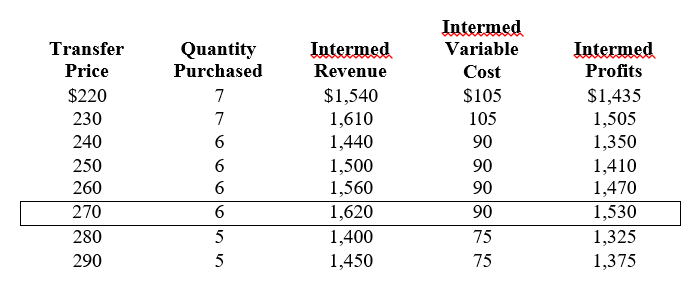
Rev = 220 x 7 = 1540
VC = $15 x 7 = 105
Profit = 1540 – 105 = 1435
c) While Corporate does not know intermed’s variable cost, it does know that the total cost of intermed is $48 per unit. This $48 per unit cost consists of both the variable costs to manufacture intermed plus the allocated fixed manufacturing costs. Intermediate allocates all its fixed costs over all the products it produces, including intermed. If Corporate sets the transfer price of intermed at $48, how many units of intermed will Final purchase?
Answer:
At a transfer price of $48, Final maximizes profits by purchasing 11 units of intermed as documented in the following table:
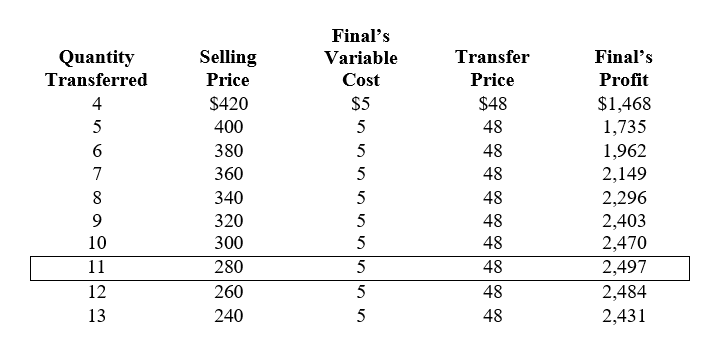
Marginal cost = 48 = 5 =53
Rev = 4 x 420 = 1680
Cost = 4 x 53 = 212
Final Profit = 1680 – 212 = 1468
d) What is the dollar impact on Intermediate’s profits if Final purchases the number of intermeds calculated in part (c )?
Answer:
For every unit of intermediate produced and transferred to Final, Intermediate’s profits rise by the amount of allocated fixed costs. Because these costs are fixed, producing more units of intermediate and selling them to Final causes Intermediate’s profits to rise by $33 ($48 – $15). Since Final will purchase 11 units, Final’s profits increase by 11 × $33, or $363
e) Should Corporate allow Intermediate to set the transfer price for itnermed that you calculated in part (b), or should Corporate set the transfer price at $48 as in part (c )? Support your recommendation with a quantitative analysis.
Answer:
Corporate should set the transfer price at full cost of $48 because this results in higher firm-wide profits than if Intermediate sets the transfer price at $270. If corporate knew Intermediate’s variable cost is $15 per unit, and corporate sets the transfer price at $15, Final would purchase 12 units. Using Intermediate’s full cost of $48 causes Final to purchase 11 units, one fewer than the firm-value-maximizing amount. While slightly less than the firm-value-maximizing transfer (11 vs. 12), full cost transfer pricing is far better than letting Intermediate set the transfer price at $270 where only six units are transferred. The following table shows that firm profits are larger at a transfer price of $48 than a transfer price of $270. And at a transfer price of $48, firm profits are only $20 below the firm-value maximizing transfer price of $15 ($2,860 vs. $2,880).
| Transfer price = $48 | ||
| Intermediate’s profits | ||
| Margin (48 – 15) | 33 | |
| Units transferred | 11 | |
| Profits | (33 x 11) = | 363 |
| Final’s profits | ||
| Margin (280 – 48 – 5) | 227 | |
| Units transferred | 11 | |
| Profits | (227 x 11) = | 2497 |
| Total firm-wide profits | 2860 | |
| Transfer price = 270 | ||
| Intermediate’s profits | ||
| Margin (270 – 15) | 255 | |
| Units transferred | 6 | |
| Profits | 1530 | |
| Final’s profits | ||
| Margin ( 380 – 2770 – 5) | 105 | |
| Units transferred | 6 | |
| Profits | 630 | |
| Total firm-wide profits | 2160 | |
| Transfer price = $15 | ||
| Intermediate’s profits | ||
| Margin (15 – 15) | 0 | |
| Units transferred | 12 | |
| Profits | 0 | |
| Final profits | ||
| Margin (260 – 15 – 5) | 240 | |
| Units transferred | 12 | |
| Profits | 2880 | |
| Total firm-wide profits | 2880 |
230) Typical measures of quality include:
a) Percentage of defects
b) Dollars spent on rework
c) Number of on-time deliveries
d) Customer satisfaction surveys
Answer: All of the above
231) Typical quality improvements include:
a) Product redesign
b) Electronic defect detection
c) Alteration of organizational architecture to increase local responsiveness to customer needs
d) Purchase of robotic manufacturing systems
Answer: All of the above
PART U
232) Ultimate U-bolts (UU) paid $161,175 for direct labor this month, paying $1.50 cents less per hour than planned. Fifty-four thousand pounds of bolts were produced and direct labor was paid for 9,210 hours. Producing one pound takes ten minutes. Which is true?
a) The direct labor rate variance is $4,605 unfav
b) The direct labor rate variance is $4,605 fav
c) The direct labor rate variance is $4,500 fav
d) The labor operating efficiency is 102%
Answer:
None of the above
Std DL hours = 54,000 lbs × (10 minutes ÷ 60 minutes per hour) = 9,000 hours
Actual wage rate = $161,175/9,210 hours = $17.50 per hour.
Standard wage rate = Actual rate + $1.50 = $19.00.
DL rate variance = ($17.50 – $19.00) × 9,210 = $13,815 fav.
DL efficiency variance = (9,210 hours – 9,000 hours) × $19.00= $3,990 unfav.
DL operating efficiency = 9,000 hours / 9,210 hours = 97.7%
233) The university athletic department has been asked to host a professional basketball game at the campus sports center. The athletic director must estimate the opportunity cost of holding the event at the sports center. The only other event scheduled for the sports center that evening is a fencing match that would not have generated any additional costs or revenues. The fencing match can be held at the local high school, but the rental cost of the high school gym would be $200. The athletic director estimates that the professional basketball game will require 20 hours of labor to prepare the building. Clean-up depends on the number of spectators. The athletic director estimates the time of clean-up to be 2 minutes per spectator. The labor would be hired especially for the basketball game and would cost $16 per hour. Utilities will be $500 greater if the basketball game is held at the sports center. All other costs would be covered by the professional basketball team.
Required:
a) What is the variable cost of having one more spectator?
Answer: The variable cost of one more spectator is the cost of clean-up (2 minutes/ 60 minutes/ hour) ($16/hour) = 0.533
b) What is the opportunity cost of allowing the professional basketball team to use the sports center if 10,000 spectators are expected?
Answer:
The opportunity cost with 10,000 spectators is
| Cost of relocating the fencing match | $200 |
| Cost of labor for preparation (20 hours)($16/hour) | 320 |
| Cost of additional utilities | 500 |
| Cost of clean-up (10,000)($0.53333) | 5,333 |
| Total | $6,353 |
c) What is the opportunity cost of allowing the professional basketball team to use the sports center if 12,000 spectators are expected?
Answer:
The opportunity cost with 12,000 spectators is:
| Cost of relocating the fencing match | $200 |
| Cost of labor for preparation (20 hours)($16/hour) | 320 |
| Cost of additional utilities | 500 |
| Cost of clean-up (12,000)($0.53333) | 6,400 |
| Total | $7,420 |
234) The university computer lab is having difficulty controlling its costs. Analysis showed that a key issue is the cost of printer supplies (ink, paper, and machine repair). Which strategy is likely to reduce costs the most, if typical student use is 200 copies per month?
Answer:
Plan A: requiring students to pay 12 cents per copy
235) Accounting for JIT
Vail operates a JIT plant assembling ceiling fans. The Sunset Model ceiling fan has a standard material cost of $28.40, a standard direct labor cost of $14.80, and overhead (fixed and variable) of $16.10. On Monday, a batch of 100 Sunset fans is completed. All of the materials for the 100 fans were on hand prior to Monday and had been previously recorded in the raw and in-process inventory account.
Required:
In analyzing the financial statements of a firm using JIT and another firm in the same industry not using JIT, what differences would you expect to observe?
Answer:
Inventories in the JIT firm should be lower. Profits may or may not be different. If both firms have chosen their production methods to maximize their firm value, there is no reason to expect that the JIT firm has higher profits even though they are in the same industry because they likely operate in different niches.
236) Valux manufactures a single product and sells it for $10 per unit. At the beginning of the year there were 1,000 units in inventory. Upon further investigation, you discover that units produced last year had $3.00 of fixed manufacturing cost and $2.00 of variable manufacturing cost.
During the year Valux produced 10,000 units of product. Each unit produced generated $3.00 of variable manufacturing cost. Total fixed manufacturing cost for the current year was $40,000. There were no inventories at the end of the year.
Required:
a) Prepare two income statements for the current year, one on a variable cost basis and the other on an absorption cost basis.
Answer:
Variable cost and absorption costing income statements Income statement under variable costing:
| Revenue ($10/unit) (1,000 + 10,000) | $110,000 |
| Cost of goods sold | |
| Beginning inventory ($2/unit) (1,000 units) | (2,000) |
| Produced this year ($3/unit) (10,000 units) | (30,000) |
| Fixed costs | (40,000) |
| Profit | $38,000 |
The $3/unit fixed cost of making the beginning inventory would have been expensed in the previous year under variable costing.
Under absorption costing the cost per unit this period is:
[($3/ unit) (10,000 units) + $40,000] / 10,000 units = $7/ unit
Income statement under absorption costing:
| Revenue ($10/unit) (1,000 + 10,000) | $110,000 |
| Cost of goods sold | |
| Beginning inventory ($5/unit) (1,000 units) | (5,000) |
| Produced this year ($7/unit) (10,000 units) | (70,000) |
| Profit | $35,000 |
b) Explain any difference between the two net income numbers and provide calculations supporting your explanation of the difference.
Answer:
The difference is due to the ($3/ unit)(1,000 units) or $3,000 of fixed cost that is carried over to this year from last year in the beginning inventory.
237) ViCom produces a wide range of consumer electronics. ViCom’s Newark, New York, plant produces two types of cordless phones: 2.4 GHz and 6.0 GHz. The following table summarizes operations at the Newark ViCom plant for Year 1 and Year 2.
| Year 1 | Year 2 | |||
| 2.4GHz | 6.0Ghz | 2.4GHz | 6.0Ghz | |
| Units produced | 120,000 | 70,000 | 90,000 | 50,000 |
| Units sold | 100,000 | 60,000 | 100,000 | 60,000 |
| Change in inventory (units) | 20,000 | 10,000 | -10,000 | – 10,000 |
| Variable manufacturing cost per unit: | ||||
| Direct labor | $7.50 | $8.00 | $7.50 | $8.00 |
| Direct material | $18.00 | $24.00 | $18.00 | $24.00 |
| Variable overhead | $2.00 | $3.00 | $2.00 | $3.00 |
| Selling price | $45.00 | $78.00 | $45.00 | $78.00 |
Fixed manufacturing overhead amounted to $4 million in each year. At the start of Year 1, there were no beginning inventories of either 2.4-GHz or 6.0-GHz cordless phones. ViCom uses FIFO to value inventories.
Required:
a) Prepare variable costing income statements for Year 1 and Year 2.
Answer:
Variable cost income statements for Year 1 and Year 2 (thousands)
| Year 1 | Year 2 | |||||
| 2.4GHz | 6.0Ghz | Total | 2.4GHz | 6.0Ghz | Total | |
| Revenue | $4,500 | $4,680 | $9,180 | $4,500 | $4,680 | $9,180 |
| Variable Mfg Cost | 2,750 | 2,100 | 4,850 | 2,750 | 2,100 | 4,850 |
| Operating margin | $1,750 | $2,580 | $4,330 | $1,750 | $2,580 | $4,330 |
| Fixed mfg costs | 4,000 | 4,000 | ||||
| Variable cost net income | $330 | $330 | ||||
b) Prepare absorption costing income statements for Year 1 and Year 2. At the end of the year, fixed manufacturing overhead is absorbed to the two phone models using direct material as the allocation base.
Answer:
Absorption cost income statements for Year 1 and Year 2 using FIFO:
The first step is to allocate the fixed manufacturing overhead to the phones produced based on direct material dollars:
| Year 1 | Year 2 | |||||
| 2.4GHz | 6.0Ghz | Total | 2.4GHz | 6.0Ghz | Total | |
| Allocate fixed mfg cost based on Direct Materials | ||||||
| Direct materials per phone | $18.00 | $24.00 | $18.00 | $24.00 | ||
| Phones produced | 120,000 | 70,000 | 90,000 | 50,000 | ||
| Total Direct materials | $2,160 | $1,680 | $3,840 | $1,620 | $1,200 | $2,820 |
| % of total Direct material | 56.25% | 43.75% | 57.45% | 42.55% | ||
| Allocated fixed mfg overhead (000) | $2,250 | $1,750 | $4,000 | $2,298 | $1,702 | $4,000 |
| Fixed mfg overhead per phone produced | $18.75 | $25.00 | $25.53 | $34.04 | ||
| Phones in inventory at beginning of year | 0 | 0 | 20,000 | 10,000 | ||
| Phones sold from current year production | 100,000 | 60,000 | 80,000 | 50,000 | ||
| Fixed OH of phones sold (FIFO): | ||||||
| Beginning inventory (units) | 0 | 0 | 20,000 | 10,000 | ||
| Produced this year (units) | 100,000 | 60,000 | 0 | 80,000 | 50,000 | |
| Beginning inventory ($) | 0 | 0 | 20,000× $18.75 | 10,000× $25 | ||
| Produced this year ($) | 100,000× $18.75 | 60,000× $25 | 80,000× $25.53 | 50,000× $34.04 | ||
| Beginning inventory ($) (000) | $0 | $0 | $0 | $375 | $250 | $625 |
| Produced this year ($) (000) | 1,875 | 1,500 | 3,375 | 2,043 | 1,702 | 3,745 |
| Fixed OH of phones sold | $1,875 | $1,500 | $3,375 | $2,418 | $1,952 | 4,370 |
| FIFO ABSORPTION COST NET INCOME (000) | ||||||
| Year 1 | Year 2 | |||||
| 2.4GHz | 6.0Ghz | Total | 2.4GHz | 6.0Ghz | Total | |
| Revenue | $4,500 | $4,680 | $9,180 | $4,500 | $4,680 | $9,180 |
| Variable Mfg Cost | 2,750 | 2,100 | 4,850 | 2,750 | 2,100 | 4,850 |
| Operating margin | $1,750 | $2,580 | $4,330 | $1,750 | $2,580 | $4,330 |
| Fixed OH of phones sold | 1,875 | 1,500 | 3,375 | 2,418 | 1,952 | 4,370 |
| Absorption cost net income | -$125 | $1,080 | $955 | -$668 | $628 | -$40 |
Absorption cost net income for Year 1 and Year 2 (LIFO):
| Year 1 | Year 2 | |||||
| 2.4GHz | 6.0Ghz | Total | 2.4 GHz | 6.0 Ghz | Total | |
| Direct materials per phone | $18.00 | $24.00 | $18.00 | $24.00 | ||
| Phones produced | 120,000 | 70,000 | 90,000 | 50,000 | ||
| Total Direct materials (000) | $2,160 | $1,680 | $3,840 | $1,620 | $1,200 | $2,820 |
| % of total Direct material | 56.25% | 43.75% | 57.45% | 42.55% | ||
| Allocated fixed mfg overhead (000) | $2,250 | $1,750 | $4,000 | $2,297.9 | $1,702.1 | $4,000 |
| Fixed mfg OHPer phone produced in current year | $18.75 | $25.00 | $25.53 | $34.04 | ||
| Fixed mfg OH of phones produced and sold(000) incurrent year | $1,875 | $1,500 | $3,375 | $2,298 | $1,702 | $4,000 |
Using these allocated fixed manufacturing costs per phone, the absorption cost income statements (000):
| Year 1 | Year 2 | |||||
| 2.4GHz | 6.0Ghz | Total | 2.4GHz | 6.0Ghz | Total | |
| Revenue | $4,500 | $4,680 | $9,180 | $4,500 | $4,680 | $9,180 |
| Variable Mfg Cost | 2,750 | 2,100 | 4,850 | 2,750 | 2,100 | 4,850 |
| Operating margin | $1,750 | $2,580 | $4,330 | $1,750 | $2,580 | $4,330 |
| Fixed mfg cost of phones produced in current year | 1,875 | 1,500 | 3,375 | 2,298 | 1,702 | 4,000 |
| Fixed mfg cost of phones produced in prior years | 0 | 188 | 250 | 437 | ||
| Absorption cost net income | -$125 | $1,080 | $955 | -$735 | $628 | -$107 |
c) Prepare a table that reconciles any differences in variable costing and absorption costing net incomes for Year 1 and Year 2.
Answer:
Reconciliation of variable and absorption cost net incomes for Year 1 and Year 2 (FIFO):
| Variable Costing | AbsorptionCosting | Difference | |
| Year 1 net income | $330 | $955 | -$625 |
| Year 2 net income | 330 | -40 | $370 |
| Total | -$255 |
| Year 1 | Year 2 | |
| Units in inventory | ||
| 2.4 Ghz | 20,000 | 10,000 |
| 6.0 Ghz | 10,000 | 0 |
| Fixed OH in inventory | ||
| 2.4 Ghz | $375,000 | $255,319 |
| 6.0 Ghz | 250,000 | 0 |
| Total | $625,000 | $255,319 |
The difference between absorption and variable cost net incomes in Year 1 is $625,000, which is the amount of fixed overhead in the inventory at the end of Year 1. At the end of Year 2, the cumulative difference between absorption and variable cost net incomes (i.e., the sum of the net incomes from Year 1 and Year 2) is $255,000, which is the amount of fixed overhead remaining in the inventory at the end of Year 2.
If instead of using FIFO, had ViCom used LIFO, the following would be the absorption cost net incomes for Year 1 and Year 2.
Reconciliation of variable and absorption cost net incomes for Year 1 and Year 2 (LIFO):
| Variable Costing | AbsorptionCosting | Difference | |
| Year 1 net income | $330,000 | $955,000 | $625,000 |
| Year 2 net income | 330,000 | -107,500 | -$437,500 |
| Total net income | $660,000 | $847,500 | $187,500 |
| Fixed mfg OH added (deducted from) to inventory | |||
| Year 1 | Year 2 | ||
| 2.4 Ghz | $375,000 | -$187,500 | |
| 6.0 Ghz | $250,000 | -$250,000 | |
| Total | $625,000 | -$437,500 | $187,500 |
238) Vintage Cellars manufactures a 1,000 bottle wine storage system that maintains optimum temperature(55-57oF) and (50-80 percent). The system has a backup for power failures and can store red and white wines at different temperatures. The following table depicts how average cost varies with the number of units manufactured and sold (per month):
| Quantity | Average cost |
| 1 | $12,000 |
| 2 | 10,000 |
| 3 | 8,600 |
| 4 | 7,700 |
| 5 | 7,100 |
| 6 | 7,100 |
| 7 | 7,350 |
| 8 | 7,850 |
| 9 | 8,600 |
| 10 | 9,600 |
Required:
a) Prepare a table that computes the total cost and marginal cost for each quantity between 1 and 10 units.
Answer:
| Quantity | Average Cost | Total Cost | Marginal Cost |
| 1 | $12,000 | $12,000 | |
| 2 | 10,000 | 20,000 | 8,000 (20,000 – 12,000) |
| 3 | 8,600 | 25,800 | 5,800 |
| 4 | 7,700 | 30,800 | 5,000 |
| 5 | 7,100 | 35,500 | 4,700 |
| 6 | 7,100 | 42,600 | 7,100 |
| 7 | 7,350 | 51,450 | 8,850 |
| 8 | 7,850 | 62,800 | 11,350 |
| 9 | 8,600 | 77,400 | 14,600 |
| 10 | 9,600 | 96,000 | 18,600 |
b) What is the relation between average cost and marginal cost?
Answer:
Marginal cost intersects average cost at minimum average cost (MC-AC=7,100). Or, at between 5 and 6 units AC = MC =7,100
c) What is the opportunity cost of producing one more unit if the company is currently producing and selling four units?
Answer:
At four units, the opportunity cost of producing and selling one more unit is $4,700. At four units, total cost is $30,800. At five units, total cost rises to $35,500. The incremental cost (i.e., the opportunity cost) of producing the fifth unit is $4,700
d) Vintage Cellars sells the units for $9,000 each. This price does not vary with the number of units sold. How many units should Vintage manufacture and sell each month?
Answer:
Vintage Cellars maximizes profits ($) by producing and selling seven units.
| Quantity | Average cost | Total Cost | Total Rev | Profit |
| 1 | $12,000 | $12,000 | $9,000 | -$3,000 |
| 2 | 10,000 | 20,000 | 18,000 | -2,000 |
| 3 | 8,600 | 25,800 | 27,000 | 1,200 |
| 4 | 7,700 | 30,800 | 36,000 | 5,200 |
| 5 | 7,100 | 35,500 | 45,000 | 9,500 |
| 6 | 7,100 | 42,600 | 54,000 | 11,400 |
| 7 | 7,350 | 51,450 | 63,000 | 11,550 |
| 8 | 7,850 | 62,800 | 72,000 | 9,200 |
| 9 | 8,600 | 77,400 | 81,000 | 3,600 |
| 10 | 9,600 | 96,000 | 90,000 | -6,000 |
PART W
239) Wendy Wall (WW) makes wall units. For the year, the following details have been budgeted. Output, 10,000 units; factory overheads $1,250,000, of which 60% is variable. Each wall unit should take 2.5 hours of direct labor to produce. WW produced 9,500 units with 24,000 DLH used and $1,175,000 actual overhead was incurred. Overhead is allocated based on direct labor hours (DLH).
a) What is the correct overhead absorption rate (to nearest cent)?
Answer: $50.00
| Budgeted Overhead | $1,250,000 | = | $50.00 | per DLH | ||
| Budgeted DLH | 25,000 | |||||
| COMPUTATIONS | ||||||
| Quantity x | DLH | |||||
| Budgeted output: | 10,000 × | 2.5 = | 25,000 | |||
b) What is Wendy’s total overhead absorbed?
Answer: $1,187,500
| Quantity× | DLHper = | DLH @SV | × OHR= | OHapplied | |
| Actual output: | 9,500 | 2.5 | 23,750 | $50.00 | $1,187,500 |
c) What is Wendy’s total overhead variance?
Answer: $12,500 over absorbed
Total overhead variance is the difference between actual overhead expenditures and the standard cost driver units allowed for actual output achieved (i.e. standard volume).
| Std DLH | 23,750 |
| OHR | × $50.00 |
| Overheads applied | $1,187,500 |
| Less: Actual OH incurred | 1,175,000 |
| Total overhead variance (over absorbed) | $12,500 |
d) What is true of Wendy’s overhead variances?
Answer: Overhead spending variance is $45,000 fav.
OH Spending Variance = Actual OH incurred – flex budget @ actual DLH
| Actual | Actual @ std | |
| Actual DLH | 24,000 | |
| VOH Rate | $30.00 | |
| Variable overheads | $720,000 | |
| Budgeted Fixed overheads | $500,000 | |
| Flex budget @ actual DLH | $1,220,000 | |
| Actual OH incurred | $1,175,000 | |
| OH Spending Variance | $45,000 fav | |
COMPUTATIONS
Budgeted Variable OH = 60% of budgeted OH
= 60% x $1,250,000 = $750,000
Budgeted DLH = Budgeted units x std DLH per unit
= 10,000 x 2.5 DLH per unit = 25,000 DLHs
Variable OH rate = Budgeted variable OH / Budgeted DLHS
= 750,000 / 25,000 DLHs = $30.00 per DLH
240) What are two common reasons for managers to manipulate reported earnings?
Answer:
They are feeling pressured to meet internal sales goals
And: They are preparing to qualify for a bank loan
241) What are two impacts on costs as sales volume increases?
Answer:
Total fixed costs will stay the same.
And: Fixed costs per unit will decrease
241) What does accounting focus on?
Answer: The impact a business’s activities have on its overall financial performance
242) What does it mean if a company has a debt ratio of 101.5%?
Answer: The company has 1.5% more total liabilities than total assets
243) What does management accounting provide?
Answer:
The insight that management needs so the business can perform more effectively.
And: The detailed data that managers need to make decisions that will give the business a competitive edge
244) What has had the most significant impact on accounting practices?
Answer: Information technology
245) What impact does the sale of equipment have on the statement of cash flows?
Answer: Increase in cash from investing activities
246) What is a common category in a statement of cash flows?
Answer: Cash from investing activities
247) What is consistent with a continual decline in gross profit if the firm’s cost of goods sold remains the same?
Answer: Continual decrease in sales
248) What is known about the direct and indirect methods of preparing statements of cash flow?
Answer: The indirect method is more popular among large U.S. companies
249) What is a significant role of the U.S. Securities and Exchange Commission (SEC) in financial reporting?
Answer:
They ensure that financial statement users are provided with reliable information to use in decision making.
250) What is true when ABC is used?
Answer: The full cost of the Masterpiece is $132.96
| Qty | Cost | Standard | Masterpiece | ||
| Materials, gross lb | 1.838 | $20 | $36.76 | $36.76 | |
| Bubble wrap, carton | 0.375 | $0.50 | $0.50 | $0.50 | |
| Drilling, gross DLH | 1.225 | $10 | $12.25 | 1.225 | $12.25 |
| craftsperson labor | 2.083 | $18 | $37.50 | 3.125 | $56.25 |
| Packaging time | 1/10 | $10 | $1.00 | 1/10 | $1.00 |
| Total DLH, DL$ per unit | 3.409 | $50.75 | 4.450 | $69.50 | |
| Direct cost | $88.02 | $106.77 |
| ABCOverheads applied | |||||
| Overhead cost pools | OH$ per | ||||
| Materials handling, per lb | $2.136 | 2.213 | $4.73 | 2.213 | $4.73 |
| Inspection, per | $0.945 | 2 | $1.89 | 2 | $1.89 |
| Machine costs, per MH | $4.217 | 1.305 | $5.50 | 1.826 | $7.70 |
| Labor-related costs, per DLH | $0.171 | $50.75 | $8.67 | $69.50 | $11.87 |
| Full cost | $108.81 | $132.96 |
251) What is the typical treatment of large year-end balances in the variance accounts?
Answer:
Prorate the direct material and labor variances across cost of goods sold, work in process and finished goods inventories.
252) What role do ethical standards have in management accounting?
Answer:
To guide the resolution to possible ethical dilemmas that the managerial accountant may encounter
253) What two items of information are revealed on the balance sheet?
Answer: Ownership – Debt
254) When activities are performed inside firms, which of the following is true?
a) Centralized firms delegate decision rights to the lowest operational level
b) The best performance measurement systems use only financial data because it is objective
c) Individuals strive to manipulate the performance evaluation system to maximize their own benefits
d) For efficiency, a manager should have both decision rights and decision control
Answer: None of the above
255) When activities are performed inside firms, which of the following is true about organizational architecture?
Answer:
It is cost-ineffective to ratify all decisions
256) When considering the purchase of a large central system, such as power generation or computer networks, firms have to decide how big a system to acquire and whether, and, if so, how to charge users for it subsequently. Which is true?
Answer:
| Charge | Likely consequence | |
| a. | None | Firm acquires more capacity than needed |
257) When traditional absorption costing is employed, which of the following is false?
Answer: In a multi-product organization, product costs are accurately reported for decision-making purposes
258) When variances are used as an input to the performance evaluation system, which of the following scenarios may be encountered?
a) Purchasing managers may buy too much inventory to get a bulk purchase discount
b) Purchasing managers may buy lower quality materials to generate a favorable price variance
c) If standards are set at easily achievable levels, some people will only do enough to meet the target, but no more
d) When labor efficiency is measured on a team or production cell basis, the free rider may take advantage
Answer:
All of the above
259) Where would an investor find a summary of a company’s significant accounting policies?
Answer:
In the notes to financial statements
260) Which account is seen on the balance sheet of a manufacturing company but not on the balance sheet of a service-oriented company?
Answer: Inventory
261) Which advantage accrues when teams, or firms, are formed?
Answer:
a) Positive synergies
b) Each participant perceives an advantage to joining
c) Increase in economies of scale
d) Contracting efficiencies
Answer: All of the above
262) Which assurance does an external audit report provide for its readers?
Answer: The company’s financial statements fairly reflect its financial position
264) Which body regulates a certified public accounting firm’s audit practices when the firm is auditing a large publicly traded company?
Answer: The Public Company Accounting Oversight Board (PCAOB)
263) Which benefit does a corporation gain by following Generally Accepted Accounting Principles (GAAP)?
Answer: An increase in its comparability to other companies
265) Which cash flow category would include “cash received from investors”?
Answer: Cash from financing activities
266) Which category on the statement of cash flows summarizes cash receipts and payments to owners and creditors of the company?
Answer: Cash flows from financing activities
267) Which category of ABC activities are machine setup and material movement costs associated with?
Answer: Batch-level activities
268) Which form of debt should be reported in the long-term liability category?
Answer: Notes payable expected to be paid in 18 months
269) Which form of debt should be reported in the long-term liability category?
Answer: Notes payable expected to be paid in 18 months
270) Which formula yields a cash times interest earned ratio of 11?
Answer: Cash before interest and taxes of $11,000 / cash paid for interest of $1,000
271) Which internal control is intended to ensure that a company does not mistakenly pay a supplier for an invoice that includes more items than were actually received?
Answer:
The inventory department counts and inspects items as received and forwards the receiving record to accounts payable
272) What is a cost that will change in the future based upon the decision made?
Answer:
Differential cost
273) Which is false of just-in-time (JIT) manufacturing systems?
Answer: The power of suppliers is reduced
274) Which is true?
Answer: The present value of a perpetual income stream of $4,000 when the market rate of interest is 8% is $50,000.
| PV of perpetuity | = Annual income/interest rate |
| $50,000 | = $4,000/ 0.08 |
275) Which is true?
Answer: The workers were efficient because they used 210 fewer hours than allowed.
The internal control system is designed to safeguard assets, protect the integrity of the accounting information system, and to prevent fraud. A key practice is the division of duties to ensure that critical tasks are performed by two or more people.
276) Which is true of a firm’s transfer pricing policy?
Answer: Is often designed to minimize tax expense
277) Which is not a reason for allocating internal costs to cost objects?
Answer:
To determine the selling price of products
278) Which is not true of Total Quality Management (TQM)?
Answer: TQM requires ISO 9000 certification
279) Which is not true of the various methods of allocating service department costs?
Answer:
The direct method is quick to compute, accurate, and has low information requirements
280) Which item is an investing activity?
Answer: Cash payments for purchase of plant assets
281) Which of the following can be an opportunity cost?
a) Interest on cost of inventory
b) Cost of idle capacity
c) Cost of underutilized labor
d) The decline in an asset’s value
Answer: All of the above
282) Which of the following is a correct matching of terms?
Answer: Cutting a table leg is a unit-level cost
283) Which of the following is true?
Answer:
Mitigating the agency problem requires alignment of the interests of principal and agent
Or Theft by employees is an example of an agency cost.
284) Which of the following is true?
a) Successful firms have lower transaction costs than markets do
b) A legal system that protects ownership rights is critical to the efficient functioning of firms and markets
c) Markets allocate resources to their highest value use
d) Markets measure and reward performance
Answer: All of the above
285) Which of the following are true about cost allocation?
a) Cost allocation is a form of transfer pricing for indirect costs
b) Cost allocation is an internal tax on services
c) Cost allocation distorts choices that managers would make otherwise
d) Cost allocation should be imposed when maginal cost exceeds average costof an internal resource
All of the above
286) Which of the following is necessary in order for accounting numbers to be effective in decision monitoring?
Answer: The controller reports to the audit committee of the board of directors
287) Which of the following is true?
Answer: Mitigating the agency problem requires alignment of the interests of principal and agent
Or: Theft by employees is an example of an agency cost
288) Which of the following statements is correct?
Answer: Agency costs can be minimized by separating decision management from decision control
289) Which of the following statements is incorrect?
Answer: Variable overhead is allocated on the basis of production expected to be achieved over a number of periods after taking planned maintenance into consideration (normal capacity).
Or: A debit balance in the overhead account indicates that overhead is overabsorbed.
290) Which of these is true?
Answer: Standard volume = Actual output x # cost driver units allowed
291) Which of these is true?
a) Budgeted fixed factory overheads = Budgeted overheads per unit × actual volume
b) Budgeted fixed factory overheads = Budgeted overheads per unit × standard volume
c) Budgeted factory overheads = Budgeted fixed overheads per unit × budgeted volume + actual variable overheads
d) Budgeted factory overheads = Budgeted fixed overheads per unit × standard volume + budgeted variable overheads
Answer: None of the above
Budgeted factory overheads = Budgeted fixed overheads + budgeted variable OH per unit x budgeted volume
292) Which of the following is not true about cost allocation?
Answer: Noninsulating cost allocations can reduce the risk managers bear.
293) Which report summarizes cash collections and cash expenditures from operating, investing, and financing activities over a period of time?
Answer: Statement of cash flows
294) Which situation should result in revenue recognition on the income statement for the year ending 12/31/14 if the firm is using accrual-basis accounting?
Answer: In 2014, a company provides services to a customer for which cash will be collected the next year (2015)
295) Which term is defined as the residual interest in the net assets of a company?
Answer: Owner’s Equity
296) Which two actions do internal auditors perform to assist in maintaining the integrity of financial statements?
Answer:
They search for and investigate fraud.
And: They review financial records and internal controls.
297) Which two cash flow adequacy ratios represent a cash cow?
Answer: $6,991 / $5,486 & $5,220 / $1,875
298) Which two concepts are studied in cost-volume-profit analysis?
Answer: Profits & Levels of activity
299) Which two costs are included when calculating inventory costs?
Answer: Direct labor & Overhead
300) Which two examples are period costs?
Answer: Administrative expenses & Selling Expenses
301) Which two examples represent financial statement errors?
Answer:
The accounting department miscalculates the payroll tax due at year-end, resulting in an inaccurate liability
And The accountant unintentionally records amounts as revenue that were prepaid by customers but not yet earned
302) Which two items’ subtotals are included in a multi-step income statement? Choose 2 answers
Answer: Gross Profit & Income from Operations
303) Which two requirements must accounting firms that audit public companies meet under the Sarbanes-Oxley Act?
Answer:
Firms must not provide certain nonaudit services to audit clients, such as management functions or legal services.
And: Firms must report to and be retained by the audit committee rather than the CFO or other company management
304) Which two requirements must management of public companies meet under the Sarbanes-Oxley Act?
Answer:
They must provide an assessment of the effectiveness of internal controls with each annual report.
And: They must support a stronger board and audit committee
305) Which two values affect the measurement of net income? Choose 2 answers
Answer: Operating Expenses & Ordinary Gains & Losses
306) Which users would have a primary concern with an organization’s ability to provide health benefit?
Answer: Employees
307) Williams manufactures a variety of iron products, made to customer specifications, in small batches.
Willie Williams, owner, is concerned that he does not have an accurate understanding of the costs of production. You, a newly-minted MBA, have researched his business and identified various costs and cost drivers.
| Janitorial | Welding | HR | Data Svcs | Assembly | Total | |
| Own costs | $12,000 | $90,000 | $37,200 | $32,400 | $54,000 | $225,600 |
| Square feet | 500 | 3,000 | 1,500 | 2,000 | 4,500 | 11,500 |
| #employees | 7 | 25 | 8 | 10 | 75 | 125 |
| #transactions (thou) | 30 | 100 | 180 | 600 | 140 | 1,050 |
| Power usage | 22 | 730 | 11 | 17 | 220 | 1,000 |
The service departments (Janitorial, HR, and Data Services) are allocated to the two production departments (Welding and Assembly). Janitorial costs are allocated using square feet, HR using number of employees, and Data Services using number of transactions. You recall that there are several approaches to the allocation of service department costs, direct, step-down and reciprocal methods
a) If the direct method is used, which of the following is true?
Answer:
The amount of Data Services costs allocated to Welding is $13,500
For the direct method, the correct choice is c, for which calculations are shown below:
| Data Svcs | Welding | Assembly | |||
| Own costs | $32,400 | ||||
| Usage fraction: # transactions | |||||
| Own transactions | 100 | 140 | |||
| Total prod. depart. transactions | 240 | 240 | |||
| Data Svcs costs allocated | $13,500 | $18,900 | |||
None of the allocation methods require allocation from one production department to another (illustrated by choice a). Choice b, which requires allocation from one service department to another, is not valid under the direct method. Choice d is a valid allocation under this method, but the amount is wrong, as shown below:
| Janitorial | Welding | Assembly | |||
| Own costs | $12,000 | ||||
| Usage fraction: square feet | |||||
| Own area | 3,000 | 4,500 | |||
| Sum of production departments’ area | 7,500 | 7,500 | |||
| Janitorial costs allocated | $4,800 | $7,200 | |||
b) If the step-down method is used in this case, which sequence of allocations is not valid?
Answer:
Janitorial, Welding, HR, Data Svcs, Assembly
c) If the step-down method is applied, allocating the most costly department first, which is true?
Answer:
Assembly’s fractional use of Janitorial is 4500/ 7500
| Biggest$ first | Data Svcs Fraction | Janitorial Fraction | Welding Fraction | Assembly Fraction | |
| Alloc base Employees | 10 | 7 | 25 | 75 | |
| HR | 117 | 117 | 117 | 117 | |
| Transactions | 30 | 100 | 140 | ||
| Data Svcs | 270 | 270 | 270 | ||
| Square feet | 3,000 | 4,500 | |||
| Janitorial | 7,500 | 7,50 |
Note 1: Whichever allocation method is used (direct, step, or reciprocal), when determining the denominator, the values of the department being allocated are always excluded. For example, the firm has 125 employees, but when allocating HR’s costs, the 8 employees from HR are deducted.
Note 2: Under the step-down method, once a service department’s costs have been allocated, its values are excluded from the calculation of the denominators of other departments
d) If the step-down method is applied, allocating the most costly department first, which is true?
Answer:
Janitorial is allocated $3,953.28 from Data Svcs
| Biggest$ first | HR | Data Svcs | Janitorial | Welding | Assembly | Total | |
| Own costs | Alloc base | $37,200 | $32,400.00 | $12,000.00 | $90,000.00 | $54,000.00 | $225,600.00 |
| Employees | |||||||
| HR | -$37,200 | $3,179.49 | $2,225.64 | $7,948.72 | $23,846.15 | $37,200.00 | |
| Transactions | |||||||
| Data Svcs | -$35,579.49 | $3,953.28 | $13,177.59 | $18,448.62 | $35,579.49 | ||
| Square feet | |||||||
| Janitorial | -$18,178.92 | $7,271.57 | $10,907.35 | $18,178.92 | |||
| $118,397.87 | $107,202.13 | $225,600.00 |
e) If the reciprocal method is applied, which is true?
Answer: Welding’s total costs after allocation are $115,840.52
| Departments | Own cost | ShareP | Share D/A | Share J | |
| Janitorial | $18,037.71 | $12,000 | 7/117 | 1/15 | |
| HR | $55,840.60 | $37,200 | 2/5 | 3/22 |
| Data Svcs | $40,452.28 | $32,400 | 10/117 | 2/11 | |
| Welding | $115,840.52 | $90,000 | 25/117 | 2/9 | 3/11 |
| Assembly | $109,759.48 | $54,000 | 25/39 | 14/45 | 9/22 |
| Total | $225,600.00 | 1.00 | 1.00 | 1.00 |
308) With gasoline prices at $3.00 per gallon, consumers are flocking to purchase hybrid vehicles (with a combination of gasoline and electric motors) that get 50 miles per gallon of gasoline. The monthly payment on a three -year lease of a hybrid in $499 compared to $399 per month on a conventional, equivalent traditional gasoline car that gets 25 miles per gallon. Both vehicles require aa one time $1,500 payment for taxes, license, and dealer charges. Both vehicles have identical lease terms for the residual value, maximum number of miles allowed without penalty, and so forth.
Required:
a) Calculate how many miles the consumer must drive per year to make the hybrid the economical choice over the conventional gasoline-only vehicle.
Answer:
The $1,500 upfront payment is irrelevant since it applies to both alternatives. To find the break-even mileage, M, set the monthly cost of both vehicles equal
499 + M($3/ 50) = 399 + M($3/25)
100 = M(0.12 – 0.6)
M = 100/ 0.06 = 1,666.66 miles per month
Miles per year = 1,666.66 x 12 = 20,000
b) How does your answer to part (a) change if the price of gasoline is $4.00 per gallon?
Answer:
499 + M(4/50) = 399 + M(4/ 25)
M = 100 / 0.08 = 1250 miles per month
Miles per year = 1250 x 12 = 15,000 miles per year
309) With the possibility of the US Congress relaxing timber cutting restrictions, a local lumber company is considering an expansion of its facilities. The company believes it can sell lumber for $0.18/board foot. A board foot is a measure of lumber. The tax rate for the company is 30 percent. The company has the following two opportunities:
a) Build Factory A with annual fixed costs of $20 million and variable costs of $0.10/board foot. This factory has an annual capacity of 500 million board feet.
b) Build Factory B with annual fixed costs of $10 million and variable costs of $0.12/board foot. This factory has an annual capacity of 300 million board feet.
Required:
i) What is the break-even point in board feet for Factory A?
Answer:
Break-even point of Factory A = $20,000,000/ (0.18 – 0.10)= 250,000,000 board feet
ii) If the company wants to generate an after-tax profit of $2 million with Factory B, how many board feet would the company have to process and sell?
Answer:
To achieve an after-tax profit of $2,000,000:
[$10,000,000 + ($2,000,000 / (1-0.3)))] / ($0.18 – 0.12) = 214,285,717 board feet.
ii) If demand for lumber is uncertain, which factory is risker?
Answer:
Factory A has higher fixed costs, but lower variable costs per unit because of its larger capacity. If the demand for lumber is lower than expected, Factory A will have a more difficult time recovering its fixed costs. The break-even point for factory B is lower than the break-even point for factory A. Therefore, Factory A is the riskier investment.
iv) At what level of board feet would the after-tax profit of the two factories be the same?
Answer:
(1-0.3)[$0.18 – $0.19)(Quantity) – $20,000,000]
= (1-0.3)[$0.18 – 0.12)(Quantity – 10,000,000]
Quantity = 500 million board feet.
310) Wujo is a Shanghai company that designs high-end software to enhance and edit digital images. Its software, EzPhoto, is more powerful and easier to use than Adobe Photoshop, but sells at a much lower price. Currently, EzPhoto is written in Chinese for the Chinese market, but Wujo is entering the English-speaking market. This requires a substantial investment to convert EzPhoto is English. Wujo has established a UK wholly owned subsidiary (WUjo UK, or WUK for short) to sell EzPhoto to North American and European customers -professional and serious amateur photographers. The following table displays the various combination of prices and quantities it expects in sales of EzPhoto to English speaking users:
| Price (euros) | Quantity (000) |
| 270 | 130 |
| 265 | 135 |
| 260 | 140 |
| 255 | 145 |
| 250 | 150 |
| 245 | 155 |
| 240 | 160 |
| 235 | 165 |
| 230 | 170 |
| 225 | 175 |
For example, at a price of $270 in expects to sell 130,000 units of EzPhoto, or at $225 it can sell 175,000 units. To enter this market, WUK must spend $15 million to convert EzPhoto from Chinese to English, advertise EzPhoto, establish a website where purchasers can download EzPhoto, and hire an administrative staff to market and maintain the website. For each English version of EzPhoto sold, WUK expects to incur costs of $70 for sales commissions paid to third parties who market EzPhoto and technical support for customers purchasing EzPhoto. EzPhoto will be distributed only via the WUK website. There are no packaging or CD-ROM costs.
WUK is evaluated and its managers compensated based on reported WUK profits. Wujo CHina, the parent company, is considering charging WUK a transfer price for each unit of EzPhoto WUK sells.
Required:
a) If Wujo China does not charge WUK a royalty for each unit of EzPhoto WUK sells (the transfer price is zero), what price-quantity combination will WUK select, and how much profit will WUK make?
Answer:
With a zero transfer price the profit maximizing price is €235 and WUK reports a profit of €12.225 million
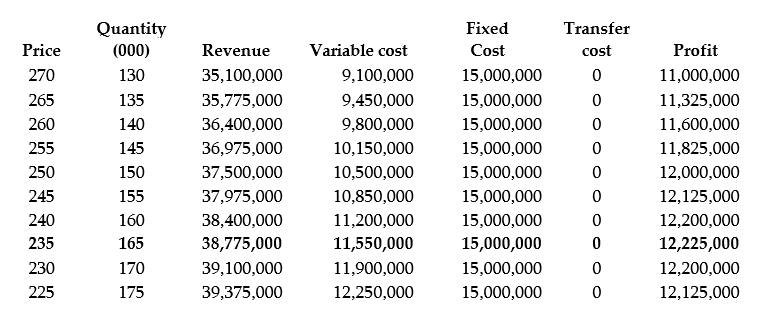
Revenue = 270 x 130,000 = 35,100,000
VC = 130,000 x 70 = 9,100,000
Profit = 35,100,000 – 9,100,000 -FC 15,000,000 = 11,000,000
b) If Wujo China charges WUK a royalty of $50 for each unit of EzPhoto WUK sells, what price-quantity combination will WUK select, and how much profit will WUK make?
Answer:
With a transfer price of €50 per unit, the profit maximizing price is €260 and WUK reports a profit of €4.60 million.
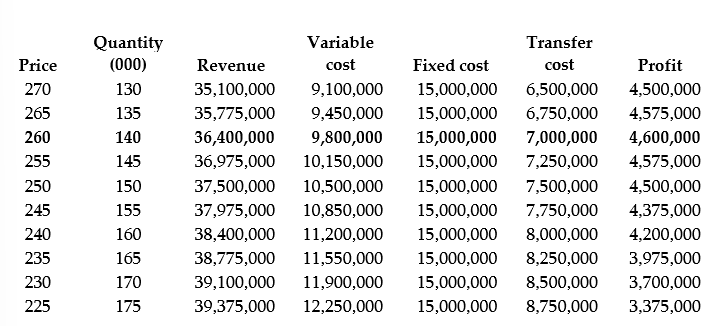
c) Ignoring any income taxes, what is the firm-value maximizing royalty that Wujo should charge WUK for each unit of EzPhoto WUK sells? Explain your answer.
Answer:
Ignoring income taxes, the value maximizing transfer price is zero. A zero transfer price induces WUK to set a lower price (€235) and sell more units (165,000), than if the transfer price is €50. The WUK managers will treat the €50 transfer price as a variable cost. They will take this variable higher cost into effect when determining their profit maximizing price. The €50 royalty effectively shifts up WUK’s marginal cost curve causing them to sell fewer units at a higher price. But this royalty is not a real marginal cost to the firm.
In effect, by charging a royalty of anything greater than zero results in the double marginalization problem discussed by economists
d) Wujo has to pay income taxes to the People’s Republic of China at the rate of 15 percent on any royalty payments it receives fromWUK, while WUK faces a UK tax rate of 33 percent on profits of EzPhoto. Note that WUK’s table income is calculated after deducting any transfer price paid to Wujo. What is the firm-value maximizing royalty that WUjo should charge WUK fir each unit of EzPhoto WUK sells? Whichever transfer price Wujo charges WUK (zero or $50), that transfer price is used to (i) measure and reward WUK managers, and (ii) calculate income taxes in the PRC, and the UK. Provide a detailed explanation supported by calculation justifying your answer.
Answer:
The following table demonstrates that overall firm value is maximized (on an after tax basis) by charging WUK a royalty of €50 for each unit of EzPhoto sold
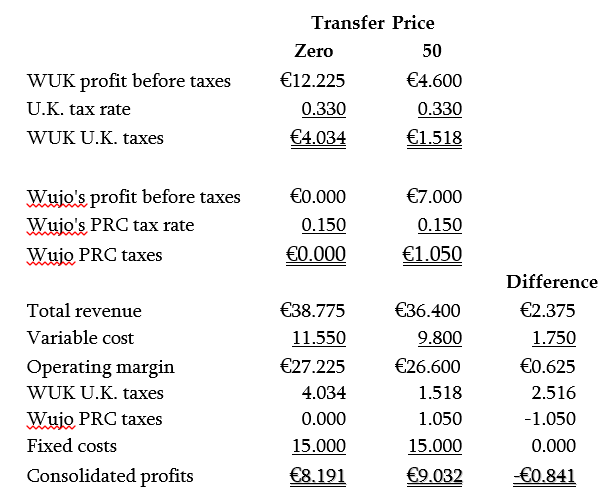
Even though WUK sells 25,000 (165,000 – 140,000) fewer units of EzPhoto at a €50 transfer price, the combined taxes paid to the PRC and the U.K. are substantially lower. With a zero transfer price, its U.K. tax bill is €4.034 million. At a €50 transfer price, profits are shifted out of the high tax U.K. jurisdiction to the lower tax PRC jurisdiction, and the total tax liability (PRC plus U.K.) is only €2.568 million. The lower total taxes paid with a €50 transfer price more than makes up for the lower operating margin (€625,000) that results from WUK setting a higher price and selling fewer units. In fact, the combined net cash flows are higher by €841,000 with a €50 royalty. This example illustrates how tax considerations often “trump” internal incentives when it comes to setting transfer prices.
e) Suppose that Wujo is able to use a different transfer price for determining WUK’s profit than it uses for calculating income taxes on its PRC and UK tax returns. What transfer prices should Wujo use for calculating WUK’s net income in determining WUK’s managers’ bonuses and for use on its two tax returns? The same transfer price has to be used on the two tax returns, but this transfer price need not be the same transfer price used for calculating WUK’s income for management bonuses.
Answer:
Clearly, if Wujo can set two different transfer prices, it would charge WUK a zero royalty internally to induce WUK to sell the profit maximizing number of EzPhotos, but the use the €50 transfer price on its PRC and U.K. tax returns. The following table calculates the combined cash flows after taxes.
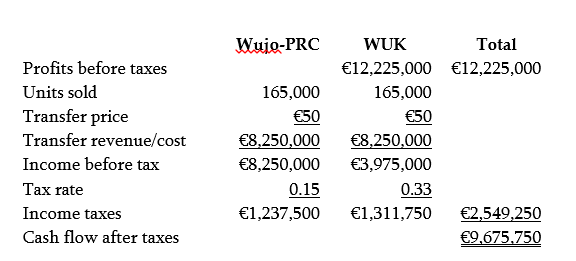
With a €50 transfer price used for both internal use and taxes, the total revenue is €4.6 million and a total tax liability of €2.568 million or net cash flows after taxes of €2.032 million. Clearly, Wujo would really like to use to separate transfer prices, a zero transfer price internally to motivate WUK to sell more units, and a €50 transfer price on its PRC and U.K. tax returns because this leads to much higher net cash flows after taxes (€7,643,750).
f) Why might you expect Wujo will be unable to implement the two transfer prices you propose in part (e).
Answer:
If the U.K. tax authorities audit WUK and find that WUK is using a €0 transfer price for internal purposes such as performance evaluation, they would challenge the use of the €50 transfer price used for taxes on the basis that the €50 transfer price being used for taxes serves no legitimate business purpose other than to minimize taxes. The only way WUK can justify its use of €50 as the transfer price for taxes is if they can show that this is normal business practice in the industry and that other software companies are using such a royalty rate in arms length transactions
311) XBT Keyboards
The keyboard division of XBT, a personal computer manufacturing firm, fabricates 50-key keyboards for both XBT and non-XBT computers. Keyboards for XBT machines are included as part of the XBT personal computer and are also sold separately. The keyboard division is a profit center. Keyboard included as part of the XBT PC’s are transferred to the PC division at variable cost ($60) plus a 20 percent markup. The same keyboard, when sold separately (as a replacement part) or sold for non-XBT machines, is priced at $100)/ Projected sales are 50,000 keyboards transferred to the PC division (included as part of the XBT PC) and 150,000 keyboards sold externally.
THey keys for the keyboard are fabricated by XBT on leased plastic injection-molding machines and then placed in purchased key sockets. These keys and sockets are assembled into a base, and connectors and cables are attached. Ten million keys are molded each year on four machines to meet the projected demand of 200,000 keyboards. Molding machines are leased for $500,000 per year per machine; maximum practical capacity is 2.5 million keys per machine per year. The variable overhead account includes all of the variable factory overhead costs for both key manufacturing and assembly. Studies have shown that variable overhead is more highly correlated with direct labor dollars than any other volume measure.
| Variable Costs | ||
| Materials | ||
| Plastic for keys | $3 | |
| Base | 11 | |
| Key sockets | 13 | |
| Connectors, and cables | 9 | |
| Direct labor, keys | 4 | |
| Direct labor, assembly | 12 | |
| Variable overhead | 8 | $60 |
| Fixed Costs | ||
| Key injection molding | 10 | |
| Fixed overhead | 18 | 28 |
| Unit manufacturing cost | 88 |
Sara Litle, manager of the keyboard division, is considering a proposal to buy some keys from an outside vendor instead of fabricating them inside XBT. these keys (which do not include teh sockets) will be used in the keyboards included with XBT PC’s but not in keyboards sold separately or sold to non-XBT computer manufacturers. The lease on one of XBT’s key injection – molding machines is about to expire and the capacity it provides can be easily shifted to the outside vendor.
The outside vendor will produce keys for $0.39 per ket and will guarantee capacity of at least 2.5 million keys per year. Little is compensated based on the profits of the keyboard division. She is considering returning one of the injection-molding machines when its lease expires and purchasing keys from the outside vendor.
Required:
a) How much will XBT save per key if it outsources the 2.5 million keys rather than producing them internally?
Answer:
The current incremental cost of manufacturing 2.5 million keys internally are
| Per key | |
| Materials ($3 / 50) | 0.06 |
| Direct labor – keys (4 / 50) | 0.08 |
| Variable overhead (8 / 16) x (4/50) | 0.04 |
| (Sum of direct labor of keys and assembly = 4 + 12 = 16) | |
| Injection molding (10/50) | 0.20 |
| Average unit cost per key | 0.38 |
Therefore, if the keys are outsourced, instead of produced internally, the firm’s cash flows fall by $0.01 ($0.39 – $0.38) per key.
b) What decision do you expect Sara Little to make? Explain why?
Answer:
Ms. Litle will purchase the keys from the outside vendor in order to maximize division profits and her own compensation, even though the average incremental cost per unit ($0.38) is lower than the vendor’s price ($0.39). The reason Litle takes this firm-value decreasing action is to convert a fixed cost (injection molding lease), which is not part of the variable cost transfer price she receives for keyboards included with XBT PCs, into a variable cost.
c) If you were a large shareholder of XBT and knew all the facts, would you make the same decision as Little? Explain
Answer:
XBT Keyboard Division’s pro forma income statement if manufacturing of all keys remains internal is:
| Revenue | ||
| External sales (150,000 @ $100) | 15,000,000 | |
| Internal transfers (50,000 @ 60 x 1.2) | 3,600,000 | 18,600,000 |
| Costs: | ||
| Variable costs (200,000 @ $60) | 12,000,000 | |
| Fixed costs: | ||
| Key injection molding (4 x $500,000) | 2,000,000 | |
| FIxed overhead (200,000 @ $18) | 3,600,000 | 17,600,000 |
| Divisional Profits | 1,000,000 |
If the outside vendor is used to manufacture the keys for units transferred for used with the XBT PC, the Keyboard Division profits are:
| Revenue | ||
| External sales (150,000 @ $100) | 15,000,000 | |
| Internal transfers (50,000 @ 70.50 x 1.2) | 4,230,000 | 19,230,000 |
| Costs: | ||
| Variable costs | ||
| External sales (150,000 @ $60) | 9,000,000 | |
| Internal transfers (50,000 @ 70.50 | 3,525,000 | |
| Fixed costs | ||
| Key injection molding (3 x 500,000) | 1,500,000 | |
| Fixed overhead (200,000 # 18( | 3,600,000 | 17,625,000 |
| Variable costs per keyboard with purchased keys: | ||
| Base | 11 | |
| Key sockets | 13 | |
| Connectors & cables | 9 | |
| DIrect labor – assembly | 12 | |
| Variable overhead (8/16) x 12 | 6 | |
| Keys (0.39 x 50) | 19.50 | |
| 70.50 | ||
Keyboard Division profits increase by $605,000 if 2.5 million keys are out-sourced. This $605,000 can be decomposed as follows:
| Increase in diisional profits | 605,000 |
| Composed of | |
| Additional revenue from internal transfers on | |
| Injection molding ($500,000 x 1.2) | 600,000 |
| Additional revenue from mark-up on higher cost of vendor keys ([0.39 -0.38] x 2,500,000 x 20%) | 5,000 |
| 605,000 |
From this analysis, most of the additional divisional profits arise from converting a fixed cost ($500,000) into a variable cost, which increases the transfer price. But, an additional $5,000 arises because the division gets a 20 percent mark-up on the increased cost of keys supplied by the outside vendor.
As a large shareholder, in possession of all the facts, the firm would be better off by $25,000 (the extra cost of the purchased keys) if the external purchase was not made, assuming there are no other benefits from outside purchase.
d) What changes in XBT’s accounting system and/ or organizational structure would you suggest, given the facts of the case? Explain why.
Answer:
Probably no major change in the accounting or organizational systems is warranted. Litle’s performance measure is higher when she cancels the lease and purchases the keys outside. If she is earning an above-market wage for her ability, other parts of her compensation can be adjusted. The only additional cash flow cost to XBT is the 1¢ additional cost per key on $2.5 million or $25,000 (before taxes). However, there are some offsetting benefits XBT receives for this $25,000. First, an external vendor now exists that can be used to benchmark the Keyboard Division’s internal cost and quality. Long-run variable cost for a keyboard is closer to $70.50 than the $60.00 because the $60.00 does not include the cost of injection molding which is variable in the long run. Therefore, the PC Division is being charged too little for keyboards at $60 and therefore might be underpricing its PCs.
312) The Xerox DocuColor iGen3 digital production press is a high-volume, on demand, full color printer capable of producing up to 6,000 impression (pages) per hour. It weighs nearly 3 tons, stretches 30 feet long, and holds more than 40 pounds of dry ink. It sells for over $500,000, and its principal market is print shops that produce mail order catalogs (e.g. LL. Bean). Xerox offers two leasing options for the iGen3. Option A requires a three year agreement with a monthly lease fee of $10,000 plus $0.01 per impression. OPtion B (also a three year agreement) does not include a monthly lease fee but requires a charge of $0.03 per impression.
Color Grafix is a print shop considering leasing the iGen3 to begin producing customized mail-order catalogs. Besides leasing the iGen3, ColorGrafix estimates that it will have to buy ink for the iGen3 at a cost of $0.02 per impression and hire an operator to run the iGen3 to produce the customized catalogs at a cost of $5,000 per month. COlorGrafix estimates that it can charge $0.08 per impression for customized color catalogs. (Note: THe customer provides the paper stock on which the color impression are printed).
Required:
a) If ColorGRafix leases the iGen3 and chooses Option A, how many impressions per month will COlorGrafix have to sell and produce to break even?
b) If ColorGrafix leases the iGen3 and chooses Option B, how many impressions per month will ColorGRafix have to sell and produce to break even?
Answer:
Break even number of impressions under Option A and B:
| Option A | Option B | |
| Monthly fixed lease cost | 10,000 | 0 |
| Labor/ month | 5000 | 5000 |
| Total fixed cost/ month | 15000 | 5000 |
| Variable lease cost/ impression | 0.01 | 0.03 |
| Ink/impression | 0.02 | 0.02 |
| Total variable cost | 0.03 | 0.05 |
| Price/ impression | 0.08 | 0.08 |
| Contribution margin/ impression | =0.08-0.03 = 0.05 | 0.03 |
| Break-even number of impressions | 300,000 = 15000/0.05 | 166667 |
c) Should ColorGrafix choose Option A or Option B? Explain why.
Answer:
The choice of Option A or B depends on the expected print volume ColorGrafix forecasts. Choosing among different cost structures should not be based on break-even but rather which one results in lower total cost. Notice the two options result in equal cost at 500,000 impressions:
15000 + 0.03Q = 5000 + 0.05Q
10000 = 0.02Q
Q=500,000
Therefore, if ColorGrafix expects to produce more than 500,000 impressions it should choose Option A and if fewer than 500,000 impressions are expected ColorGrafix should choose Option B.
d) ColorGrafix is a fairly new firm (only three years old) and has a substantial amount of debt that was used to help start the company. ColorGrafix has positive net cash flow after servicing the debt, but the owners of ColorGRafix have not felt it wise to withdraw any cash from the business since its inception, except for their salaries. ColorGRafix expects to sell and produce 520,000 impressions per month. Which lease option would you recommend ColorGrafix choose? Explain why.
Answer:
At 520,000 expected impressions,
Option A costs $30,600 ($15,000 + .03 x 520,000),
whereas Option B costs $31,000 ($5,000 + .05 × 520,000).
Therefore, Option A costs $400 less than Option B. However, Option A generates much more operating leverage ($10,000/month), thereby increasing the expected costs of financial distress (and bankruptcy). Since ColorGrafix has substantial financial leverage, they should at least consider if it is worth spending an additional $400 per month and choose Option B to reduce the total amount of leverage (operating and financial) in the firm. Without knowing precisely the magnitude of the costs of financial distress, one can not say definitively if the $400 additional cost of Option B is worthwhile.
313) You are considering buying a $50,000 car. The dealer has offered you a 13.6 percent loan with 30 equal monthly payments. On questioning him, you find that the interest charge of $17,000 (or 0.136 x 50,000 x 2.5 years) is added to the %40,000 for a total amount of 67,000. The payments are $2,233.33 a month ($67,000 / 30). What is the approximate effective annual interest rate?
Answer:
Let A = annuity factor
50000 = 2,233.33 x A
A = 22.39 → i = 2% month → 24% annual rate compounded monthly
Or (1.02) ^12 = 26.8% = annual rate compounded annually
314) You are evaluating ways to expand an optometry practice and its earnings capacity. Optometrists perform eye exams, prescribe corrective lenses (eyeglasses and contact lenses), and sell corrective lenses. One way to expand the practice is to hire an additional optometrist. The annual cost of the optometrist, including salary, benefits, and payroll taxes, is $63,000. You estimate that this individual can conduct two exams per hour at an average price to the patient of $45 per exam. The new optometrist will work 40-hour weeks for 48 weeks per year. However, because of scheduling conflicts, patient no-shows, training, and other downtime, the new optometrist will not be able to conduct, bill, and collect 100 percent of his or her available examination time.
From past experience, you know that each eye exam drives additional product sales. Each exam will lead to either an eyeglass sale with a net profit (revenue less cost of sales) of $90 (not including the exam fee) or a contact lens sale with net profits of $65 (not including the exam fee). On average, 60 percent of the exams lead to eyeglass sales, 20 percent lead to contact lens sales, and 20 percent of the exams lead to no further sales.
Besides the salary of the optometrist, additional costs to support the new optometrist include:
| Office occupancy costs | $1,200/year |
| Leased equipment | $330/year |
| Office staff | $23,000/year |
Required:
In terms of the percentage of available time, what is the minimum level of examinations the new optometrist must perform to recover all the incremental costs of being hired?
Answer:
Hiring the optometrist generates two income streams, examination revenue and eyeglass and contact sales. Each exam is expected to produce the following additional revenue:
| Frequency (1) | Profits (2) | Expected Profits(1) × (2) | |
| Eyeglasses | 60% | $90 | $54 |
| Contact lens | 20% | $65 | $13 |
| Expected profits per exam | $67 |
The break-even point is calculated as follows:
| Contribution margin per exam: | |
| Exam fee | $45 |
| Expected gross margin on sales | $67 |
| Contribution margin | $112 |
| Fixed costs: | |
| Optometrist | $63,000 |
| Occupancy costs | 1,200 |
| Equipment | 330 |
| Office staff | 23,000 |
| Total fixed costs | $87,530 |
| Break even volume of exams | = | Total fixed costs Contribution margin |
| = | $87,530$112 | |
| = | 781.5 exams |
| Break even volume as a fraction of capacity | |
= | 781.5 exams2 × 40 × 48 |
| = | 20.3% |
315) You are going to dinner with three friends, one who likes steak, another wine, and the third is a vegetarian (which is assumed to be the least expensive). Which is true?
Answer:
The wine-drinker will argue for equal shares, and will drink as fast (and/or as much) as possible
316) You are a new consultant with the Boston Group and have been sent to advise the executives of Penury Company. The company recently acquired product line L from an out-of-state concern and now plans to produce it, along with its old standby K, under one roof in a newly renovated facility.
Management is quite proud of the acquisition, contending that the larger size and related cost savings will make the company far more profitable. The planned results of a month’s operations, based on management’s best estimates of the maximum product demanded at today’s selling prices are:
| LINE K | LINE L | ||||
| Amount | Per Unit | Amount | Per Unit | Total | |
| Sales revenue | $120,000 | $1.20 | $80,000 | $0.80 | $200,000 |
| Variable expense | 60,000 | 0.60 | 60,000 | 0.60 | 120,000 |
| Contribution margin | $60,000 | $0.60 | $20,000 | 0.20 | 80,000 |
| Fixed expense | 50,000 | ||||
| Net income | $30,000 | ||||
Required:
a) Based on historical operations, K alone incurred fixed expenses of $40,000, and L alone incurred fixed expenses of $20,000. Find the break-even point in sales dollars and units for each product separately.
Answer:
Break-even when products have separate fixed costs:
| Line K | Line L | |
| Fixed costs | $40,000 | $20,000 |
| Divided by contribution margin | $0.60 | $0.20 |
| Break-even in units | 66,667 units | 100,000 units |
| Times sales price | $1.20 | $0.80 |
| Break-even in sales revenue | $80,000 | $80,000 |
b) Give reasons why the fixed costs for the two products combined are expected to be less than the sum of the fixed costs of each product line operating as a separate business.
Answer:
Cost sharing of facilities, functions, systems, and management. That is, the existence of economies of scope allows common resources to be shared. For example, a smaller purchasing department is required if K and L are produced in the same plant and share a single purchasing department than if they are produced separately with their own purchasing departments.
c) Assuming that for each unit of K sold, one unit of L is sold, find the break-even point in sales dollars and units for each product.
Answer:
Break-even when products have common fixed costs and are sold in bundles with equal proportions:
At break-even we expect:
Contribution from K + Contribution from L = Fixed costs
$0.60Q + $0.20Q = $50,000
Where Q = number of units sold of K = number of units sold of L
$0.80Q = $50,000
Q= 62,500 units
| Break-even | Break-even | ||
| Product | Units | Price | Sales |
| K | 62,500 | $1.20 | $75,000 |
| L | 62,500 | $0.80 | $70,000 |
317) You have just purchased a house and have obtained a 30-year. $200,000 mortgage with an interest rate of 10 percent.
Required:
a) What is your annual payment?
Answer:
PV of mortgage = period payment x annuity factor
200,000 = Payment x Annuity Factor (r = 0.10, n = 30)
Payment = 200,000 / 9427
Payment = 21,216.
b) Assuming you bought the house on January 1, what is the principal balance after 1 year? After 10 years?
Answer:
After 1 year, Principal = 21216 x Annuity factor (r = 0.10, n = 29)
= 21216 x 9.370 = 198, 793
After 10 years, Principal = 21216 x Annuity factor (r = 0.10 , n = 20)
= 21216 x 8.514 = 180633
c) After 4 years, mortgage rates drop to 8 percent for 30years fixed rate mortgages. You still have the old 10 percent mortgage you signed four years ago and you plan to live in the house for another five years. The total cost to refinance the mortgage is $3,000, including legal fees, closing costs, and points. The rate on a five year CD is 6 percent. Should you refinance your mortgage or invest the $3,000 in a CD? The 6 percent CD rate is your opportunity cost of capital.
Answer:
The remaining principal after 4 is:
Principal = 21216 x Annuity factor (r = 0.10,n = 26)
= 21216 x 9.161 = 194360
If the house is remortgaged at 8 percent, the payments are:
194360 = payment x annuity factor (r=0.08 , n=30)
Payment = 194360 / 11.258 = 17264
The difference between the two payments is $3,952 ($21,216 – $17,264). The present value of the incremental difference over five years is:
PV of Savings = 3952 x Annuity Factor (r=0.06, n=5)
= 3952 x 4.212 = 16646
318) You work for the strategy group of Adapt Inc., a firm that designs and manufactures memory cards for digital cameras. Your task is to gather intelligence about dapt’s key competitor. DigiMem, a privately held company. Your boss has asked you to estimate DigiMem’s fixed costs. Industry sources, such as trade associations, provide the following information on DigiMem:
| DigiMem | Last Fiscal Year |
| Revenues (millions) | 6200 |
| Net income after taxes (million) | 1700 |
| Income tax rate | 25% |
| Operating margin | 70% |
b)
Required:
a) Using the preceding data, estimate DigiMem’s annual fixed costs.
Answer:
NIAT = (PQ – VQ-F)( 1-T) and (PQ -VQ)/ PQ = 70%
Where
NIAT = Net income after taxes
P = Price
Q= = Quant.
V = VC per unit
F = FC
T = tax rate
1.700 = (6.200 – vQ – F) (1 – 0.25)
2.267 = 6.200 – VQ – F
(PQ – VQ) / PQ = 70%
1-VQ / PQ = 0.70
VQ / PQ = 0.30
VQ = 0.30PQ = 030(6.200) = 1.860
F = 2.073
b) Why might your boss be interested in knowing DigiMem’s fixed cost?
Answer:
Knowing DigiMem’s fixed costs informs Adapt, Inc. about DigiMem’s operating leverage. Knowing DigiMem’s operating leverage helps Adapt design pricing strategies in terms of how DigiMem is likely to respond to price cuts. The higher DigiMem’s operating leverage, the more sensitive DigiMem’s cash flows are to downturns. If DigiMem has a lot of operating leverage, they will not be able to withstand a long price war. Also, knowing DigiMem’s fixed costs is informative about how much capacity they have and hence what types of strategies they may be pursuing in the future.
319) You work in the long-run strategic planning group of a large automotive firm and are tasked with following the development of electric vehicles. Your firm has electric cars in development but has not yet decided to enter the battery-powered car market. One company you follow is Tesla Motors, founded by Silicon Valley engineers, that specializes in high-performance luxury electric vehicles. A recent article in The Wall Street Journal, entitled “Tesla Motors, Approaches Crossroad.,” describes Tesla’s current and expected operating performance. Last quarter, Tesla lost $49 million when it was making 200 cars a week. To break even, Tesla needs to make 400 cars a week. Tesla operates its plant 50 weeks out of the year and is shut down for the remainder of the days in the year for holidays and planned maintenance. While the list price of a Tesla ranges between $60,000 and $100,000 depending on battery capacity and other options, the average price is $75,000.
Required:
a) What is the variable cost of a Tesla automobile and what are Tesla’s quarterly fixed costs?
Answer:
From the problem we are given the number of cars per month to break-even (400) and the loss generated at 200 cars per month. We first must convert these weekly output figures to quarterly amounts:
200 cars per wk = 2500 cars per quarter (200 x 50 / 4)
400 cars per wk = 5000 cars per quarter (400 x 50 / 4)
Using these quarterly production data we can write down the following two equations based on last month’s loss and the break-even condition:
(P-V) x Q – FC = Profit loss
(75,000 – V) x 2500 – FC = 49,000,000 (i)
(75,000 – V) x 5000 – FC = $0 (ii)
Subtracting equation (i) from (ii) yields:
(75,000 -V) x 2500 = 49,000,000 (iii)
187,500,000 – 2500V = 49,000,000
-2500V = -138,500,000
V = 55,400
Substituting V = 55,400 into equation (iii) and solving for FC yields:
(75,000 – 55400) x 2500 – FC = 0
FC = 98,000,000 per quarter
b) Why would your firm be interested in knowing about Tesla’s fixed and variable cost structure?
Answer:
My firm would be interested in knowing about Tesla’s fixed and variable cost structure for a couple of reasons. If we decide to enter the high performance luxury battery-powered car market and compete head-to-head with Tesla, knowing their variable cost per car gives us valuable competitive information in terms of how low Tesla can price their cars and still cover their variable costs. Knowing Tesla’s fixed costs helps us estimate what the fixed costs we will need to make each quarter to produce electric cars.
320) Your firm uses return on assets (ROA) to evaluate investment centers and is considering changing the valuation basis of assets from historical cost to current value. When the historical cost of the asset is updated, a price index is used to approximate replacement value. For example, a metal fabrication press, which bends and shapes metal, was bought seven years ago for $522,000. The company will add 19 percent to this cost, representing the change in the wholesale price index over the seven years. This new, higher cost figure is depreciated using the straight-line method over the same 12-year assumed life (no salvage value).
Require:
a) Calculate depreciation expenses and book value of the metal press under both historical cost and price-level-adjusted historical cost.
Answer:
Book value and depreciation expense:
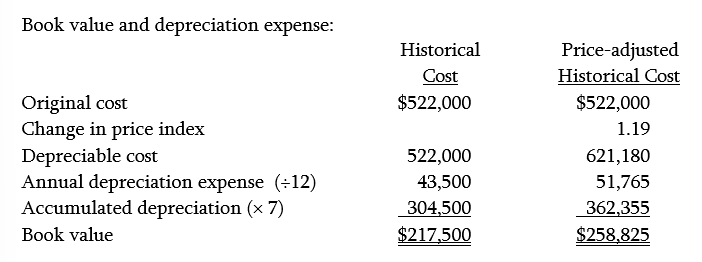
b) In general, what is the effect on ROA of changing valuation bases from historical cost to current values?
Answer:
ROAs will fall because of two reasons:
- Larger depreciation expense being subtracted from income reduces the numerator, and
- Larger asset values in the denominator
c) The manager of the investment center with the metal press is considering replacing it because it is becoming obsolete. Will the manager’s incentives to replace the metal press change if the firm shifts from historical cost valuation to the proposed price-level adjusted historical cost valuation?
Answer:
Division managers have greater incentive to replace obsolete equipment under the price-level-adjusted method than under historical cost because the differential between the book value of the old equipment and the new equipment is smaller. Hence, the historical cost incentive to keep older equipment is reduced.
321) Zagart’s Zambonis manufactures Zambonis (ice rink machines). Its cost of quality data appears below. Total manufacturing cost this year was $4.6 million.
| $ thou | |
| Engineering tests at supplier’s factory | 18 |
| Field testing new product | 12 |
| Inspection costs | 42 |
| Process re-engineering | 50 |
| Product redesign | 42 |
| Rework | 45 |
| Sales returns (at cost) | 105 |
| Scrap | 22 |
| Training employees on new system | 6 |
| Warranty repairs | 60 |
| Waste | 14 |
| Total | 416 |
a) Which is true
Answer: Prevention costs are $116,000
| Cost of quality report | |
| Prevention | $ thou |
| Engineering tests at supplier’s factory | $18 |
| Process re-engineering | 50 |
| Product redesign | 42 |
| Training employees on new system | 6 |
| $116 | |
b) In evaluating Zagart’s Zambonis cost of quality report, which is false?
Answer: ZZ is likely to have achieved its optimum quality level
322) Zelean Manufacturing uses 10 units of part KJ37 each month in the production of radar equipment. The cost to manufacture one unit of KJ37 is presented in the accompanying table.
| Direct materials | $1,000 |
| Materials handling (20% of direct material cost) | 200 |
| Direct labor | 8,000 |
| Manufacturing overhead | 12,000 |
| Total manufacturing cost | $21,200 |
Materials handling represents the direct variable costs of the receiving department and is applied to direct materials and purchased components on the basis of their cost. This is a separate charge in addition to manufacturing overhead. Zelean’s annual manufacturing overhead budget is one-third variable and two-third fixed. Scott Supply, one of Zelean’s reliable vendors, has offered to supply part KJ37 at a unit price of $15,000. The fixed cost of producing KJ37 is the cost of a special piece of testing equipment that ensures the quality of each part manufactured. This testing equipment is under a long-term, noncancelable lease. If Zelean were to purchase part KJ37, materials handling costs would not be incurred.
Required:
a) If Zelean purchases the KJ37 units from Scott, the capacity Zelean was using to manufacture these parts would be idle. Should Zelean purchase the parts from Scott? Make explicit any key assumptions.
Answer:
Cost of outside purchase:
| Payment to Scott | $15,000 |
| Continuing cost of idle capacity 12,000 x 2/3 | 8,000 |
| $23,000 | |
| Cost if continue to make | 21,200 |
| Incremental cost of purchase | 1,800 |
Explicit assumption: the two-thirds of the fixed manufacturing overhead ($8,000) is not a sunk cost and will still be incurred if the facility is idle.
b) Assume Zelean Manufacturing is able to rent all idle capacity for $25,000 per month. Should Zelean purchase from Scott Supply? Make explicit any key assumptions.
Answer:
Cost of outside purchase:
| Payment to Scott | $15,000 |
| Continuing cost of capacity | 8,000 |
| Lease receipts ($25,000 ÷ 10 units) | (2,500) |
| Net cash outlay of purchase | 20,500 |
| Cost if continue to make | 21,200 |
| Incremental cost of making | $700 |
Explicit assumption: the two-thirds of the fixed manufacturing overhead ($8,000) is not a sunk cost and will still be incurred if the facility is idle.
c) Assume that Zelean Manufacturing does not wish to commit to a rental agreement but could use idle capacity to manufacture another product that would contribute $52,000 per month. Should Zelean manufacture KJ37? Make explicit any key assumptions.
Answer:
Cost of outside purchase:
| Payment to Scott | $15,000 |
| Continuing cost of capacity | 8,000 |
| Contribution from new product ($52,000 ÷ 10 units) | (5,200) |
| Net cash outlay of purchase | $17,800 |
| Cost if continue to make | 21,200 |
| Incremental cost of manufacturing | $3,400 |

